Relicts of Mirosławiec Castle: Medieval Castle Remains in Poland


Site at a Glance
- Rating
- 3.7
- Popularity
- Very Low
- Country
- Poland
- Primary era
- Medieval
- External website
- Open
- Eras represented
- Medieval
- Civilizations
- Holy Roman Empire, Margraviate of Brandenburg
- Site type
- Military
- Remains
- Castle
On this page7 sections
History
The von Wedel castle
The Relicts of Mirosławiec Castle in Poland are the remains of a knightly castle built in the early fourteenth century by the von Wedel family. In 1576, Jerzy von Wedel, the last male-line member of the Mirosławiec Wedels, transferred the estate to his son-in-law Henryk von Blankenburg, who had married Elżbieta von Wedel of the Frydland branch. Her dowry included the town, castle, and landed estate. After Elżbieta died in 1589, their son Dionizy inherited the property.
Destruction and the Blankenburg palace
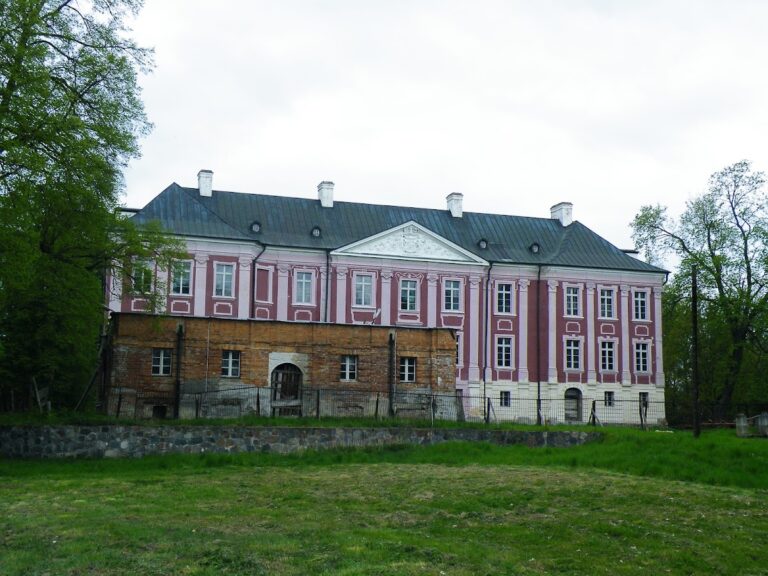
The castle burned on 9 May 1719. It was then abandoned and uninhabited for many years, while townspeople from Mirosławiec leased the grounds. Major Dionizy Jerzy Joachim subsequently initiated and financed a new family residence, a Baroque palace. After marrying Countess Charlotta Luisa von Schwerin in 1726, he commissioned its design several years later. Construction took place from 1731 to 1738 and drew inspiration from Dutch architectural projects developed from the mid-seventeenth century.
After Dionizy Jerzy and his wife died, she in 1748, the estate passed first to their cousin Fryderyk Wilhelm Johann and then to Dionizy Johannes Carolus. Dionizy Johannes Carolus died in 1836, ending the Mirosławiec line of the Blankenburg family. The estate then passed to the von Goltz family, and in 1894 it belonged to Max Kruger.
Ruin and archaeological identification
The palace had been uninhabited since the 1870s and burned in 1890. A plan to rebuild it was prepared before the First World War but was never implemented. After the Second World War, the palace ruin deteriorated and the park was divided. Its eastern wooded sections were transferred from the State Land Fund to the State Forests in the early 1980s.
The palace remained a ruin until the 1960s, when its above-ground walls were dismantled. Archaeological investigations carried out in 2015 and 2016 confirmed that the castle had stood at this location. The castle relics are protected as cultural property in Poland and were registered under designation A-175 on 2 August 2004.
Remains
Castle remains
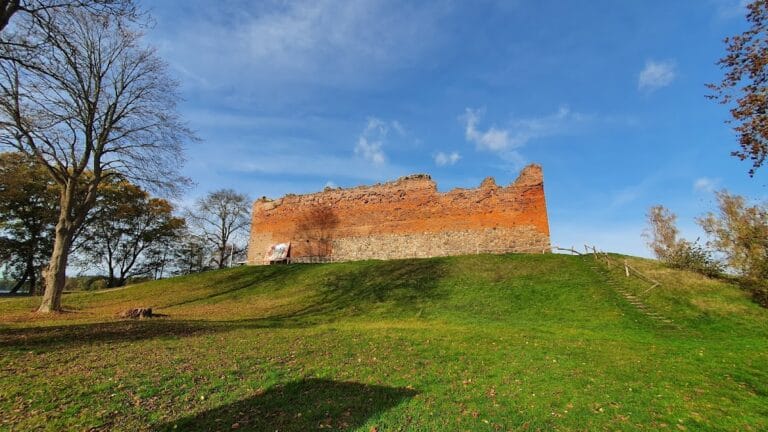
The surviving castle consists of small remnants of its ground-level walls. The archaeological site also includes the castle yard, the principal enclosed area within the fortification, together with the surrounding moat, a defensive ditch excavated around the site.
Baroque palace remains
The former family residence was a Baroque palace constructed between 1731 and 1738. Its design was inspired by Dutch architectural projects of the mid-seventeenth century. After the palace burned in 1890, the building survived as a ruin until its above-ground walls were dismantled in the 1960s.