Wallenburg: A Medieval Hilltop Castle Ruin in Germany
Site at a Glance
- Rating
- 4.5
- Popularity
- Very Low
- Country
- Germany
- Primary era
- Medieval
- Eras represented
- Medieval
- Civilizations
- Holy Roman Empire
- Site type
- Military
- Remains
- Castle
On this page16 sections
History
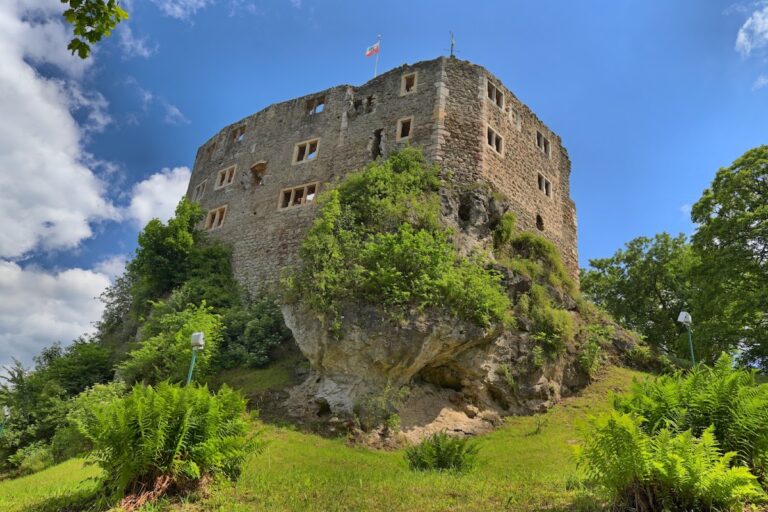
Wallenburg is a medieval hilltop castle ruin in Germany, standing on the 523.8-metre Heinberg, also called Hühnberg, above Auwallenburg in the municipality of Brotterode-Trusetal, Thuringia. Built around 1200 in the outer territory of Herrenbreitungen Monastery, it controlled an important route toward the Rennsteig and later became a contested fortress, a base for regional military operations, and an administrative seat.
Foundation and Route Control
The castle initially guarded the old road rising from Herrenbreitungen toward the Rennsteig pass at Grenzwiese and Kleiner Inselsberg. Beyond the pass, the route continued through Cabarz toward Waltershausen and Gotha, within the territory of the Thuringian landgraves. Wallenburg’s judicial and castle district included Heßles with Nüßleshof and the part of Bairoda east of the Farnbach.
Wallenburg gained military importance at the outbreak of the Thuringian-Hessian War of Succession in 1247, a conflict over the succession to the territories of the Ludovingian dynasty. The Lords of Frankenstein, also known as the Counts of Frankenstein, expanded the castle. Its first recorded mention dates to 1249, when Ludwig III of Frankenstein acknowledged the feudal authority of Herrenbreitungen Monastery and agreed to pay compensation. The name then appeared as “Waldenburch.”
Frankenstein and Divided Ownership
Royal troops captured and destroyed Frankenstein, the ancestral castle of the Lords of Frankenstein, after a short siege in 1295. The defeated counts were required to pay tribute, and Wallenburg subsequently passed into divided ownership. This arrangement was a ganerbschaft, a form of joint ownership in which several co-owners held shares in one castle and shared responsibility for its defense and administration.
A document sealed on 29 August 1317 identified the Frankenstein share as half of the “house at Waldinburg.” Fulda Monastery, represented by Abbot Heinrich VI of Hohenberg, had become a co-owner. The two shares were initially equal, and their holders jointly appointed the gatekeeper, tower watchman, and other guards. They were also responsible for preserving the castle peace.
In 1330, the second Frankenstein sale brought Count Berthold VII of the Schleusingen line of the Counts of Henneberg into the ownership group. Siegbodo and Ludwig of Frankenstein released their servants from their oaths, while the family lost its political power by the middle of the fourteenth century. Around 1340, the Hennebergs were still opposed to the bishops of Würzburg. Pledges and exchanges involving the Würzburg and Fulda monasteries transferred parts of Wallenburg to Würzburg.
The co-owners were required to establish a castle peace, but disputes involving the garrison and lower-nobility vassals repeatedly broke the agreement. In 1374, Bishop Gerhard of Schwarzburg of Würzburg sought military help from his cousins, Counts Heinrich and Ernst of Schwarzburg, offering them 400 gulden to protect Wallenburg. In 1384, the Würzburg share was pledged to Counts Günther and Johannes of Schwarzburg against a debt that had risen to 7,400 gulden. The bishop also had to provide 740 gulden each year for the fortifications, weapons, and provisions, together with 200 pounds of Heller for the troops serving the Schwarzburg counts.
Feuds and Military Use
A feud in 1388 with the Rhön knights Wetzel of Buchenau and Hermann of Völkershausen drove the Schwarzburg garrison from the castle. Archbishop Adolf of Mainz acted as arbitrator. He ordered the Schwarzburg counts either to pay a fine of 3,000 gulden by the end of that year or to grant the castle to the two knights as a fief with annual compensation of 300 gulden. The Schwarzburg share was consequently reduced by half, and each knight received a quarter.
Otto of Buchenau the Elder sold his quarter to Hermann of Reckrodt in 1408. The other quarter was to be divided amicably among Wetzel of Stein and his cousins Hans, Heinrich, and Wetzel of Stein, with lots determining the allocation. The Reckrodt family sold its share to Bishop Johann II of Brunn of Würzburg in 1421. Wallenburg then served as a base for military operations and helped monitor and block roads leading north.
In 1459, the Henneberg half was granted to Hans of Wangenheim of Winterstein. He and his sons were appointed officials responsible for protecting the mines. Iron mining expanded in the Trusetal, increasing the castle’s importance because iron goods and weapons made in its hammer mills and smithies were valuable and attracted organized raids.
Philipp of Farnrode, who served the Counts of Gleichen, held a quarter of the castle from 1470, probably the former Reckrodt share, and was required to station armed men there. In 1471, he unsuccessfully sought money and timber from Count Wilhelm of Henneberg for repairs. Wolfgang of Stolpenrode, an official of Sonneberg in Würzburg service, appeared as another co-owner in 1477, and Andreas of Liechtenstein took over that share in 1479.
Repair, Consolidation, and Destruction
The castle’s poor condition led to an inspection and plans for construction and repair in 1483. Wilhelm of Roßdorf became the Henneberg official and received the fief for life. From 1501, the Hennebergs negotiated with the Counts of Gleichen, who held the Würzburg share as a pledge, in an effort to obtain the entire castle. The Fuchs family of Arnschwanz served as Henneberg castle men, with Hans Christoph Fuchs becoming its best-known representative.
Götz von Berlichingen, a German knight known for his military career and feuds, stayed at Wallenburg for several days in 1516 while seeking safety during his feud with Count Philipp II of Waldeck. In 1520, Count Wilhelm IV of Henneberg-Schleusingen obtained full possession of the castle and appointed the Fuchs family to administer it.
During the German Peasants’ War in 1525, a widespread uprising against aspects of territorial and social authority, rebels besieged Wallenburg and set it on fire after an assault. The service buildings and part of the inner castle burned. Hans Christoph Fuchs of Arnschwang sold the ruined castle to Eitel von Boyneburg of Lengsfeld in 1580. Three years later, the Wettins acquired it as part of the Henneberg inheritance. Wallenburg continued to serve as an administrative seat, although its military value had become negligible.
From Administrative Seat to Ruin
The Wettins sold Wallenburg to Hersfeld Monastery through the Treaty of Friedewald in 1588. In 1589, the Landgrave of Hesse acquired the castle and its associated settlements and incorporated them into the Oberamt Schmalkalden. Landgrave Wilhelm IV of Hesse-Kassel authorized the dismantling of the ruin so its building material could be used for Schloss Wilhelmsburg in Schmalkalden. Only the tower was allowed to remain because it could still serve as a watchtower.
During the Thirty Years’ War, the major European conflict fought mainly between 1618 and 1648, the surrounding settlements suffered severe disruption. Wallenburg’s outlying farmstead was plundered and destroyed, although it remained inhabited until the nineteenth century.
Duke Ernst II of Saxe-Coburg and Gotha became the last noble owner in 1866. The ruin then formed part of an 8,800-hectare former Hessian state forest and Prussian land without sovereign rights awarded to him as compensation for his costly participation in the Battle of Langensalza. The forest belonging to the Gotha dukes was expropriated in 1945.
Local residents began investigating the ruin during the nineteenth century. A systematic examination in 1979 revealed a previously unknown underground passage, but collapsed and blocked masonry allowed it to be followed for only a few metres. The tower had been climbable since 1963, was closed because of structural deterioration in 2012, repaired in 2013, and reopened. Wallenburg is protected as an architectural and archaeological monument.
Remains
Wallenburg occupied the summit of the Heinberg as a hilltop castle. The inner castle stood on the highest ground, with a closely adjoining outer bailey on the western side. Residential, economic, and ancillary buildings occupied these areas, while an outlying farmstead or forework stood east of the main castle. The surviving tower and scattered wall remains are the principal parts of the castle’s fabric after its later dismantling for building material.
Summit Castle
The Bergfried
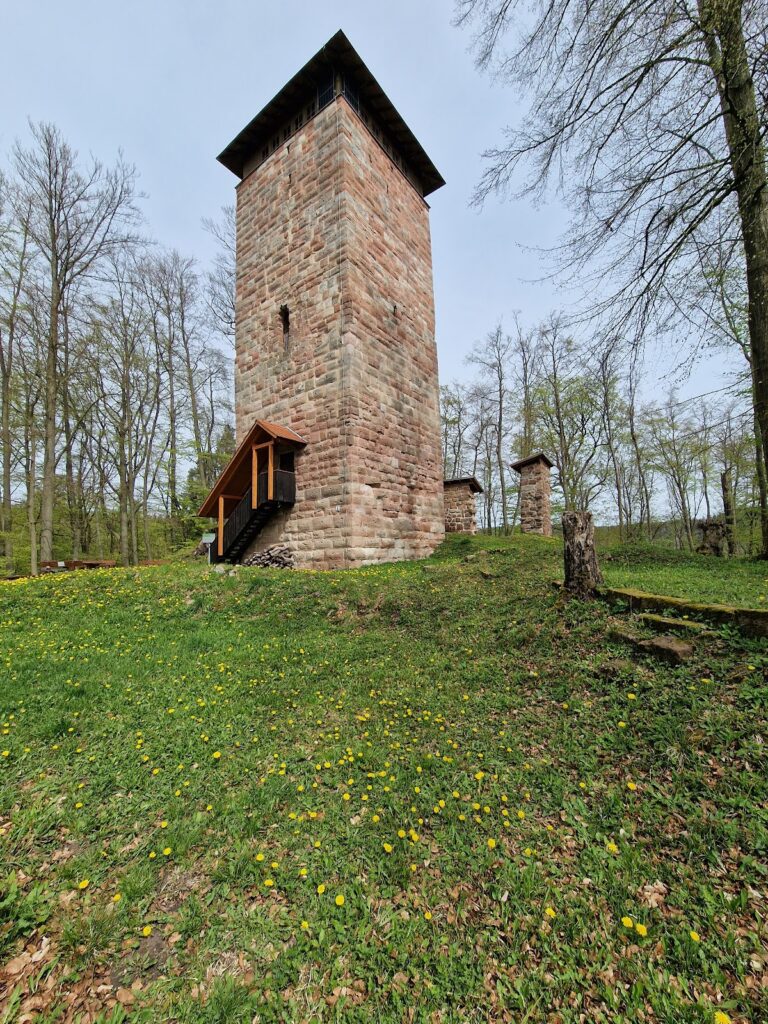
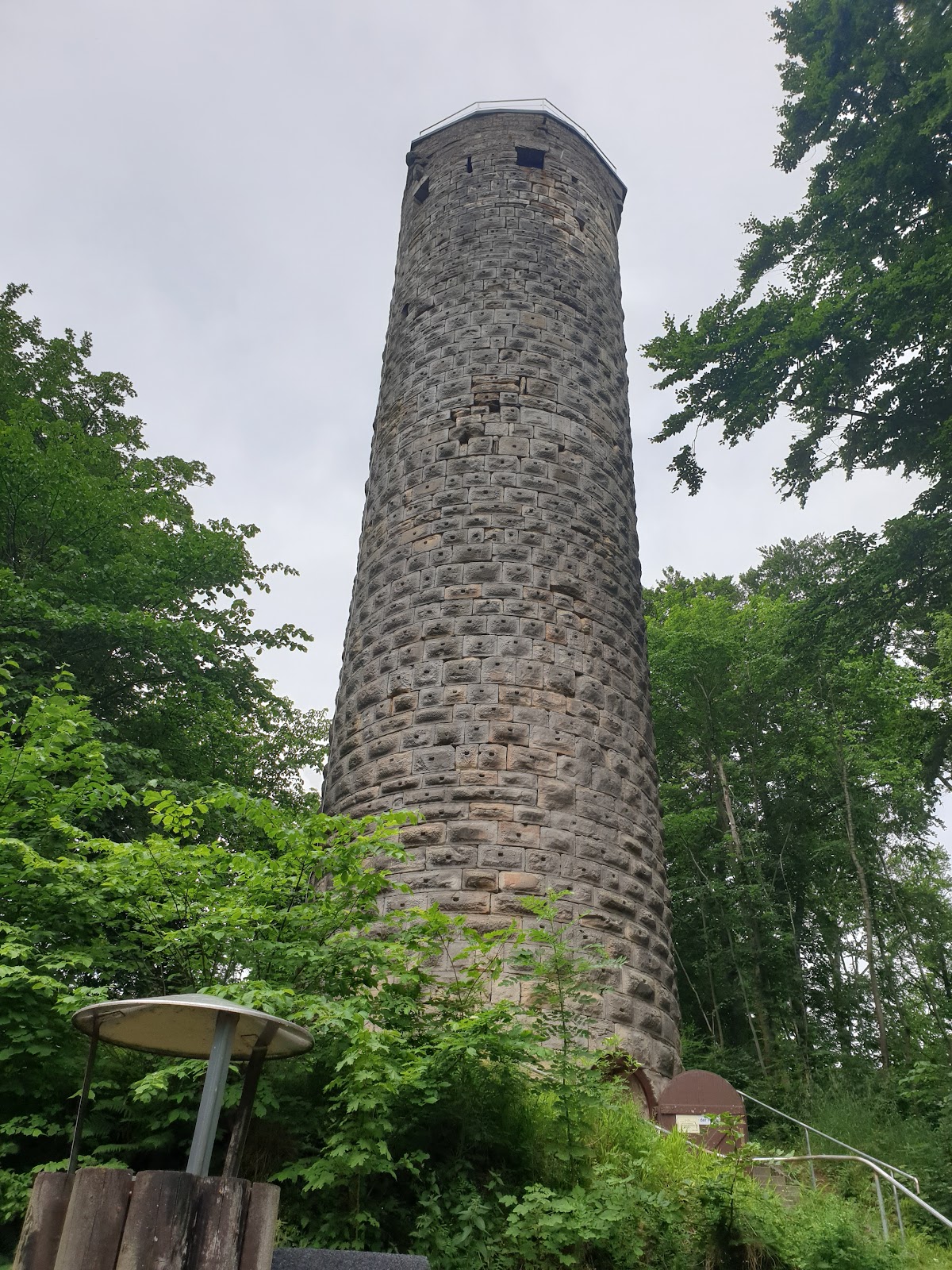
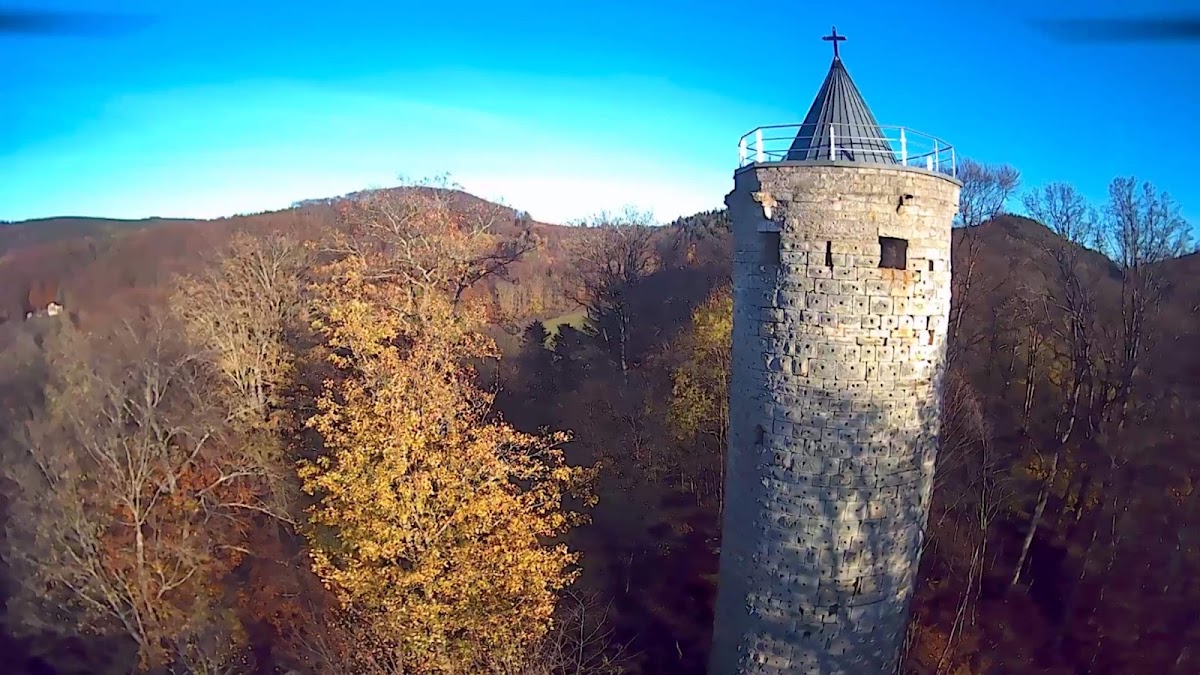
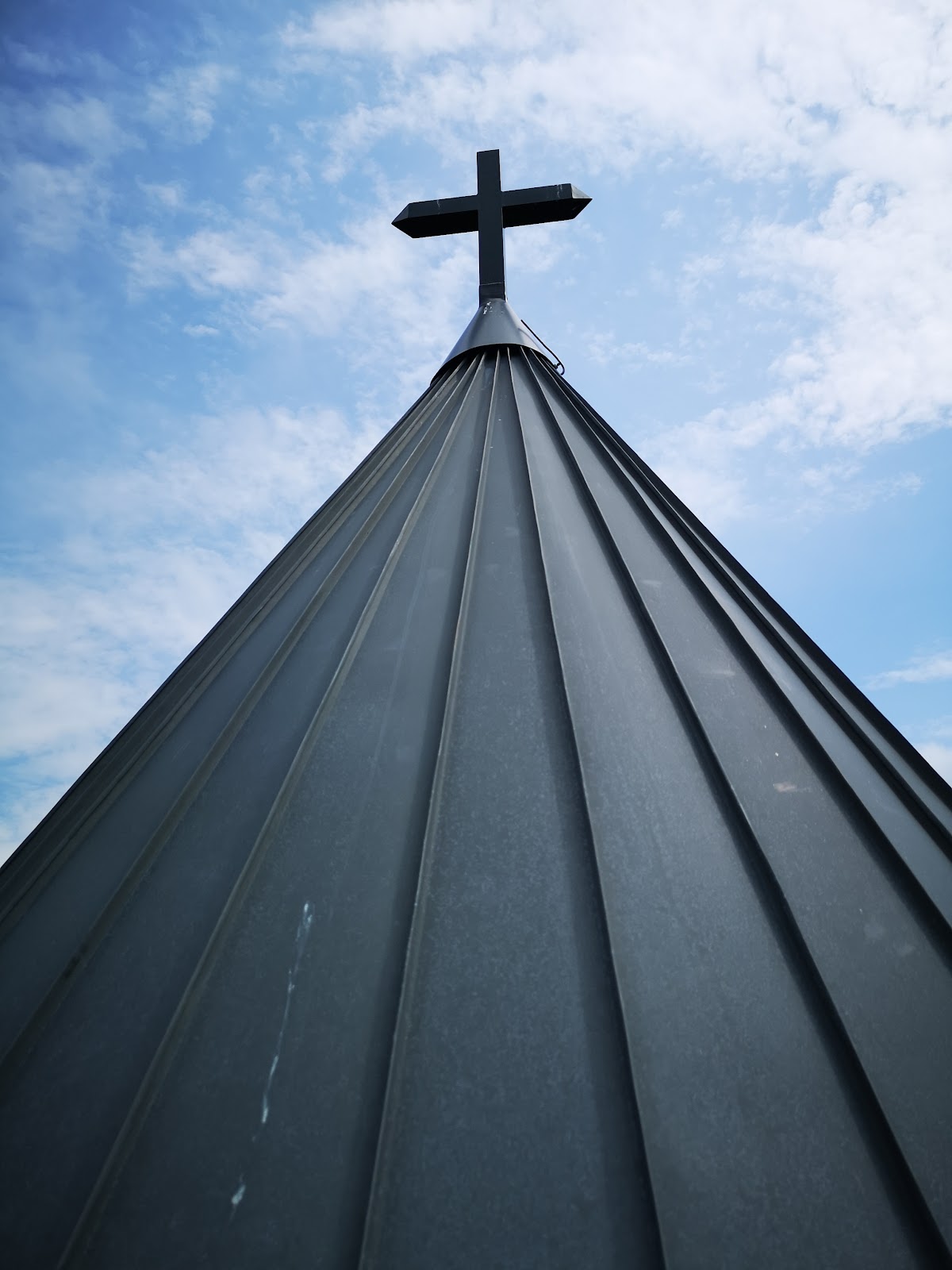
The surviving Bergfried, the principal defensive tower of a medieval German castle, is a slender structure with four storeys and a height of 27.5 metres. Its walls are made from bossage blocks, stones with roughly projecting faces, and retain clamp holes associated with its construction. The tower rises above the surrounding forest and is now used as an observation tower. Its present ground-level entrance was cut by miners, apparently in the hope of recovering finds from rubble at the bottom of the tower dungeon.
The Inner Castle
A Romanesque palas, the representative residential hall of a medieval castle, stood beside a well within the inner castle. Its foundations survive. The inner castle was enclosed by its own ring wall and had a gate with a drawbridge. On an isolated rocky area west of the surviving tower, archaeologists identified a wall remnant as the presumed location of a second tower. A drawbridge at the entrance was considered probable.
Defensive Areas
Eastern Ditch
The eastern side was the principal direction of attack. It was defended by a ditch approximately 300 metres long, forming the main barrier between the summit castle and the approach from that direction.
Outer Bailey
The outer bailey on the western side had its own defensive wall and three additional ditches. Its presumed main entrance was probably on the southern side and may have been reached by a drawbridge. The bailey contained residential, economic, and ancillary buildings adjoining the inner castle.
Lower Castle and Farmstead
Lower Castle Area
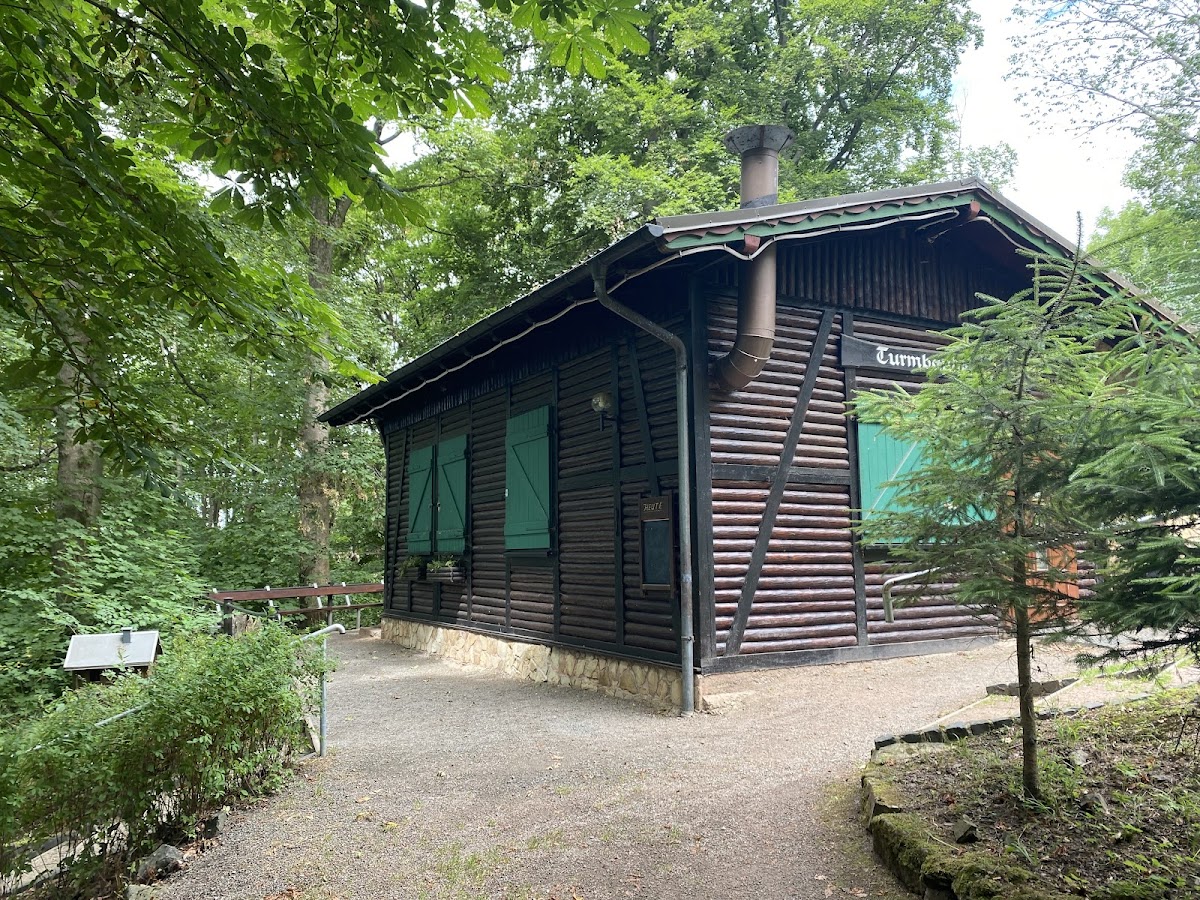
A lower castle area stood in front of the inner castle. Its buildings were protected by a separate wall, and the site is now occupied by the Turmbaude. A sketch of the Wallenburg district made in 1589 still showed the castle with two towers, providing a later view of its arrangement before the surviving fabric was reduced further.
Outlying Farmstead
An outlying farmstead or forework stood east of the castle. It was plundered and destroyed during the Thirty Years’ War, although the farmstead remained inhabited until the nineteenth century.
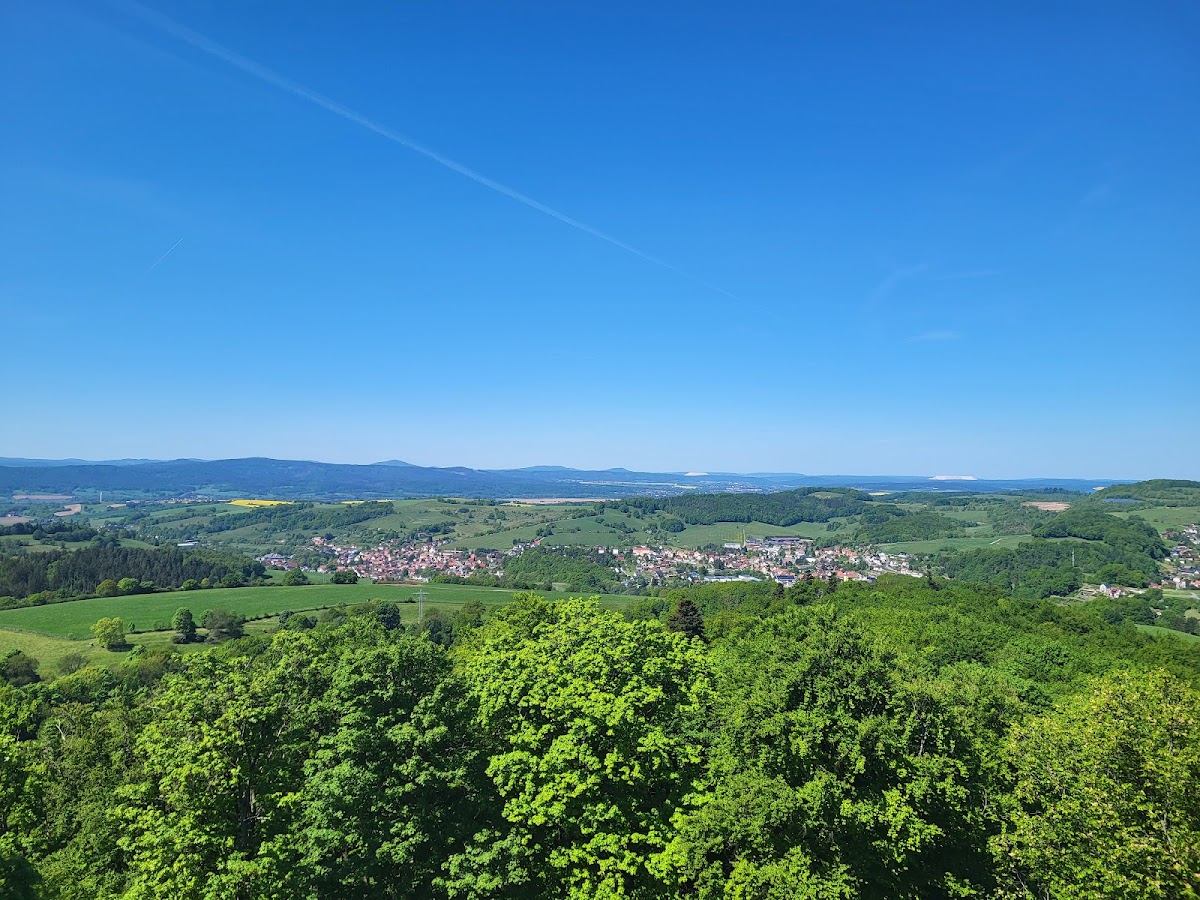
From the surviving tower, the view extends westward across the Werra valley toward the Vorder Rhön. The remaining tower, foundations, wall fragments, ditches, and traces of the associated castle areas preserve the principal physical evidence of Wallenburg’s development from a medieval route-controlling fortress into a later administrative ruin.