Real Cittadella: A Spanish Fortress Built to Defend Messina
Site at a Glance
- Popularity
- Medium
- Country
- Italy
- Primary era
- Early Modern
- Eras represented
- Early Modern
- Civilizations
- Kingdom of Sicily, Spanish
- Site type
- Military
- Remains
- Fort
On this page8 sections
History
Real Cittadella is a Spanish-built star fort on the San Raineri Peninsula in Messina, Italy, constructed between 1680 and 1686 while the Spanish Empire controlled the Kingdom of Sicily. It was intended to defend Messina’s harbor and secure the city with a strong garrison after the revolt of 1674–1678. Its construction cleared a neighborhood of about 8,000 residents, a Benedictine monastery, and several churches.
Spanish rule and later conquests
The design was entrusted to Carlos de Grunenbergh, military engineer to Sicily’s viceroy, the Spanish monarch’s representative in the territory. The completed fort was regarded as one of the Mediterranean’s important fortifications. After Spain lost control of Sicily to the House of Savoy, a European royal dynasty, in 1713, Spanish forces invaded during the War of the Quadruple Alliance, a European conflict involving Spain and an alliance that included Austria. The Cittadella surrendered to the Spanish general Spinola in 1718. Austrian commander Claude Florimond de Mercy retook it the following year.
In 1735, Charles III of Spain, a member of the Bourbon royal house, captured the fort during the War of the Polish Succession, a European dynastic conflict. The Cittadella also served as a prison. In 1798, the French geologist Déodat Gratet de Dolomieu was held there.
Revolution and the end of Bourbon rule
During the Sicilian revolution of 1848, insurgents besieged and bombarded the fort but failed to take it. Its Bourbon garrison had resisted since January. On 3 September, Bourbon troops under General Carlo Filangieri landed near Messina in the amphibious Real Marina regiment. After fierce fighting, they secured a foothold for further landings. Messina was occupied on 7 September, following five days of bombardment from the sea and the fort.
In 1860, during Giuseppe Garibaldi’s Expedition of the Thousand, his forces occupied Messina on 27 July, leaving the Cittadella as the Kingdom of the Two Sicilies’ last stronghold in Sicily. About 4,000 Bourbon troops remained inside under General Gennaro Fergola and made no sortie. Piedmontese forces heavily bombarded the fort. Following the Bourbon surrender at Gaeta on 13 February 1861, the garrison surrendered in March to Piedmontese troops commanded by General Enrico Cialdini.
Military use and later changes
After the fort’s capture, Messina’s inhabitants called for its demolition, but the new government retained it and repaired damage from the sieges of 1848–1849 and 1860–1861. Port construction after Italian unification damaged the fort further, and some inner walls and bastions were removed. It remained an active military installation until the 1908 earthquake damaged it. The fort was then used as a warehouse.
In the 1920s, the Norimberga, San Francesco, and San Carlo bastions were demolished to make way for a road. The military occupied the remaining fort again during the Second World War, when aerial bombardment caused further damage. The surrounding area became industrialized after the war. The Sicilian Region now owns the fort, which is protected by the regional heritage authority.
Remains
Plan and construction
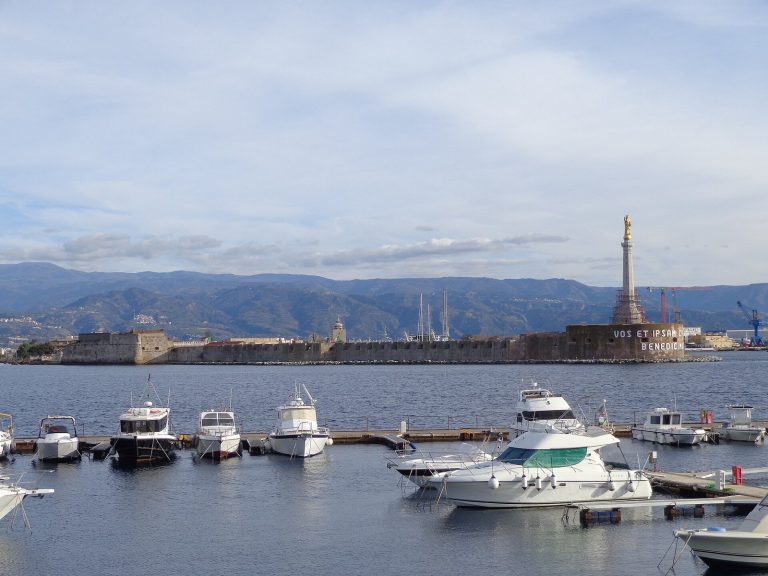
The fort occupied the narrow, sickle-shaped San Raineri Peninsula, which encloses Messina’s natural harbor and shelters it from the open sea. Its defenses extended across the peninsula, facing both the harbor and the sea, while a moat separated the fort from the mainland. The sixteenth-century Forte del Santissimo Salvatore stood at the peninsula’s tip. Built of limestone, Real Cittadella had a pentagonal star-shaped plan, with five projecting bastions joined by curtain walls. Each bastion contained a raised gun platform. Its outer defenses included a forward defensive work set before the main wall, as well as other forms of outer works.
Surviving defenses
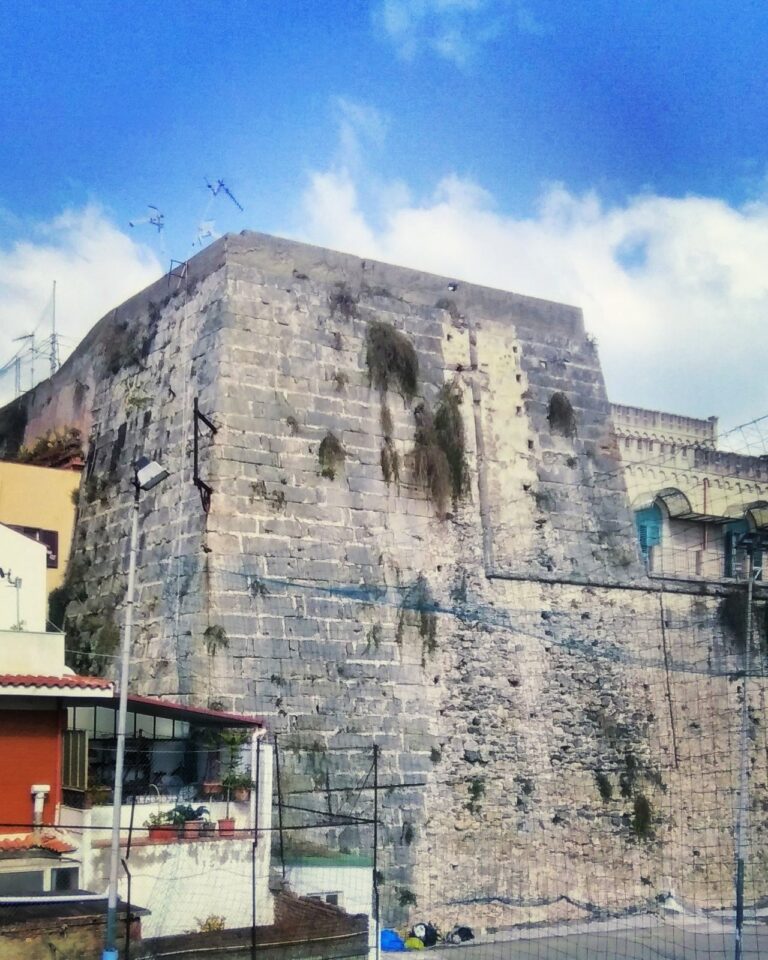
The five bastions were named Norimberga, San Francesco, San Carlo, Santo Stefano, and San Diego. Santo Stefano and San Diego survive in part and are partly buried, along with sections of curtain wall and outer defenses. Foundations of demolished bastions remain underground. The surviving fortifications are neglected, and waste is sometimes dumped illegally within the site.
Porta Grazia
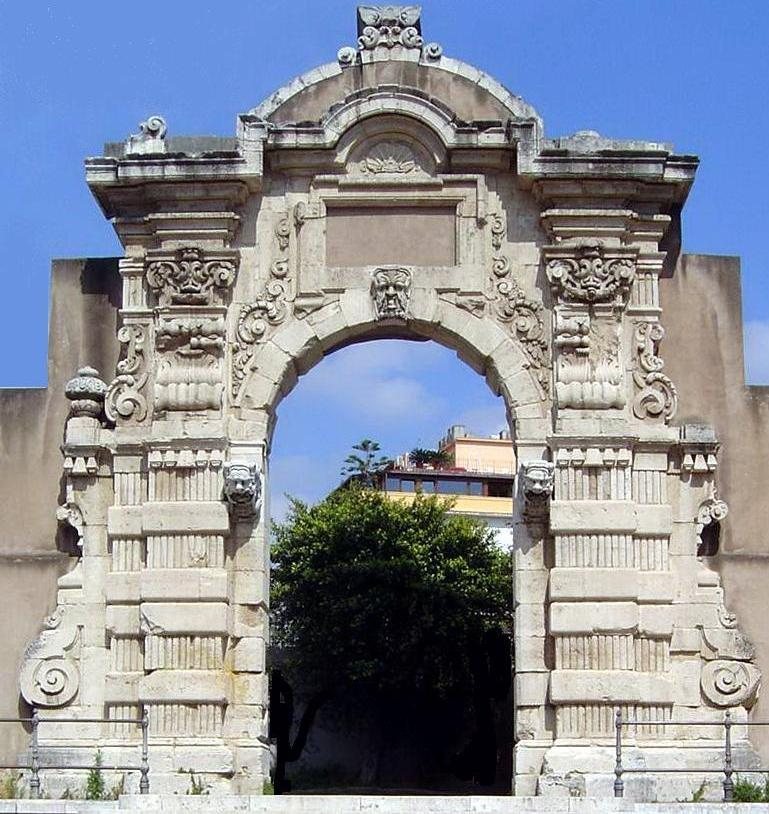
Porta Grazia, the fort’s main gate, has elaborate stone decoration by the stone artist Domenico Biondo. It was dismantled and relocated in 1961 and now stands in Piazza Casa Pia dei Poveri.