Raudondvaris Castle: A Noble Estate and Cultural Center in Lithuania
Site at a Glance
- Rating
- 4.7
- Popularity
- Medium
- Country
- Lithuania
- Primary era
- Early Modern
- External website
- Open
- Eras represented
- Early Modern, Modern
- Civilizations
- Grand Duchy of Lithuania, Polish–Lithuanian Commonwealth
- Site type
- Domestic
- Remains
- Castle
On this page13 sections
History
Raudondvaris Castle is a former noble estate in Lithuania, west of Kaunas, whose principal residence originated as a Renaissance masonry building in the first half of the seventeenth century. Set on the right bank of the Nevėžis near its confluence with the Nemunas, the estate later became a Neo-Gothic and Neo-Renaissance residence and an important cultural center under the Tyszkiewicz family.
Royal Estate and Early Noble Ownership
The land formed part of a royal estate in the sixteenth century. In 1549, Sigismund II Augustus, the last male ruler of the Jagiellonian dynasty and Grand Duke of Lithuania as well as King of Poland, granted it to his second wife, Barbara Radziwiłł. A residence may already have stood there, but this remains uncertain. An unconfirmed tradition identifies an earlier Teutonic castle on the site as Rothenburg.
A masonry residence had been built before 1615, probably through the initiative of Jonas Dziavialtauskas of the Trąby arms, who referred to it in correspondence. The first documentary reference to the castle dates to 2 September 1615. Another tradition credits Barbara Radziwiłł with laying its foundations, linking the early history of the residence to one of the most powerful aristocratic families of the former Polish-Lithuanian Commonwealth.
After Barbara Radziwiłł died, the estate passed to her Radziwiłł relatives. It later came to Wojciech Gintowt-Dziewałtowski and his son Jonas, the Kaunas standard-bearer. Around 1630, Jonas’s daughter Katarzyna married Jan Eustachy Kossakowski, who subsequently sold the castle to Hetman Janusz Radziwiłł. Janusz transferred it to his nephew Bogusław Radziwiłł.
In 1662, Jan Karol Worłowski, the Kaunas treasurer, purchased the estate from Bogusław Radziwiłł for 30,000 florins. The Worłowski family held it for almost a century. Ownership then passed to the Zabiełło family, and before 1761 the estate had been acquired by Antoni Zabiełło, Marshal of Kaunas. In 1671, a Zabiełło owner is said to have received Charles, Duke of Courland, at the castle.
The Tyszkiewicz Residence
Michał Tyszkiewicz, a colonel in the Napoleonic period, bought Raudondvaris in 1819. He repaired the residence, added agricultural and service buildings, and established a park. The Tyszkiewicz family retained the estate until 1915.
The residence burned during the November Uprising of 1831, a Polish-Lithuanian insurrection against Russian rule. The Tyszkiewicz family restored and partly reconstructed it between 1832 and 1840. This work is associated with Cesare Anichini, an architect involved in the nineteenth-century rebuilding, Jonas Margevičius, and the German architect Voler. A further reconstruction after 1855 gave the old residence a more elaborate Neo-Gothic and Neo-Renaissance appearance under direction attributed to Anichini.
During the Tyszkiewicz period, Raudondvaris developed into a center of cultural and artistic life. The family archive contained about 20,000 documents and 12,000 letters, while the library held more than 10,000 books and manuscripts, including material from the sixteenth and seventeenth centuries.
The art collection included works attributed to Leonardo da Vinci, Rubens, Caravaggio, Andrea del Sarto, Bernardino Luini, Bartolomeo di Pietro, Correggio, Annibale and Ludovico Carracci, Guercino, Albani, Canaletto, Marcello Bacciarelli, and other Polish and foreign artists. Sculpture, tapestries, wall hangings, and thirty Slutsk belts were also held at the estate. The belts were later destroyed during the Warsaw Uprising. Benedykt Henryk Tyszkiewicz purchased Jan Matejko’s Stefan Batory at Pskov for 60,000 francs, and the painting was displayed in an upper-floor room.
Before 1915, the collection was transported eastward, with part transferred to Sucha Beskidzka. The last private owner was Benedykt Jan Tyszkiewicz, who was married to Róża Branicka.
War, Nationalization, and Destruction
During the First World War, the German Ober Ost administration, the military authority governing German-controlled territories on the Eastern Front, used the residence as its headquarters. The writer Arnold Zweig served there for a time and later described the castle and its library in his historical novel Einsetzung eines Königs.
After 1920, Raudondvaris became part of Lithuania. The Lithuanian government expropriated the Tyszkiewicz estate and divided its land into parcels. The family was initially left with 40 hectares, which were later taken as well. From 1927 to 1943, the nationalized residence housed an orphanage and a primary school. A Lithuanian women’s charitable organization established the children’s home.
In 1940, the former estate became part of the Soviet Union, and in 1941 it came under German occupation. In 1943, the SS Sonderkommando “Pflaum,” commanded by Guntram Pflaum, occupied the complex. As German forces withdrew in 1944, they burned the palace and orangery.
Restoration and Later Institutional Uses
After 1945, a Machine and Tractor Station occupied the site. Demolition of the ruins began in 1952 but was halted, and investigations were commissioned in 1959. The Lithuanian Institute of Agricultural Mechanization and Electrification began operating at the estate in 1958.
The estate complex was restored between 1959 and 1973 from designs by S. Čerškutė and V. Jurkštas, with Renaissance features emphasized. The principal palace was rebuilt in 1962–1967, the orangery was rebuilt in 1960, and the stables were repaired between 1970 and 1973.
The restored complex later accommodated the Agricultural Institute, whose institutional affiliation passed to Aleksandras Stulginskis University in 1996. A history exhibition devoted to Raudondvaris and the Tyszkiewicz counts opened in the palace in 1994. On 1 January 2002, a memorial museum for the Lithuanian composer Juozas Naujalis was established there. Benedykt Tyszkiewicz had discovered Naujalis and financed his education. In 2008, the estate ensemble was designated a Lithuanian cultural monument. The Civil Registration Division of the Kaunas District Municipal Administration moved into the complex in 2018.
Remains
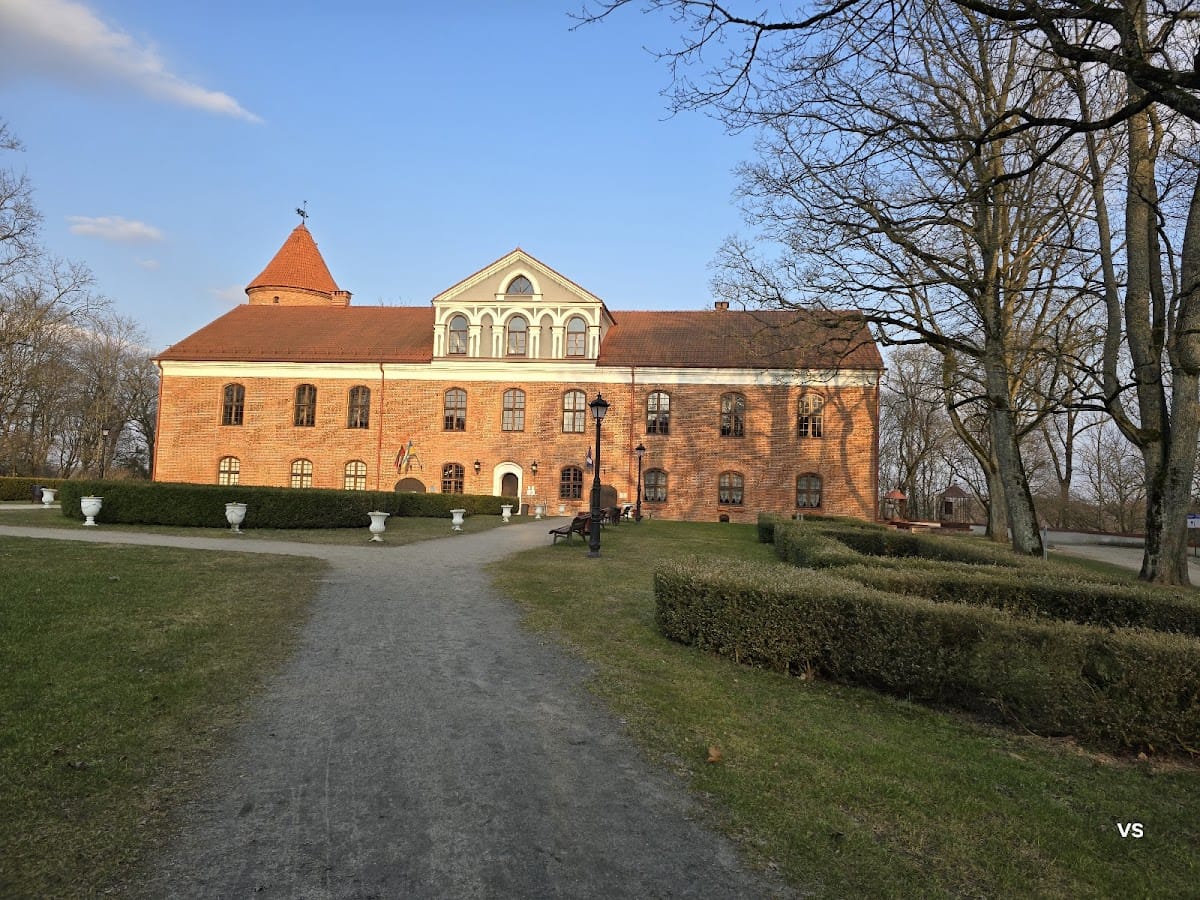
Raudondvaris Castle forms part of an estate ensemble comprising the principal palace, northern and southern outbuildings, an orangery, a butler’s house, stables, a steward’s house, northern and southern granaries, an icehouse, nineteenth-century gates, and a park. The complex combines the remains and reconstructed forms of a seventeenth-century Renaissance residence with nineteenth-century Neo-Gothic and Neo-Renaissance alterations and twentieth-century rebuilding.
Principal Palace
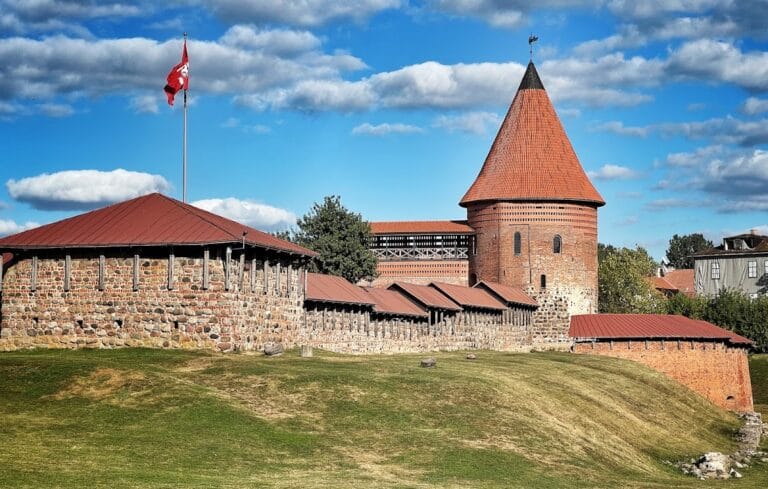
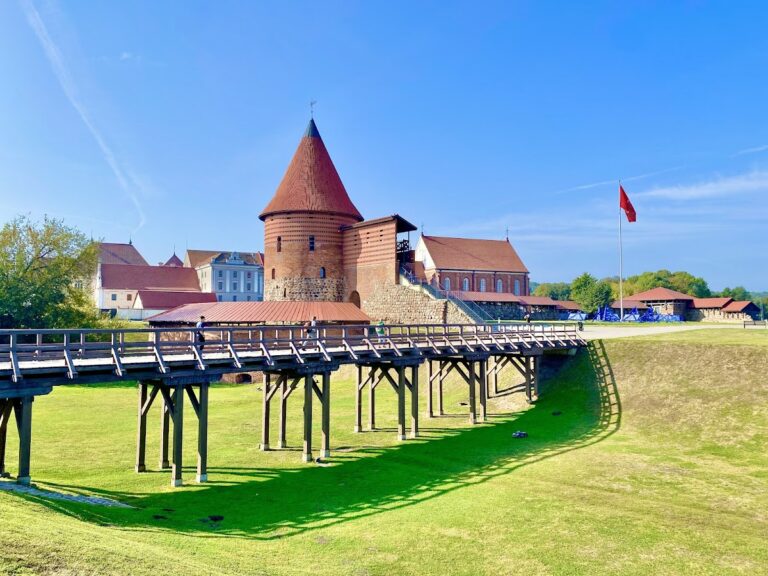
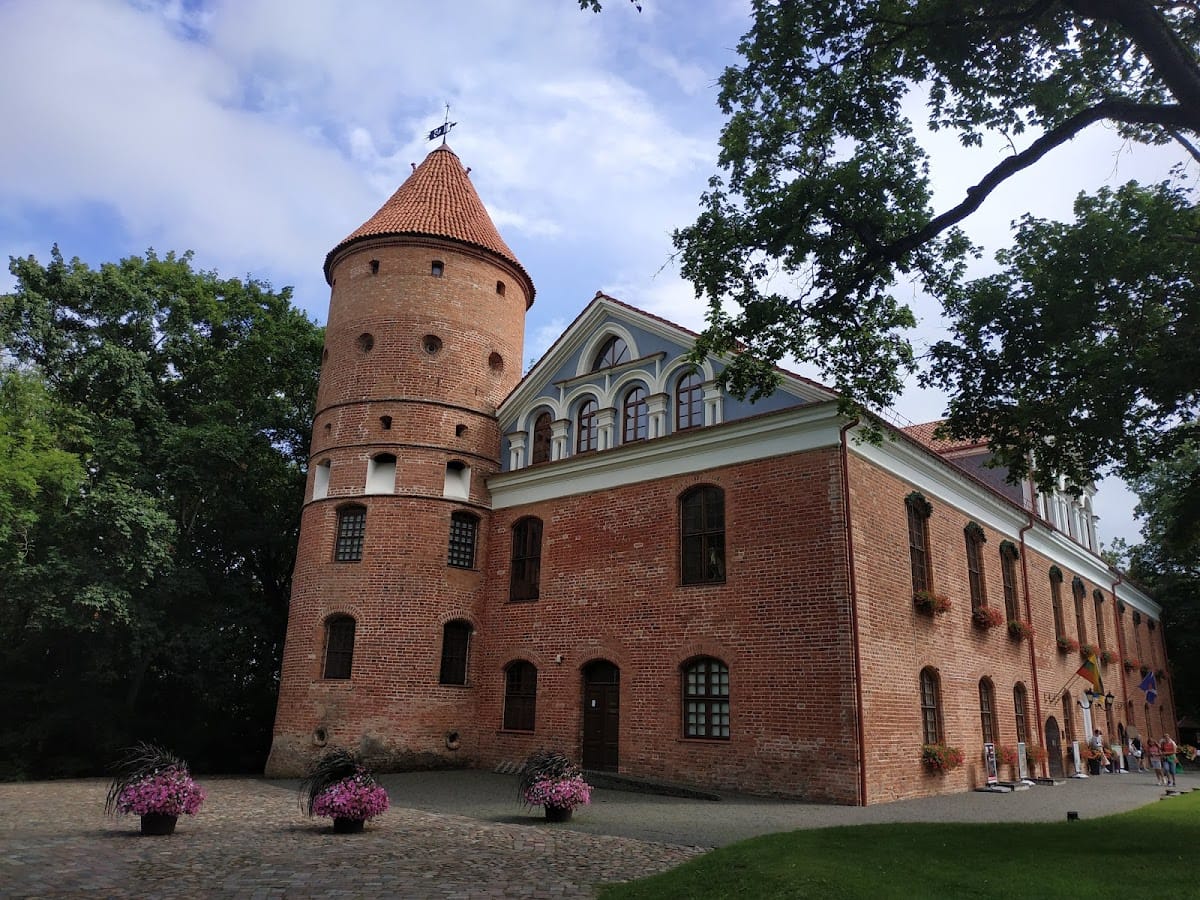
The principal palace began as a Renaissance masonry residence in the first half of the seventeenth century. It is commonly called a castle because of its tower and loopholes, but its role was representative rather than that of a militarily important fortress. Its walls would have been vulnerable to the artillery of the period.
Nineteenth-century work altered the building’s architectural character. The facades were apparently stripped of plaster to emphasize the red masonry. The tower received a Neo-Gothic crenellated top, a battlement-like parapet intended to create a medieval appearance, and gables were added above the longer elevations. Moats surrounded the castle, as described in nineteenth-century accounts.
During the twentieth-century rebuilding, the tower was heightened and reshaped to strengthen its Gothic appearance. New floor structures were installed, and a columned porch was removed from the facade. A weather vane bearing the three-horn Radziwiłł coat of arms was placed on the tower. The rebuilt palace now contains the Raudondvaris and Tyszkiewicz history exhibition and the Juozas Naujalis Memorial Museum.
Estate Buildings
Orangery
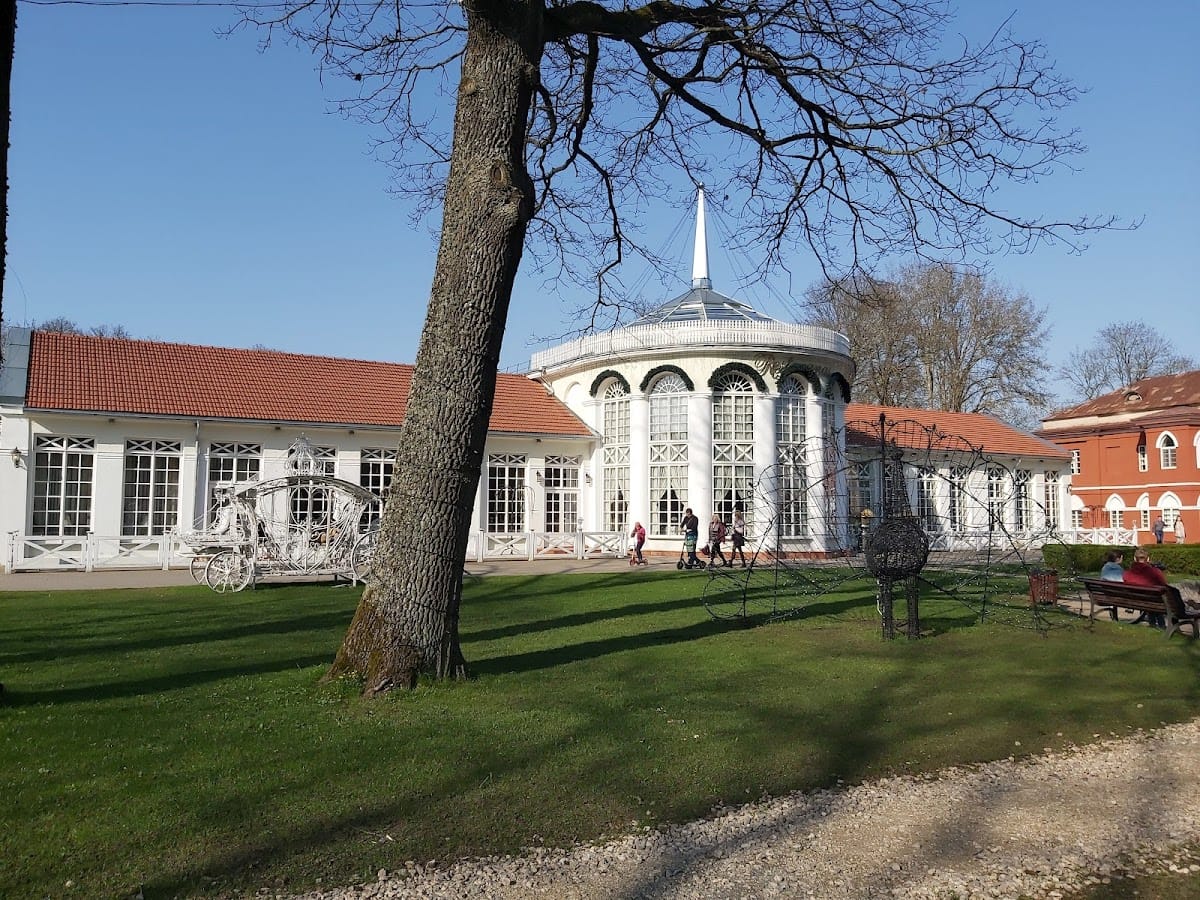
The orangery, also called a palm house, was built in 1837–1839 as a glazed horticultural building for protecting plants from cold weather. Lemon trees were cultivated there. German forces burned it in 1944, and it was subsequently rebuilt. The building now contains a restaurant.
Outbuildings
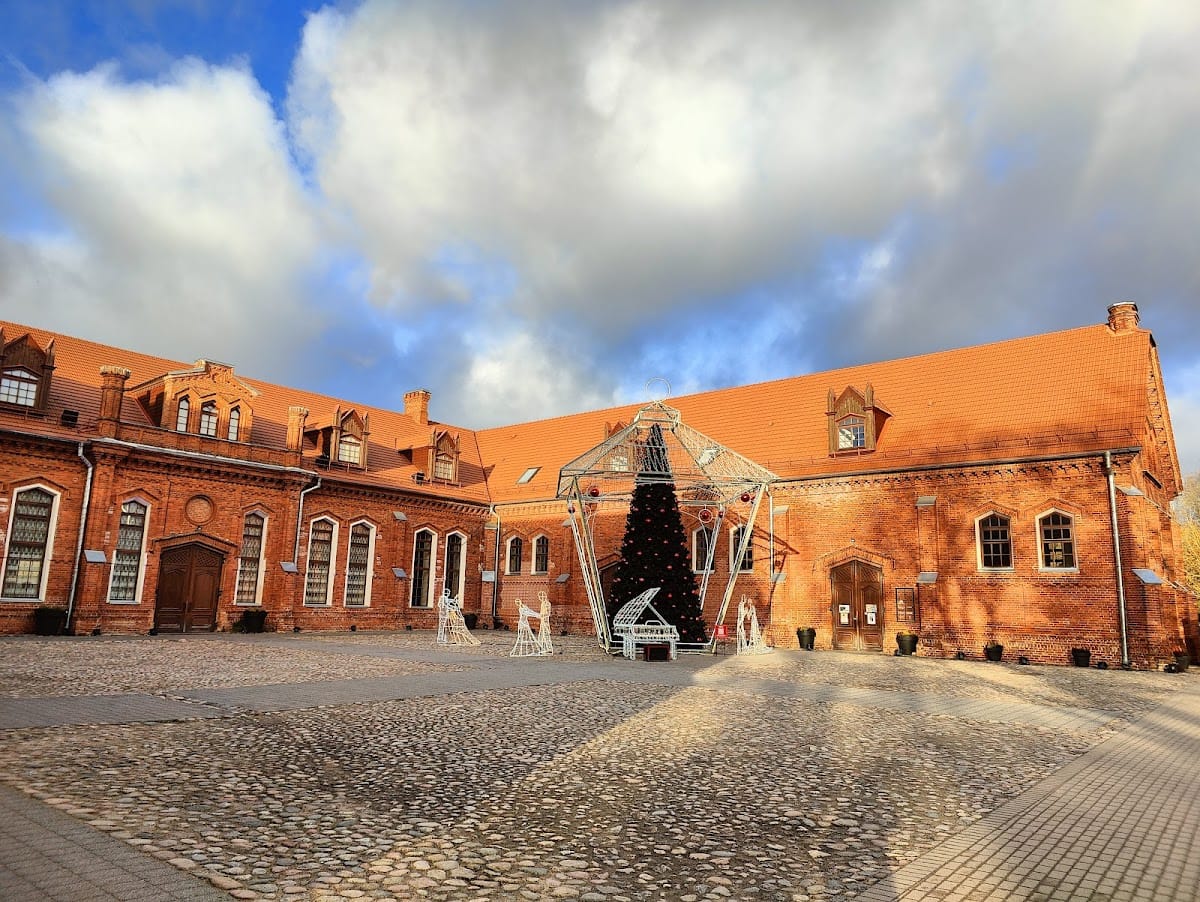
The southern outbuilding received a second floor in 1839, while the northern outbuilding was built in 1840. Together with the butler’s house, steward’s house, and granaries, these buildings formed the service and agricultural component of the estate.
Stables and Carriage House
The stables and carriage house were constructed around the middle of the nineteenth century. The stables were repaired between 1970 and 1973 and now contain a 500-seat concert and theater hall as well as an art incubator.
Icehouse
The icehouse survives as a separate part of the complex. Its present use is as the Kaunas District tourist information center.
Park and Setting
The date when the park was first established is uncertain. It was reconstructed in the twentieth century and covers 3.8 hectares. Its northern edge merges into woodland, where red maple, Weymouth pine, and western linden are among the recorded trees.
Paths in the park lead toward the Nevėžis Landscape Reserve, which protects the Nevėžis valley, its erosional ancient-valley landscape, and communities of rare plants. An old “wedding path” leads toward the Raudondvaris arboretum.