Radensleben Church: An Evangelical Village Church in Germany


Site at a Glance
- Rating
- 4.8
- Popularity
- Very Low
- Country
- Germany
- Primary era
- Medieval
- Eras represented
- Medieval, Early Modern, Modern
- Civilizations
- Holy Roman Empire, Kingdom of Prussia, Margraviate of Brandenburg
- Site type
- Religious
- Remains
- Church
On this page17 sections
History
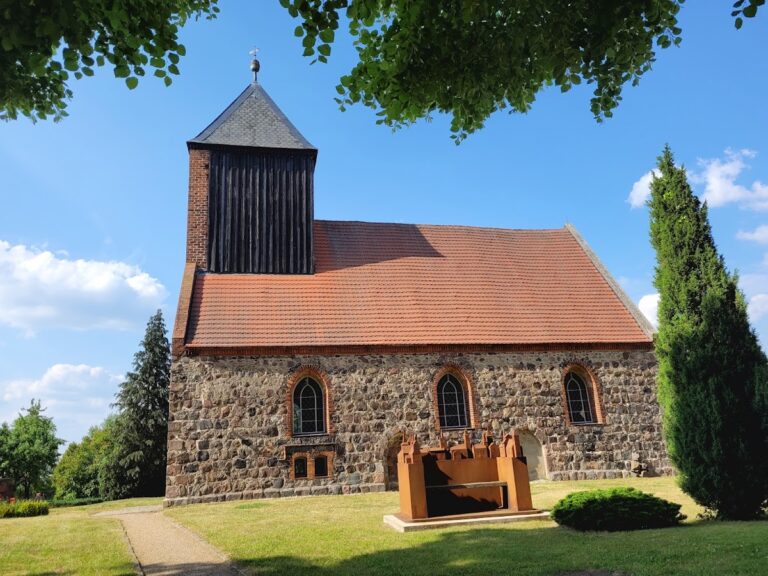
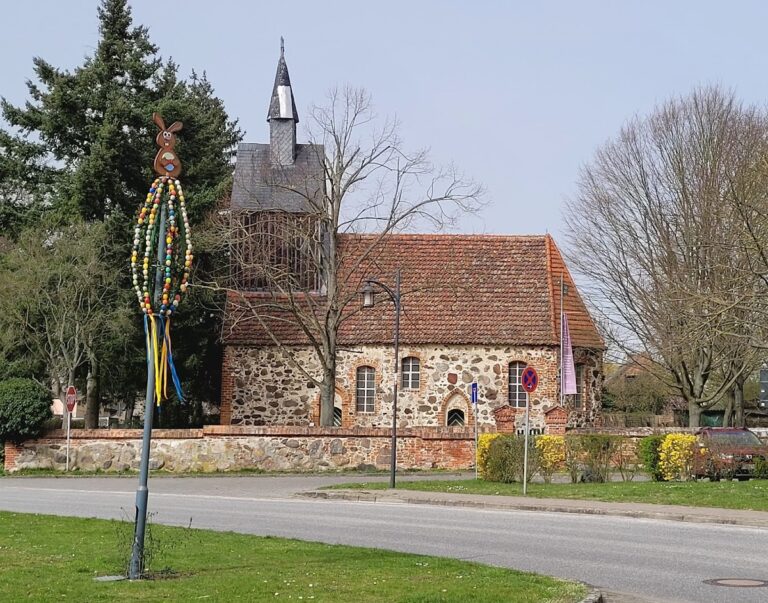
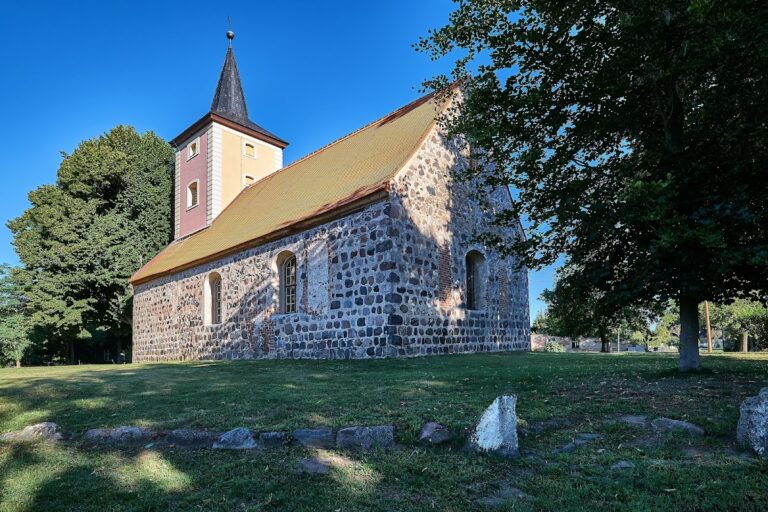
Radensleben church is an Evangelical village church in Germany, located in Radensleben, now a district of Neuruppin in Brandenburg. It began as a rectangular fieldstone building in the thirteenth or fourteenth century and later received a late Gothic square west tower. Today it belongs to the Protzen-Wustrau-Radensleben Evangelical United Parish in the Wittstock-Ruppin church district of the Evangelical Church Berlin-Brandenburg-Silesian Upper Lusatia.
Medieval origins
The original church was a simple rectangular hall built of fieldstone. Its early Gothic east wall survives with a carefully arranged group of pointed-arch openings, while the square tower at the west end represents a later late Gothic phase. Together, these elements preserve the church’s medieval development across more than one period.
Ferdinand von Quast’s redesign
Between 1865 and 1870, Ferdinand von Quast undertook a comprehensive restoration and redesign. Quast owned the Radensleben estate and served as the church’s patron. He was also Prussia’s first state conservator, an architectural historian and architect influenced by Karl Friedrich Schinkel, a leading Prussian architect. His extensive travels in Italy shaped the historicist renewal of Radensleben church.
Quast also established a family burial complex east of the choir. Begun in 1854 as a Campo Santo, an enclosed cemetery arranged around a court or cloister-like open space in the Italian tradition, it served the von Quast estate-owning family and their relatives. The enclosure survives, and Ferdinand von Quast was buried there in 1877.
Modern restoration
Restoration work in the 1960s probably covered the church’s historic wall and window-reveal paintings with white plaster. The interior was comprehensively restored again, including the recovery of these paintings, in a project completed in spring 2022. A service held at the end of May marked its completion, with Wolfgang Huber, former chair of the Council of the Evangelical Church in Germany and former bishop of the regional church, preaching on the occasion.
Remains
Medieval building and later additions
Fieldstone hall
The church remains a rectangular fieldstone hall with a flat interior ceiling. Its early Gothic east wall contains a central twin window set inside a pointed-arch brick blind arcade, a shallow decorative recess rather than an open passage. Slender lancet windows flank this central opening. The longitudinal sides contain further twin windows added during the nineteenth-century redesign.
West tower and southern addition
A square late Gothic tower stands at the west end. The southern addition contains the patronal box, a private enclosed seating area reserved for the church patron or founding family. This addition, together with the side windows, belongs to the 1865 to 1870 renewal associated with Quast.
Interior furnishings
Altar, pulpit, and ambo
The altar, pulpit, and ambo, a lectern or preaching stand used in Christian worship, are terracotta works made by Otto March to Quast’s designs. Their forms draw on the Italian Renaissance. The altar was donated by the Berlin theologian Ernst Wilhelm Hengstenberg, who was Quast’s brother-in-law.
Patronal box and maiolica reliefs
The patronal box contains a representation of Christ between the archangels Gabriel and Michael. It also holds a maiolica relief, meaning a tin-glazed earthenware work, from around 1500 associated with the Florentine workshop of Giovanni della Robbia, son of Andrea della Robbia. The relief is a lunette, a semicircular composition, showing Mary within a mandorla, an almond-shaped sacred aureole, held by four hovering angels.
A second relief from around 1500, also associated with the della Robbia workshop, is a circular tondo showing a Madonna adoring the Child, accompanied by angels and the infant John the Baptist. Modern overpainting has disfigured it, and the work is kept in the parish house.
Paintings and memorials
Three Baroque oil paintings are associated with the church. They include a late-seventeenth-century crucifixion scene set before the city of Jerusalem, Christ before Caiaphas, painted by C. C. Hartung in 1710, and a Last Judgment from 1725 that serves as the epitaph of Balthasar Friedrich von Quast. Caiaphas was the high priest who presided over the questioning of Jesus in the New Testament narrative. All three paintings were restored in 1962.
A sandstone epitaph commemorates the Prussian officer Hans Georg von Quast, who died at the Battle of Mollwitz in 1741, an eighteenth-century conflict in the War of the Austrian Succession. The monument has elaborate painted and carved decoration in the form of flags and weapons, together with a painted portrait medallion of the deceased.
Chandelier and baptismal font
A bronze wheel chandelier belongs to the nineteenth-century redesign. It follows the medieval example in Hildesheim Cathedral and represents the twelve-gated heavenly Jerusalem described in chapter 21 of the Book of Revelation. The church also has a chalice-shaped sandstone baptismal font dating from the sixteenth century.
Organ and painted decoration
Organ case and instrument
The west gallery contains the Baroque case of an organ made by Christian Kreynow in 1709. The case stood in the church at Neustadt (Dosse) until 1764. The present organ was built by Friedrich Hermann Lütkemüller in 1856, with eight stops on one manual and a pedal. Its facade was revised during the church’s restoration.
Wall and window paintings
Quast designed continuous curtain paintings for the interior walls and had the window reveals covered with oriental patterns. These historic paintings were restored as part of the interior work completed in 2022, returning an important element of the nineteenth-century interior scheme to the church.
Burial enclosure
East of the choir, the preserved Campo Santo forms a courtyard-like burial enclosure for the von Quast family and their relatives. Its arrangement reflects the Italian model selected by Quast when the family cemetery was begun in 1854.