Rēzekne Castle: A Livonian Order Fortress in Latvia


Site at a Glance
- Rating
- 4.5
- Popularity
- Medium
- Country
- Latvia
- Primary era
- Medieval
- External website
- Open
- Eras represented
- Medieval
- Civilizations
- Crusader, Livonian Order
- Site type
- Military
- Remains
- Castle
On this page11 sections
History
Rēzekne Castle is a medieval fortress in Latvia, built by the Livonian Order on the site of an earlier Latgalian hillfort during the late thirteenth century. Traditionally, construction of the stone castle began in 1285 under Wilhelm von Schauerburg, the Order’s twenty-second master, although no surviving document confirms that date. The castle became the residence of the Rēzekne vogt, an Order official responsible for local administration, justice, revenue collection, and military defense. Historically known also as Rositten or Rositen, it was one of the early stone fortifications established by the crusaders in Livonia.
The Latgalian settlement and the Livonian Order
The castle occupied territory formerly belonging to the Principality of Jersika. A Latgalian hillfort stood beside the Rēzekne River from approximately the ninth to the thirteenth century, developing in connection with a trade route between Russia and Scandinavia. Novgorodian chronicles called the region Lotigolu. Archaeological excavations have revealed that merchants and craftsmen lived there during the tenth and eleventh centuries, while surviving ramparts in the outer bailey preserve part of the earlier settlement’s landscape.
In 1209, after the Knights attacked Jersika, Prince Visvaldis became a vassal of Bishop Albert of Riga, who returned one-third of the principality, including Rēzekne, to him. Bishop Albert acquired the entire territory in 1224. An agreement of 1239 divided the dead prince’s possessions among the Livonian Order, the cathedral chapter of Riga, and their vassals. The Order received most of Jersika under specified conditions. By 1264, it had consolidated its authority in the region and could develop a stronger base at Rēzekne.
A major battle took place near the old wooden hillfort in 1281, leaving only a few Order knights alive. The later stone fortress was established on this contested site. The settlement of Rositten appeared in Lübeck documents in 1285, and Otto Paschedach was among the first recorded vogts, serving from 1288. In 1324, the castle was mentioned in documentary records in the same year that Novgorodian forces invaded the Rēzekne vogtship and took much of its population hostage.
The vogtship in the later Middle Ages
Rēzekne served as an administrative and military center within the Livonian Order’s southeastern territories. Its vogt defended the castle and surrounding district against attacks from Russia and Lithuania, while the region also supplied high-quality brick clay to Old Livonia from the fourteenth century onward. Seventeen vogts are recorded between 1348 and 1555.
Fighting reached the castle in 1437, and Pskov forces with their allies attacked it in 1481. Wolter von Plettenberg served as vogt from 1482 to 1488 before becoming one of the later masters of the Livonian Order. A visitation in 1488 described the castle as fully supplied with the necessities expected for the fortress and its vogt. In 1534, the vogt Dietrich van der Balet joined three other Order officials authorized by Plettenberg to negotiate with King Zygmunt II August of Poland over the Polish-Lithuanian frontier.
War, occupation, and destruction
Rēzekne became entangled in the final crisis of the Livonian Order. In July 1556, a guard force led by Vogt Werner Schall von Bell detained the Polish king’s envoy, Kaspar Łącki, near Biržai. The envoy’s servants were killed, and Łącki was later murdered. Secret letters taken from him were delivered to the Order’s master, providing Zygmunt II August with the final pretext to declare war on the Livonian Order.
In 1558 and 1559, the Order pawned Rēzekne Castle and its district to Zygmunt II August to help finance the war against Russia. Intelligence prepared for Duke Albrecht of Prussia estimated that the Rēzekne vogtship could field 250 mounted men in wartime. The Livonian War, fought from 1558 to 1583 by Russia, Poland-Lithuania, Sweden, and Denmark over control of Livonia, soon brought direct attacks to the fortress.
Russian forces entered the Rēzekne region in January 1558. Rēzekne and Dünaburg garrisons repelled a Russian detachment near Eessen in February, and Rēzekne forces raided the Pskov area the following month. Fighting continued through the summer. In March 1559, a large Russian army approached Rēzekne but withdrew after coming under artillery fire. Russian envoys who arrived to announce a truce were imprisoned at the castle.
A Polish relief force of 100 men reached Rēzekne in September 1559. In January 1560, the Lithuanian military official Johannes Chodkiewicz arrived as royal governor of the territories being transferred to Poland. He brought 480 men, ten cannon, eight lighter firearms, twelve barrels of gunpowder, and other supplies, then appointed Nicolaus Ościki, Baron of Kriemeniec, as commander at Rēzekne. The troops and equipment were divided between Rēzekne and Ludza.
Rēzekne belonged to the Polish-controlled Duchy of Livonia from 1561 to 1620. During the Livonian War, the castle burned, its population was taken captive, and the fortress was looted and rebuilt several times. In July 1577, forces led by Ivan the Terrible captured Rēzekne after taking the outpost and auxiliary castle at Ludza. They destroyed the castle and its church and deported captured nobles and their families to Pskov. Russian forces held Rēzekne until 1579.
The Treaty of Jam Zapolski in 1582 returned Rēzekne to Poland. The Polish authorities appointed Tiesenhausen as starost and ordered him to restore the Catholic chapel, although the work was delayed. A map prepared by the Jesuit Antonio Possevino in 1582 depicted Rēzekne as a medium-sized castle with four towers. On 1 March 1601, local nobles transferred Rēzekne to the Swedish king, reportedly under the influence of Otto Vietinghoff and Fabian Tiesenhausen. Swedish troops captured Rēzekne and Ludza in 1625 under the command of Captain Hans von Wrangel, acting on the orders of Governor-General Jacob Pontusson De la Gardie. The castle returned to Poland under the 1629 Truce of Altmark after repeated damage during the Polish-Swedish War of 1600–1629.
Russian forces occupied the castle from 1654 to 1656. In the 1656 Battle of Rēzekne, Swedish troops defeated a much larger Russian army allied with Poland. During the Northern War of 1655–1660, the Swedes completely destroyed the castle, which was never fully rebuilt. The territory returned to Poland under the 1660 Peace of Oliva and received a Polish garrison, but the ruined fortress had lost its former military importance. Rēzekne nevertheless became the center of a starosty, a district administered by a starost.
Ruins and archaeological investigation
In 1712, local house owners received official permission to take stones from the castle walls for the foundations of residential and farm buildings. The castle thereafter remained in ruins. Following the First Partition of Poland, the region entered the Russian Empire in 1773 and became part of Pskov Governorate. Johann Christoph Brotze drew the ruins in 1794, while a plan to reconstruct the fortifications and moat was prepared in 1889.
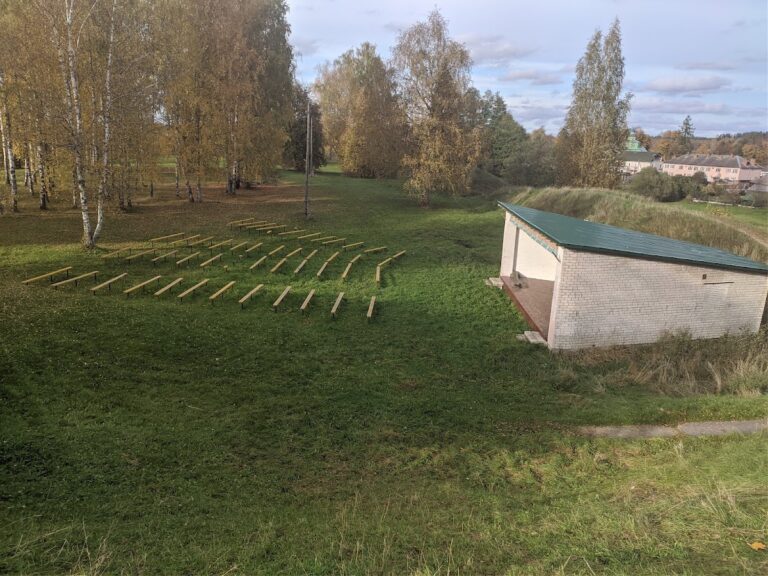
Residential and economic buildings still stood on the castle hill at the beginning of the twentieth century. Part of the area was adapted for public use with a park, lighting, a summer theater, and a restaurant. Archaeological excavations led by Ē. Mugurēvičs in 1980 and 1981 covered approximately 300 square meters and confirmed the presence of tenth- and eleventh-century Latgalian merchants and craftsmen. In 2003, the public organization Latvian History Park built a model of the castle near the ruins, with Edmunds Smans as its creator. A nearby square was named for Bishop Jāzeps Rancāns.
Remains
Island fortress and defensive layout
Rēzekne Castle stood on the northern bank of the Rēzekne River, on a hill about 15 meters high within a bend of the river. A moat was cut across the approach, and the river was straightened so that water surrounded the castle area on all four sides. This arrangement combined the defensive advantages of an elevated position with those of a water barrier. Rēzekne formed part of a compact group of five Livonian Order fortresses defending the southeastern corner of Old Livonia. Ludza lay about 25 kilometers to the east, Wolkenburg about 27 kilometers to the southeast, Dünaburg about 76 kilometers to the southwest, and the auxiliary castle at Krāslava about 70 kilometers to the south.
The fortress combined a central tower-castle with a curtain-wall enclosure. A strongly fortified gate complex with a drawbridge connected to the main defenses. From this entrance, a protected castle road passed through a zwinger, a defended passage between fortification lines, before reaching the outer bailey. Entry required crossing the drawbridge and passing through three gates fitted with iron bars.
Main castle
By the end of the thirteenth century, the main castle appears to have consisted of a two-story building with three wings and a three-story tower. The enclosed complex contained the vogt’s residence and a chapel. Gates beneath the chapter hall in the northwestern corner connected the main-castle courtyard with the courtyard of the outer bailey. A square tower flanked these gates, and its masonry joints indicate that it was added later. The main castle stood about a meter higher than the outer bailey, while a well occupied its courtyard.
Keep and bridge gate
The western side was dominated by a powerful, plain circular keep of the bergfried type. A bergfried was the principal defensive tower of a medieval castle, used chiefly as a stronghold and observation point rather than as a permanent residence. The keep rose well above the other structures and protected the fortification’s western side. A smaller circular tower guarded the bridge gate and may also have been a later addition.
Outer bailey
The outer bailey was rounded, and its high curtain wall followed the slope of the riverbank. It contained economic buildings, soldiers’ barracks, and housing for servants. The earlier Latgalian settlement left ramparts in this area, linking the medieval fortress to the hillfort that had occupied the riverbank for centuries before the stone castle was built.
Materials and surviving masonry
The castle buildings were constructed mainly from fieldstone, with brick used for additions. Their rooms had timber roofs, and the surviving masonry indicates a relatively plain architectural treatment. Foundations generally used dressed fieldstone. Some walls employed the Schalenmauer technique, in which carefully selected stones formed the inner and outer faces while the core was packed with small stones, mortar, and brick fragments. This method simplified and accelerated construction and was common in castles of the German military orders.
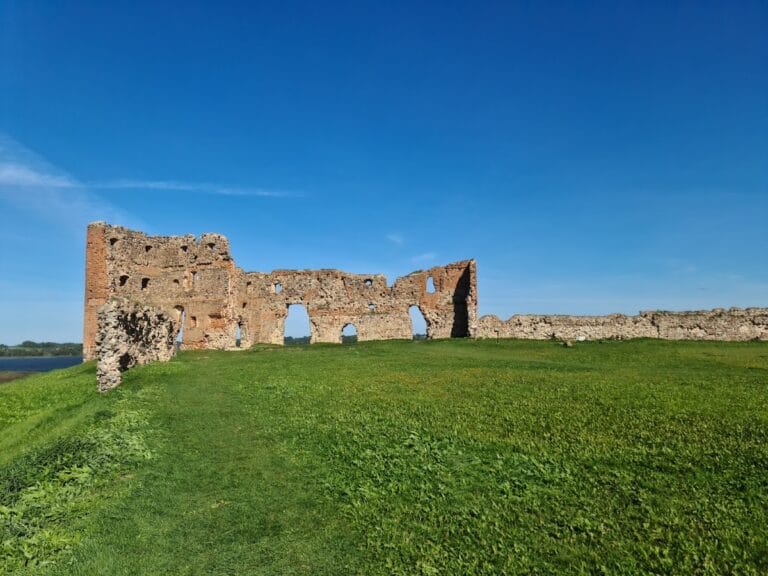
Individual higher wall sections remain, and the line of the defensive-wall foundations can be traced across parts of the hill. Grass-grown collapse debris covers much of the slope. Surviving features include sections of the southeastern corner of the main castle’s southern wall, parts of the outer-bailey curtain-wall foundations, and the basement of the square tower. The exposed masonry consists of fieldstone with only a small amount of brick mixed into the mortar.
The castle hill provides broad views over the surrounding area and the center of Rēzekne. A model of the former castle was erected beside the ruins in 2003, and a memorial stone to Bishop Jāzeps Rancāns stands on the adjacent square.