Qila Mubarak: The Fortified Palace Complex of Bathinda
Site at a Glance
- Rating
- 4.5
- Popularity
- Medium
- Country
- India
- Primary era
- Classical
- External website
- Open
- Eras represented
- Classical, Medieval, Early Modern, Modern
- Civilizations
- Kushan, Mughal, Rajput
- Site type
- Military
- Remains
- Castle
On this page11 sections
History
Qila Mubarak, also known as Bathinda Fort or Gobindgarh, is a fortified palace complex in Bathinda, India, whose origins are associated with the Kushana period and whose later history spans Hindu Shahi, Muslim, Mughal, Sikh, and Patiala rule. The fort stands in the heart of the city and is recognised as a monument of national importance.
Early foundations and medieval rule
The original construction date remains uncertain. The fort’s bricks are attributed to the Kushana period, when Emperor Kanishka ruled a major state across parts of South and Central Asia. Construction is attributed to the local ruler Raja Dab, described as an ancestor of Vena Pal. One tradition connects the fort with efforts to prevent Hun invasions of Kanishka’s kingdom, while another places a building phase in the early ninth century under local Bhatti Rajput rulers.
Hindu chronicles from Kashmir describe the fort as the capital of Jayapala, a ruler of the Hindu Shahi dynasty, which governed parts of the northwestern Indian subcontinent before the expansion of Ghaznavid power. These chronicles also state that Mahmud of Ghazni captured it. Early Muslim historical writing refers to the settlement as Batrinda, a name that has often been incorrectly rendered as Tabarhind.
A later medieval phase dates to approximately AD 1100–1200. Successive regional rulers altered and strengthened the fort, with further reinforcement taking place during the Mughal period, particularly under Emperor Akbar, who ruled the Mughal Empire from 1556 to 1605.
Razia Sultan and the Patiala period
Qila Mubarak is associated with the imprisonment of Razia Sultan, the first woman to rule the Delhi Sultanate, a succession of Muslim dynasties that governed much of northern India from the thirteenth to the sixteenth centuries. After Altunia, a provincial governor and military commander who had rebelled against her, defeated and deposed her, Razia was held at the fort. She escaped, married Altunia, and joined him in an attempt to recapture Delhi. Both were later killed.
In 1754, Baba Ala Singh, ruler of the Patiala state, captured the fort and renamed it Gobindgarh in honour of Guru Gobind Singh, the tenth and final human Guru of Sikhism. A later version of the fort was built from 1763 under Ala Singh.
Local tradition associates the complex with visits by Guru Nanak Dev in 1515 and Guru Tegh Bahadur around 1665. Guru Gobind Singh is said to have visited in 1705 after his victory at the Battle of Muktsar. Two gurdwaras, or Sikh places of worship, were later established within the complex to commemorate his visit. The principal gurdwara was originally built in 1835 during the reign of Maharaja Karam Singh of Patiala in the Phulkian style, the architectural tradition associated with Patiala and related Sikh ruling houses.
Restoration and preservation
The fort was restored under a Maharaja of Patiala. In the early twenty-first century, a restoration team spent two years analysing the complex and submitted a restoration plan to the Archaeological Survey of India. Minor repairs began while approval was pending. The site is maintained by the Archaeological Survey of India.
Remains
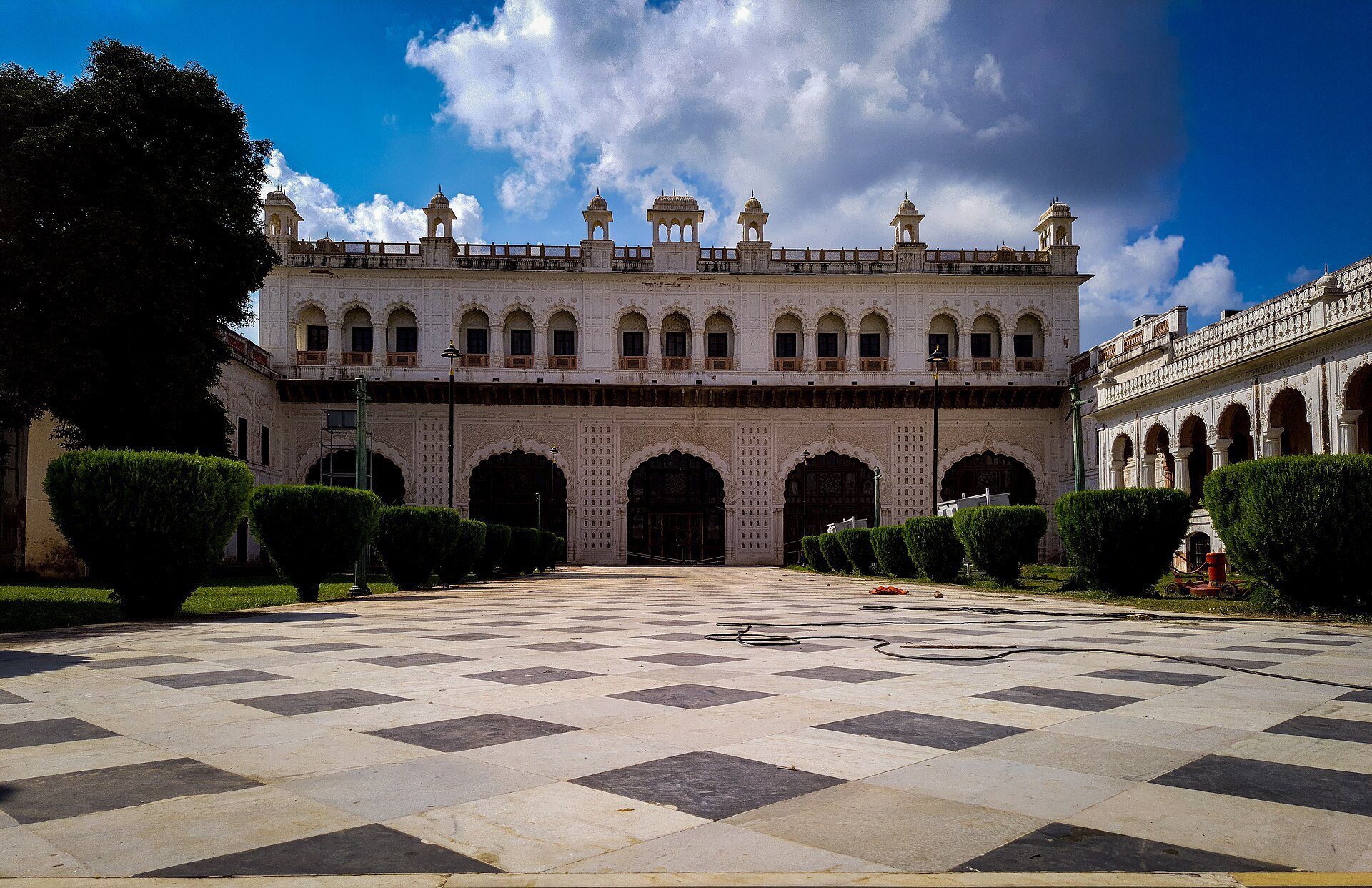
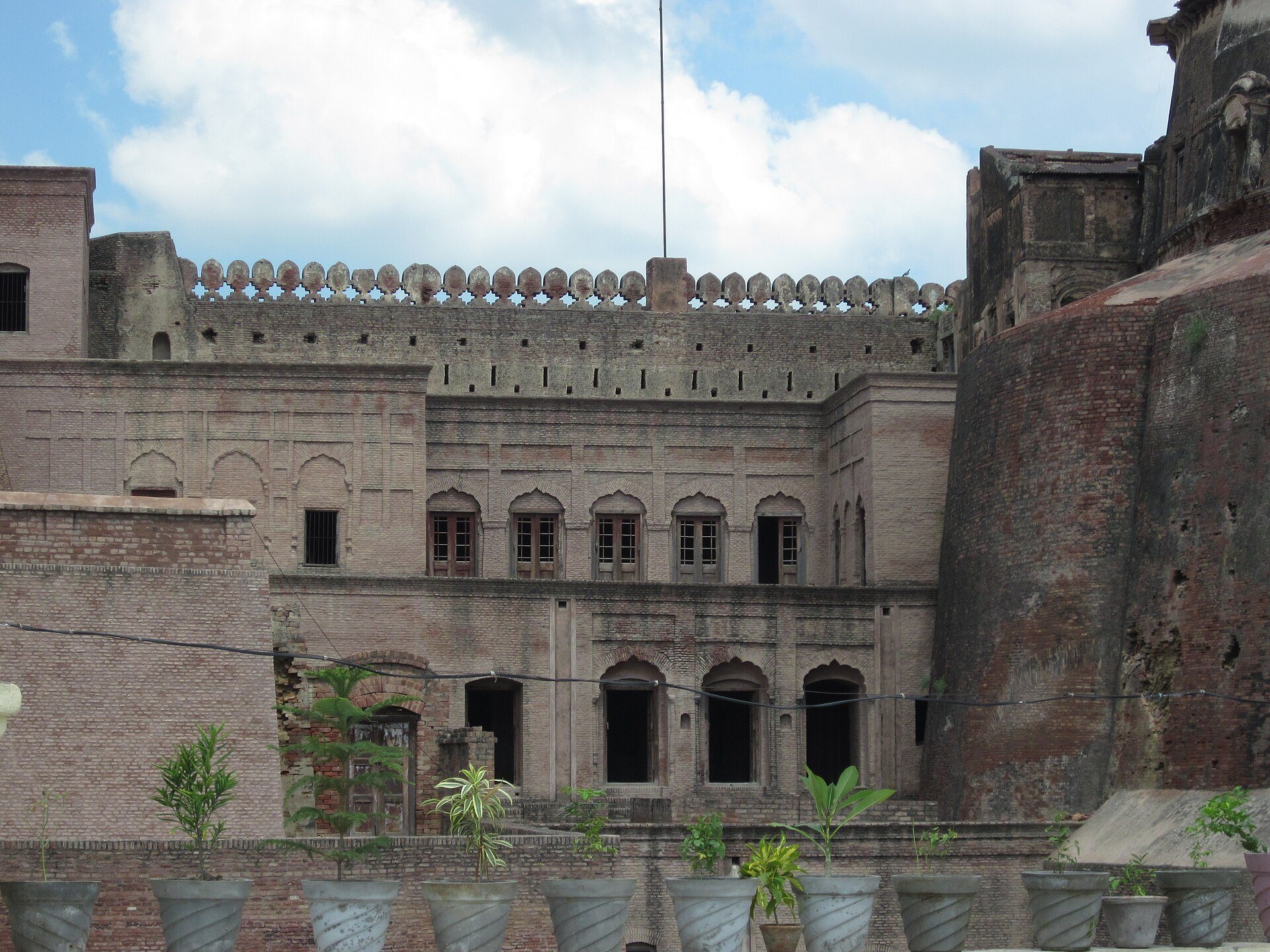
Qila Mubarak is principally a brick-built fortified palace complex, with sandstone also used in its construction. Its defensive circuit includes 36 bastions, projecting fortifications designed to strengthen the walls and cover the surrounding approaches. The fortress rises approximately 30 metres, or 98 feet, and was formerly visible for many miles around. The surviving complex brings together its defensive walls, later royal additions, Sikh religious buildings, and painted decoration.
Fortifications and royal spaces
Bastions and walls
The fort’s brick ramparts and 36 bastions form its principal defensive structure. The bricks are attributed to the Kushana period, while the fortress was modified and strengthened during later phases, including the Mughal period. A gurdwara stands on the ramparts and commemorates the visit traditionally associated with Guru Gobind Singh.
Rani Mahal
The Rani Mahal, a queen’s residence within a royal complex, is positioned above the entrance. It was added at a later stage, forming a distinct royal space within the fortified palace.
Gurdwaras and painted decoration
Gurdwara Qila Mubarak
Two gurdwaras stand within the fort complex, including the principal Gurdwara Qila Mubarak. The principal building dates to 1835 and follows the Phulkian style of Sikh architecture. It is regarded as one of the few surviving original gurdwara structures built during Maharaja Karam Singh’s reign.
Murals
Numerous Indian and Sikh murals decorate the fort. Their imagery combines classical symbols of Indian royalty with Rajput and Mughal references. Together, these painted themes supported the legitimacy of the Sikh ruling dynasty.