Qadamgah: An Ancient Rock-Cut Monument in Iran
Site at a Glance
- Popularity
- Medium
- Country
- Iran
- Primary era
- Unclassified
- Eras represented
- Unclassified
- Civilizations
- Unclassified
- Site type
- Religious
- Remains
- Sanctuary
On this page6 sections
History
Qadamgah is a rock-cut monument in Fars province, Iran, dating to the Achaemenid or post-Achaemenid period, during or after the ancient Persian empire ruled by the Achaemenid dynasty. Its Persian name means “footprint”; the local form Qadamgah-e Ali means “Ali’s footprint,” referring to Ali, revered as the first imam in Shia Islam.
Date and proposed function
Its purpose is disputed. Proposals include an unfinished royal tomb, a completed funerary monument whose cavities held human bones, and a place used for religious worship or ritual. One tomb theory compares Qadamgah with two tombs near Persepolis, including the structure known as the unfinished tomb of Darius III, the Achaemenid Empire’s last king. It suggests construction at Qadamgah may also have stopped before completion. Later observations, however, indicate that the monument was completed. Clay tablets in Persepolis’s administrative archives, which preserve records of imperial government, may refer to Qadamgah.
In a 2007 study, archaeologist Jean-Claude Bessac favored a completed religious function linked to sacred water and rejected a funerary purpose. A later study associated the monument with Mithra, an ancient Iranian deity, and Anahita, a goddess associated with water. If the water-related interpretation is correct, Qadamgah would be a rare known Achaemenid place of worship.
Discovery and modern recognition
Captain H. L. Wells, an officer in the British Army’s Royal Engineers, identified the monument in 1881 and published a plan and cross-section without describing it. Qadamgah is registered as an Iranian National Heritage site.
Remains
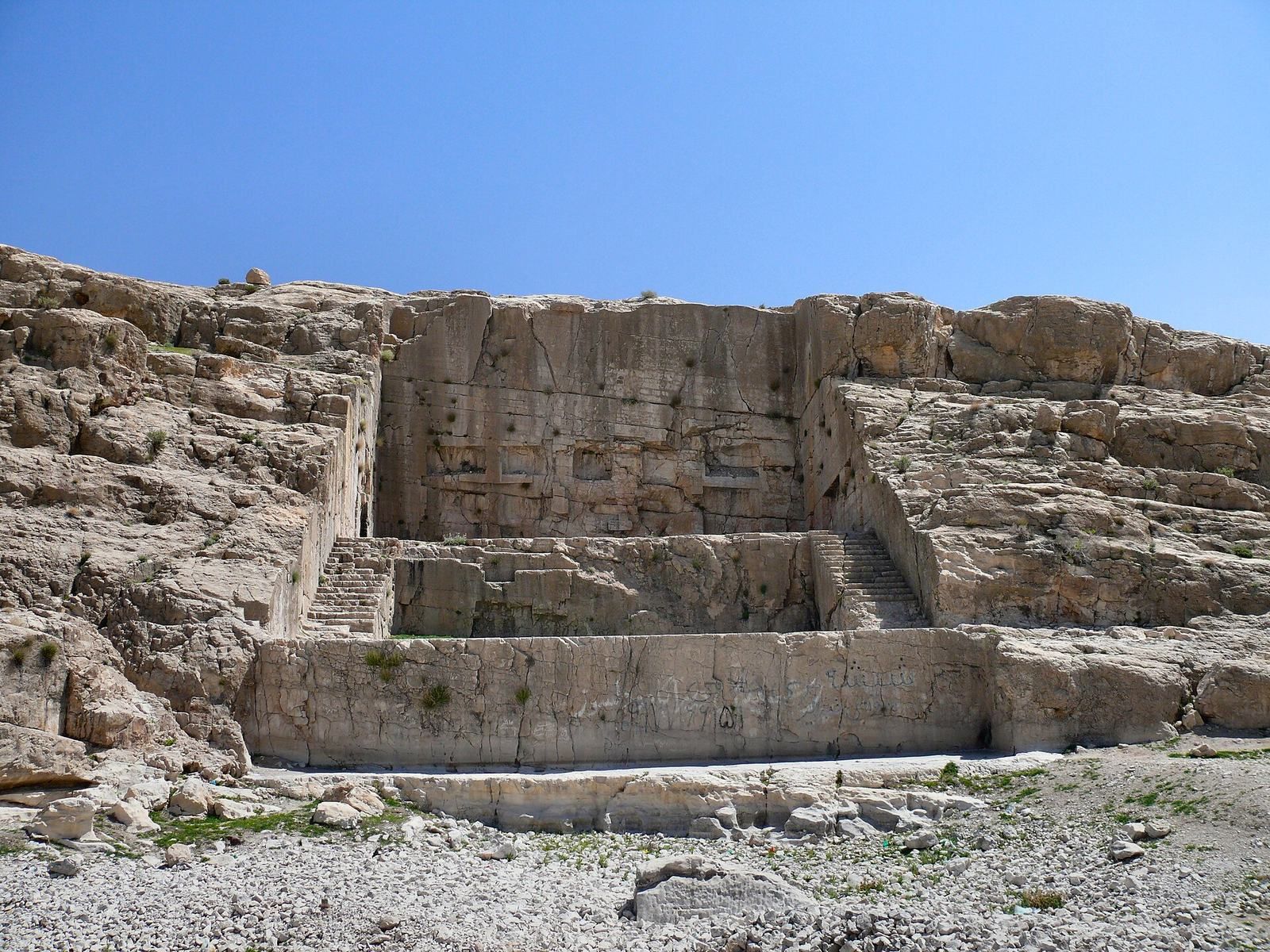
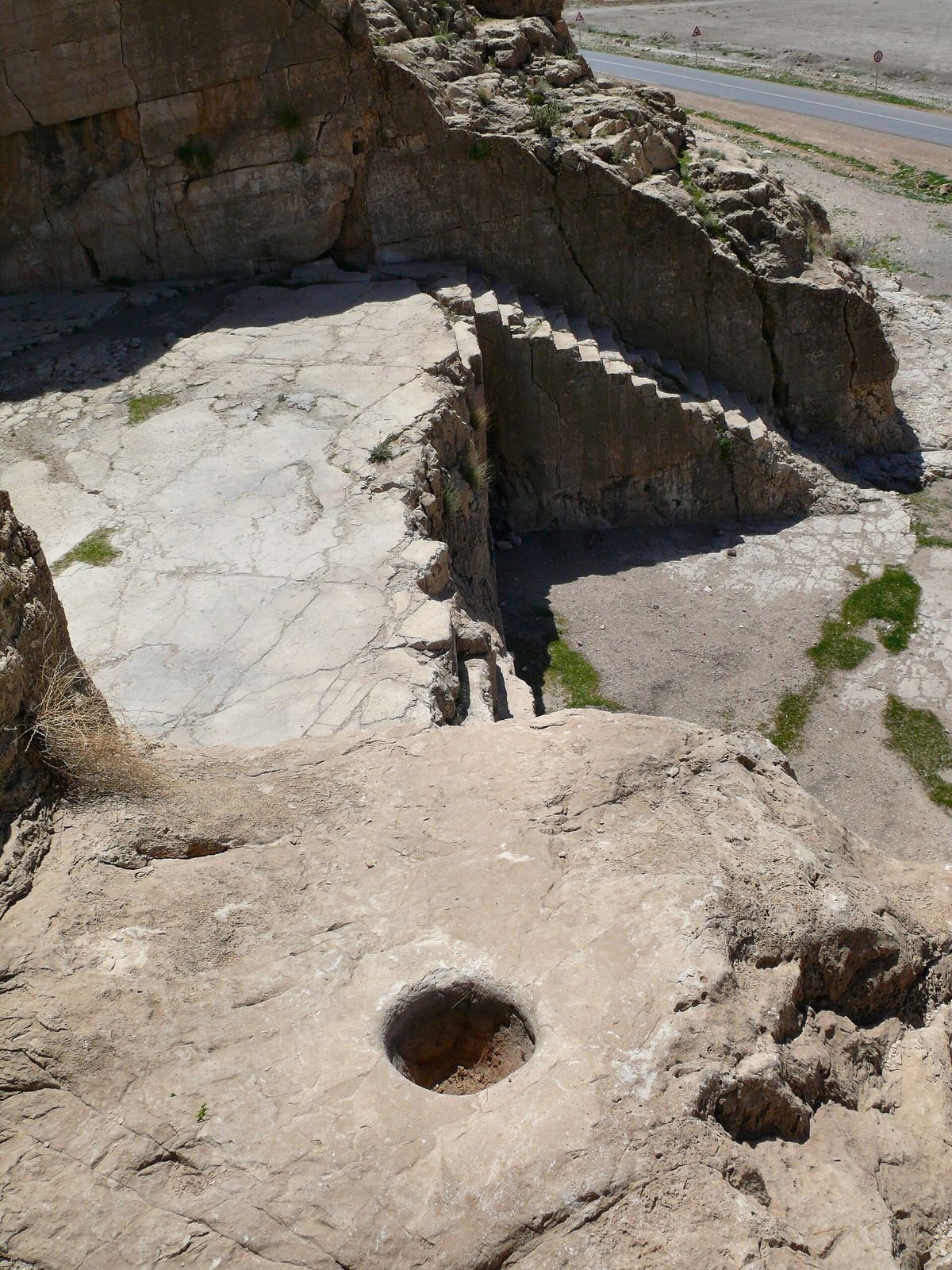
Qadamgah is cut into a limestone slope on the southeastern part of Kuh-e Rahmat, at an elevation of 1,580 metres. It lies north of Chasht-Khor village and near Ahmadabad, about 40 kilometres south of Persepolis. The monument measures 20.30 metres long, 13.50 metres wide, and 16.50 metres high. Two deep vertical cuts shape three platforms, one above another, with vertical rock faces behind them. The structure is also described as two iwans, vaulted spaces open on one side.
Terraces and carved features
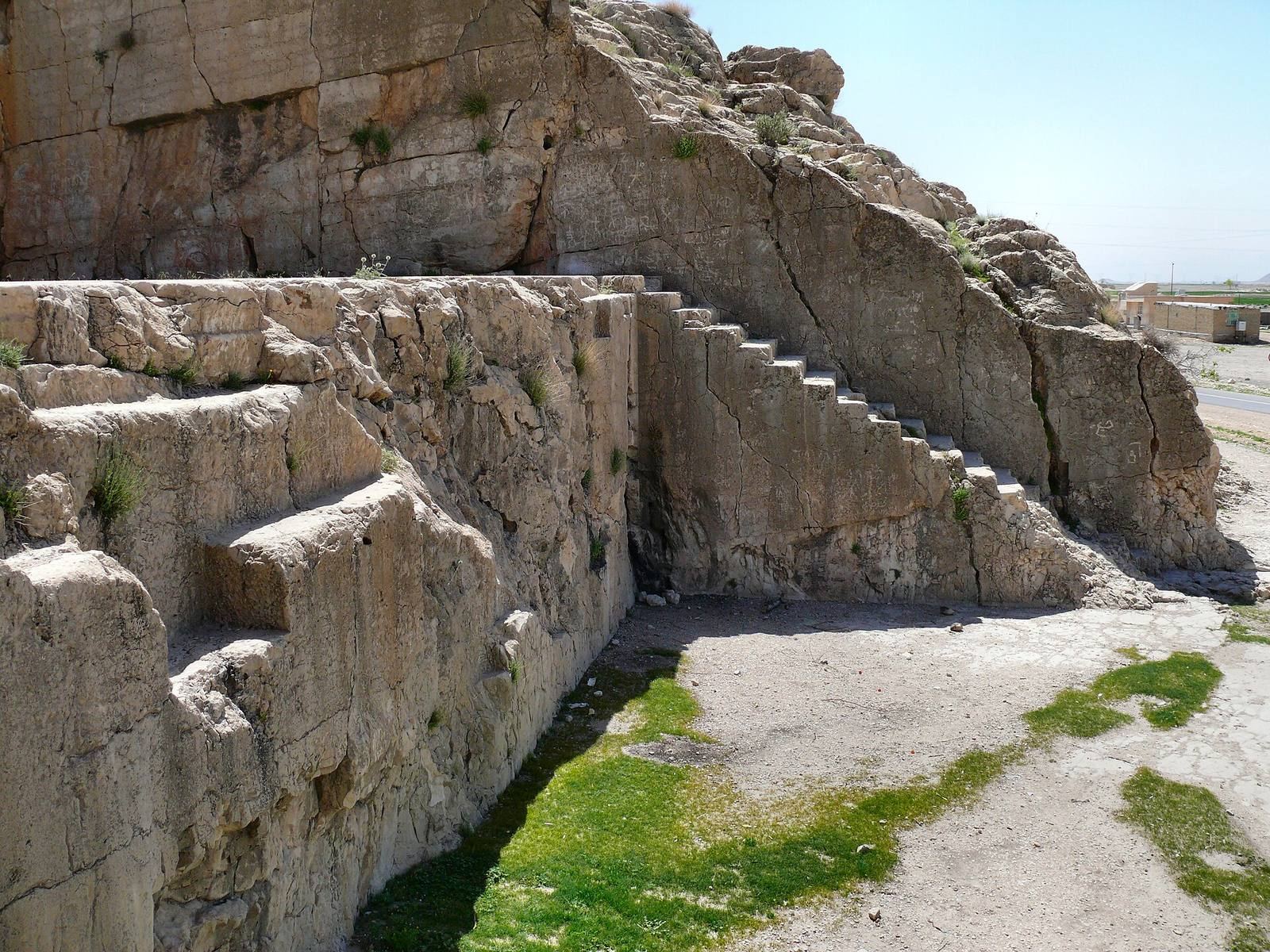
The lower terrace stands 3 metres above ground. Two staircases carved into the rock at its sides connect it to the upper terrace, which is 4.25 metres higher; both terraces are 13.50 metres wide. Above the upper terrace, the rear wall has three rows of five shallow rectangular cavities. Stone slabs may once have covered them, perhaps carrying inscriptions or reliefs for decoration. Several shallow, rounded holes are cut along the upper terrace’s edge.
Spring and nearby cemetery
A spring below the lower terrace once supplied a pool in front of the monument, overlooking it; both are now dry. About 100 metres to the west, a cemetery contains graves dating from pre-Islamic times through the Qajar period, an era of Iranian rule from the late eighteenth to the early twentieth century. The rock-cut monument is fragile and slowly deteriorating.