Pylos: A Mycenaean Palace Center in Greece
Site at a Glance
- Popularity
- High
- Country
- Greece
- Primary era
- Bronze Age
- Eras represented
- Bronze Age
- Civilizations
- Mycenaean
- Site type
- Civic
- Remains
- Palace
On this page15 sections
History
Pylos is an archaeological site at Epano Englianos in Greece, where a Mycenaean palace center flourished in the thirteenth century BCE. Mycenaean civilization was a Late Bronze Age society of mainland Greece organized around palace centers. Pylos served as the capital of Messenia and as one of this civilization’s major centers.
Legend and the Mycenaean kingdom
Greek tradition traced Pylos’s foundation to Neleus, a son of Poseidon and Tyro. In the legend, Neleus left Iolcus, found refuge at the court of the Messenian king Aphareus, and became ruler of Pylos. After Neleus’s death, his son Nestor succeeded him. Homeric poetry likewise presents Pylos as the home of Neleus and Nestor. Nestor was said to have joined the Trojan War with several of his sons and returned safely. Together with Agamemnon, he called the Greek kings to the expedition, and he contributed about 90 ships. In another episode, he welcomed Telemachus, the son of Odysseus. A separate tradition made Codrus, Athens’s last king, a descendant of Neleus.
The Messenian region had been inhabited since the Late Neolithic. During the Mycenaean period, Pylos ruled a kingdom divided into two provinces, extending across much of the Messenian peninsula and as far as the island of Sphacteria. Finds from the center indicate wealth and contacts with Crete and Egypt.
Destruction and later ancient history
Fire destroyed the palace complex around 1200–1190 BCE. The burning that baked the archive’s clay tablets has been taken as evidence of an attack by Dorians, one of the ancient Greek-speaking peoples, at the beginning of the Greek Dark Age, the period following the collapse of Mycenaean palace society. Pylos was devastated and not rebuilt as a palace center. Sparta took control of the region, and most of its inhabitants were said to have moved toward Mount Cyllene.
In 425 BCE, the Athenian leader Cleon captured Pylos. After the Mycenaean age, the city remained a minor center until Roman times, when the palace was restored and the settlement expanded. It nevertheless continued to be an unimportant city under Roman rule. In the Byzantine period, repeated attacks by the Emirate of Crete, a medieval Muslim state on Crete, brought about the area’s complete depopulation.
Medieval Navarino
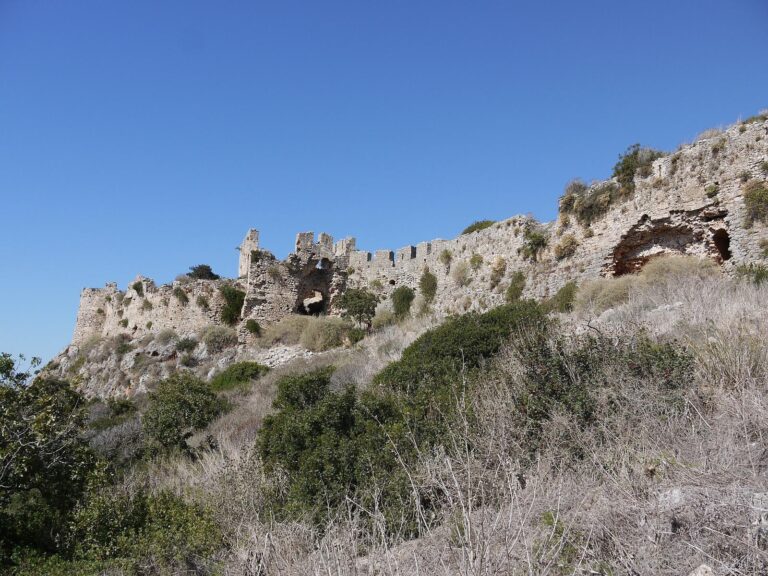
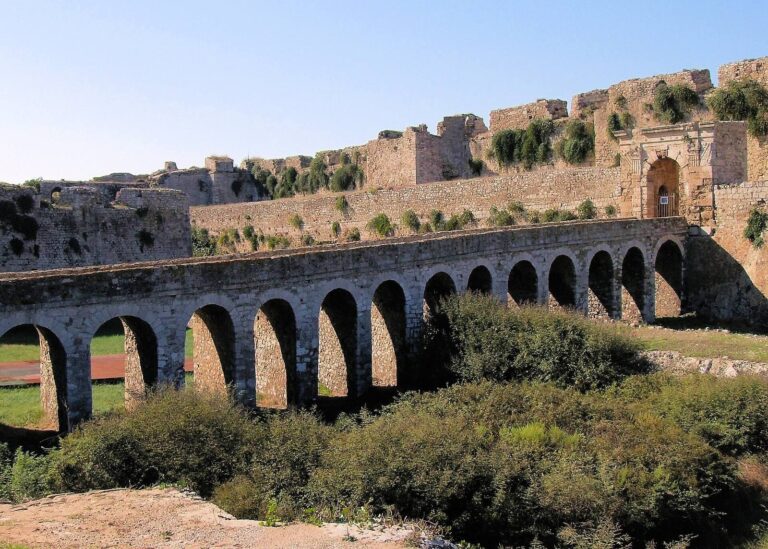
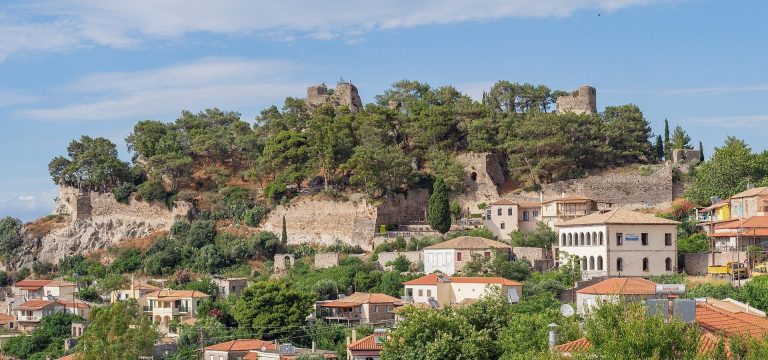
Following the Fourth Crusade, an early thirteenth-century campaign that established Latin-ruled states in parts of Greece, the region became part of the Principality of Achaea. Nicholas II of Saint-Omer received it as a fief and built Old Navarino Castle at a small site farther south, where Avars, a Eurasian people, had once lived. The settlement that grew there gradually replaced the largely forgotten ancient Pylos.
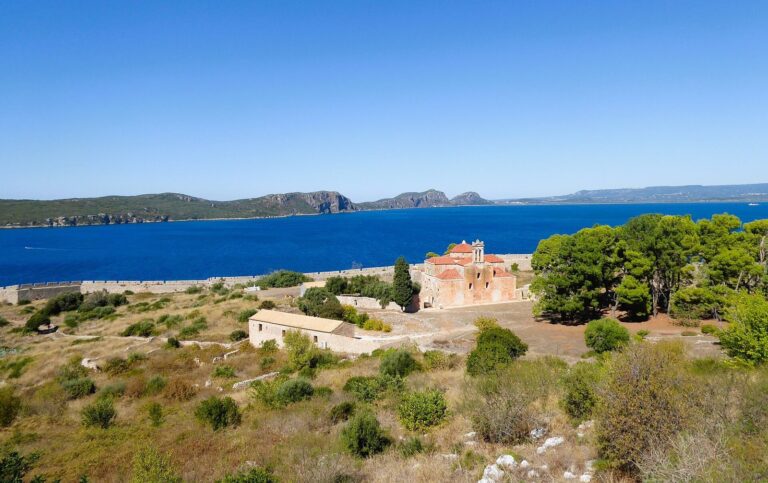
Navarino later became a point of contest among Venice, Genoa, and the Catalan Company, a mercenary force active in the eastern Mediterranean that served the Crown of Aragon, an Iberian dynastic polity. The Ottoman Empire took control of the settlement and used it as a naval base. In 1572, the Ottomans built a new castle there. Navarino gained strategic importance during Ottoman–Venetian conflicts and the Cretan War, fought between the Ottomans and Venice over Crete.
Navarino and the Greek state
During the Orlov revolt, an eighteenth-century Greek uprising supported by Russia, Russian forces took Navarino. The Ottomans later regained the town and burned it. In the Greek War of Independence, revolutionary forces first captured Navarino, but troops commanded by Mehmet Ali of Egypt and his son Ibrāhīm Pasha retook it. At the Battle of Navarino, British, Russian, and French forces destroyed the Ottoman fleet.
The Morea campaign, a French military expedition during the struggle to end Ottoman rule in Greece, brought Navarino and the ancient ruins under Greek control and into the Kingdom of Greece. Pylia was established near Navarino in 1829, with the ancient site within its jurisdiction. In 1833, Pylos, Pylia, and Navarino were joined as a single municipality.
Excavation and identification
Carl Blegen and the Greek archaeologist Kourouniotis began excavating at Epano Englianos in 1939 in search of ancient Pylos. They recovered their first finds on the opening day, and about 600 Linear B tablets had been unearthed by the end of the first season. Linear B is a syllabic script used for Mycenaean Greek records, especially administrative documents. Work stopped during the Second World War and resumed in 1952. Spyridōn Marinatos continued work at the site until 1965, while Blegen retired in 1964.
In antiquity, Homer, Strabo, and Pausanias placed Pylos in different locations. Excavations at Epano Englianos between 1955 and 1958 made its identification with the ancient city highly probable. The work revealed two palace phases whose dates have been associated with the traditions of Neleus and Nestor.
Remains
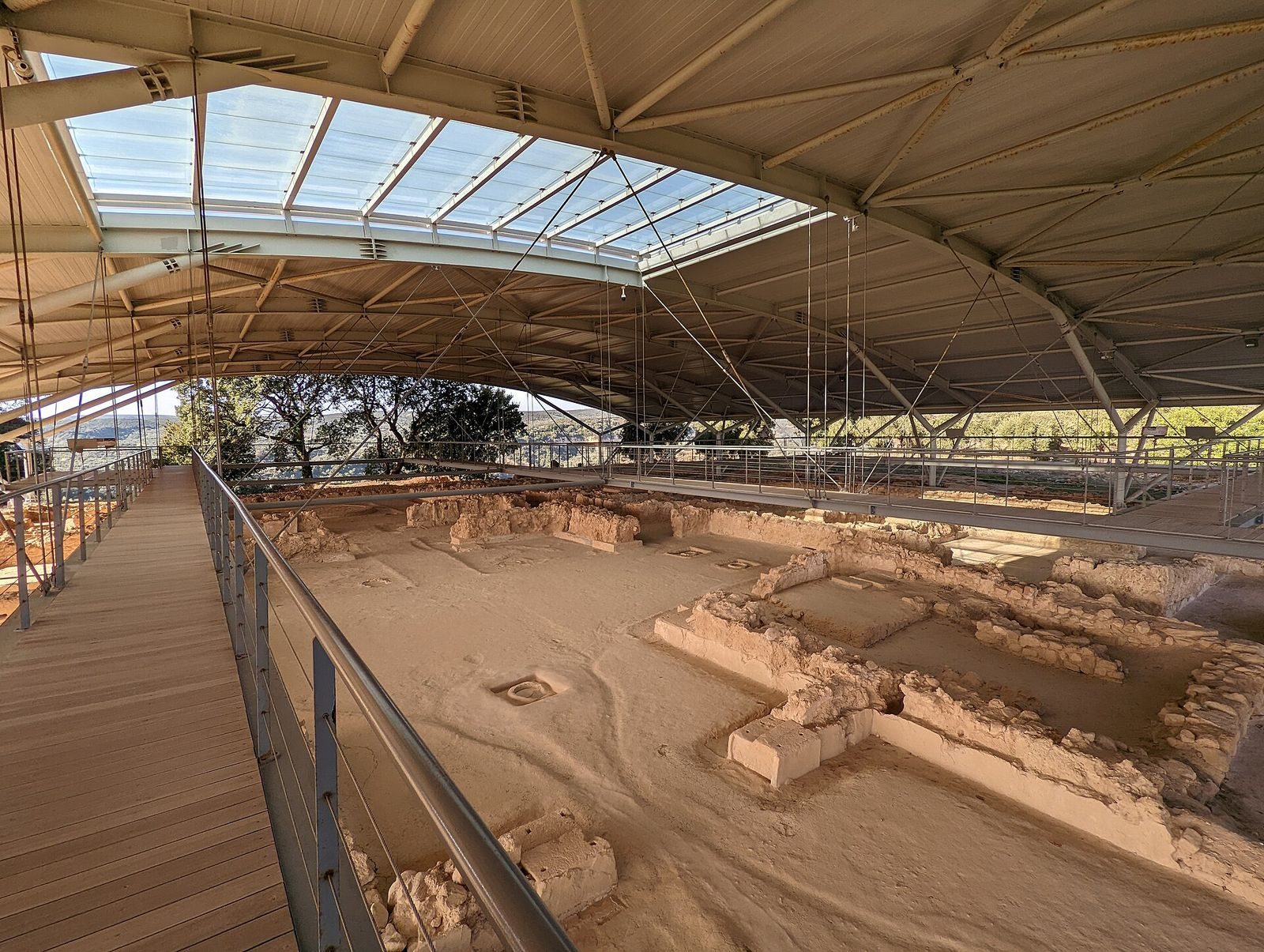
The site occupies a hilltop at Epano Englianos, about three kilometres west-southwest of Chora and roughly 17 to 18 kilometres from the modern coastal town of Pylos, also known as Navarino. Its palace complex covers about 5,600 square metres. The remains include earlier activity predating 1300 BCE and two Mycenaean palace phases from the thirteenth century BCE, one dated to about 1280 BCE and a later one to about 1250 BCE.
The palace complex
Plan and royal rooms
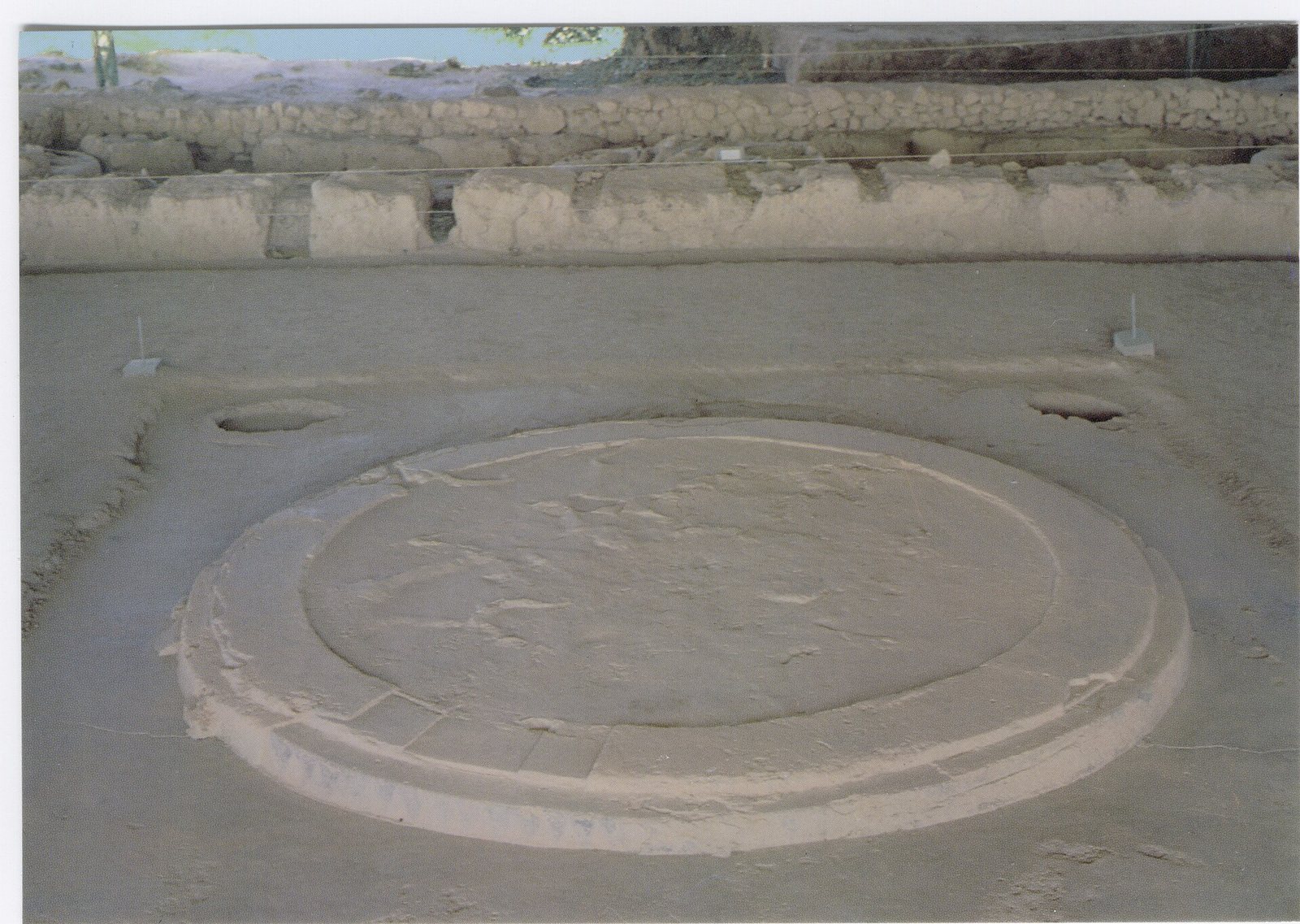
In the southwestern part of the complex, a vestibule opens into a large hall. Three monumental courts form the central core and lead toward the megaron, the principal palace hall, typically arranged around a central hearth. The main megaron at Pylos had a hearth, and a smaller megaron stood nearby. Rooms around this central group served as residences and as storage and pantry spaces.
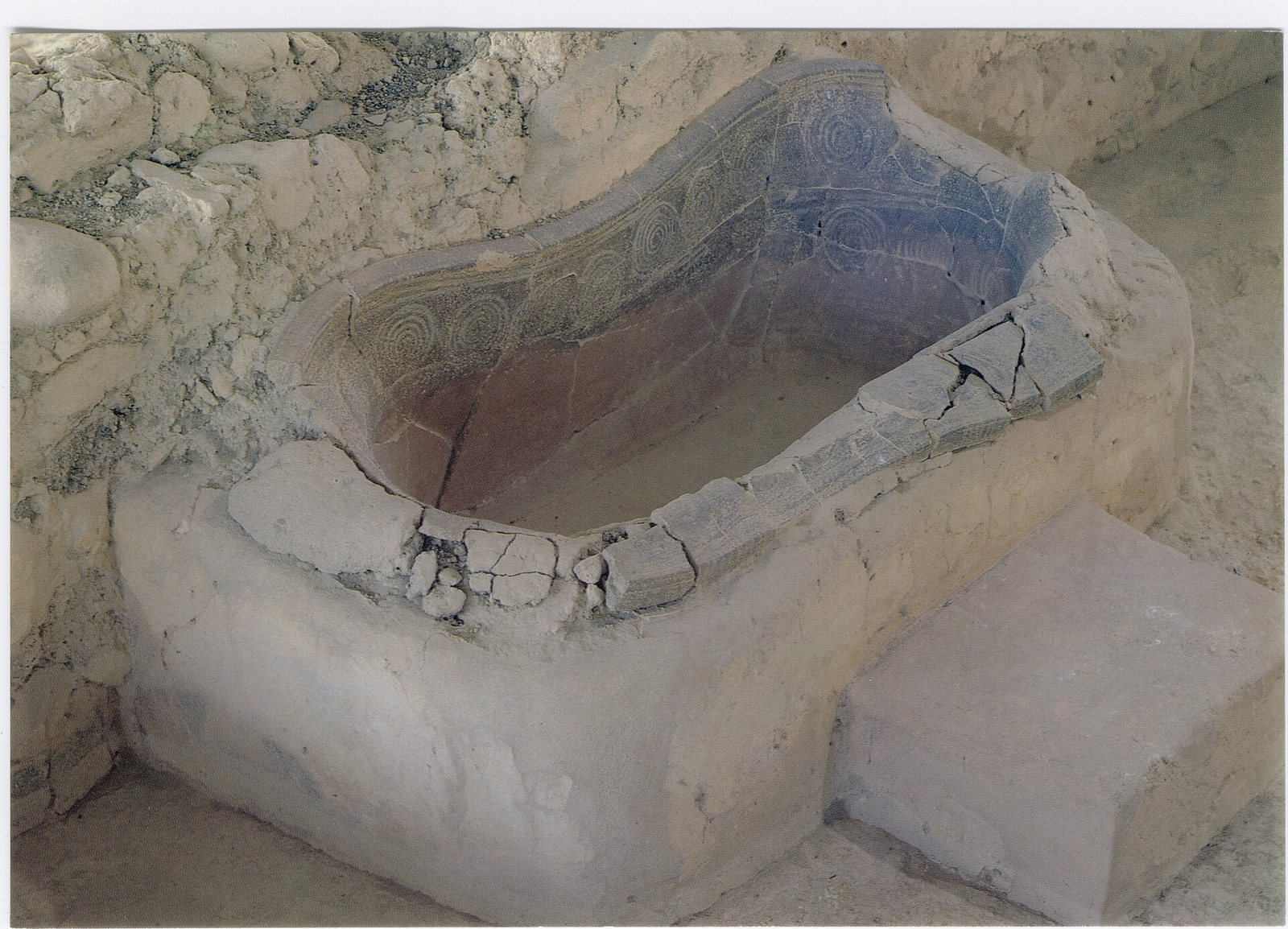
The southeastern sector contains the queen’s apartment, which included a richly decorated megaron and a bathroom. The northeastern sector held a repair workshop and an armory. Together, these spaces show the range of royal, residential, storage, and working areas within the complex.
Decoration, storage, and archive
Both palace phases had throne rooms and were decorated with stucco and frescoes. The throne room’s stucco floor included an octopus design opposite the throne. Wine-storage rooms contained jars and clay sealings, while other storerooms held amphorae for wine and perfumed oil.
The archive lay at the front of the central area. More than 1,000 clay tablets bearing administrative inscriptions in Linear B were found in the complex. Pylos’s archive is one of the few known collections of tablets from a Mycenaean kingdom, and its tablets were among the first deciphered by Michael Ventris, a British architect and linguist.
Seals and other finds
Numerous Minoan seals and engraved seal stones came from Pylos, along with Bronze Age weapons. The Pylos Combat Agate, a gemstone carved with a warrior, was recovered from the tomb of a probable wanax, a Mycenaean king or high ruler. Another find is a gold pendant depicting Hathor, an Egyptian goddess.
Burials and nearby features
Grave Circle and tombs
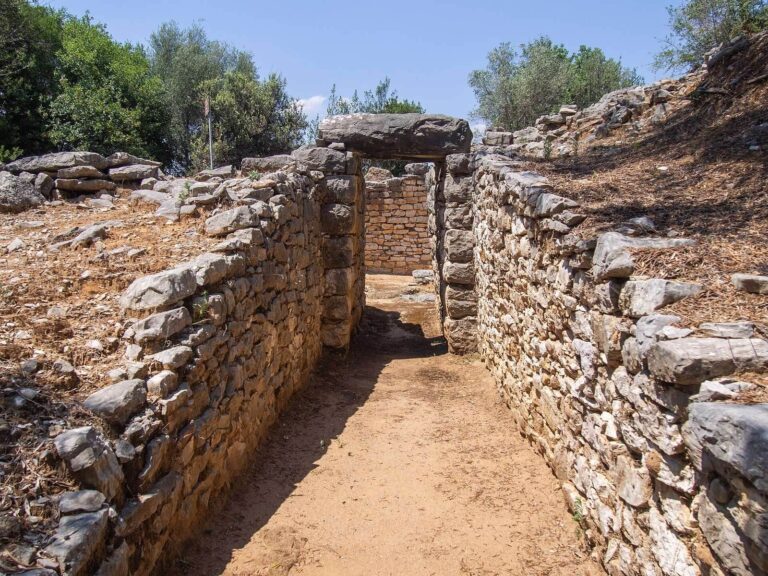
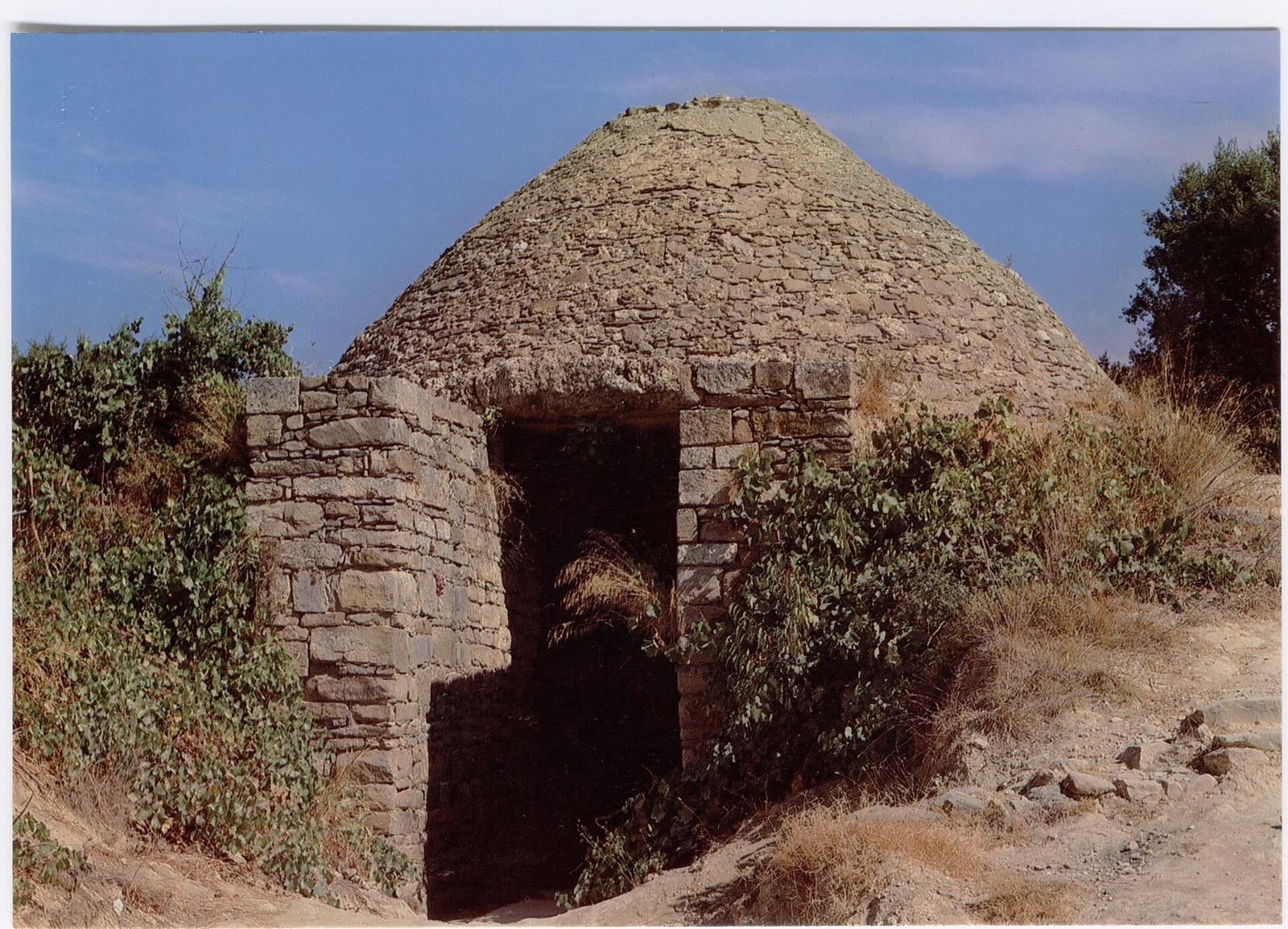
The Grave Circle, a burial area arranged in a circle, lies about 150 metres south of the palace. Numerous tholos tombs have also been found in the area. These circular chamber tombs had beehive-like roofs built from overlapping stone courses.
The Griffin Warrior burial
In 2015, archaeologists discovered a subterranean tomb containing a burial dated to about 1500 BCE. The individual, nicknamed the Griffin Warrior, was accompanied by rich grave goods.
Voidokilia Beach and the cave tradition
Tombs dated to about 4000 BCE lie at Voidokilia Beach, also called Nestor’s Beach. Near the site’s acropolis, its elevated central area, a stalactite cave has been identified with the cave in a Greek legend where Hermes hid cattle stolen from Apollo.