Prinsenhof: The Former Palace of the Counts of Flanders in Ghent
Site at a Glance
- Popularity
- High
- Country
- Belgium
- Primary era
- Unclassified
- Eras represented
- Unclassified
- Civilizations
- Unclassified
- Site type
- Domestic
- Remains
- Palace
On this page13 sections
History
Prinsenhof was a medieval palace in Ghent, Belgium, built in the 13th century on grounds associated with the city’s castellans, officials who administered castles. It later became the official residence of the Counts of Flanders and the birthplace of Charles V.
Early palace and changing ownership
A walled summer residence with towers is attributed to Hugo I. In 1064, Count Baldwin V leased the marshy site to Hugo II, a castellan, and his wife Oda. A palace combining a raised mound with an enclosed courtyard was established there in the 13th century.
Alexander Braam de la Lune acquired the property in 1231. It was also known as Ser-Sandershof. The financier Simon de Mirabello took ownership in 1324 and was killed by Ghent’s inhabitants in 1346.
A residence of the Counts of Flanders
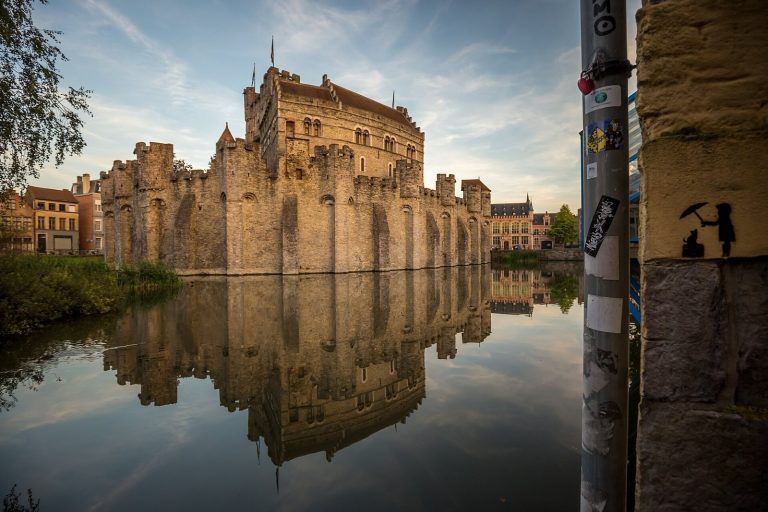
In the mid-14th century, Louis II, Count of Flanders, had the main building rebuilt as a luxurious court residence. It offered the court more space and comfort than Gravensteen, Ghent’s medieval castle and the earlier seat of the counts. They were using Prinsenhof by 1366, and from the 15th century it replaced Gravensteen as their official residence.
The estate was called Ten Waele in the 14th century and later Hof ten Walle. From the 16th century, Prinsenhof, meaning Prince’s Court, became its established name. Ten Waele has been linked etymologically to a word for Wallonia and to one meaning stranger. Philip the Good ordered another complete rebuilding, and work on a new wall around the palace began in 1499.
In August 1477, Hof ten Walle hosted Maximilian I, Holy Roman Emperor, during his ceremonial entry into Ghent after his marriage to Mary of Burgundy. The palace also held chapters, or formal meetings, of the Order of the Golden Fleece, a Burgundian-founded chivalric order.
Habsburg court and imperial authority
Prinsenhof became the principal residence of Philip the Handsome and Joanna of Castile. Their son Charles V, Holy Roman Emperor and king of Spain, was born there on 24 February 1500. Joanna’s sister Catherine of Aragon, later the first wife of Henry VIII of England, visited on 5 March that year.
Margaret of Austria, Duchess of Savoy, stayed at the palace from 25 to 31 May 1507, from 4 April to 25 May 1508, and from 20 May to 21 June 1517. During her final stay, Charles convened the States General of the Netherlands, an assembly representing territories ruled by the Habsburgs, and addressed it for the first time on 16 June. The assembly returned in July 1521, when a ceremony was held to burn books judged heretical.
In 1537, Charles’s regent, Mary of Austria, imposed heavy taxes to finance a campaign in Italy. Flanders was required to pay 1.2 million guilders, but Ghent refused. On 28 August, the city publicly tore up an imperial decree restricting its privileges, a confrontation that led into the Ghent revolt of 1539–40. During the unrest in 1539, Cardinal Granvelle, a senior Catholic cleric, and the Count of Egmont were imprisoned at Prinsenhof.
Charles arrived in Ghent with a large army on 14 February 1540 to suppress the revolt. On 30 April he imposed sanctions and presented the Concessio Carolina, a constitutional ordinance reorganizing the city government, in the palace’s Great Hall. Ghent’s aristocrats were forced to approach him barefoot with nooses around their necks. Seventeen people were beheaded and one was burned. The decree ended the city’s autonomy and strengthened princely authority. Ghent’s annual Procession of the Noose-Bearers commemorates the punishment.
Charles favored Prinsenhof as a residence, but soon ceased visiting. In 1557 it became the residence of Christina of Lorraine. During the 16th century it served both as a court home and, at times, a prison for prominent people.
Decline and disappearance
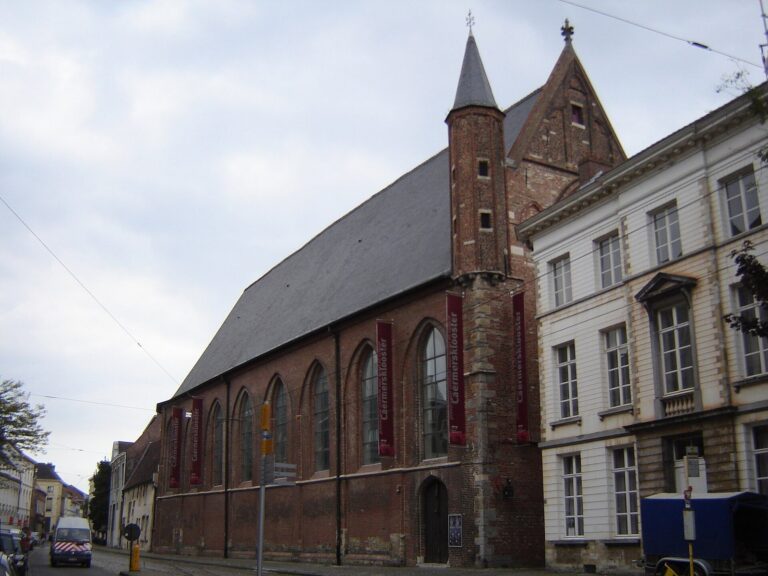
The palace fell into disuse during the 17th century. Around 1650, the Carmelites acquired buildings used by the ducal menagerie for their monastery. Other structures were abandoned or put to new uses, including as barracks, a riding stable, and a sugar refinery.
The city bought the remaining buildings in 1776, after which they were gradually demolished. Local residents reused some ruins as homes. A sugar-refining and soap works opened on the site in 1793, followed later by a spinning mill. Fire damaged the western ruins in 1832, and by 1870 almost the entire complex had disappeared. Today, Prinsenhof is the name of the residential Ghent district between Gravensteen and the Rabot.
Remains
Plan and water system
At its height, the walled palace complex contained 300 rooms and had six gates. Its moat was enlarged to meet former city moats and connect with canals, including the Lieve and Begijnengracht. This linked water system allowed boats to reach the palace and gave the grounds the form of an island within an artificial lake. A pond beside the Dark Gate also connected to the Lieve.
Residential and service buildings
The palace included spacious, well-lit halls, a courtyard, gardens, and separate chambers for the count and his consort. The consort’s residence occupied the north wing, with a tower workshop, kitchen and well, sauce and wine-service rooms, an oratory (a private prayer room), a tapestry room, and a wardrobe. Other facilities included a bakery, laundry, stables, jewellery and spice rooms, the cupbearer’s residence (for the household officer who served drinks), wine cellars, kitchens, furnaces for heating baths, and a chapel dedicated to Saint Vitus.
Waterfront grounds
A small palace beside the water housed the ducal menagerie, also called the Lion Court. It held lions and other wild animals. Charles V sent four lions captured in Tunisia in 1535. The grounds were also used for jousting and handball games.
Tower and gardens
The four-storey Margaret of Austria Tower was built as a corner tower in 1518. Extensive gardens laid out by Lieven Laephaut included 20 beds of rosemary. Charles V undertook major work in 1538 to create gardens and walkways, then funded bridges and stonework in 1545.
Surviving structures
Dark Gate
The Dark Gate, also known as Donkere Poorte, is the principal surviving feature of the palace complex. This northern secondary gate on Bachtenwalle consists of two towers flanking a vaulted arch.
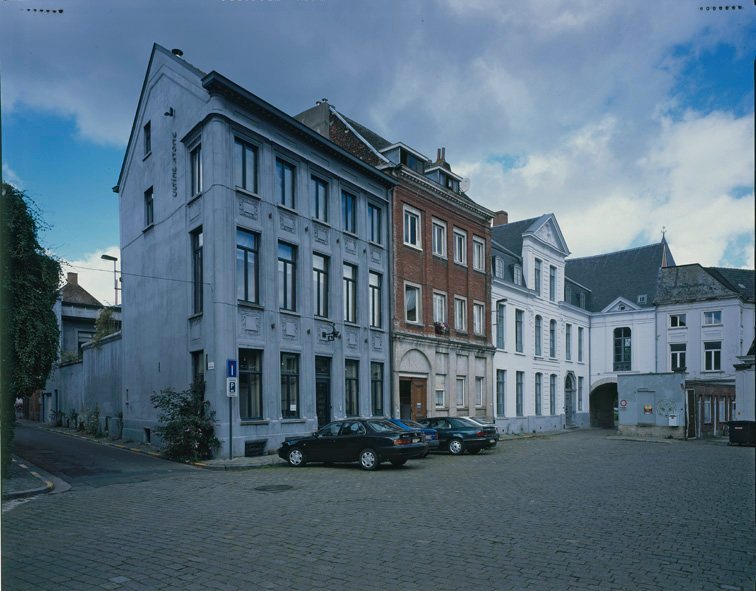
Arched passage on Prinsenhof Street
An arched passageway at Baron Jean-Baptiste Bethune’s former residence on Prinsenhof Street is another remnant of the palace’s ancillary buildings.