Primate’s Palace in Warsaw: Residence of Poland’s Primates
Site at a Glance
- Popularity
- Medium
- Country
- Poland
- Primary era
- Early Modern
- Eras represented
- Early Modern, Modern
- Civilizations
- Polish–Lithuanian Commonwealth
- Site type
- Religious
- Remains
- Palace
On this page10 sections
History
The Primate’s Palace in Warsaw, Poland, was established as a residence for the primate, the senior church prelate associated with the Archbishop of Gniezno. Construction began in the late sixteenth century on the initiative of Wojciech Baranowski, then Bishop of Płock. After buying and clearing stables and other outbuildings on the site, Baranowski transferred the palace to the Archdiocese of Gniezno, the Catholic jurisdiction headed by the archbishop, in 1612, for use as the primate’s Warsaw residence.
Construction and early rebuilding
Work continued under Primate Wawrzyniec Gembicki, and Primate Jan Lipski commissioned decorative additions. The Swedish invasion of 1655–60, also known as the Swedish Deluge, was an attack on the Polish-Lithuanian Commonwealth that destroyed the palace. At the request of Primate Michał Prażmowski, it was rebuilt between 1666 and 1673 to designs by Józef Fontana. Primate Michał Radziejowski then arranged its restoration and enlargement in 1690–91, probably following a design by Tylman van Gameren.
In 1704, Saxon, Wallachian-Italian, and Cossack troops ravaged the palace during the Great Northern War, an early-eighteenth-century conflict involving Sweden and other European powers. Primate Stanisław Szembek undertook another rebuilding, with builder Jan Chrzciciel Ceroni involved in the work.
Eighteenth-century residence and political events
The palace remained the Polish primates’ residence until 1795 and underwent repeated enlargement and alteration. Primate Theodor Andreas Potocki changed the interior arrangement. From 1749 to 1759, Primate Adam Ignacy Komorowski had the building substantially remodelled in the Rococo style, an ornate decorative fashion of the eighteenth century.
In November 1767, a delegation formed by the Repnin Sejm met at the palace with Russian ambassador Nikolai Repnin to negotiate equal treatment for religious dissenters in Poland. The Sejm was a parliamentary session held under strong Russian influence during 1767–68. A major rebuilding began in 1777 under Archbishop Antoni Kazimierz Ostrowski, following designs by Ephraim Schröger. After Schröger’s death, Szymon Bogumił Zug supervised the work. It was completed in 1783 under Primate Michał Jerzy Poniatowski, giving the residence its Neoclassical form, drawing on forms associated with ancient Greece and Rome. Jan Chrystian Kamsetzer and Zug also worked on the interiors.
Poniatowski died in the palace on 12 August 1794 during the Kościuszko Uprising, an insurrection against foreign control of Poland. A story held that he had taken poison sent by his brother, King Stanislaus II Augustus, rather than face arrest over an alleged plan to disclose weaknesses in Warsaw’s defences to Prussian troops.
From primatial residence to government offices
After the uprising was suppressed, Russian field marshal Alexander Suvorov took up residence in the palace. During the Prussian occupation of Warsaw, Prussian minister Karl Georg Heinrich von Hoym lived there. Under the Duchy of Warsaw, the government took control of the complex. Following the Third Partition of Poland, the palace served a succession of administrative and military purposes. These included the Warsaw Chamber, a fiscal and administrative office, and the Government Commission of War, which managed military affairs. The commission occupied the building from 1816 to 1832, followed by other military offices. From 1870, it housed an officers’ school and later the Directorate of Military Engineering.
Nineteenth-century changes, including the addition of a storey to the main block, altered the character of the former residence. After renovation, the palace became the Ministry of Agriculture and Agrarian Reform in 1927.
War damage and postwar use
Bombs damaged the palace and fire burned it during the defence of Warsaw in September 1939. After the war, the damage was estimated at about 60 percent. Architect and monument conservator Kazimierz Saski led its reconstruction in 1949–50. The building then became the headquarters of the Central Directorate of Museums and Monument Protection. Its later uses included Warsaw’s civil registry office and, briefly in 1983, the Museum of Caricature. In 1965, the Column Hall held the coffin of writer Maria Dąbrowska; in 1977, it held the coffin of Czesław Wycech, a figure in the Polish peasant movement.
Remains
Main block and wings
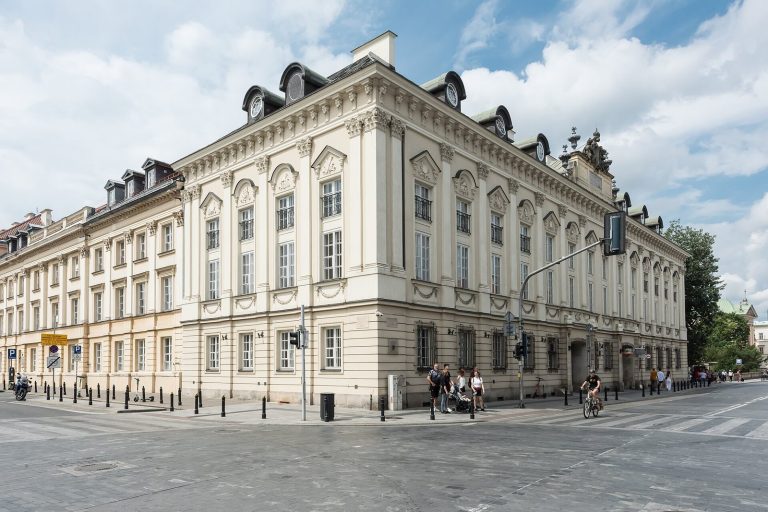
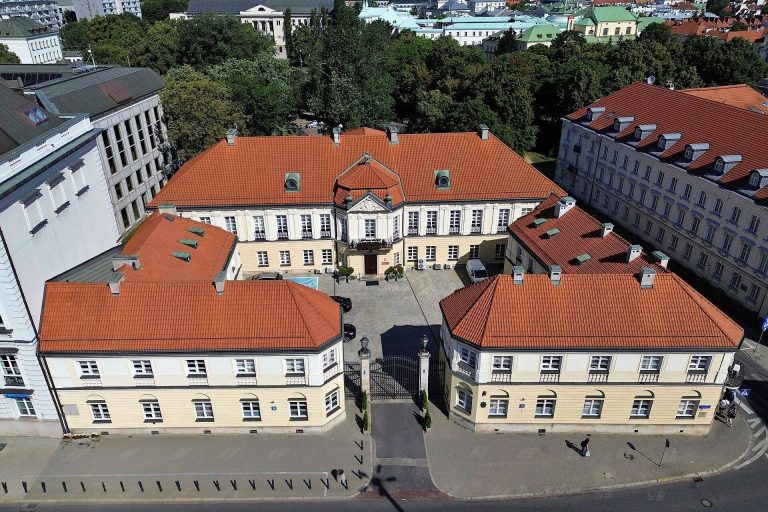
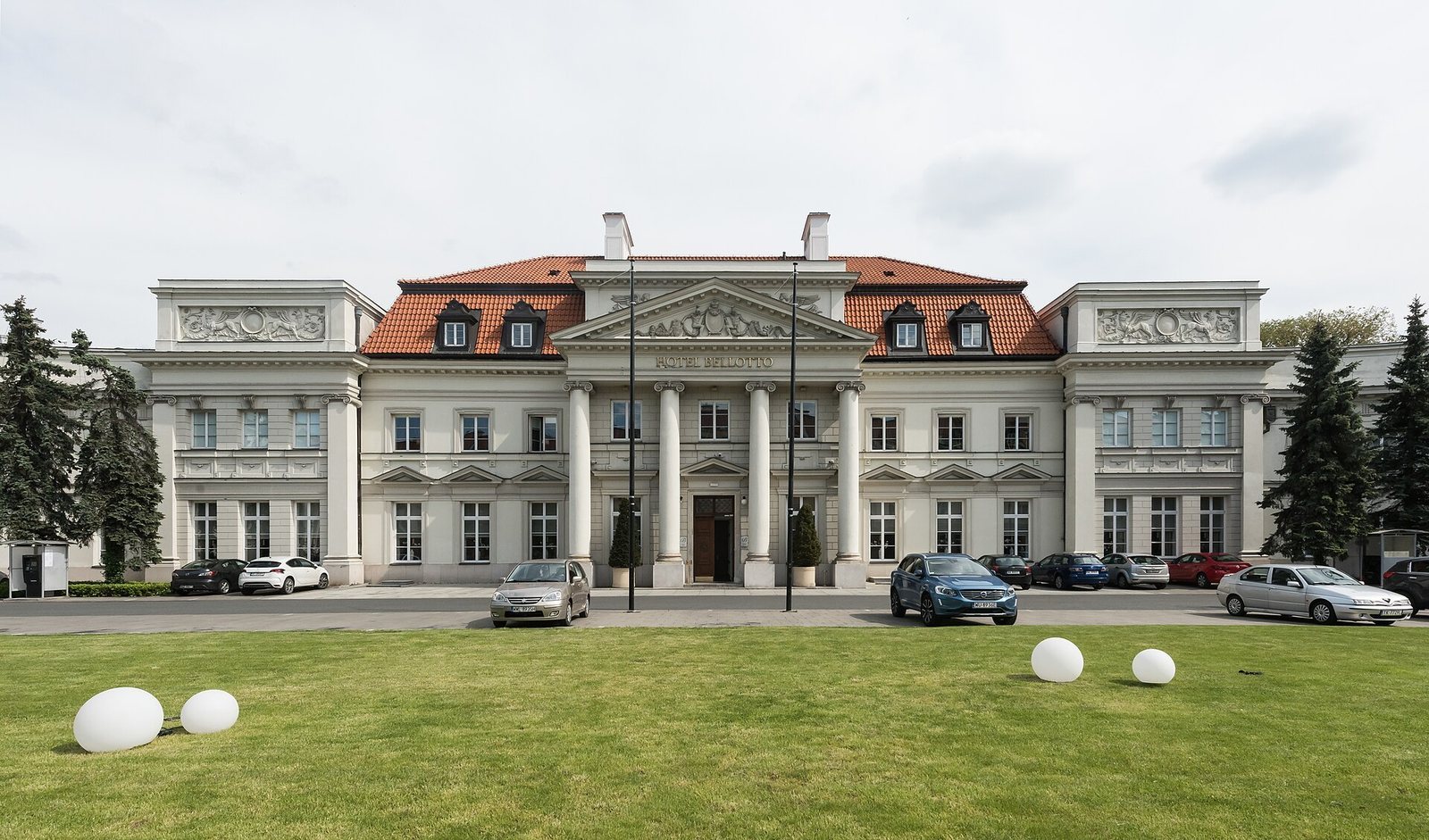
The palace’s late-eighteenth-century composition centres on a main block with projecting corner sections and a central projecting section fronted by a four-column portico, a column-supported porch. The corner sections rise behind unbroken walls, while the Baroque mansard roof, with its steep lower slopes, was retained. Two wings curve out from the block to form a semicircle. Each ends in a pavilion with a portico facing the courtyard. A large ballroom forms part of the main residential block. A shallow relief appears on an unbroken wall of one of the corner sections. Reconstruction in 1949–50 restored the building’s appearance to its late-eighteenth-century form.
Interiors
Jan Chrystian Kamsetzer and Szymon Bogumił Zug were associated with the interior design, and some rooms were remodelled in the Neoclassical style. When the Ministry of Agriculture and Agrarian Reform occupied the palace, the words Ministerium Rolnictwa, meaning “Ministry of Agriculture,” were placed above the entrance.
Forecourt and former garden
The semicircular forecourt enclosed by the wings is now a public car park. The palace’s former garden is a public park, with access from the Kozia Street side and from Plac Teatralny. The palace frontage faces Senatorska Street near Miodowa Street, while narrow Kozia Street runs behind its left wing.
Square in front of the palace
A European white elm stands in the square before the palace. A monument to Polish writer and public figure Stanisław Staszic was unveiled there in 1976 and moved after 2007 to the campus of the Warsaw University of Life Sciences in Ursynów.