Sijilmasa: A Trans-Saharan Trading City in Morocco
Site at a Glance
- Popularity
- Very High
- Country
- Morocco
- Primary era
- Medieval
- Eras represented
- Medieval, Early Modern
- Civilizations
- Alaouite, Amazigh
- Site type
- City
On this page10 sections
History
Foundation and Midrarid rule
Sijilmasa was founded around 757 in Morocco’s Tafilalt oasis by Sufrite Kharijites, followers of an early Islamic movement distinct from Sunni and Shi’a traditions. Nomadic groups had gathered in the fertile grazing area for an annual market. After Berber revolts against Umayyad rule, settlers established a community there; the geographer al-Bakri describes their numbers reaching about 4,000 before they laid out the city. Sijilmasa is described as the Maghreb’s second Islamic city after Kairouan.
Isa al-Aswad governed the settlement from 757 to 772. His appointment has been interpreted as an effort to limit rivalry among Miknasa groups, recognize the community’s diversity, affirm eligibility to rule regardless of sex or color, and encourage caravan trade. In 771, Sijilmasa asserted independence from the Abbasid Caliphate. After power shifted toward settled Miknasa groups, Isa was killed in 772 and succeeded by Abu al-Qasim Samgu ibn Wasul al-Miknasi, who established the Midrarid dynasty, a local ruling house associated with the Miknasa. The Midrarid polity lasted until 976.
Caravan trade and a diverse population
Sijilmasa’s position between North Africa, the lands south of the Sahara, and the Islamic East made it a major centre for caravans and gold. For centuries, it served as the northern end of the western trans-Saharan route. Irrigation supported farming alongside trade, pottery, and other crafts, while the town’s growing urban population lived in a notably diverse community.
Its inhabitants included Amazigh groups such as the Miknasa and Maghrawa, with Banu Marin arriving from the early 13th century. Early Arab settlers associated with the Islamic conquests of the second half of the seventh century helped spread Islam. Later, Banu Hilal and Banu Maqil groups shifted from nomadic to settled life. Andalusians were present from the city’s beginnings and may have helped build it; their numbers increased after the Cordoba Suburb Revolt of 818 brought refugees, including craftspeople, merchants, and scholars. People from sub-Saharan Africa also arrived through the caravan trade, and a substantial African population lived in the city’s early years. An agricultural population of African ancestry lived there as well, though its origins are unclear.
Protected non-Muslim communities contributed to commerce, minting, textiles, and leatherworking. Their arrival date is uncertain: traditions trace their origins either to the East before Islam or to Iberia in the 14th or 15th century. Sharifs, people who claim descent from the Prophet Muhammad, became established later. Moulay Hassan al-Dakhil arrived in 1265; his descendants became ancestors of the Alaouite dynasty, which unified Morocco from the second half of the 17th century.
Trade routes shifted from a direct desert crossing between Egypt and Ghana toward a path through the Maghreb and Sijilmasa. Routes were measured in stages, often by the number of wells: Taghaza lay 20 stages away, Awdaghust 51, Awlil 60, Ghana or Kaw 61, and Takrur 90. Exports included food, salt, textiles, jewelry, pottery, leather and wooden goods, henna, kohl, spices, books, and manuscripts. Imports included Ghanaian gold, hides and ostrich feathers from Awdaghust, eastern silk, and Andalusi pottery.
Medieval writers convey the scale of the city’s commercial connections. Ibn Hawqal described a credit of 42,000 dinars issued by a Sijilmasa merchant to a trader in Awdaghust, while al-Masudi noted that Sudanese gold was minted in the city. Roughly 400,000 dinars, about half of Fatimid tax revenue, came through Sijilmasa. Of 32 Umayyad gold coins found at Aqaba in 1992, 29 had been minted there in the late ninth or early tenth century.
Merchants and scholars carried goods, Islamic learning, and cultural practices between North Africa and the Sahel. Sijilmasa’s food, pottery, and clothing reached southern cities. Cotton cultivation spread from Sijilmasa to Awdaghust, which had become a textile centre by the mid-11th century. Maghrebi traders and scholars also helped circulate agricultural foods and Islamic urban planning and building practices in the region.
Political conflict and changing dynasties
Shifting alliances with the Cordoban Caliphate and the Fatimids unsettled Sijilmasa during the 10th century. Abd Allah al-Mahdi, later founder of the Fatimid dynasty, and his son al-Qa’im reached the Maghreb in 905 while fleeing Abbasid persecution. They are said to have taken refuge for four years under Midrarid ruler Prince Yasa’. A legend linked their arrival to a prophecy about the coming of the Mahdi, an expected figure in Islamic belief. Another story says al-Qa’im caused a spring to appear outside the city. After a resident spread a rumor that Abd Allah planned to seize Sijilmasa, Yasa’ received a warning from Baghdad and imprisoned people he had previously protected.
Abd Allah’s servant escaped to Kairouan, where the Ismaili leader Abu Abdallah al-Shi’i organized an army to intervene. The force subdued Tahert, a stronghold of the Rustamids, then reached Tafilalt and besieged Sijilmasa in the latter half of 909. Yasa’ was killed in 909 or 910. The Midrarid state fragmented, and the Maghrawa took control of the city.
Maghrawa rule began around 976. The group later declared independence from Cordoba, while Sijilmasa remained a trading centre and a base for leadership and campaigns against other Moroccan tribes. In 979, Zirid ruler Buluggin ibn Ziri briefly captured the city and compelled Zenata groups to acknowledge Fatimid overlordship. After he returned to Ifriqiya, his forces tried to maintain control in the far Maghreb until 983.
Almoravid and Almohad rule
In 1055, after an appeal from Sijilmasa’s elders, Almoravid religious leader Abdallah ibn Yasin brought an army into the city and killed Maghrawa leader Mas’ud ibn Wanudin al-Maghrawi. The Almoravids imposed strict religious controls, destroying musical instruments and closing wine shops. Although the city rebelled against their garrison more than once, it became their first conquest and an important centre of their centralized empire. Sijilmasa housed the Almoravids’ first mint and, for a time, their only one; they later opened mints in other cities, including Marrakesh, Aghmat, Fez, Tlemcen, and towns in Muslim Spain. Almoravid rule lasted until 1146.
The Almohads took control in the mid-12th century and drew on the wealth generated by trade through Sijilmasa. Their rule also brought violent persecution, including the massacre of many Jewish residents.
Decline, rebuilding, and archaeological work
Sijilmasa came under Marinid rule during the 13th century and remained one of Morocco’s major cities, but its commercial role weakened. Atlantic-facing trade routes gained ground, Banu Maqil groups controlled important caravan routes and centres, and the Marinids favored a route through the western Draa and Nul Lamta. Political and military conflict, heavy taxes, and tribal strife added to the decline. The city was largely abandoned around 1393.
Ibn Battuta stopped there in the mid-14th century on his way to the Mali Empire. He praised the plentiful, high-quality dates and compared houses set among gardens and fields with the arrangement of homes in Chinese cities. By the early 16th century, Leo Africanus found Sijilmasa in ruins. He attributed its destruction to townspeople killing their last prince, while Ibn Khaldun connected the decline to a lack of resources. A Tafilalt oral tradition instead tells of the overthrow of a tyrannical “Black Sultan.” Leo also described former residents dispersing to villages and forts outside the city.
Sultan Moulay Ismail ordered Sijilmasa rebuilt in the 18th century. Nomadic Ait Atta tribes conquered and destroyed it in 1818. Modern investigations included Italian archaeological and ethnological expeditions in 1971 and 1972, followed by excavation near the mosque in 1974. A Moroccan-American project ran five field seasons between 1988 and 1997, mapping the medieval city’s central area in its first season. Separate work in 1991–92 examined the western wall and pottery workshops. The World Monuments Fund recognizes the ruins as an endangered site, and Morocco’s Ministry of Culture preserves them.
Remains
Urban setting and water systems
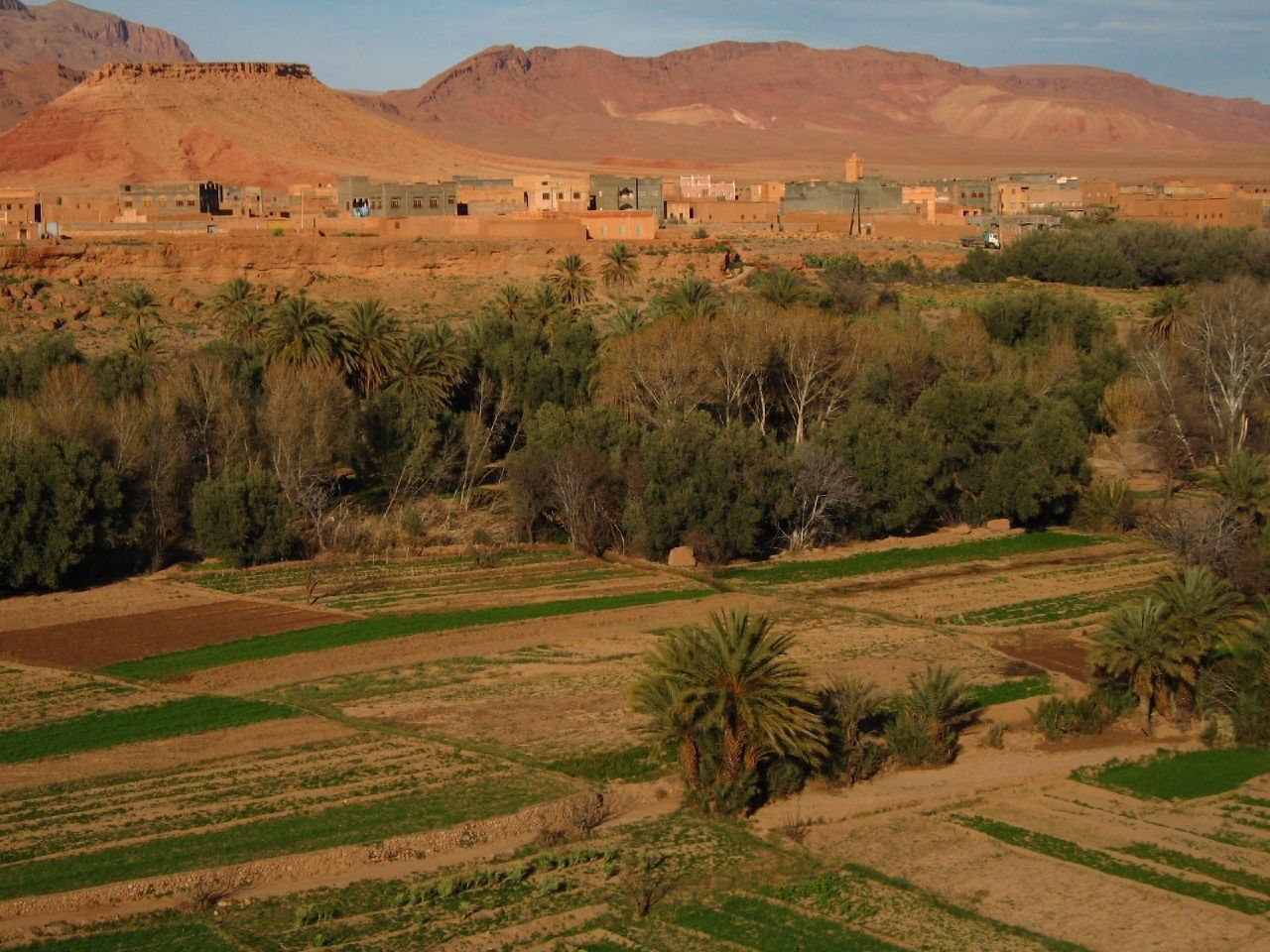
The ruins lie along the River Ziz at the northern edge of the Sahara, about a kilometre north of Rissani. They extend for roughly eight kilometres beside the river. The walled settlement’s agricultural prosperity depended in part on a large irrigation canal. Ibn Battuta described houses arranged among gardens and fields, while Leo Africanus depicted a well-built city with high walls, large religious buildings, colleges, and waterwheels that lifted water from the Ziz.
Excavated features and finds
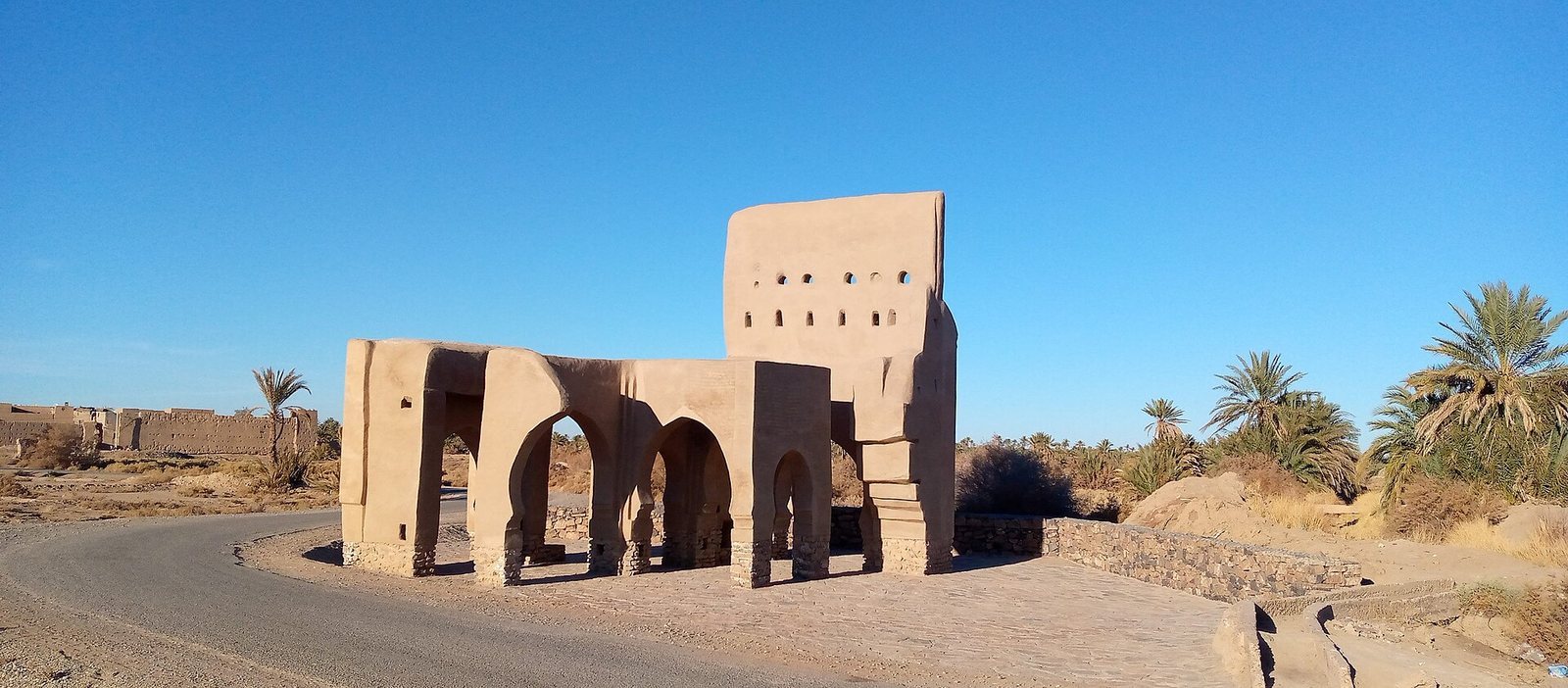
Excavations north of the site in 1971 uncovered irrigation channels, wall remains, a fountain, plant fossils, human bones, glass and ceramic objects, and jewelry. Work near the mosque in 1974 linked its mud-brick walls to the Alaouite period in the 17th century. Research in 1991–92 also focused on the western city wall and the remains of pottery workshops.
Jebel Mudawwar fortress
A mountain fortress called Jebel Mudawwar stands near the city. It was established during the Almoravid period.