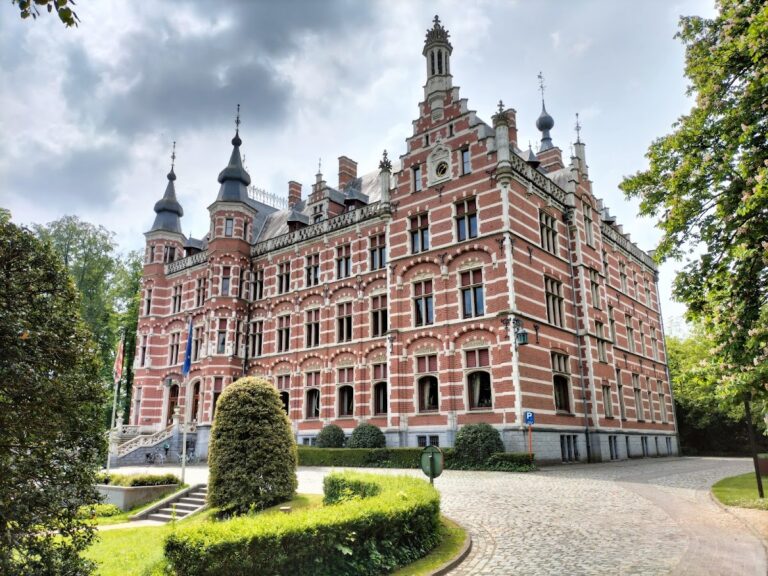
Postel Abbey: A Premonstratensian Religious Community in Belgium


Site at a Glance
- Rating
- 4.3
- Popularity
- Medium
- Country
- Belgium
- Primary era
- Medieval
- External website
- Open
- Eras represented
- Medieval, Early Modern, Modern
- Civilizations
- Belgian, Duchy of Brabant, Habsburg, Holy Roman Empire
- Site type
- Religious
- Remains
- Fortified Monastery
On this page14 sections
History
Postel Abbey is a Catholic Premonstratensian, or Norbertine, abbey in Belgium, located at Postel within the municipality of Mol near the Dutch border. Premonstratensians are canons regular whose communal religious life is combined with pastoral service, especially in parish churches. The abbey began as a dependent priory founded by canons from Floreffe Abbey in 1138, and its late-twelfth-century church remains in use.
Foundation and Medieval Development
Around 1134, Fastrad of Uitwijk, lord of Uitwijk in the Land of Altena, gave about one-third of his property at Postel to Floreffe Abbey. Before 1145, he made a similar donation involving one-third of his estate at Reusel. The earlier ownership of the Postel land may have been connected with Corbie Abbey, although that attribution remains uncertain. Floreffe established the Postel religious community in 1138.
Postel stood at a crossroads linking Breda with Maastricht and ’s-Hertogenbosch with Leuven. Hospitality to travellers therefore became one of the community’s central responsibilities. The canons also developed forestry, agriculture, cattle breeding, and quarrying in the surrounding region. Income came from land, mills, and other properties, especially in territories that are now in the Netherlands. These resources supported the community, relief for poor people, and payments owed to Floreffe Abbey and the dukes of Brabant.
The distance from Floreffe encouraged greater autonomy during the fourteenth century. Postel formally became an independent provostry, a religious institution governed by a provost, in 1613, and it was raised to abbey status in 1618. Colibrant became its first abbot. The negotiations involved Gijsbertus Maas, bishop of ’s-Hertogenbosch, and the governors Albert of Austria and Isabella of Spain. Independence required a substantial payment to Floreffe.
War, Border Changes, and Religious Work
Postel endured repeated wartime demands. During the fourteenth-century Brabantian War of Succession, the community faced exactions, including ransom demands linked to the capture of Duke Wenceslaus I of Luxembourg and 270 Brabantian knights. The sixteenth-century Guelders Wars brought further financial pressures, and the Geuzen later plundered the abbey.
During the seventeenth and eighteenth centuries, wartime levies and retaliatory orders issued by the Dutch Republic continued to damage the abbey’s finances. The Peace of Münster in 1648 clarified the border but left Postel’s disputed status unresolved. A legal decision in 1785 assigned Postel to the Austrian Netherlands and transferred 48 farms and twelve mills north of the border to the Dutch Republic. Nine farms and one mill remained with the abbey. The resulting loss of income forced the sale of property, although building work continued.
The abbey’s religious role extended beyond its immediate surroundings. Postel and other Norbertine abbeys supplied priests to parishes in the northern Netherlands, where they helped maintain Catholic worship in opposition to Protestantism. This network was described as a “white line” against Protestantism. The need to train priests and establish a novitiate also strengthened the case for Postel’s independence from Floreffe. Floreffe’s patronage had often led to the appointment of Walloon priests who did not speak the local language, while Postel was expected to continue caring for poor people and travelling guests.
Suppression, Return, and Twentieth-Century Continuity
French troops arrived in 1797 during the French Revolution, a period of political upheaval that brought the confiscation of church property in territories controlled by France. The canons were expelled, the abbey and its possessions were confiscated and sold, and some buildings were demolished. The community returned in 1847 after an absence of fifty years. Restoration and rebuilding then took place in several phases over roughly 150 years, constrained by limited funds.
The community’s poverty was still evident in 1943, when its red-copper brewing kettles were sold. From that year until the end of the Second World War, Herman Van Breda, a Belgian Franciscan friar and philosopher, hid part of Edmund Husserl’s manuscripts at the abbey. In September 1944, German soldiers occupied the complex while it was filled with refugees. They left on 22 September as British troops approached, accompanied by a fighter from the Mol Resistance.
Postel began producing cheese in 1947. The monks have maintained a medicinal-plant garden since 1994, including the cultivation of ginseng. Beer once brewed at the abbey was transferred to Brouwerij Campina in Dessel in 1953, then to Brouwerij De Smedt in Opwijk in 1988. After De Smedt was acquired by Heineken in 2000 and renamed Affligem Brouwerij BDS, production continued there. The abbey receives payments for use of the Postel name and trademark, and the beer is recognized as a Belgian abbey beer.
The abbey remains a religious community whose Norbertines serve parishes, mostly near Postel. A guesthouse opened in 1970 for retreats and company seminars, while the Beiaard inn was established within the enclosing wall in 1960. The community’s parchment charters and other archival records were digitized by Kempisch heritage organizations and the State Archives. Since March 2017, an inventory and scanned records have been available for online study.
Remains
Postel Abbey is an enclosed complex surrounded by walls and partly by moats. Its surviving buildings combine late-twelfth-century Romanesque work with later Gothic, Renaissance, Baroque, and Rococo additions. The principal entrance is through a rustic eighteenth-century porch, while the oldest public entrance gate, built in the Romanesque period, stands behind the church in the area now occupied by the devotional chapel.
Church and Enclosure
Saint Nicholas Church
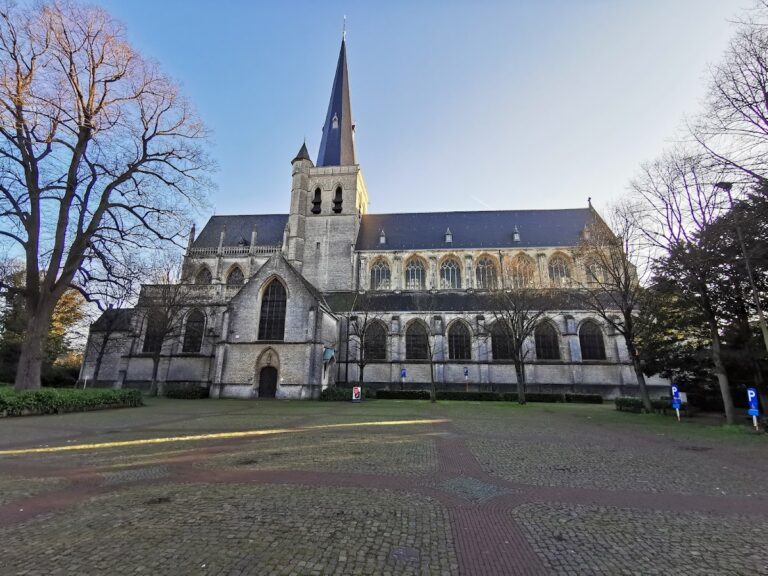
The first place of worship was consecrated in 1140 but soon proved too small. A larger church was consecrated in 1190 and remains in use. Dedicated to Saint Nicholas, it is a late-twelfth-century building in Rhenish Romanesque style, a regional form of Romanesque architecture associated with the Rhineland. Later rebuilding introduced Gothic and Baroque characteristics. During the seventeenth century, parts of the vaulting and windows were altered.
Ring Wall and Belfry
Abbot Colibrant built an approximately 1,200-metre ring wall around the abbey and constructed the Renaissance belfry in 1610. The tower carries a carillon, a musical instrument made from tuned bells played by a keyboard or mechanism, with 49 bells. An earlier carillon was lost when the abbey closed in 1797.
Religious and Residential Buildings
Sacristy and Choir Furniture
The Gothic sacristy dates from 1631. The choir stalls are partly from 1621 and were enlarged in 1930 by the artist Gustaaf Goethijn, who also made two confessionals. The high altar had previously been moved forward toward the nave.
Abbot’s Residence and Former Guest Quarters
The abbot’s residence and former guest quarters date from 1731 and contain Rococo elements. The main building joins a right-hand wing from 1631 to a left-hand wing from 1731. Its facade, apart from the refectory building, was restored in 1909. The ground floor contains reception rooms, the chapter house, and the refectory.
Refectory
The refectory facade dates from 1743. Its ceiling has Italian Rococo stucco decoration from approximately 1750, executed by Italian stucco workers. The building forms part of the main architectural group and preserves the decorative treatment associated with the eighteenth-century rebuilding of the complex.
Guest Wing
The guest wing, built in 1713, contains sculpture by Edgard Fonteyne made through direct carving, including works incorporated into beam ends and statues. Three painted portraits of abbots are also preserved there. One is associated with the school of Rubens, while two are Baroque portraits by the painter Hans Laagland.
Library and Art Collections
The abbey library is estimated to contain about 100,000 volumes. Its older holdings include 54 incunabula, books printed in Europe before approximately 1501. The oldest dates from 1475 and was printed in Leuven by Jan van Westfalen. The collection also contains 143 post-incunabula from 1500 to 1540 and approximately 350 Plantin editions, books produced by the printing house founded by Christophe Plantin.
Among the Plantin holdings are a polyglot Bible and the statutes of the Order of the Golden Fleece printed on parchment. The library also includes atlases, among them a fifteen-volume edition of Willem Blaeu’s atlas, as well as devotional booklets, etchings, and engravings. The abbey’s wider art holdings include paintings, stucco work, and numerous other artworks, together with a fourteenth-century dinanderie candelabrum, a piece of decorative hammered copper or brass metalwork.
Nearby sites