Pir Bakran Mausoleum: A Sufi Memorial and Ilkhanid Monument in Iran


Site at a Glance
- Rating
- 4.4
- Popularity
- Very Low
- Country
- Iran
- Primary era
- Medieval
- External website
- Open
- Eras represented
- Medieval
- Civilizations
- Ilkhanate
- Site type
- Religious
- Remains
- Tomb
On this page8 sections
History
Pir Bakran Mausoleum is the tomb of the Sufi mystic Muhammad ibn Bakran in Iran, in the city of Pir Bakran in Isfahan Province. Dating from the Ilkhanid era and built in the Azeri architectural style, it developed at the place where Muhammad ibn Bakran lived and taught approximately 750 years ago.
Muhammad ibn Bakran and the mausoleum
Muhammad ibn Bakran, also known as Pir Bakran, was a prominent Sufi mystic and teacher. Sufis are Muslims associated with Islamic mysticism, which emphasizes direct spiritual experience. He taught at this location before being buried there. His death is given as Tuesday, the tenth day of Rabi al-awwal in 703 AH.
An Ilkhanid religious setting
The mausoleum belongs to the Ilkhanid period, when the Mongol Ilkhanate ruled much of Iran and neighboring regions from the thirteenth century onward. Inscriptions naming the Rashidun Caliphs place the monument in the early phase of the Mongols’ conversion to Islam, when they remained Sunni. The Rashidun Caliphs are the first four caliphs recognized in Sunni Islamic tradition after Muhammad’s death.
Protection and later care
The monument was registered as a national monument of Iran under registration number 101 on 15 Dey 1310 in the Iranian calendar. Its complex has also received repairs in several periods, including work on its earliest section, the chilla-house, a secluded space used for a forty-day spiritual retreat.
Remains
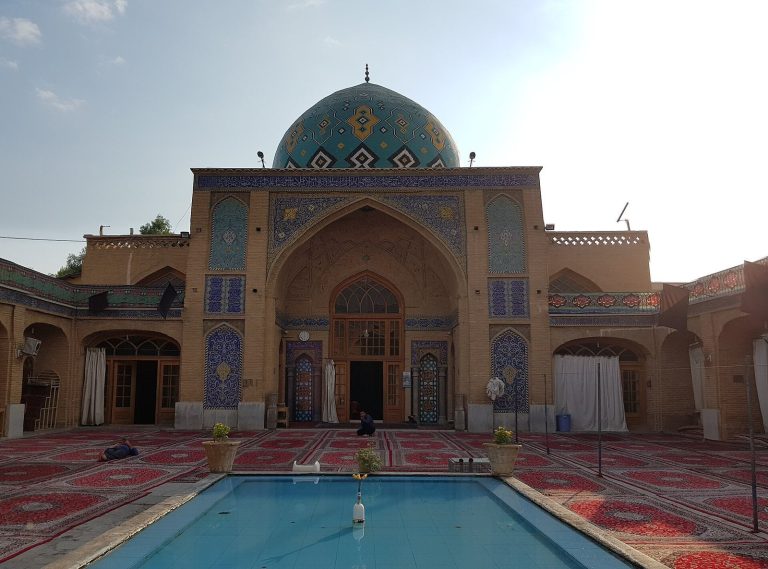
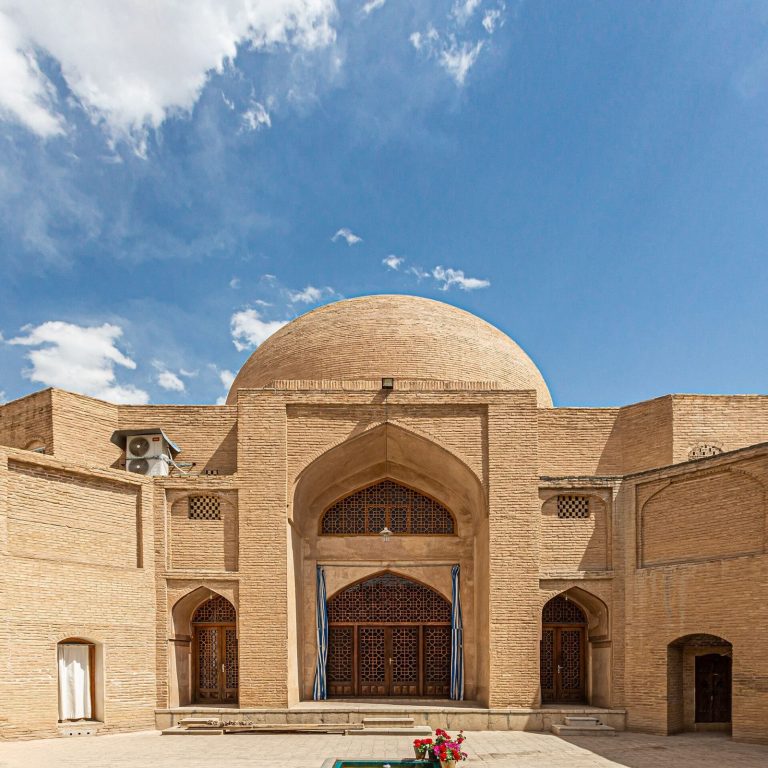
The mausoleum combines Islamic architectural features with stucco, tilework, painting, and stone decoration. Its enclosed courtyard is bounded by walls and contains small iwans, vaulted halls or recesses opening onto the courtyard, together with the arched portals of the main iwan. The courtyard and main iwan carry Kufic inscriptions and floral, bush-like stucco ornament associated with Mohammad Naghash.
Courtyard and prayer spaces
The upper gallery leads to a small mihrab, a niche indicating the direction of prayer. Kufic, an angular calligraphic style, appears alongside Thuluth, a more flowing monumental script, in the monument’s decorative program. Stucco, or shaped decorative plasterwork, forms both relief ornament and inscribed surfaces within the complex.
Teaching room and burial area
Muhammad ibn Bakran’s grave lies behind the courtyard. A small enclosed room on the courtyard’s northern side was probably used as his teaching room, linking the physical arrangement of the mausoleum with the religious instruction associated with his life.
Chilla-house and tombstones
The chilla-house is the earliest part of the building. It was originally made of adobe and was repaired during several later periods. A finely decorated tombstone associated with Muhammad ibn Bakran bears Kufic and Thuluth inscriptions in stucco. Its texts include Quranic verses, blessings on the Imams, a description of Muhammad ibn Bakran, and his recorded date of death. Another identified feature is a tombstone associated with Pir Bakran and Mohammad Shah Naghash. Across the complex, the builders employed the range of materials commonly used in Iranian architecture.