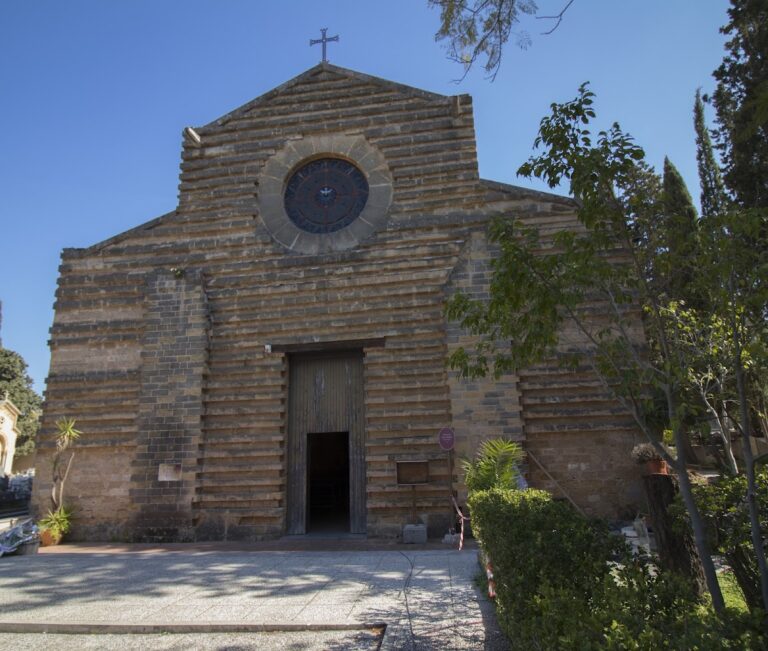
Piana degli Albanesi Cathedral: Cathedral of the Italo-Albanian Byzantine Catholic Church

Site at a Glance
- Rating
- 4.6
- Popularity
- Very Low
- Country
- Italy
- Primary era
- Early Modern
- External website
- Open
- Eras represented
- Medieval, Early Modern, Modern
- Civilizations
- Kingdom of Sicily, Spanish
- Site type
- Religious
- Remains
- Cathedral
On this page14 sections
History
Piana degli Albanesi Cathedral is the principal church of the Eparchy of Piana degli Albanesi in Italy and the cathedral of the Italo-Albanian Byzantine Catholic Church. Built for the Arbëresh, the Albanian communities established in southern Italy and Sicily by migrants and exiles from the Balkans, it is dedicated to Saint Demetrius of Thessalonica, the principal patron of the town and eparchy. The present Church of Saint Demetrius was begun in 1498 according to Byzantine canons, although later rebuilding introduced Western artistic forms.
Foundation of the Albanian settlement
The parish was established on 30 August 1488, when Juan de Borja, Archbishop of Monreale, granted the fiefs of Mercu and Ayndingli to Albanian exiles from the Balkan Peninsula. The settlement’s first parish church was Saint George the Megalomartyr, built at its center. As the community grew, a larger church was required, and construction of Saint Demetrius began ten years later.
On 24 July 1589, the town’s Albanian representatives, with authorization from the Archbishop of Monreale, transferred the matricial honors and rights of Saint George’s church to the new building. During the town’s expansion, the main road was cut through Piana degli Albanesi. The church was enlarged and remodeled under D’Allegro, a master from Monreale, and its axis was reversed, turning the apses from east toward west.
Baroque transformation
Further alterations took place between 1641 and 1644, when the church received its monumental apse frescoes by Pietro Novelli, the seventeenth-century Sicilian painter known as “Il Monrealese.” These works formed part of a wider adaptation of Byzantine liturgical painting to Western artistic forms after the Council of Trent, the Catholic council that addressed doctrine and church practice during the Reformation era. The older iconostasis, or screen of icons separating the sanctuary from the nave, had already been removed.
Novelli’s work brought Byzantine religious subjects into dialogue with Sicilian Baroque painting. The apse decoration included the Eternal Father, the Apostles, the Ascension, and the Fathers of the Eastern Church, while other images represented the Holy Spirit, the Virgin, Saint Nicholas of Bari, Saint John the Baptist, and Saint John of Damascus. The commission was associated with Paolina, widow of the cleric Lorenzo Petta, who had requested burial in the Chapel of the Blessed Sacrament.
An episcopal and collegiate church
From 1784, Saint Demetrius served as the seat of the Byzantine-Greek ordaining bishop for Sicily’s Albanians. An ordaining bishop provides episcopal ordination for a Byzantine-rite community that does not have its own diocesan bishop. Giorgio Stassi, Giuseppe Guzzetta, Francesco Chiarchiaro, Giuseppe Crispi, Agostino Franco, Giuseppe Masi, and Paolo Schirò successively held this office between 1784 and 1941.
Pope Pius VII established the Collegiate Church of Saint Demetrius through the bull Incumbentes in eam curam on 12 November 1820. Until 18 July 1924, the church was Piana degli Albanesi’s only Byzantine-rite parish and was served by a college of four papàs, the priests of the Italo-Albanian Byzantine tradition. The parish was then divided, creating Saint George the Megalomartyr, the Santissima Annunziata, and Saint Anthony the Great as separate parishes.
The Eparchy of Piana degli Albanesi was established on 26 October 1937, and Saint Demetrius was elevated to cathedral status. It became the principal church for the town and for Sicily’s Albanian communities of the Eastern rite. The cathedral remains the setting for the eparchy’s Byzantine worship and solemn episcopal functions, including Epiphany, Holy Week, Easter, and Christmas. It is also where the bishop of the Italo-Albanian Eastern-rite communities in insular Italy is consecrated and proclaimed. Saint Demetrius is celebrated there on 26 October.
Modern changes and continuing identity
Since 1954, the cathedral has housed the incorrupt remains of the Venerable Father Giorgio Guzzetta, an eighteenth-century Arbëresh religious figure who defended the Eastern rite and the identity of Sicily’s Albanians. His beatification cause is in progress. The repeated use of the double-headed eagle within the church expresses both Eastern Christian religious identity and the Albanian identity of the community. The cathedral has consequently remained a central institution of Sicilian-Albanian religious, linguistic, and cultural life.
A major renovation in 1960 sought to create a more purely Byzantine liturgical space, but it caused extensive losses to the building’s artistic and cultural heritage. Funeral and commemorative inscriptions, carved stone arms of local Albanian families, Baroque stucco, side chapels, and two Baroque altars were removed or destroyed. The intervention also enlarged the choir and central nave, replaced the barrel vault with a coffered ceiling, and substantially changed the perception of the interior.
Since the early 1990s, the Greek iconographer Eleuterio Hatsaras has worked on an ongoing liturgical-decorative cycle showing the major feasts, scenes from the life of Christ, and various saints. The cycle remains incomplete in the lower portions of the side aisles, where scenes concerning Saint Demetrius and the Albanian exodus are still lacking.
Remains
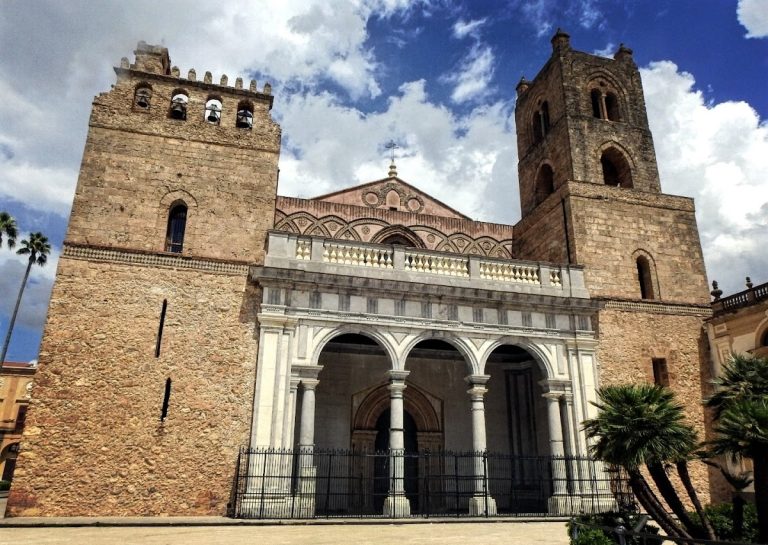
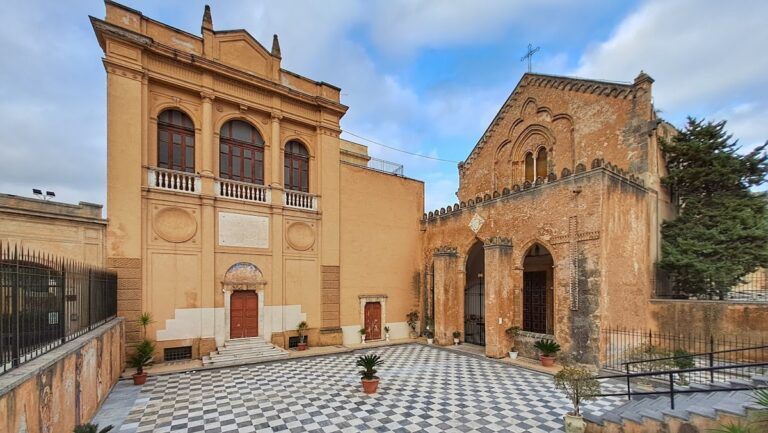
Piana degli Albanesi Cathedral stands on Corso Kastriota, the town’s principal street. Its late-fifteenth-century building has been remodeled repeatedly and is approached across an elevated churchyard enclosed by a marble balustrade. The surviving complex combines a late-Baroque exterior approach, a longitudinal Byzantine plan, monumental marble divisions, painted apses, and later furnishings that reflect the cathedral’s changing liturgical history.
Facade, entrances, and bell tower
The gabled facade is reached by a late-Baroque staircase facing Corso Kastriota and a valuable late-Baroque stone portal. The canonica, the official residence associated with the clergy, opens from the scenic staircase on Via Pietro Novelli. Two further Baroque entrances stand at the sides, one beside the canonica entrance and another on Via Arciprete Matranga, opposite Via San Demetrio and Via Schiptari. Two ancient stone coats of arms are set into the facade.
Two mid-twentieth-century mosaics from the Monreale school occupy the facade. The upper composition shows Christ enthroned between the warrior saints George and Demetrius, while a lower niche contains the Virgin Platytera. The rectangular bell tower is fully plastered and robust in form, ending in a pointed summit. It has eight single-light openings and three large bells.
Plan and structural divisions
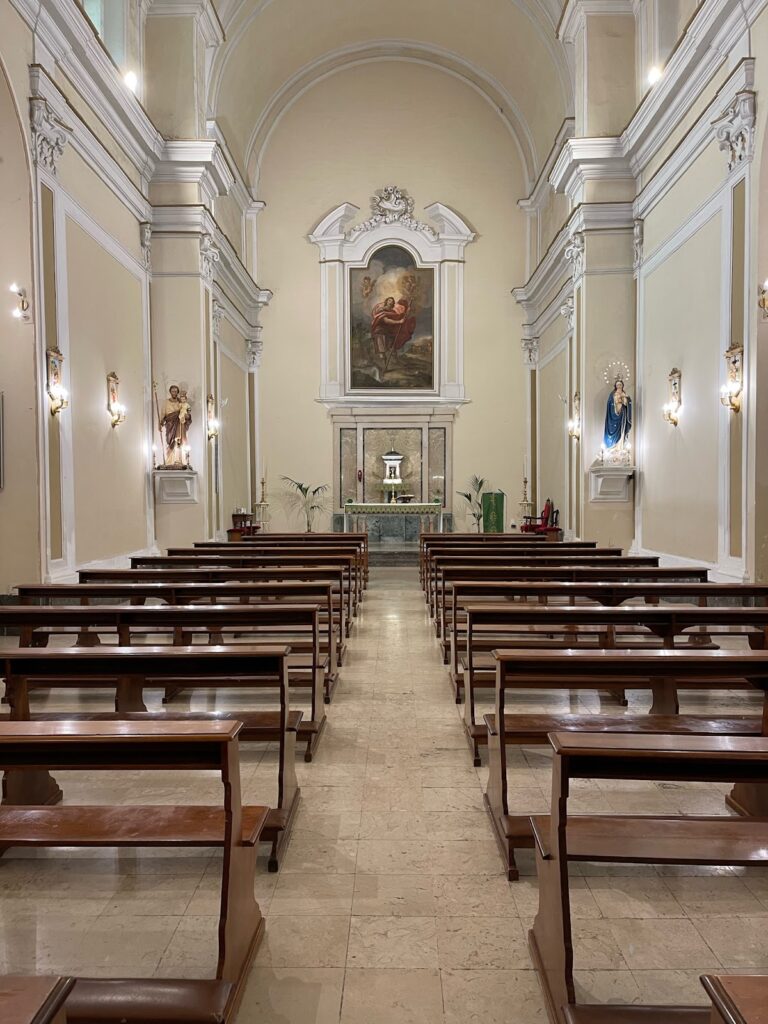
The cathedral has a longitudinal plan with three aisles ending in three apses, of which the central apse is the largest. It contains six bays, although only four are externally visible. Two monumental rows of seven marble columns divide the interior. The outer columns in each row are half-columns, cut along their diameter and attached to the walls, while round arches complete the divisions between the aisles.
The transept rises one step above the aisles and is enclosed by a balustrade. The presbytery, the raised liturgical area around the main altar, stands three steps above the transept. Local red Kumeta marble is used in the presbytery, which contains icons and seventeenth-century frescoes by Pietro Novelli. Before later restoration work, the interior also suggested a non-structural transept.
Sanctuary furnishings and painted decoration
Iconostasis
The present wooden iconostasis surrounds the three apses. Built from the postwar period through the late 1960s under the direction of Cathedral Archpriest Papàs Gjergji Schirò, it was made by the La Bruna artisan brothers of Monreale. Its icons were painted by the Cretan iconographer P. Giorgio Manusakis and installed in 1975. The screen has three registers, large Byzantine-style icons, and richly gilded wood carving.
An earlier sixteenth-century iconostasis, called a pergula, was removed after the Council of Trent. A marble-based replacement was installed in 1937 and supplemented in 1947 and 1948 with approximately thirty icons by Giuseppe Rondini of the Monastery of Grottaferrata. That screen was dismantled in 1968, and its icons were transferred to the eparchial museum and the seminary chapel.
Central nave frescoes
The central nave walls carry a late-twentieth-century Neo-Byzantine cycle by Eleuterio Hatsaras. On the right side of the bema, the raised sanctuary area of a Byzantine church, are the Annunciation, Nativity, Circumcision, Presentation in the Temple, Theophany in the Jordan, and Transfiguration. The left side shows the Raising of Lazarus, Palm Sunday, the Deposition of Christ, Ascension, Pentecost, and Exaltation of the Cross. Old Testament prophets occupy the higher register.
The great arch presents the mystical Supper as a diptych. Christ gives the Holy Bread to six Apostles on one side and offers the Cup to the other six on the other. Above it, the tympanum contains the Deesis, a Byzantine composition of Christ enthroned with the Virgin and John the Baptist interceding before him. The archangels Michael and Gabriel accompany the central figures, while Christ Pantocrator represents Christ as the all-ruling sovereign.
Apse frescoes and Blessed Sacrament Chapel
Novelli’s apse frescoes are arranged in three principal zones. The apse basin contains the Eternal Father. The middle zone places the twelve Apostles within stucco and gilded frames, and the lower zone depicts the Ascension of Christ with a red victory banner and the Fathers of the Eastern Church. The central apse includes the Exaltation of the Trinity, while the right apse includes the Ascension. The vault imagery shows the blessing Father between seven archangels and two circles of cherubim, with the Apostles above Christ surrounded by Saint John Chrysostom, Saint Basil, Saint Gregory, and Saint Athanasius. The frescoes were restored in the early 1970s.
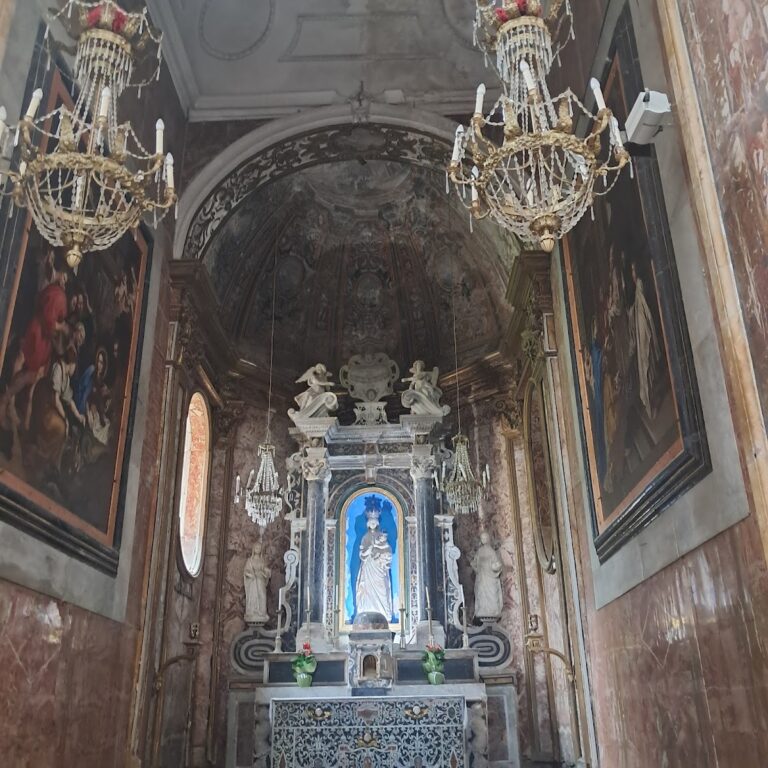
The Chapel of the Blessed Sacrament contains the Holy Spirit as a dove surrounded by fourteen cherubim and the resurrected Christ triumphing over mortal sin. Its adjoining lunettes show the Archangel Michael and the theologians Saint Hilary of Poitiers, Saint Jerome, and Saint Augustine. The apse campaign involved Novelli, Luigi di Geraci, Matteo Ferrea, and Battista Serpotta during the alterations of 1641 to 1644.
Later furnishings and artworks
A gilded wooden chandelier hangs above the transept. It reuses the form of an earlier chandelier and combines Neo-Byzantine and Neo-Baroque elements. Cathedral Archpriest Papàs Gjergji Schirò designed it, Vincenzo Corpora made it during the 1960s, and it was installed in 1974. A Byzantine-style ambo, a raised stand for scripture and liturgical readings, was installed recently and decorated with locally produced Italo-Albanian-school icons by Zef Giuseppe Barone depicting the life of the Son of God.
The right wall contains the tomb of Giorgio Guzzetta and a copy of his portrait, near an altarpiece depicting Saint Demetrius and Saint Nestor. Contemporary icons by local iconographers also decorate the cathedral. In the left aisle, an 1845 oil painting by Andrea D’Antoni shows Saint Nicholas giving his possessions to the poor. Other canvases depict Saint Spyridon, including works by Giuseppe Patania and a nineteenth-century painter.
The oldest work in the cathedral is an egg-tempera icon of the Mother of God with Christ from the Sienese school, dated to 1500. A polychrome nineteenth-century wooden group of Saint Demetrius of Thessalonica and Saint Nestor was made by Girolamo Bagnasco and his workshop. The collection also includes an alabaster-marble Madonna produced by a Tuscan-Lombard school between the fifteenth and sixteenth centuries. Wooden triptychs in the side aisles depict the life of the Virgin, the principal feasts, and the Fathers of the Eastern Church.
Inscriptions, emblems, and liturgical objects
Double-headed eagles appear in the side-aisle triptychs and elsewhere in the building. The oldest is part of an Albanian commemorative inscription honoring Papàs Demetrio Camarda. Originally placed in the right aisle, it is now in the corridor before the canonica. Another eagle is set in red Kumeta marble before the iconostasis, while the largest Byzantine-Albanian eagle is mounted on the gilded wooden chandelier.
Ancient epitaphs, carved stone family arms, and Albanian funerary and commemorative inscriptions survive in varying condition. Some were reduced to fragments or removed during the 1960 renovation; others were assembled in the corridor leading to the sacristy. The cathedral also preserves Byzantine liturgical vestments belonging to the eparchy, including the sakkos, sticharion, phelonion, epitrachelion, and mandyas, as well as a decorated four-lobed mitre, omophorion, epigonation, epimanikia, aer, and epitaphios. Their decoration reflects Byzantine sacred art and the late-eighteenth-century taste of the period in which some were remade or restored.
Nearby sites