Petit Vieux Sou Gallery Grave: A Late Neolithic Tomb in France
Site at a Glance
- Popularity
- Very Low
- Country
- France
- Primary era
- Stone Age
- Eras represented
- Stone Age
- Civilizations
- Unclassified
- Site type
- Burial
- Remains
- Tomb
On this page11 sections
History
The Petit Vieux Sou gallery grave is a late Neolithic megalithic tomb about 2.5 km southeast of Brecé in France’s Mayenne department. Charcoal collected at the site in 1979 yielded a radiocarbon result of 3,960 ± 70 years BP, with BP meaning “Before Present,” conventionally counted from 1950. The result is associated with a date range of 2800–2260 BCE, and the tomb is assigned to the late Neolithic.
Recognition and investigation
M. Pichot mentioned the monument in 1907, and L. Trohel referred to it the following year. It appears to have been plundered in 1942. Excavation began in 1978 and continued in four further campaigns through 1982. Archaeologist Roger Bouillon excavated and restored the tomb during this period. France listed it as a historic monument on 14 June 1988.
Remains
Layout and construction
Position and chamber
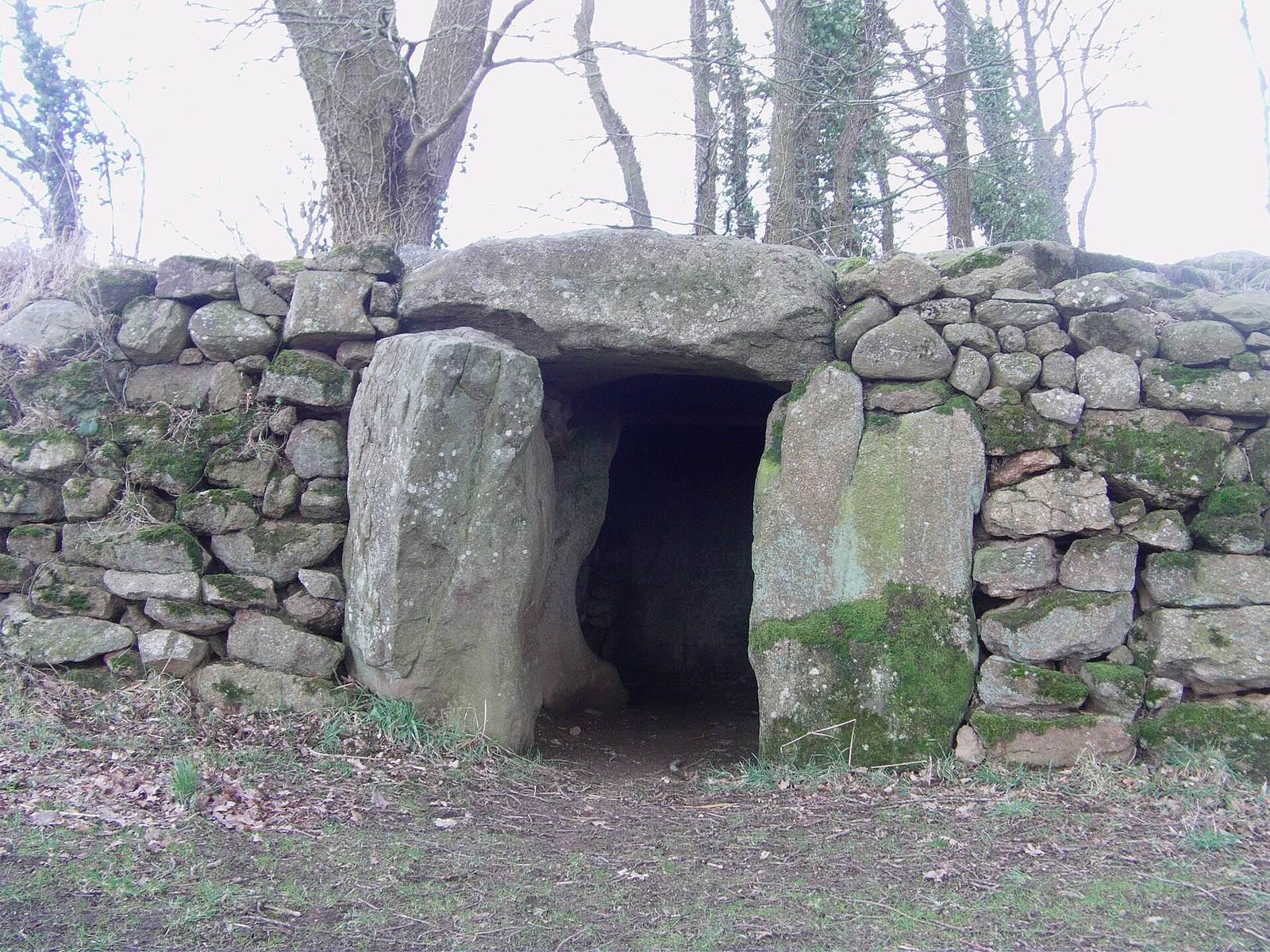
The tomb stands 157 m above sea level at the edge of a plateau overlooking the Colmont valley. Its gallery runs northwest to southeast, measuring about 11 m long and 1.4 m in both width and height. Twenty-one upright stones form the chamber, with nine slabs covering it.
Gallery and entrance
A side entrance interrupts the southwest long side at the gallery’s midpoint. This arrangement is characteristic of Armorican-type covered galleries, a form associated with Armorica, the historical name for western France, including Brittany and neighboring areas. A 2.2 m passage, set at right angles to the chamber, leads to the entrance. Four upright stones form its sides, and a single slab covers it. At the junction, grooves cut into the bases of the two corner pillars create a rounded, porthole-like opening. The grooves reach about 0.65 m in height and 0.20 m in depth; a slab of matching size probably once closed the opening.
Mound and restoration
An oval mound, about 15 m long and 6 m wide, enclosed the chamber as a narrow casing. Its fill of compacted clay and sand measured about 2 m across and 0.60 m high. Large, flat facing stones were set on edge, leaning slightly toward the chamber; part of this facing extended for 7 m on the eastern side. The mound probably carried a stone cairn, or mound of stones, about 2.5 m high. Staggered stones behind the chamber uprights reinforced the structure and filled spaces between slabs. During restoration, original elements were reused, and one upright stone, four roof slabs, and the upper cairn stones were reconstructed with similar local stone.
Excavated deposits and finds
Chamber deposit
Inside the chamber, excavation revealed a sandy archaeological layer about 0.25 m thick. Finds from this area included three polished axes, two arrowheads, several flint blades, numerous pottery fragments, and seven broken vessels that were nearly complete.
Objects from the tomb and mound area
The combined finds from the chamber, spoil from the 1942 looting, and the area around the mound numbered 1,280 objects. The pottery included 13 nearly complete vessels, six vessels with recognizable shapes, a small pierced cup, and 1,180 assorted sherds. Among 81 stone objects were five polished axes, three made of flint and two of dolerite, and five arrowheads, three designed for cutting and two for piercing. Scrapers and blades were also present. Other objects included a thin, flat pendant pierced at its top, probably made of schist, and a roughly cylindrical bead of hard, fine-grained stone.
Pottery and cup
The pottery is generally coarse, fragile, irregular in form, and poorly fired. Vessels have rounded or flat bases, as well as shapes between those forms. Their decoration includes rough punctures and grooves. One decorated vessel has parallel lines around its neck, while another bears abstract markings. A small, asymmetrical cup has an unstable shape and a 15 mm hole just below its rim; its intended use remains uncertain. Part of the assemblage is displayed at the archaeological museum in Jublains.