Panagia Kernitsis Monastery: An Orthodox Monastery in Arcadia, Greece
Site at a Glance
- Popularity
- Medium
- Country
- Greece
- Primary era
- Modern
- Eras represented
- Modern
- Civilizations
- Greek
- Site type
- Religious
- Remains
- Monastery
On this page14 sections
History
Panagia Kernitsis Monastery is an Eastern Orthodox monastery in Arcadia, Greece, founded in March 1116. Three brothers laid its foundation stone, and its first monks came from Nymfasia. The monastery took its name from a medieval town initially inhabited by Slavs; the town’s name has been interpreted as meaning either black soil or black stone.
Foundation and tradition
Local tradition connects the monastery’s foundation with a cave beneath the main church. A shepherd is said to have seen a heavenly light there for three days before finding a miraculous icon of the Virgin. The discovery prompted the establishment of the monastery, according to the tradition.
Ottoman rule and the Greek Revolution
The monastery provided supplies, care, and other assistance to people resisting Ottoman power, and was repeatedly raided. Its first destruction came in 1366. In 1764, Albanian attackers looted and burned the monastery, leaving only the church’s entrance vestibule, or narthex. Manuscripts were burned, lost, or stolen.
From 1680, monks ran a clandestine school for children who had taken refuge at the monastery, teaching them to read and write. The Greek military leader Theodore Kolokotronis learned to read from the monk Neophytos. Around 1710, the school moved to Vytina.
The Greek Revolution, a revolt against Ottoman rule that began in 1821, brought further attacks. Forces under Ibrahim Pasha, an Egyptian commander fighting the revolt, raided the monastery seven times. It may have been burned and completely destroyed on several occasions.
Revival and religious practice
After a period of abandonment, a royal decree re-established the monastery in 1940 as a women’s community. Women have lived there as monastics since then. Kosmas Kollara, a hieromonk (a monk ordained as a priest) and archimandrite (a senior monastic cleric), remained and continued to lead services until his death in 1983. Magdalena Tla became abbess, the head of the women’s monastery, in 1952 and held the office until her death in 1994. Her tenure brought renewed life and expansion, including a major renovation in the 1970s.
The monastery’s icon of the Virgin is revered as its protector, and believers have associated it with healing from schizophrenia and paralysis. Monastery codices preserve certificates relating numerous miracles to the prayers of the faithful. The sisters emphasized the Virgin’s love and relatives’ faith, alongside fasting, confession, fervent prayer, attendance at the liturgy, and communion. A wooden block was used to restrain people with mental illness brought by relatives seeking a cure.
One codex recounts the story of Catherine, the sister of woodcarver George Dinopoulos. She was brought to the monastery with a psychiatric illness and was said to have recovered after her family followed the religious practices there. She then settled at the monastery and helped her family make its carved iconostasis, the screen separating the sanctuary from the main worship space.
The monastery celebrates the Dormition, the Eastern Orthodox feast commemorating the Virgin Mary’s death, on 15 August. Its dependencies are the Monastery of Saints Theodore at Pyrgaki and the old monastery of Sfyrida.
Remains
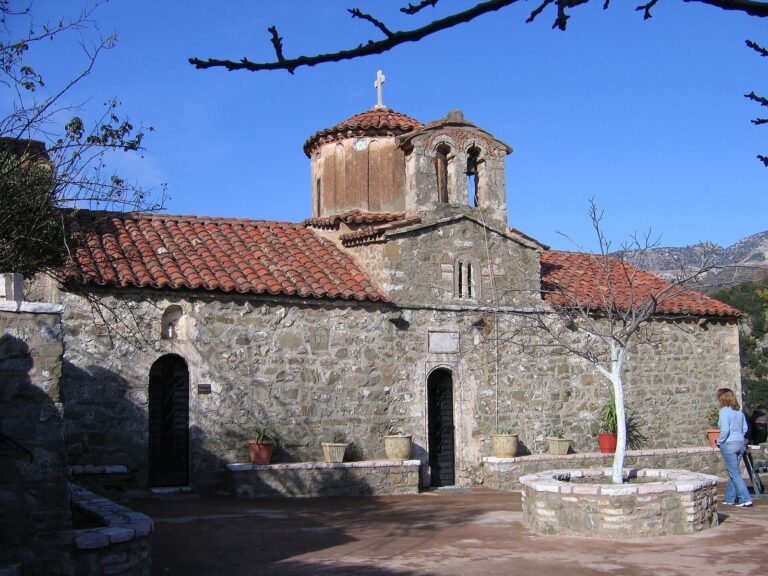
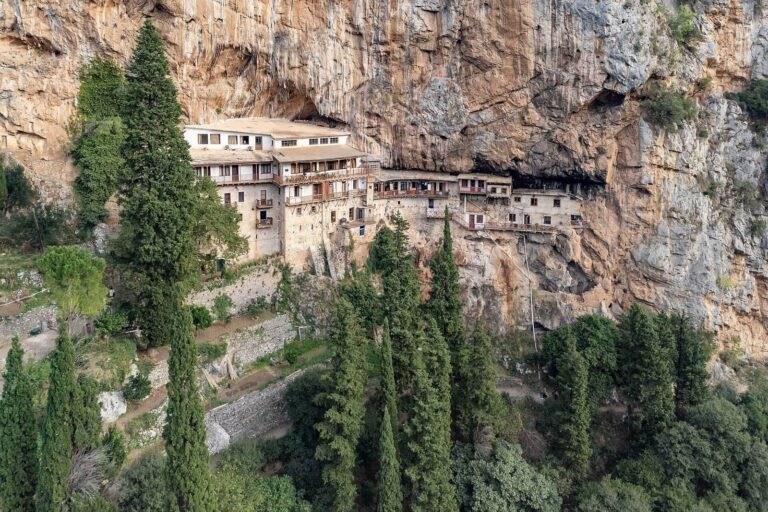
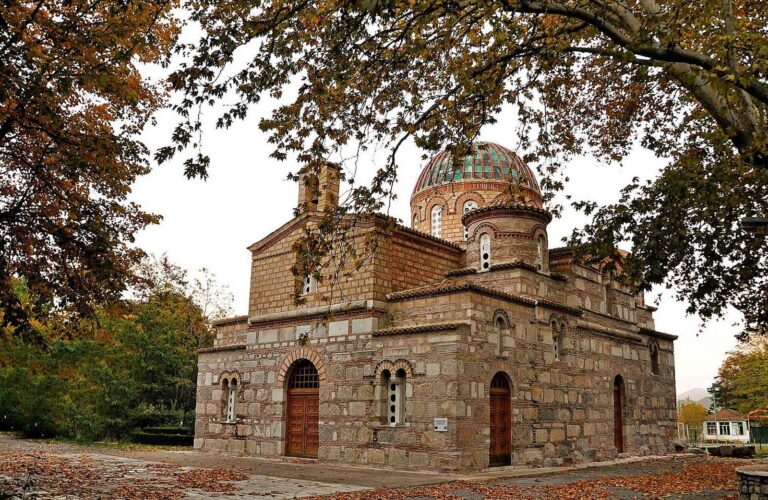
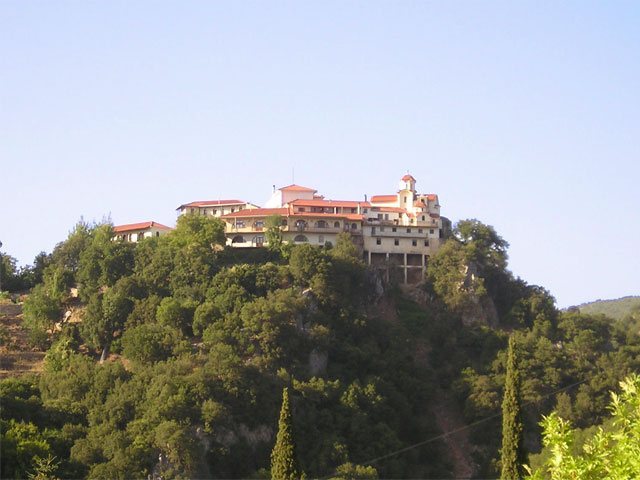
The monastery’s principal church stands in the eastern part of its enclosure, on the summit of Kernitsa rock. This Byzantine church is dedicated to the Dormition. It is small, with an imposing interior, and forms the main focus of a group of churches and chapels within the monastery.
Monastery churches
Principal church
The church floor was paved with slabs in 1901, supplied by Dimitrios Theodōrelos. In 1902, walnut choir stalls and an offering stand were made, along with a series of images depicting the Twelve Great Feasts of the Eastern Orthodox year.
Alterations and murals
Renovation between 1956 and 1968 removed the old dome and replaced it with a roof supported on columns. The wooden entrance vestibule was rebuilt in concrete. The church’s bones and relics of numerous saints and martyrs were left untouched during the work.
Rallis Kopsidis and Georgios Chochlidakis painted the church’s murals. G. Sikeliotis was also present during work on the dome in June 1966. Chochlidakis is credited with the image of Christ as ruler of all. The painting proceeded from the dome to the vault above the sanctuary, the sanctuary scenes, and the vaulted sections over the church’s cross arms.
The main painting work was completed in 1968, apart from the saints on the north wall, the Last Judgment on the west wall, and the Nativity in the area used to prepare the Eucharistic offerings. The north-wall saints were painted on canvas and attached to the wall. Kopsidis completed these remaining scenes between 1977 and 1980. The murals remain in good condition.
Furnishings and the icon of the Virgin
A metal chandelier hangs beneath the central image of Christ. It shows a choir of saints in monastic dress and in the traditions associated with Mount Athos. Papakosmas and Beletzas donated it. Gold and silver votive lamps burn day and night before images of the Virgin, Jesus Christ, John the Baptist, and the Crucified Christ.
The large icon of the Virgin is kept in the main church. The Virgin is shown from the bust upward, turned slightly toward Christ, whom she holds with her right arm; her left hand is placed before his lower legs. Christ stands upright, blesses with his right hand, and looks down. The Virgin wears a crown, with angels beside her head. Both figures wear green inner garments, red-purple mantles, and white sleeves.
Other chapels
Other churches within the monastery are chapels dedicated to Saint John the Forerunner, also known as John the Baptist, the Archangels, and Saint Nicholas.
Cave and other monastery features
Cave chapel
A large cave lies directly beneath the principal church. Once used as a hermitage, it now contains a stone chapel dedicated to All Saints, inaugurated in September 1982.
Hidden gate and restraining block
A hidden side gate served as an escape route for monks in danger. Above it stood a device for pouring liquids, allowing hot water or boiling oil to be poured onto attackers.
The monastery’s wooden restraining block was used in practices intended to treat people with mental illness. Relatives brought them to the monastery in the hope of healing.
Monastic and guest accommodation
Following the monastery’s revival, cells were provided for monks and nuns, as well as accommodation for guests.