Panagia Kanakaria: A Byzantine Church and Monastery in Cyprus


Site at a Glance
- Rating
- 4.5
- Popularity
- Very Low
- Country
- Cyprus
- Primary era
- Medieval
- Eras represented
- Medieval, Early Modern, Modern
- Civilizations
- British, Byzantine, Kingdom of Cyprus, Ottoman, Venetian
- Site type
- Religious
- Remains
- Church
On this page8 sections
History
Panagia Kanakaria is a Byzantine church in Cyprus, at Lythrangomi, also known as Boltaşlı, on the Karpas Peninsula. Built by the Byzantine Christian community around AD 525–550, it began as an Early Christian basilica serving a settlement of the period. Its history includes repeated rebuilding, medieval monastic development, and the dispersal and recovery of parts of its sixth-century mosaic.
Early Christian foundation and rebuilding
The first church was founded around AD 500 and constructed as a three-aisled basilica during the sixth century. Its apse mosaic belongs to this early phase, associated with the reign of Justinian I, the Byzantine emperor who ruled from AD 527 to 565. The original basilica was destroyed in the mid-seventh century, probably during attacks by Muslim or Arab pirates.
Several decades later, around AD 700, the church was rebuilt. Masonry piers replaced the earlier columns, creating a different internal arrangement. This second church survived Byzantine Iconoclasm, the eighth- and ninth-century controversy over the religious use of images, without deliberate vandalism. The apse mosaic may have been covered with plaster during this period and was apparently rediscovered only in the twentieth century.
Medieval and later transformations
An earthquake around AD 1160–1169 destroyed the rebuilt church, leaving the apse standing. The building was then reconstructed as a multi-domed church, and another rebuilding phase is dated to the fourteenth century. A monastery probably developed around the church during this medieval reconstruction. The south aisle was renovated in the thirteenth century, and an open porch was placed before the entrance.
The central dome collapsed during an earthquake in 1491 and was rebuilt around 1500. At the same time, the walls were embellished with numerous frescoes. The church’s interior now contains wall paintings from the twelfth, fourteenth, and sixteenth centuries, although most of the frescoes added around 1500 are no longer visible. The surviving painting of Panagia Kanakaria, a Greek Orthodox title meaning “All-Holy One” and commonly referring to the Virgin Mary, is in the blind arch above the southern entrance.
The existing monastery buildings probably date from the eighteenth century, while a monastic foundation associated with the church is specifically dated to 1738. A bell tower was added in 1888. Conservation of the church and its mosaics took place in 1973, and restoration of the church and monastery was completed in June 2008.
Theft, litigation, and repatriation
Following the expulsion of Greek Cypriots during the events of 1974, the church was closed because it was no longer in use. Since 1974, the surrounding area has been administered by the internationally unrecognized Turkish Republic of Northern Cyprus. The political uncertainty after the Turkish invasion created conditions in which the church’s Early Byzantine mosaics were illicitly removed and trafficked.
In 1978–1979, antiquities thieves broke into the church and removed almost the entire apse mosaic from the wall. A tourist indirectly brought news of the theft to the Republic of Cyprus in late 1979. Fragments subsequently entered international art markets through the Munich-based Turkish art dealer Aydın Dikmen, who was involved in the trafficking of mosaics and other works taken from churches and monasteries in northern Cyprus.
In 1983, the Menil Collection in Houston acquired several small fragments through an intermediary. Their identifiable provenance led to their transfer to the Republic of Cyprus after they had been exhibited in the United States. These pieces included portions of medallions depicting the Apostles Luke and Bartholomew.
In 1988, the Indiana art dealer Peg Goldberg bought four important fragments from Dikmen for approximately $1–1.2 million. She later tried to sell them to the J. Paul Getty Museum in California for $20 million, apparently without knowing that they had been stolen. Legal proceedings resulted in an order for their return to Cyprus in 1991. The fragments included part of the upper half of Christ, the head and part of the chest of the Archangel Michael, and medallions of the Apostles Matthew and James.
A medallion of the Apostle Thaddeus was returned from Munich in 1997. A search of Dikmen’s Munich properties also uncovered approximately 260 works of art from churches and monasteries in northern Cyprus, collectively valued at about 70 million marks. Among them were a mosaic medallion of the Apostle Thomas, a fragment showing the Virgin’s left hand, and the hand of the Archangel Gabriel.
After years of litigation in German courts, works recovered from Dikmen’s properties were transferred to the Republic of Cyprus during the 2010s, including a recorded return in 2013. Because the Turkish Republic of Northern Cyprus is not internationally recognized, the recovered fragments were deposited in the Byzantine Museum in Nicosia rather than returned to the church. Two further fragments were repatriated in 2018: a medallion of Saint Mark, formerly held by a British family, and a medallion of the Apostle Andrew. A Cyprus Post stamp series featuring the mosaics was issued in 1991.
Remains
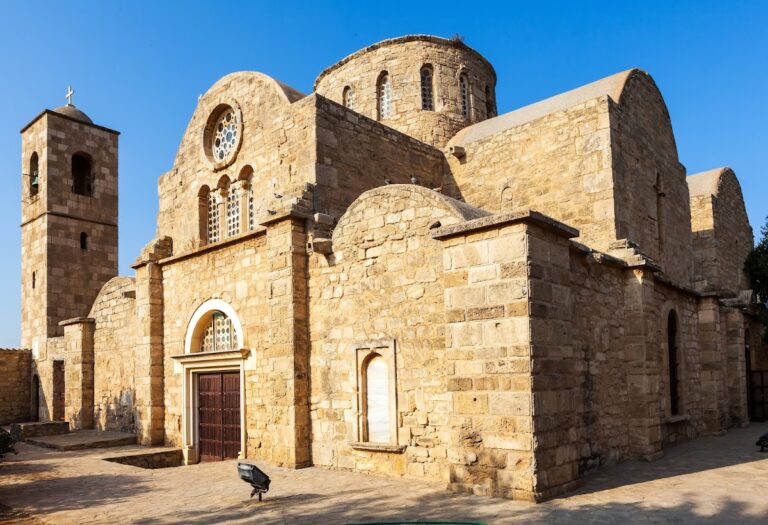
Panagia Kanakaria combines the surviving apse of a sixth-century basilica with a later multi-domed church and a monastery complex. The building incorporates construction fragments from several periods. Its early form had three aisles, a timber roof, a narthex, which is an entrance vestibule adjoining the main worship space, and three apses on the eastern side. The surviving apse was enclosed within the later church, a treatment also compared with Panagia tis Kyras at Livadia and Panagia Angeloktisti at Kiti.
Church structure and paintings
The later church has domes over the main nave, the narthex, and the bema, the altar area of an Orthodox church. Two of the domes rest on drums, cylindrical or polygonal structures that support domes. The thirteenth-century south-aisle renovation and the open porch before the entrance form part of the building’s later development. The central dome, rebuilt after its collapse in 1491, belongs to the sixteenth-century appearance of the church.
Wall paintings from the twelfth, fourteenth, and sixteenth centuries survive inside. The painting of Panagia Kanakaria is placed in the blind arch above the southern entrance. Other mosaic images in the northern part of the church, including the Archangel Gabriel and the Virgin with the Christ Child, have undergone repeated restoration.
Sixth-century apse mosaic
The sixth-century apse mosaic was made in the Early Byzantine style. At its center, the Virgin Mary sits with the Christ Child on an ivory throne, enclosed within a radiant mandorla, an almond-shaped halo surrounding a sacred figure. The archangels Michael and Gabriel stand beside them. Mary wears a blue maphorion, while the Christ Child faces forward in white and gold garments.
The frontal presentation of the Child is described as the earliest known example of a type later called the Cypriot form, which was widely adopted in Byzantine art. A broad ornamental border surrounds the central image. It uses a thorn meander with acanthus-leaf decoration, followed by thirteen medallions portraying Christ and the twelve apostles.
The mosaic was assembled from glass tesserae, the small pieces used to construct a mosaic, in more than forty shades. Glass cubes covered with gold and silver leaf were combined with coloured marble and stone cubes. The large glass tesserae and linear treatment reflect a transition from Classical artistic traditions toward the more schematic techniques of Early Byzantine art.
Over the centuries, pilgrims repeatedly removed individual glass tesserae because they were believed to have healing powers. Almost the entire apse mosaic was later taken from the wall by antiquities thieves. Only fragments remain in the church, while recovered pieces are held for reconstruction and display at the Byzantine Museum in Nicosia. Major parts of the composition, including sections of the Virgin, the mandorla, the throne, and the archangels, remain in illicit private collections or are otherwise unaccounted for.
Monastery complex
The monastery surrounding the church includes buildings probably dating from the eighteenth century. Their surviving fabric forms the later monastic setting of the Byzantine church and its successive reconstructions. Restoration of the church and monastery was completed in June 2008.
Nearby sites