Palazzo Romagnoli: Historic Palace and Civic Cultural Center in Forlì


Site at a Glance
- Rating
- 4.6
- Popularity
- Low
- Country
- Italy
- Primary era
- Modern
- External website
- Open
- Eras represented
- Modern
- Civilizations
- Unclassified
- Site type
- Domestic
- Remains
- Elite Residence
On this page7 sections
History
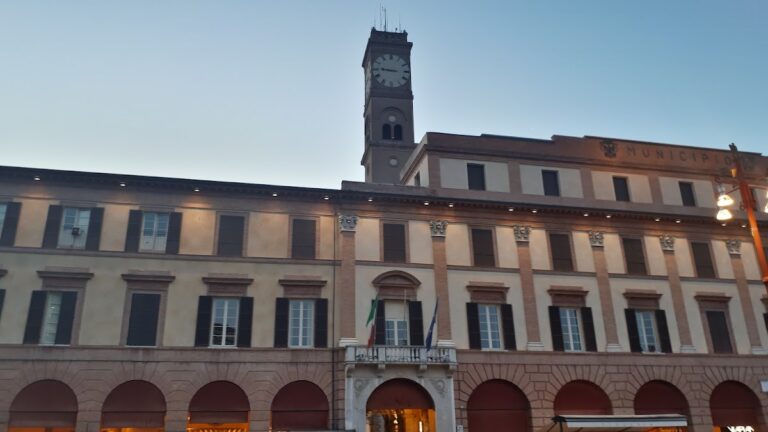
Palazzo Romagnoli is a historic palace in Forlì, Italy, commissioned by the Romagnoli family and shaped in Baroque and Neoclassical styles through the unification of several earlier buildings. Its creation followed the family’s return to Forlì and expressed its position within the city’s hereditary urban elite.
The Romagnoli family and the palace
The Romagnoli were an old patrician family from Forlì who had settled in Cesena during the fifteenth century. In 1806, Lorenzo Romagnoli became prefect of Forlì under Napoleon, the French emperor whose administrative rule extended into Italy during the early nineteenth century. His appointment enabled the family to return to its city of origin and commission a residence suited to its social standing.
The palace later acquired the name Palazzo Romagnoli-Reggiani. Girolamo Lorenzo Reggiani married Virginia, the last descendant of the Romagnoli family, and adopted the surname Reggiani Romagnoli, linking his name to the building’s alternative designation.
Municipal and cultural use
In 1965, the family sold Palazzo Romagnoli to the Municipality of Forlì. The building then served as the headquarters of the Forlì military district, whose responsibilities included conscription medical examinations for the province of Forlì, the territory of Rimini, and the province of Pesaro-Urbino. During this period, the palace’s artistic interiors were not accessible to the public.
After the military administration ended, the municipality redeveloped the building for cultural purposes. Its ground floor now houses the municipal Aurelio Saffi Library, while the first floor is used for municipal twentieth-century art collections. The “Museum in the Library” project presents temporary exhibitions of paintings and sculptures from the civic collections of the nineteenth and twentieth centuries, arranged around particular themes.
The palace formerly housed the Verzocchi Collection, focused on the theme of work, as well as works by Adolfo Wildt donated by Marquis Raniero Paulucci di Calboli. From 2025, these collections have been housed at the San Domenico Museum.
Remains
Palazzo Romagnoli is a unified palace complex created by joining several pre-existing buildings. Its architectural character combines Baroque and Neoclassical elements. A monumental staircase leads to the piano nobile, the principal ceremonial or residential floor of a traditional palace. Rooms on both the ground and upper floors retain decorated ceilings largely attributed to the workshop of Felice Giani, an Italian Neoclassical painter and decorator known for extensive interior schemes.
Interior collections and exhibition areas
Ground-floor displays
The ground-floor exhibition arrangement presents works associated with the innovative activity of the Forlì Artistic Circle, a local association active in the city’s early twentieth-century cultural life. The represented artists include Bernardino Boifava, Maceo Casadei, Giovanni Marchini, Francesco Olivucci, and Carlo Stanghellini.
First-floor landscapes and sculpture
The first-floor section titled “Visions of Landscape” brings together works by artists from Emilia-Romagna, including Gianna Nardi Spada, Irene Ugolini Zoli, Licinio Barzanti, Rezio Buscaroli, Cesare Camporesi, Giannetto Malmerendi, Gino Mandolesi, Ettore Nadiani, Pier Claudio Pantieri, and Gino Ravaioli. The exhibition route also includes sculptures by Ercole Drei and Carmen Silvestroni.
Nearby sites