Palazzo di Seravezza: A Medici Ducal Residence and Defensive Outpost in Italy


Site at a Glance
- Rating
- 4.7
- Popularity
- Low
- Country
- Italy
- Primary era
- Early Modern
- External website
- Open
- Eras represented
- Early Modern
- Civilizations
- Grand Duchy of Tuscany, Habsburg
- Site type
- Domestic
- Remains
- Palace
On this page13 sections
History
Palazzo di Seravezza is a sixteenth-century Medici palace in Seravezza, Italy, built for Cosimo I de’ Medici between 1560 and 1564. It combined the functions of a ducal residence, summer retreat, and potential military outpost in a strategically contested part of Versilia.
A Medici stronghold in Versilia
For centuries, Pisa, Lucca, Genoa, and Florence had competed for control of the Versilia region. After Medici grand-ducal rule was established in 1513, Cosimo I placed the villa near the frontier as a tangible outpost of his territory. Its solid form and defensive provisions allowed it to support military purposes when necessary, while its position near the Vezza River also made it suitable for summer stays by the court.
Members of the Medici family used the palace for extended periods. Bianca Cappello, the second wife of Francesco I de’ Medici, and Cristina of Lorraine, the widow of Ferdinando I de’ Medici, spent particularly long periods at Seravezza during the sixteenth and seventeenth centuries. The site also enabled Cosimo I to supervise the renewed exploitation of nearby marble quarries and mines. Mining had previously become inactive, but extraction resumed after the discovery of silver-bearing lead veins. From 1563, the local mistio marble, also known as peach blossom marble or Seravezza Breccia, became highly sought after.
Architectural authorship and later dynasties
The palace’s architect is not known with certainty. Some scholars have attributed the design to Bartolomeo Ammannati, while others have proposed the young Bernardo Buontalenti, partly because of similarities with the Medici Villa at Artimino.
After the Medici dynasty ended in the eighteenth century, the palace passed to the Habsburg-Lorraine dynasty, the ruling house that succeeded the Medici in Tuscany. Grand Duke Peter Leopold assigned part of the building to storage rooms and administrative offices for an ironworks constructed around 1786 beside the palace along the Vezza watercourse.
When the ironworks closed in 1835, the villa again became a residence of the grand-ducal family. It later passed to the Italian state and was donated to the Municipality of Seravezza in 1864. The municipality first used the building as a prison and then adapted it as its town hall, a function it retained until 1966.
Public and cultural uses
The municipal Sirio Giannini Library moved to the ground floor in 1984 with approximately 30,000 holdings, and the historical archive was later transferred to the same premises. The Museo del Lavoro e delle Tradizioni Popolari della Versilia Storica opened in 1996. The adjacent former grand-ducal stables were restored in 2006 for temporary exhibitions and events, while the palace also became a venue for modern and contemporary art exhibitions.
On 23 June 2013, UNESCO recognized Palazzo di Seravezza as part of the serial World Heritage property “Medici Villas and Gardens in Tuscany,” under criteria (ii), (iv), and (vi).
Remains
Setting and surviving layout
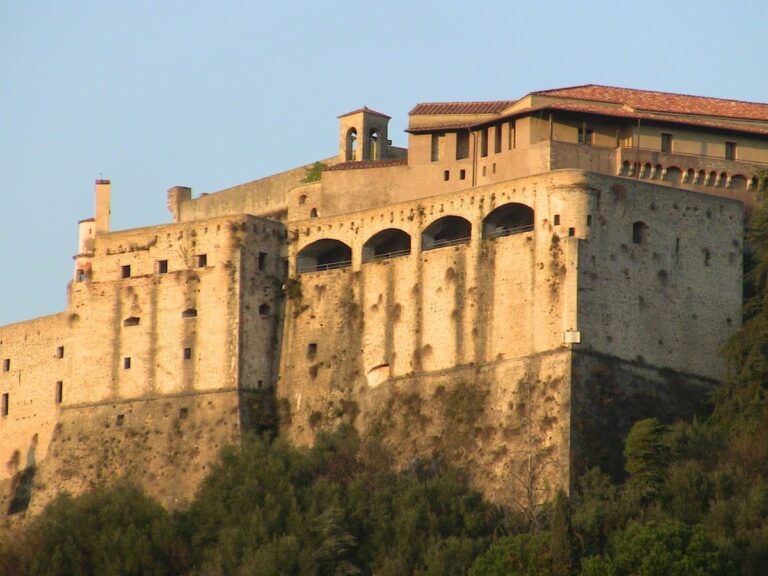
The palace stands on the slopes of the Apuan Alps at the confluence of the Serra and Vezza rivers. The World Heritage property associated with it covers 1.01 hectares. The building has a compact, fortress-like form, with reinforced-looking corners and loopholes on the ground floor that reflect its potential defensive role.
Palace and associated buildings
Palace entrance and interior features
The facade seen today is actually the rear of the palace, facing the Medici stables. The original entrance has been sealed and lies where the children’s library is now located. A Latin inscription honoring Francesco I de’ Medici remains visible above the former entrance. The complex also includes a chapel, a courtyard with a well, and a Medici coat of arms.
Gardens and service buildings
The former villa complex included extensive woodland used for hunting, a vegetable garden, a geometrically arranged Italian garden, a chapel, and a separate stable building. These elements are recorded in a view of the villa by Giusto Utens, whose detailed paintings of Medici residences provide visual records of their former layouts. The ironworks built around 1786 remains visible beside the palace along the Vezza watercourse.
Memorial to Vittorio Emanuele II
A bust and commemorative plaque dedicated to Vittorio Emanuele II are attributed to the sculptor Giacomo Zilocchi. Vittorio Emanuele II was the first king of unified Italy, reigning from 1861 to 1878.
Museum collections and present functions
Marble and metalworking displays
The museum presents the working history of the surrounding region through tools, machines, and machine models. Material from the nearby Monte Altissimo quarries illustrates the extraction, transport, and processing of marble. Other tools relate to metal extraction and working, including iron production in ironworks and craft workshops.
Rural and domestic work
Additional displays include weaving equipment, agricultural tools used on mountain and lowland terrain, photographs, and explanatory cards. The work tools are arranged in eleven rooms and date from the late eighteenth century to the mid-twentieth century.
Today, Palazzo di Seravezza accommodates the municipal library, the historical archive, the museum of work and popular traditions, and spaces for exhibitions of modern and contemporary art.
Nearby sites