Pietrasanta Cathedral: The Collegiate Church of Saint Martin in Italy


Site at a Glance
- Rating
- 4.6
- Popularity
- Low
- Country
- Italy
- Primary era
- Medieval
- External website
- Open
- Eras represented
- Medieval, Early Modern, Modern
- Civilizations
- Genoese, Grand Duchy of Tuscany, Republic of Florence, Republic of Lucca
- Site type
- Religious
- Remains
- Cathedral
On this page11 sections
History
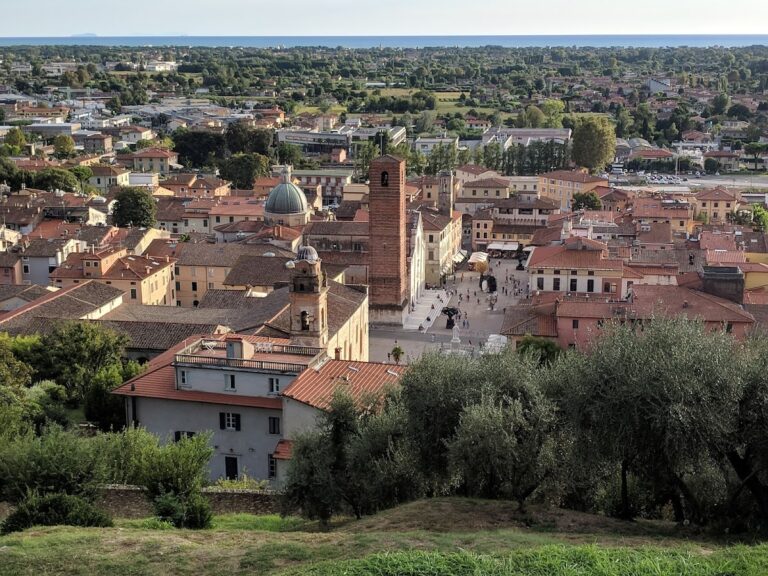
Pietrasanta Cathedral, officially the Collegiate Church of Saint Martin, is the principal Catholic place of worship in Pietrasanta, Italy. Dedicated to Saint Martin of Tours, a fourth-century Christian bishop widely venerated in Western Europe, the church is associated with the Archdiocese of Pisa. It is first recorded in 1223, and expansion work was recorded in 1330.
Medieval collegiate foundation
In 1387, Pope Urban VI established a chapter of canons, a body of clergy assigned to administer the church, and elevated the building to collegiate status. The same act provided a baptismal font. Urban VI served during the Western Schism, the period from 1378 to 1389 when rival papal obediences contested the papacy. The new collegiate role gave the church an institutional character beyond that of a parish church and supported regular communal worship.
Renaissance and seventeenth-century transformation
The bell tower was completed around 1520 and is attributed to the Florentine architect Donato Benti. Possible involvement by Michelangelo Buonarroti, particularly in the construction of its spiral staircase, is also recorded. Inside the church, the marble choir enclosure in the presbytery was begun by Lorenzo Stagi in 1502 and completed in 1508 by collaborators after his death. The marble pulpit was made in 1508 by Donato Benti and Lorenzo Stagi.
Grand Duchess Christina of Lorraine commissioned a major renovation in 1627. Florentine artists produced the side altars and large devotional altarpieces, painted or sculpted works placed near or behind altars, while Giovan Battista Stagi and Ferdinando Tacca directed the sculptural decoration. The church’s artistic program consequently acquired an important seventeenth-century layer, including works by Marcello Tommasi, Matteo Rosselli, Francesco Curradi, Jacopo Vignali, Pietro Dandini, Bastiano Bitozzi, Jacopo Chiavistelli, and Alessandro Cominotti.
Nineteenth-century rebuilding and painting
The dome, which had an octagonal form in 1453, was rebuilt with a circular plan in 1820. Luigi Ademollo, a painter from Milan, painted the walls and ceilings between 1823 and 1825. These interventions reshaped the church’s appearance while retaining elements from its medieval, Renaissance, and seventeenth-century development.
The cathedral’s organ also underwent successive changes. In 1784, an instrument from the Oratory of the Confraternity of the Holy Trinity in Pistoia was transferred to the church. Domenico Francesco Cacioli built it between 1748 and 1749 with Antonio and Filippo Tronci. It was sold to the parish church of San Michele in Farnocchia in 1833 and replaced by an organ made by Giosuè Agati. The nineteenth-century instrument was restored in 1852 and rebuilt by the Agati-Tronci firm late in that century. It was demolished in 2017–2018 and replaced by a new organ built by the Chichi firm.
Devotional traditions
Pietrasanta Cathedral retains traditions of devotion to the Madonna del Sole, a Marian devotional image, and to Saint Martin. The Madonna del Sole is displayed only during special celebrations. Saint Constantius is also remembered in the dedication of one of the cathedral’s bells.
Remains
Plan, facade, and portals
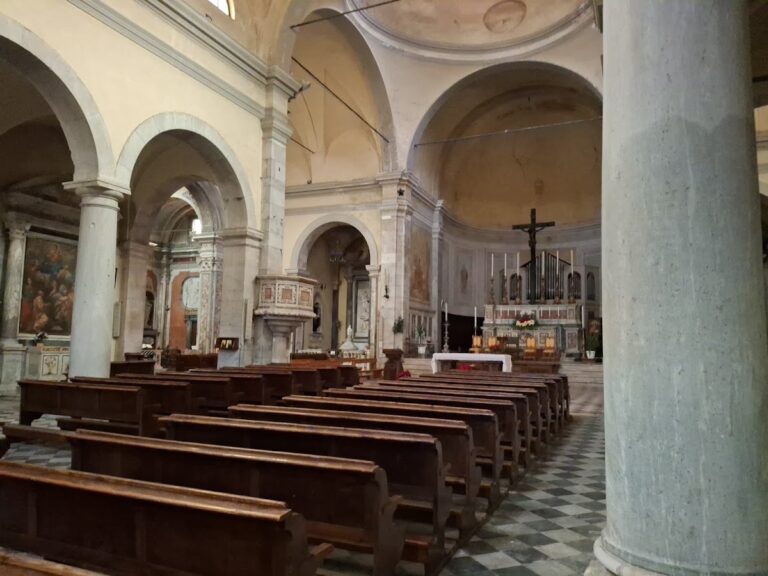
The church has a Latin-cross plan, formed by a long central axis crossed by a shorter transverse arm, with three naves and a transept. Its exterior is faced with white marble, and the stepped profile of the facade reflects the arrangement of the interior naves. The building measures 46.46 metres from the entrance portal to the apse, the curved or polygonal termination of the church. The naves are 18.39 metres wide in total, the main nave is 15.84 metres high, and the transept measures 28 metres across. The dome reaches an interior height of 28.79 metres, while its drum, the supporting cylindrical or polygonal section beneath the dome, has a diameter of 9.25 metres.
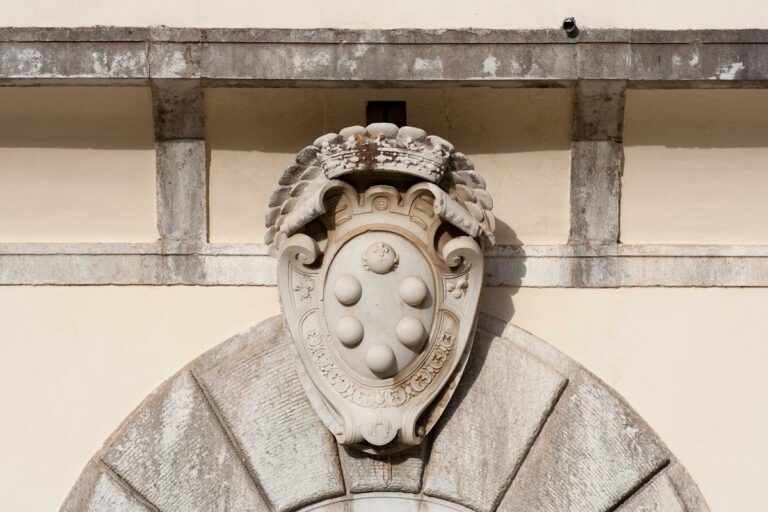
Three principal portals have sculpted lunettes, semicircular fields above doorways, showing scenes from the Passion and Resurrection of Christ. These carvings are generally attributed to the Pisan school. A further portal opens from the right transept toward Via Garibaldi. Its lunette depicts Saint John the Baptist and is a fourteenth-century work attributed to Bonuccio Pardini. The facade also carries heraldic emblems recalling Genoese and Florentine rule in the city, together with the large coat of arms of Pope Leo X, the Medici pope who held office from 1513 to 1521. The central marble rose window, a large circular window with radiating tracery, is attributed to Riccomanno Riccomanni and dates from the fourteenth century.
Bell tower
The bell tower stands beside the collegiate church and rises approximately 36 metres. It has a square plan, with sides measuring 8 metres, and a simple exposed-brick exterior. Its original scheme included marble facing that remained unfinished. Inside, a distinctive complex spiral staircase forms one of its notable features. Four bronze bells were cast in 1887 at the Lorenzo Lera foundry in Lammari, Lucca. The large bell is tuned to E-flat 3 and dedicated to the Madonna del Sole; the medium bell, tuned to F 3, to Saint Martin; the smaller middle bell, tuned to G 3, to Saint Constantius; and the smallest, tuned to A-flat 3, is called Ave Maria.
Altars, choir, and sacred furnishings
The side altars created during the seventeenth-century renovation carry large altarpieces. Among the recorded works are Jacopo Vignali’s Almsgiving of Saint Martin, Matteo Rosselli’s Madonna of the Rosary, and Pietro Dandini’s Nativity, dated 1679–1680. The marble choir enclosure in the presbytery was begun in 1502 by Lorenzo Stagi, drawing strongly on the marble enclosure by Civitali in Lucca Cathedral, and completed in 1508 by collaborators. Two holy-water basins by Stagio Stagi belong to the preceding century.
Madonna del Sole and baptistery
In the chapel on the right side of the transept, beside the high altar, stands the venerated Madonna del Sole. This panel painting shows the Madonna and Child among saints. An unknown Late Gothic painter made it in 1424. The image is displayed only during particular celebrations, preserving its connection with the cathedral’s devotional traditions.
The former seventeenth-century Oratory of Saint Hyacinth was converted into a baptistery in 1786. It contains two baptismal fonts, the basins used for baptism, dated 1385 and 1612.
Organ
The present organ is arranged in three sections. The principal section stands on the choir loft at the counter-facade, the interior wall opposite the main facade. The other two sections are positioned behind the high altar and beneath the right side of the transept. Built by the Chichi firm in 2017–2018, the instrument has electronic transmission, 54 stops, three manuals, pedals, and 2,663 pipes.
Nearby sites