Palazzo della Prefettura: L’Aquila’s Historic Provincial Government Building
Site at a Glance
- Rating
- 3.6
- Popularity
- Very Low
- Country
- Italy
- Primary era
- Modern
- Eras represented
- Modern
- Civilizations
- French, Kingdom of the Two Sicilies
- Site type
- Civic
- Remains
- Palace
On this page10 sections
History
Palazzo della Prefettura, also known as Palazzo del Governo, is a former Augustinian monastery complex and provincial government building in L’Aquila, Italy. Traditionally founded in 1282 by Charles of Anjou, the Angevin ruler also known as Charles I of Naples, it was rebuilt after an earthquake in the early eighteenth century and later transformed into a Neoclassical administrative centre.
Augustinian monastery and eighteenth-century rebuilding
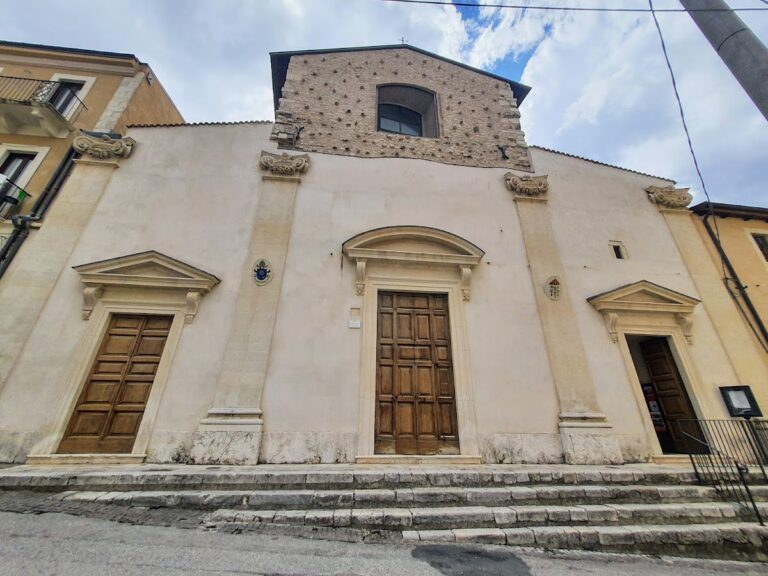
The complex belonged to the Augustinians, a Catholic religious order following the Rule of Saint Augustine. After the early-eighteenth-century earthquake severely damaged the monastery, restoration of rooms around the central courtyard had begun by 1705. The architect Giovan Battista Contini designed a new church in 1707, construction began in 1710, and the church was completed between 1725 and 1730.
During the second half of the eighteenth century, from 1769 to 1806, the convent housed a school of Sacred Sciences administered by the Augustinian order. This phase ended when the Napoleonic administration established the Province of L’Aquila in 1806, then called Abruzzo Ulteriore Secondo.
Napoleonic conversion and Neoclassical reconstruction
From 1807, a Royal Commissioner occupied the monastery complex, while the Augustinian community was compelled to move to the Celestine monastery at Collemaggio. The Celestines were a separate Catholic monastic order. The confiscated complex was adapted for public administration and partly rebuilt in the Neoclassical style, which revived architectural forms associated with ancient Greece and Rome.
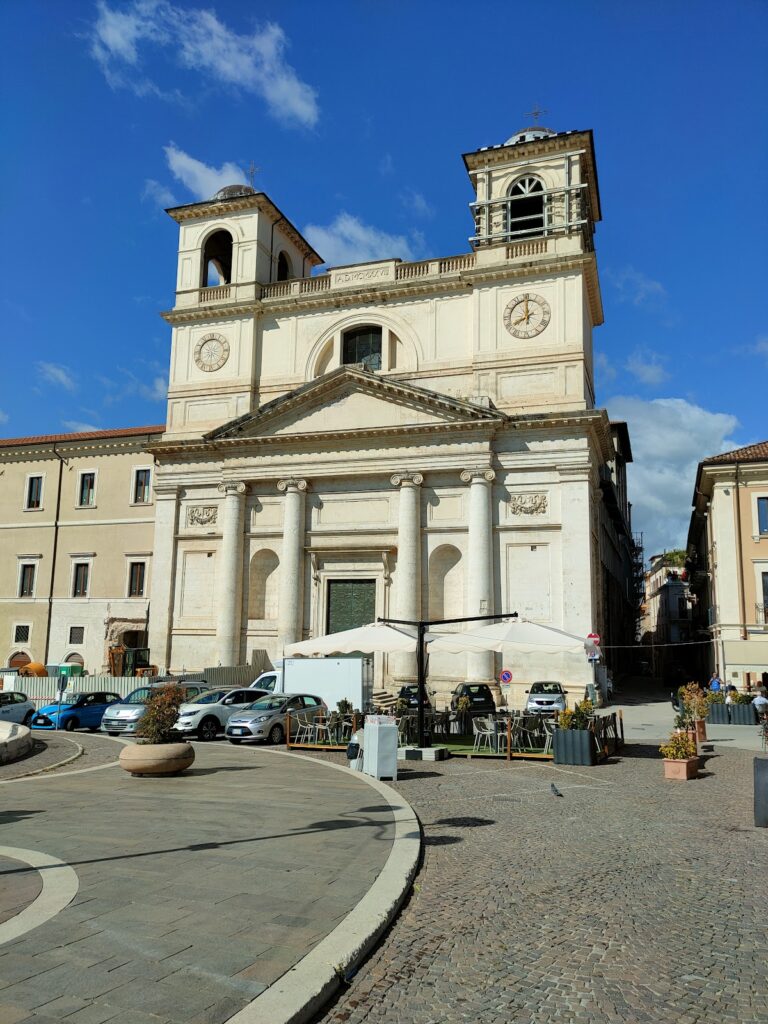
The principal reconstruction phases took place between 1809 and 1814, 1829 and 1835, and 1840 and 1846. The first established the plan of the new administrative building. The second added the principal entrance on Piazza della Repubblica, and the third completed the definitive arrangement of the facade. The resulting government offices stood beside the Baroque church, creating a marked contrast between the later administrative buildings and the church completed in the eighteenth century.
The Sala Olimpica and the provincial administration
Federico Guarini, government intendant from 1817 to 1820, and Lieutenant Gennaro Loiacono promoted the creation of the Sala Olimpica. The small public theatre was intended to replace the obsolete Teatro San Salvatore and opened on 30 May 1820. It operated until 1854.
The theatre was dismantled in 1853 and 1854 to make room for the State Archive, an institution that preserves official historical records. After the unification of Italy, the complex officially became the seat of the Prefecture in 1861. A prefecture is the administrative office headed by a prefect, the central government’s representative in an Italian province. The palace also housed the State Archive, continued to serve as the prefecture under the Italian Republic, and accommodated the provincial Civil Protection headquarters.
Twentieth-century events and the 2009 earthquake
King Victor Emmanuel III, who reigned from 1900 to 1946, stayed at the palace in 1942 and delivered one of his last public speeches before his flight to Brindisi in 1943. In 1971, the building hosted the Abruzzo Regional Council session that approved the regional statute. The session was followed by unrest in L’Aquila.
The earthquake of 6 April 2009 caused the roof and entire upper floor to collapse. It also severely damaged the load-bearing structures and the entrance portico. The ruined facade and debris-filled square became associated with the earthquake’s destruction, and the palace was included among 45 monuments identified for preservation.
Reconstruction and present institutional role
In 2010, Provincial President Antonio Del Corvo presented a proposal for reconstruction that initially envisaged a Museum of Memory and the Salvatore Tommasi Provincial Library. The intended use later changed to the new headquarters of the Province of L’Aquila. A preliminary project was presented in 2011, a definitive project in 2015, and reconstruction work began in 2016. The palace is owned by the Province of L’Aquila.
Remains
The administrative building
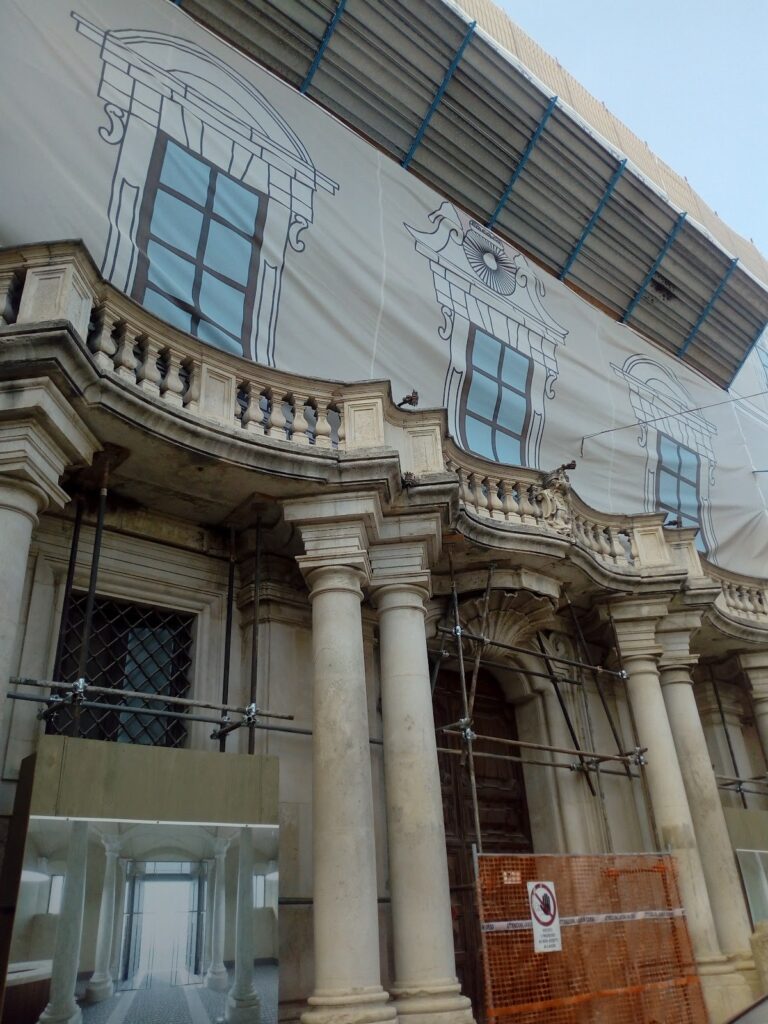
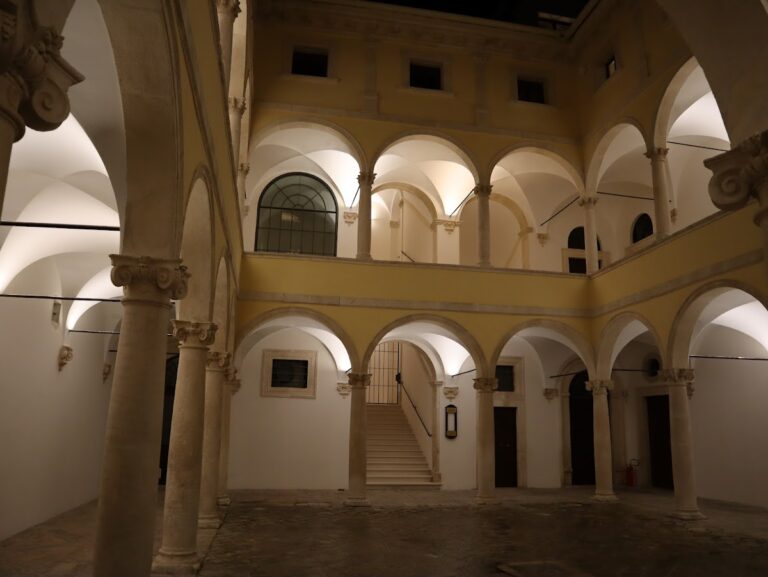
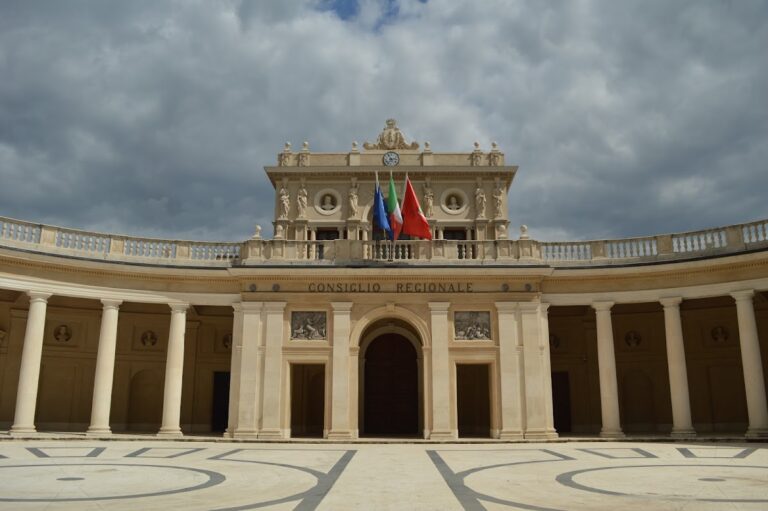
Palazzo della Prefettura stands on Piazza della Repubblica, near Piazza del Duomo and beside the Church of Sant’Agostino. The building has a trapezoidal plan, a rectangular internal courtyard, and two levels. Its facade is set at an angle to the rest of the complex and has a restrained Neoclassical design. A projecting entrance portico faced in stone carries a small suspended balcony supported by two pairs of Doric columns, while Doric columns also structured the interior.
The earthquake of 2009 left the building unusable. The roof and upper floor collapsed, the load-bearing structures suffered grave damage, and the entrance portico was severely damaged. These losses form part of the physical condition addressed by the reconstruction begun in 2016.
The Sala Olimpica
The Sala Olimpica occupied a trapezoidal space between the church and the institutional offices. Its Roman-style plan included a semicircular cavea, meaning the curved seating area of a theatre, with two seating tiers and an upper gallery. Twenty Doric columns arranged in two rows supported the gallery.
The theatre was dismantled between 1853 and 1854, probably in part because its proximity to Sant’Agostino was considered unsuitable and insufficiently respectful. Its architectural arrangement remains visible in a wooden model preserved at the Auditorium of the Spanish Fort.
Paintings from the provincial collection
Before the 2009 earthquake, the palace contained a small art collection belonging to the provincial administration. It included Teofilo Patini’s Beasts of Burden, painted in 1881, and Pulsations and Heartbeats, painted in 1888. Both paintings were transferred after the collapse.
Nearby sites