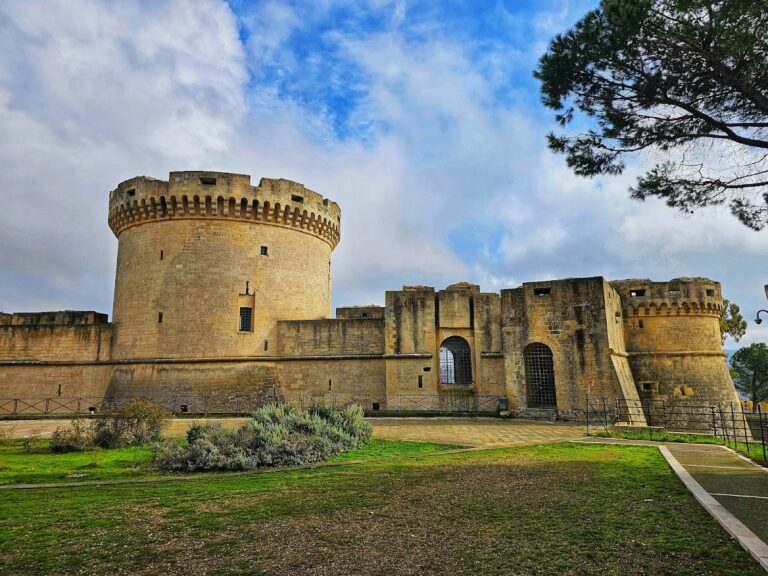
Palazzo del Sedile: Matera’s Historic Civic Council Palace


Site at a Glance
- Rating
- 4.6
- Popularity
- Very Low
- Country
- Italy
- Primary era
- Early Modern
- External website
- Open
- Eras represented
- Early Modern, Modern
- Civilizations
- Kingdom of Naples
- Site type
- Civic
- Remains
- Palace
On this page6 sections
History
Palazzo del Sedile is a historic civic palace in Matera, Italy, whose building stood by 1575 and whose facade was modernized in Renaissance style in 1779. It takes its name from the Sedile, literally a seat, the municipal council institution and meeting place of Matera when the city belonged to the Kingdom of Naples, the monarchy that governed much of southern Italy.
The civic Sedile
The municipal Parliament was Matera’s principal political institution. It met in the Sedile, also known as the Portico or Tocco, where the Curiae and Fraternities, organized bodies involved in local public life, also held their meetings. The earliest Sedile stood in the forecourt of the cathedral, while the chancery occupied the house of Tuccio de Scalzonis and the Moro lords. Because this arrangement separated the council from its administrative offices, the Sedile moved into the former suburban church of Sant’Eustachio while the municipal hall was being constructed.
In 1575, the Palazzo del Sedile stood at the foot of the castrum walls, the fortifications of a fortified settlement, between the Porta di Juso and the San Francesco height on Piazza Maggiore, now Piazza del Sedile. The council addressed practical matters affecting daily life, including the prices of bread, cheese, and legumes, the water supply, repairs to the Fontana water conduit, and the regulation of ice sales. Many of its measures responded to widespread poverty. In 1584, the Sedile considered building a bridge over the Gravina di Picciano. On December 25, 1599, the mayor proposed enlarging the chancery and reorganizing the archive.
From civic hall to conservatory
In 1965, a branch of the Niccolò Piccinni Conservatory of Bari was established in the palace and named for the Materan musician Egidio Romualdo Duni. The branch became autonomous in 1969. During its early years, recitals, concerts, and debates took place in the small theater of Casa Malvezzi before moving to the larger Raffaele Gervasio Auditorium. The palace’s new role as the first home of Matera’s music conservatory was regarded as important because an active institution helped counter the depopulation of the historic center. The building remains in use for conservatory and auditorium functions.
Remains
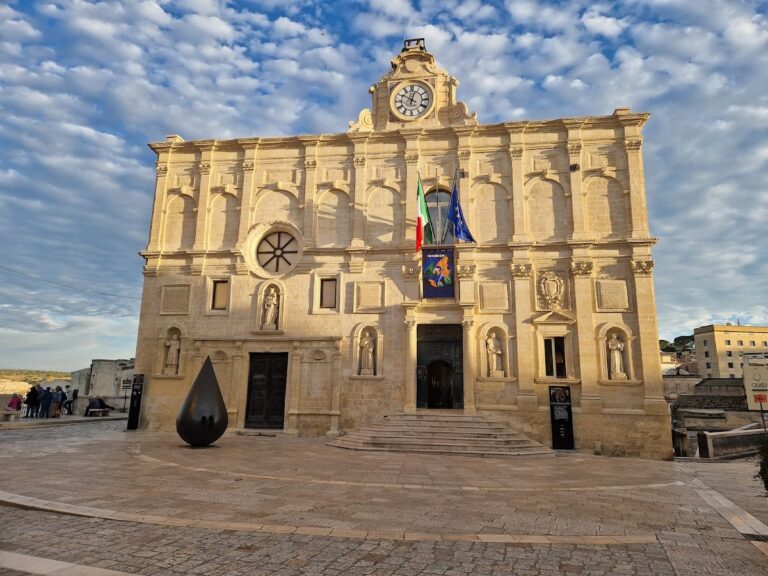
Palazzo del Sedile occupies Piazza del Sedile, the square named after the civic institution it housed. Its principal exterior is organized around a large Renaissance entrance arch, flanked by two towers that contain a clock and a sundial. The 1779 modernization gave the facade its Renaissance character, while statues and vaulted niches turn the front of the building into an openly civic program of images.
Facade sculpture and civic ideals
Saint Eustace stands on the left side of the facade and Saint Irene on the right. The Sassi of Matera can be recognized at Saint Irene’s feet. The right-hand figure was sometimes identified as the Madonna della Bruna, but Pietro Antonio Ridola wrote in 1857 that the Madonna della Bruna statue had originally stood between the two saints and was ruined by a storm.
Four further statues occupy vaulted niches and represent the cardinal virtues, understood here as principles of civic administration. Prudence appears as a woman with a serpent at her feet, fortitude as a woman breaking a column, temperance as a woman pouring water into a cup of wine, and justice as a woman holding scales and a sword. Together, these images present the building as a speaking palace, expressing the qualities expected of a good administrator.
Interior spaces and later alterations
A fresco of Charles III on horseback decorates the right side of the entrance hall. Charles III was a Bourbon monarch who ruled the Kingdom of Naples in the eighteenth century. Paintings on the vault celebrate the beauties of that kingdom. In 1840, the construction of an internal council chamber was decided as an addition to the external Sedile.
A political-administrative monument called the Sedile once stood in front of the entrance hall and was demolished around 1930 for an unexplained reason. The building’s later performance function is represented by the Raffaele Gervasio Auditorium, which has approximately 400 seats and forms part of the palace’s continuing use for musical education and events.
Nearby sites