Palazzo Comunale in San Miniato: Civic Palace and Town Hall
Site at a Glance
- Rating
- 4.8
- Popularity
- Very Low
- Country
- Italy
- Primary era
- Medieval
- External website
- Open
- Eras represented
- Medieval, Early Modern, Modern
- Civilizations
- Grand Duchy of Tuscany, Italian, Republic of Florence
- Site type
- Civic
- Remains
- Town Hall
On this page9 sections
History
Medieval origins and civic use
Palazzo Comunale in San Miniato, Italy, is a civic palace founded in the fourteenth century as the residence of the Lords, the Twelve Defenders of the People, the executive magistracy of the free commune. It continues to serve as the town hall. Franco Sacchetti, a writer known for the Trecentonovelle, served San Miniato as chief magistrate and died in the palace; his public service there is recalled in his writings.
Memorials to the Cathedral massacre
Two plaques once displayed on the palace façade commemorated the Cathedral massacre of 22 July 1944. A plaque from 1954, written by Professor Luigi Russo, blamed German forces for 55 civilian deaths, although its inscription commemorated 60 victims. It described them as unarmed and innocent, including elderly people, and said they had been urged to seek refuge in the cathedral. The text condemned the grenade attack as deliberate cruelty rather than military necessity, called on Italians to forgive but not forget, and linked civilization with peace and work.
A second plaque, installed in 2008 and drafted by former Italian president Oscar Luigi Scalfaro, presented a different attribution. It said newer historical analysis assigned responsibility for the massacre to Allied forces, specifically US shelling. It also referred to German responsibility for the war and reprisals, with Italian Fascist republican forces complicit, and invoked Article 11 of the Italian Constitution, which rejects war as aggression or as a means of settling disputes between nations.
The plaques were taken from the palace façade in April 2015 and moved to the San Domenico Loggias. The Museum of Memory, inaugurated there on 24 July 2018, occupies premises that had served as the Dominican convent’s refectory and later as a meeting room for the National Balilla Organization and the GIL, both Italian Fascist youth organizations.
Remains
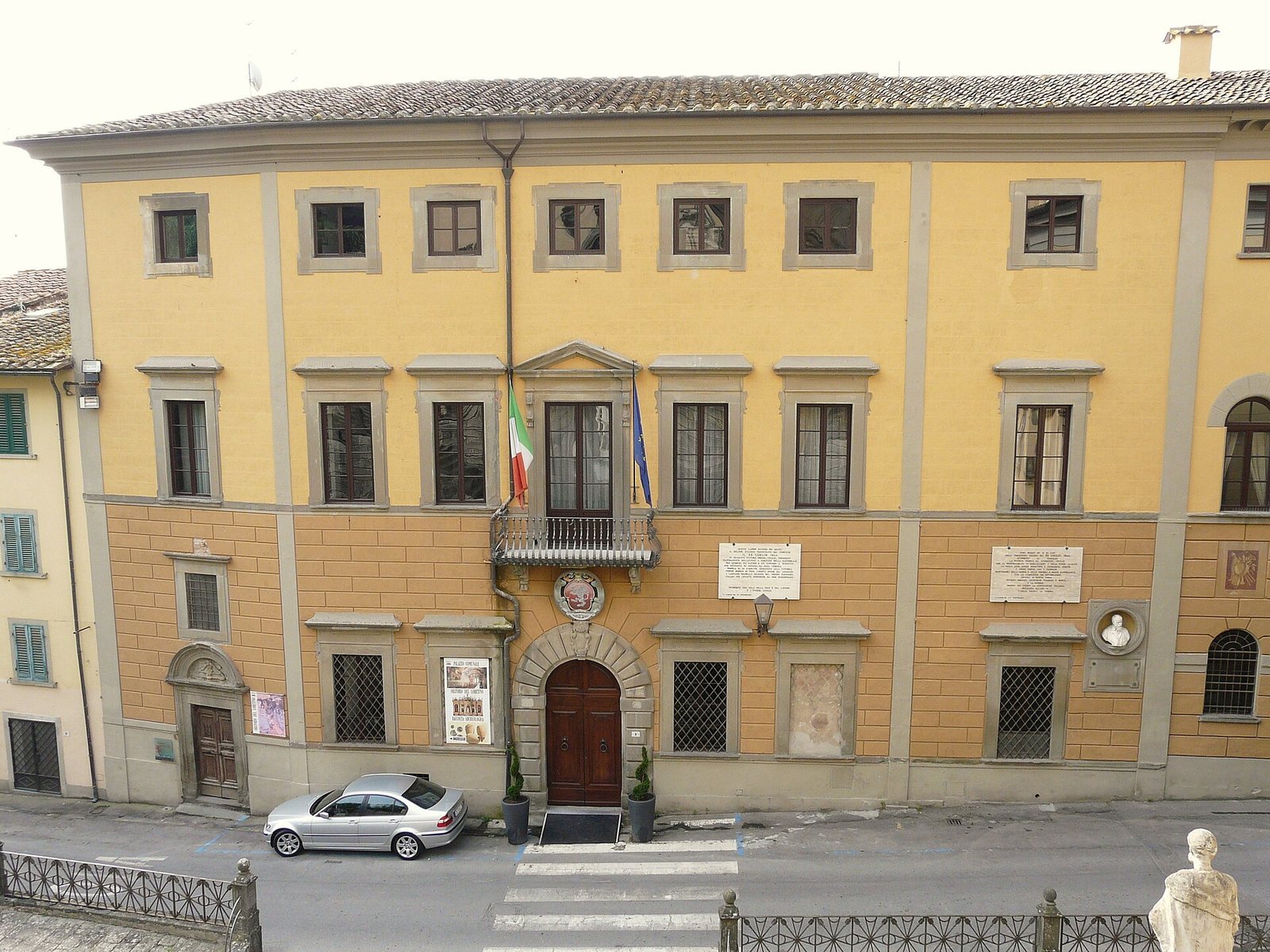
The palace has a modern façade and several distinct interior spaces. The ground-floor Lorentino Oratory is beneath the Hall of the Seven Virtues, while a separate entrance hall occupies the first floor.
Palace features
Façade
The modern exterior is decorated with painted panels and a bust of Augusto Conti, an Italian philosopher.
Hall of the Seven Virtues
The hall contains a fresco painted in 1393 by the Florentine artist Cenni di Francesco. It depicts the Madonna and Child surrounded by the cardinal virtues of prudence, justice, fortitude and temperance, and the theological virtues of faith, hope and charity.
Entrance hall and Lorentino Oratory
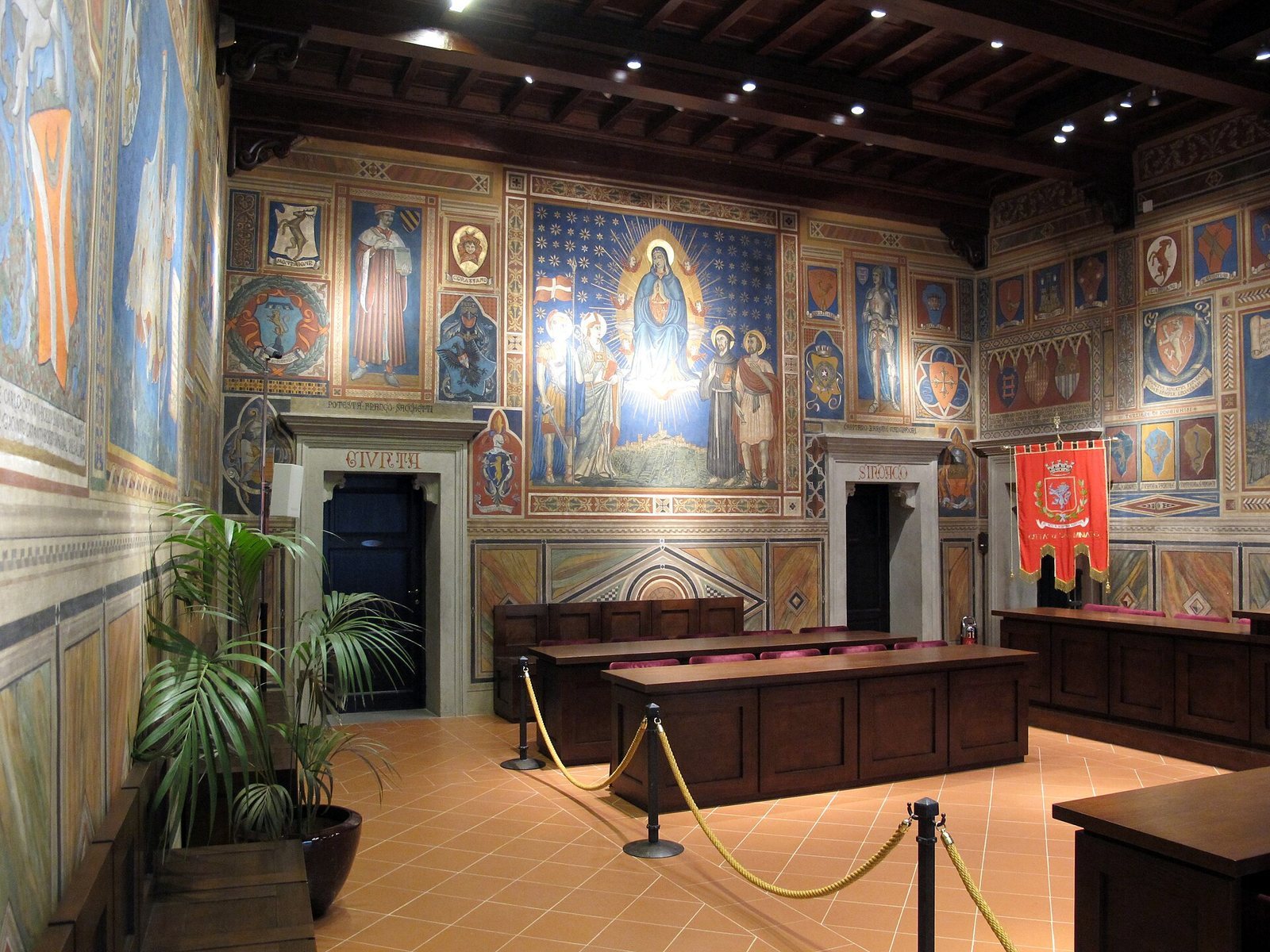
The first-floor entrance hall dates to the eighteenth century. In 1928, canon Francesco Maria Galli Angelini, a member of a church chapter, decorated its three walls in a Neo-Gothic style, a revival of medieval Gothic design. The decoration includes coats of arms, heraldic emblems and figures from San Miniato’s history, among them Francesco Sforza, a fifteenth-century military leader and Duke of Milan, and Franco Sacchetti. The hall became the municipal council chamber in 2008. On the ground floor below the Hall of the Seven Virtues is the Lorentino Oratory.
Memorial plaques at the San Domenico Loggias
The two plaques are mounted above the entrance to the Museum of Memory at the San Domenico Loggias.