Los Naranjos: A Lenca Archaeological Center in Honduras
Site at a Glance
- Rating
- 5
- Popularity
- Very Low
- Country
- Honduras
- Primary era
- Classical
- Eras represented
- Iron Age, Classical, Medieval
- Civilizations
- Unclassified
- Site type
- City
On this page10 sections
History
Los Naranjos is a Lenca archaeological site on the northern shore of Lake Yojoa in Honduras, occupied from approximately 800 BC to AD 1250 during the Formative and Classic periods of Mesoamerican history. Monumental construction began in the Jaral phase, from 800 to 400 BC, and the settlement later developed through the Edén, Yojoa, and Río Blanco phases. Its position between routes leading toward the Santa Bárbara, Comayagua, and Sula valleys placed it within regional exchange networks and helped make it one of the emerging centers on the southeastern periphery of Mesoamerica.
Jaral and Edén phases
During the Jaral phase, the principal monumental buildings were constructed mainly from earth. Artifacts from this period indicate contact or exchange with Olmec-related populations, an early Mesoamerican civilization centered largely on Mexico’s Gulf Coast. Jade working and Olmec-influenced pottery occur among the early remains, while some stone sculptures have been described as resembling Olmec art. This evidence has led to continuing debate about the nature of Olmec influence at Los Naranjos. The overall plan of the settlement does not follow an Olmec pattern such as that of La Venta, so the material is better understood within the wider history of contact and cultural exchange.
Los Naranjos reached one of its major phases of development during Edén, from 400 BC to AD 550. This period corresponds to the Late Formative and Early Classic eras, when large political and ceremonial centers expanded across Mesoamerica. Structures 1 through 4 were built mainly with stone, particularly rounded stones, although worked stone was used in some sections. Structure 4 became a large platform carrying several buildings and has been interpreted as an acropolis, a raised complex associated with elite, political, or ceremonial activity, and as the political center of the Main Group.
The settlement’s history reflects changing relationships among local Proto-Lenca communities, the earlier population associated with the development of later Lenca society, and neighboring Maya and Olmec-related societies. During the Late Classic period, approximately half of the pottery used at Los Naranjos was Maya-related and polychrome, meaning it was painted in several colors. Edén II pottery, however, had little or no similarity to the Maya Tzakol ceramic tradition. Los Naranjos therefore provides evidence for shifting connections rather than a single, unchanging cultural affiliation. Its location was also near a proposed Maya territorial boundary about 80 kilometers away.
Yojoa and Río Blanco phases
Construction expanded into other parts of the settlement during the Yojoa phase, from AD 550 to 950, including Groups 1 and 5. The main occupation appears to have declined during this period, while the Río Blanco phase, from AD 950 to 1250, brought a change in settlement pattern toward areas east and west of the present park. Ballcourts were built in Groups 5 and 6 during Río Blanco. Their construction indicates a reorganization of political and ritual spaces during the settlement’s later occupation.
The inhabitants are presumed to have spoken Lenca. Burials containing different quantities and qualities of valuable objects led Claude F. Baudez and Pierre Becquelin to propose that the settlement had a hierarchical social organization. Obsidian, jade, marble, and shell ornaments from Pacific and Caribbean regions show that Los Naranjos participated in exchange networks linking it with other centers and chiefdoms. These connections, together with the site’s ceramics and monumental architecture, have made its development important to the study of sociopolitical change among Maya- and Proto-Lenca-speaking peoples.
Archaeology and protection
Doris Stone recorded Los Naranjos in 1934, noting five or six partially buried mounds along former paths between different areas of the settlement. In 1935, Frans Blom and Jens Yde excavated a large mound and recovered a substantial collection of polychrome pottery. They considered the mound a possible burial place because vessels had been deliberately buried there. J. B. Edwards, a former Harvard botanist who had previously excavated at the site, assisted with the work. Yde acquired many specimens for the Danish National Museum, including the vessel later known as the Yde Vessel.
Samuel Kirkland Lothrop visited Los Naranjos in 1947 and photographed some of its numerous mounds before later excavation and restoration. Claude F. Baudez and Pierre Becquelin carried out excavations in the late 1960s and 1970s, including work in the area called the Looters’ Trench, where earlier looting was visible. Their investigations and the recovery of ceramics from four cultural phases established the length and complexity of occupation. A new excavation program begun in 2005 examined the origins and development of the settlement, concentrating on Structures 2, 3, and 6. Wells dug in low-lying and swampy areas were used to investigate the ancient diet, particularly agriculture.
Los Naranjos became an archaeological park by government decree on December 7, 2001. The protected eco-archaeological park covers approximately 19.5 hectares and is surrounded by ten additional park areas. Its position beside Lake Yojoa may have contributed to the deterioration of the architecture, since some structures may have remained underwater for a period after abandonment. The park museum displays Lenca artifacts recovered from the area, while continuing research addresses the settlement’s history and material culture.
Remains
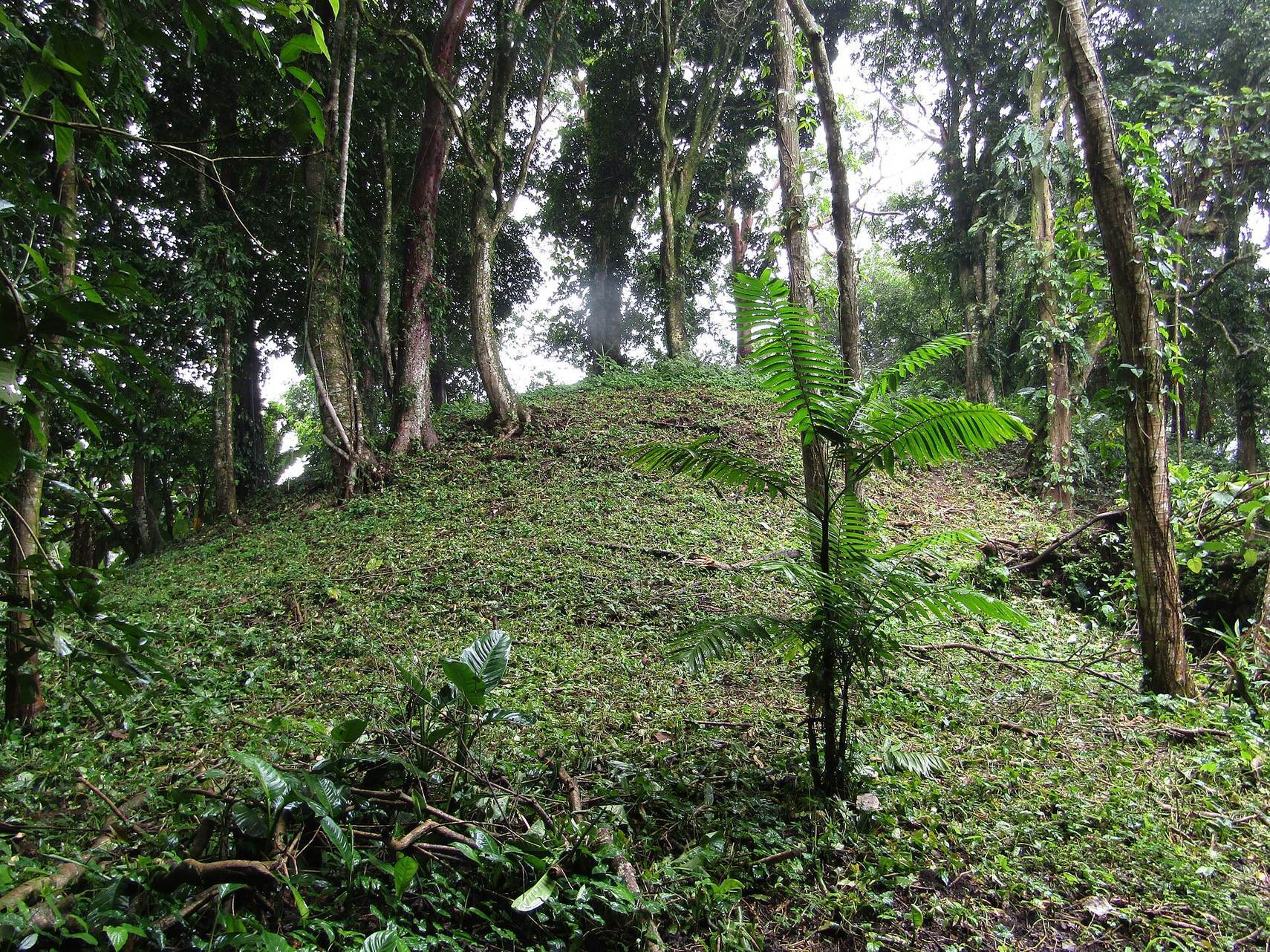
Los Naranjos lies at approximately 635 meters above sea level on the northern shore of Lake Yojoa, within a tropical rainforest landscape. The archaeological area contains numerous mounds, pyramids, pottery remains, and other monumental features. The settlement is organized around the Main Group, also called Group 1, while other groups and ballcourts extend beyond it. The earliest monumental buildings were chiefly earthen, whereas important Edén-phase structures used rounded river stones and worked stone. This sequence preserves a change from large earth constructions to more substantial stone architecture.
Main Group
Structure 1
Structure 1 is the tallest building in the Main Group and the principal stepped pyramid of the settlement. Its height forms part of a group of seven large mounds whose elevations range from 3 to 18.5 meters. The pyramidal structures at Los Naranjos have been regarded as among the oldest surviving pyramid structures in Honduras. Structure 1 belongs to the stone-building tradition associated especially with the Edén phase, when rounded stones formed much of the construction and worked stone was used in selected portions.
Structure 4
Structure 4 developed during the Edén phase as a large platform supporting several buildings. Its arrangement has led to its interpretation as an acropolis and as the political center of the Main Group. Artistic reconstructions propose that the major pyramids and platforms were covered mainly with red and white stucco, although this appearance remains interpretive. The surviving platform and associated buildings express the expansion of the settlement’s central architecture during its major period of development.
Groups, ditches, and ballcourts
Groups 1 and 5 preserve evidence of construction that expanded beyond the central architectural group during the Yojoa phase. Groups 5 and 6 contain ballcourts excavated during investigations in the 1970s. Their construction is assigned to the Río Blanco phase and reflects the later reorganization of ceremonial and political space. The courts belong to a period when settlement activity shifted toward areas east and west of the present park.
Two large ditches formed part of the site’s landscape. One was constructed during the Jaral phase and extended from Lake Yojoa to a pool north of an encampment. The second was probably built during the Edén phase. Their exact function remains uncertain. The archaeological setting supports a defensive use, while the porous bedrock at the bottoms makes the possibility that they were intended to hold water less likely.
Pottery and other artifacts
Excavations recovered polychrome, monochrome, and Ulúa bichrome pottery. The oldest layers contained mainly monochrome vessels with little decoration, while later layers held more developed polychrome wares. Most of the pottery appears to have been made locally, although some pieces may have entered the settlement through trade. Seven sherds were radiocarbon-dated to help establish the cultural sequence. Terminal Classic Las Vegas polychrome, a white-slipped painted ceramic type, is stylistically related to material from Comayagua and to sherds from Rivas-Papagayo, a ceramic tradition of the Pacific region of Nicaragua and Costa Rica, although it is earlier than the latter material.
The Yde Vessel is an unusually large and elaborately decorated ceramic vessel. Its surviving fragment is 24.4 centimeters high, and its rim appears to have been about 23 centimeters across. Black and red decoration stands against an orange base. The scene shows dancing figures inside a cave. This setting has been interpreted as a motif connected with the first humans and the origin of humankind. Jesper Nielsen and James E. Brady proposed that a crocodilian figure outside the cave represented a fertility deity associated with human origins, and that Lake Yojoa and the Cave of Taulabé may have been viewed by the people of Los Naranjos as places of human birth.
Other finds include jade figurines, a jadeite hand axe, decorated clay vessels, small stone statues, and sculptures that may reflect Olmec influence. One broken sculpture has been compared to a human torso, with facial features resembling those found at Monte Albán, the ancient Zapotec center in Oaxaca. Pottery from the nearby La Sierra site appears to have direct ties to Los Naranjos pottery during the Late Classic period. Together, the ceramics, stone objects, and monumental remains preserve evidence of a settlement connected to several regional traditions while maintaining its own long development beside Lake Yojoa.