Oyama Shrine: A Shinto Mountain Sanctuary in Tateyama, Japan
Site at a Glance
- Popularity
- High
- Country
- Japan
- Primary era
- Medieval
- Eras represented
- Medieval, Early Modern, Modern
- Civilizations
- Ashikaga shogunate, Japanese, Kamakura shogunate, Tokugawa
- Site type
- Religious
- Remains
- Sanctuary
On this page19 sections
History
Oyama Shrine is a Shinto sanctuary in Tateyama, Toyama Prefecture, Japan, comprising three sites from Mount Oyama’s summit to the Joganji River. Its foundation date is uncertain, with traditions placing its beginnings in 701 or 703. The mountain was also called Tateyama Gongen and Oyama Gongen. During Shinto-Buddhist syncretism, the blending of kami worship and Buddhist beliefs, it became closely associated with Buddhist practice and Tateyama Shugendo, a form of mountain religion combining ascetic discipline with Buddhist and kami worship. Tateyama was revered alongside Mount Fuji and Mount Hakusan as one of Japan’s three sacred mountains.
Origins and sacred traditions
One foundation story dates the shrine’s origins to 701. In this account, Emperor Monmu appointed Saeki no Ariwaka governor of Etchu after a deity promised to quell unrest in the province. Ariwaka’s son, Saeki no Ariyori, followed a white hawk toward the mountain. After encounters involving a bear and sacred sites at Iwakuraji and Ashikuraji, he made a difficult ascent and found Amida Buddha, associated with the Pure Land, and Fudo Myoo, a protector of Buddhist teaching, in a cave. They revealed themselves as Buddhist counterparts of the local kami, or Shinto deities, and urged him to open the mountain for the salvation of living beings. The story places this encounter on the morning of September 2, 701. Ariyori and his father reported it to the emperor, who declared a wide area around the mountain sacred; they then began developing the mountain and establishing shrines.
The same tradition gives Tateyama a Buddhist cosmological meaning. It describes the mountain as representing the ten realms, its peaks as the nine grades of the Pure Land, and its forms as the 136 hells and the law of cause and effect. Another account credits an unnamed monk and his disciple Jiko with early development: the monk established a principal shrine, Komyozan, and Ho-on-ji south of the river, while Jiko founded religious centers at Ashikuraji and Iwakuraji to the north. A separate tradition attributes the opening of Tateyama to Kosai, a cleric of the Tendai school. Ariyori, later known as Jiko, is also remembered as the shrine’s founder and a Buddhist mountain ascetic. Shrine tradition places his later years at Ashikuraji.
A poem associated with Otomo no Yakamochi in the Man’yoshu indicates Tateyama’s religious importance by the mid-eighth century. The deity named in the poem has sometimes been identified as the Oyama kami, though that identification remains uncertain. Court records note promotions in the shrine deity’s rank in 863 and 889. Its identity has been debated: some interpretations equate it with Ogami, while Ogami’s separate promotion in 870 has been taken to indicate that the two were distinct. Another interpretation connects the Oyama kami with the deity of the Joganji River.
Provincial shrine and patrons
The shrine appeared in the Engishiki, a tenth-century compilation of court regulations and shrine listings, as a small shrine in 927. Medieval texts, including the Shinto Shu, recognized it as the ichinomiya, or leading shrine, of Etchu. Emperors Genmei and Go-Daigo are said to have designated it for imperial prayer. The institutions at Ashikuraji and Iwakuraji developed as Buddhist-Shinto centers; Iwakuraji’s supervising temple belonged to the Tendai tradition. Ashikuraji’s adherents formed a group called Ichizan-e. From the sixteenth century, they travelled around the country distributing shrine talismans, pictures of Tateyama’s origins, sacred papers, herbs, and medicines, with payment accepted the following year. This activity is described as an origin of the Etchu medicine trade.
The Kamakura government is credited with beginning construction of shrine halls in 1185. The early history of the Maedate Shadan main hall is less certain. Shrine tradition associates its construction in the 1190s with Minamoto no Yoritomo, founder of the Kamakura shogunate. A shrine stood at the site by 1220, and a Buddhist cleric constructed a building there in 1467. Ashikaga Yoshitane and the regional lord Sassa Narimasa are also linked with later work. Patrons included successive Ashikaga shoguns and the Etchu military official Jinbo Nagachika. In 1483 the Muromachi shogunate commissioned Sanjonishi Sanetaka to prepare a fundraising register. Yoshitane granted rice and money in 1492, and Narimasa made a rice grant in 1583. Narimasa also supported Ashikuraji’s grandmother hall and recognized the land rights of Ashikuraji and the principal shrine.
In August 1585, during Toyotomi Hideyoshi’s military campaign in Etchu, troops burned the shrine area. Hideyoshi’s order covered land from Tateyama’s grandmother hall to the foothills of Mount Tsurugi. Maeda Toshiie later rebuilt the shrine and made it a place of prayer for the Kaga domain, the feudal territory ruled by the Maeda family. His grants included rice, land and forest, two portable shrines, and sacred objects.
Rebuilding and modern changes
The summit sanctuary was rebuilt repeatedly under the Kaga domain, with reconstructions recorded in 1641, 1667, 1711, 1755, 1783, 1807, 1818, 1839, 1845, and 1860. A new summit shrine hall was built in 1996. At Maedate Shadan, the shrine regained its name in 1879 after a period when it served as a place for worship from afar. The Meiji-era separation of Buddhism and Shinto brought the dismantling of Buddhist halls, gates, and more than thirty lodging houses at Ashikuraji, including the grandmother hall and halls dedicated to Enma, Jizo, and Taishakuten.
Maedate Shadan became a prefectural shrine in 1873, received government offerings of food and cloth from 1907, and was ranked a Minor National Shrine in 1940. Since 1948 it has belonged to the specially listed shrines affiliated with Jinja Honcho, the national association of Shinto shrines. It is also listed in the Engishiki and remains the traditional leading shrine of Etchu. The Maedate main hall and the wooden statue of Jiko received national Important Cultural Property status in 1906 and 1931 respectively. The Ashikuraji cedar grove, brass offering bowls, mirror, and historical documents have prefectural cultural-property status; other buildings and objects at the lower sanctuaries have town-level recognition. The grandmother deity’s annual change of clothing is recognized as prefectural intangible folk heritage, while the Ashikuraji portable-shrine procession and Maedate children’s dance have town-level recognition.
Other structures at Ashikuraji were also rebuilt after damage and removal. Enma Hall was rebuilt in 1928, and the Cloth Bridge in 1970. The Kaison-do, a hall dedicated to the religious founder, was demolished when the shrine was raised to national shrine status because of its Buddhist character. Rebuilt in 1953, it was destroyed by a typhoon in 1965 and rebuilt again. The former summit building from 1860 was dismantled in 1995, reconstructed in 2013, and put on display at Hotel Tateyama.
Pilgrimage and ritual life
For local boys, climbing to the summit traditionally marked passage into adulthood. Pilgrims generally undertook the journey after joining the community of young men at about fifteen and before coming of age by eighteen. They observed a month of abstention from killing animals beforehand and postponed the climb if mourning required it. Until around 1907, they wore new white clothes and carried new equipment, including walking staffs. Each pilgrim brought one to three river stones to place beside the summit shrine. A local story said the stones would help raise Tateyama after it lost a height contest with Hakusan; another interpretation treats them as offerings to the mountain deity.
Women could not climb Tateyama during the period of Shinto-Buddhist syncretism, but they could visit Ashikuraji’s grandmother hall, understood as the farthest point they could reach. During Higan, a Buddhist observance around the equinoxes, the Grand Consecration of the Cloth Bridge linked women’s passage across the bridge with rebirth in Amida’s Pure Land. Other recurring observances included an Ashikuraji New Year visit and rice-cake distribution, and a spring ceremony in which local women purified themselves, sewed a white garment, and changed the grandmother deity’s clothing.
In July, portable shrines of the Great Shrine and Young Shrine were carried in procession at Ashikuraji, accompanied by a dance on the stone stage. In a separate rite, the two shrines met at a path junction before returning to their own sanctuaries. At Maedate Shadan’s autumn festival, four boys performed spear, fan, and butterfly dances on the stone stage. They were carried rather than allowed to touch the ground, serving as vessels for the kami. In 1925, Prince Regent Hirohito composed a poem about Tateyama for the annual imperial poetry ceremony. A court musician’s dance based on the poem entered the shrine’s major festival in 1942.
Remains
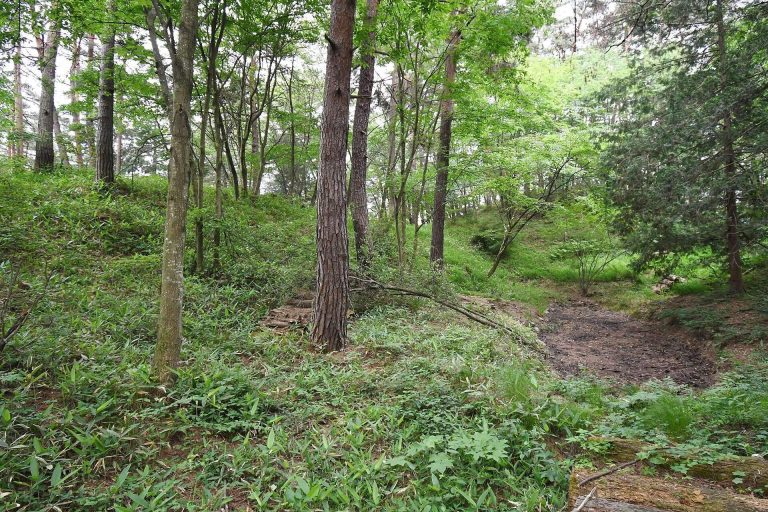
The shrine’s three sanctuaries form a sequence along the Joganji River and Mount Oyama. Mine Honsha stands on the 3,003-metre summit; Ashikuraji Chugu Kigan-den lies about 20 kilometres east of it, and Maedate Shadan is roughly 10 kilometres farther downstream. The wider religious landscape includes the Tateyama range, Jigokudani, and Midagahara. The precincts combine wooden shrine buildings, stone features, and structures shaped by centuries of worship and rebuilding.
Mine Honsha on Mount Oyama
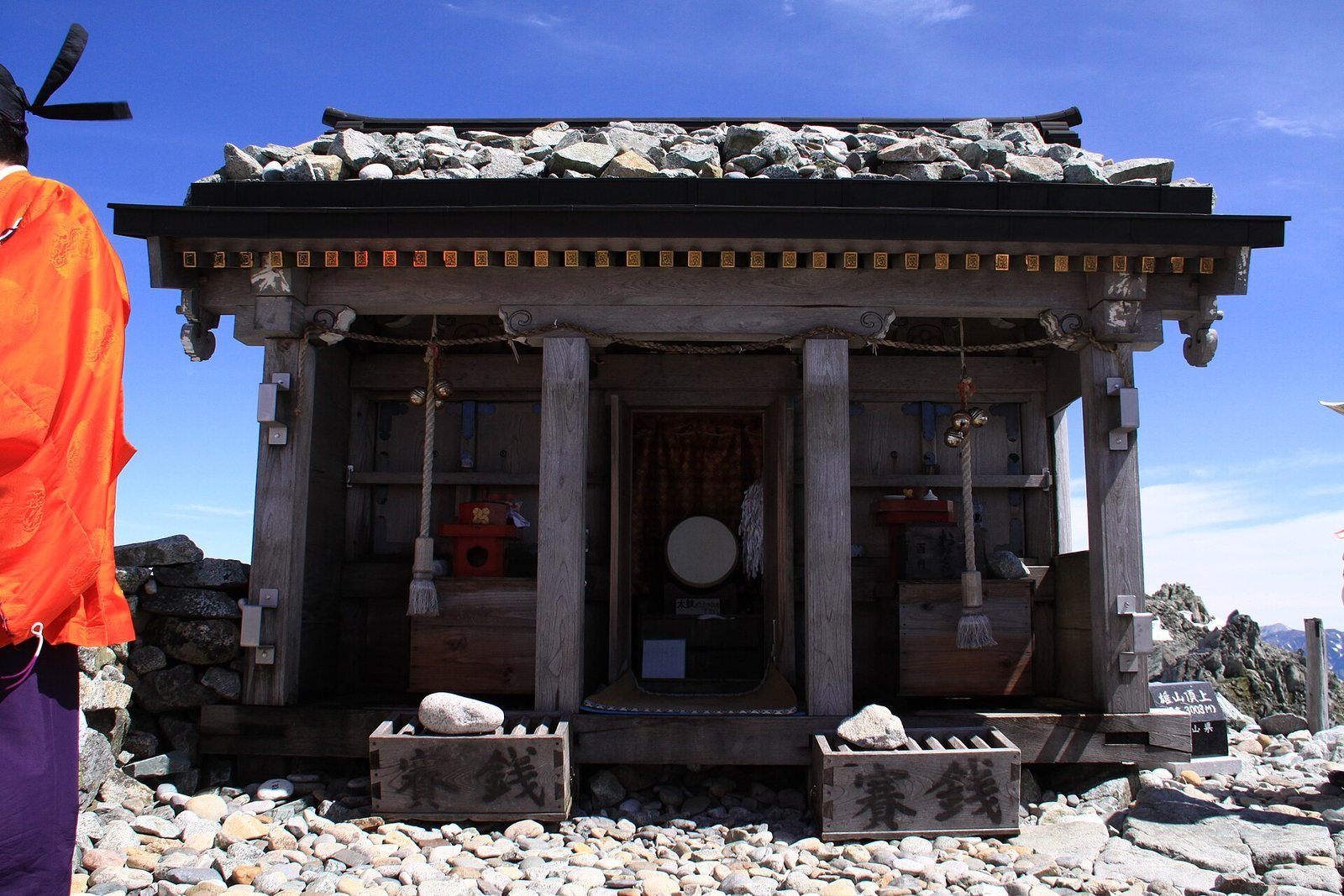
Summit shrine hall
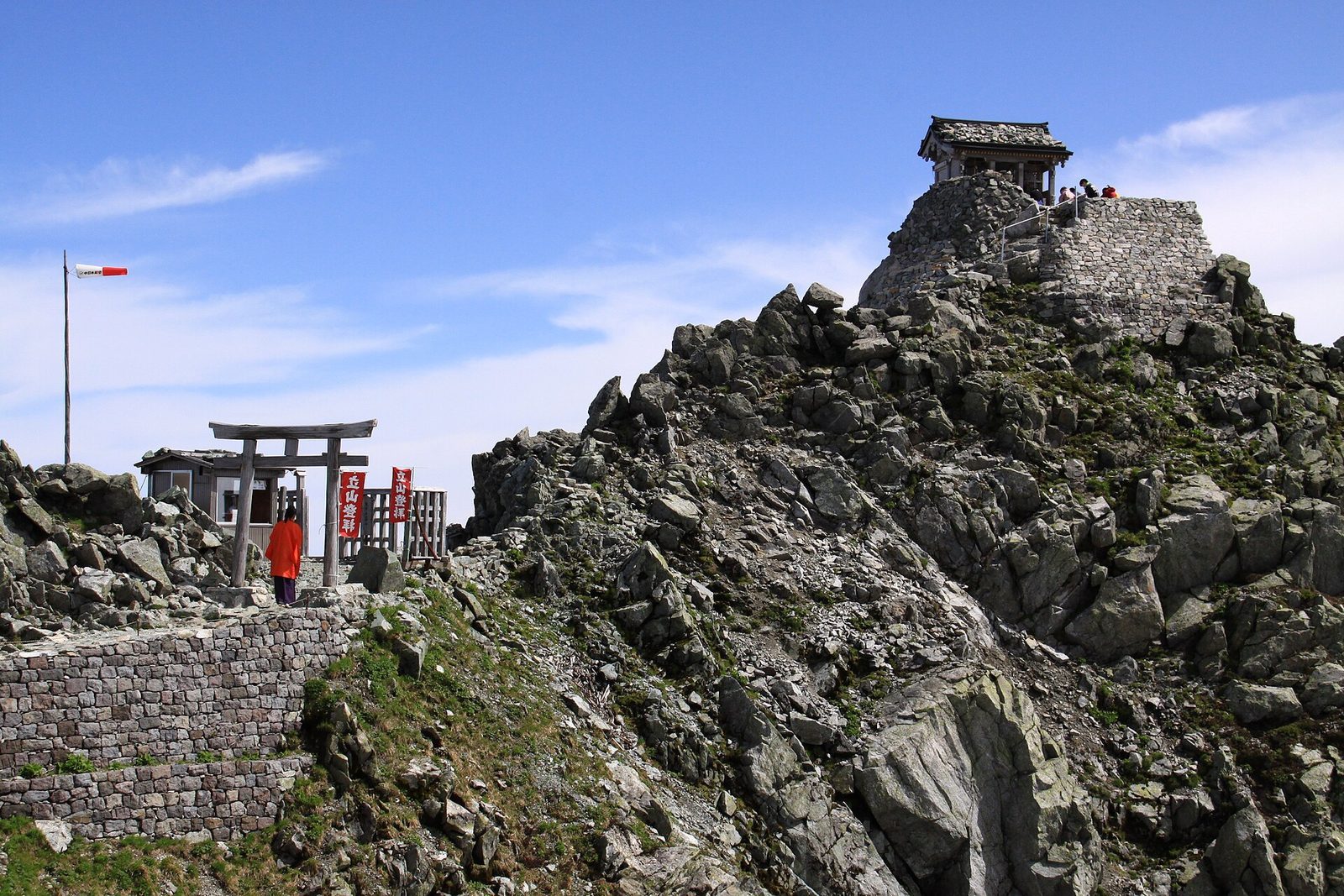
The Mine Honsha enclosure covers about 23 square metres. Its south-facing wooden hall is built of zelkova and stands directly on rock, supported by stone retaining walls. Stones laid across the roof help hold it against strong winds. The building has three structural bays and follows nagare-zukuri, a shrine form with an extended roof slope over the entrance side. Its interior is divided into three spaces: a central storehouse and areas for the kami Izanagi and Ame-no-Tajikarao. Calligraphy by naval admiral Togo Heihachiro and army general Nogi Maresuke appears on plaques to the right and left.
Summit approach and former hall
A torii, a gateway marking a Shinto sacred space, faces the shrine. The summit shrine office stands at about 2,992 metres, while Murodo hut historically served as accommodation, a shrine office, and a place for worship from a distance. The former hall built in 1860 measured about 3.64 metres across and 2.73 metres deep. After its reconstruction, it was placed on display at Hotel Tateyama.
Ashikuraji sanctuary
Great Shrine and Young Shrine
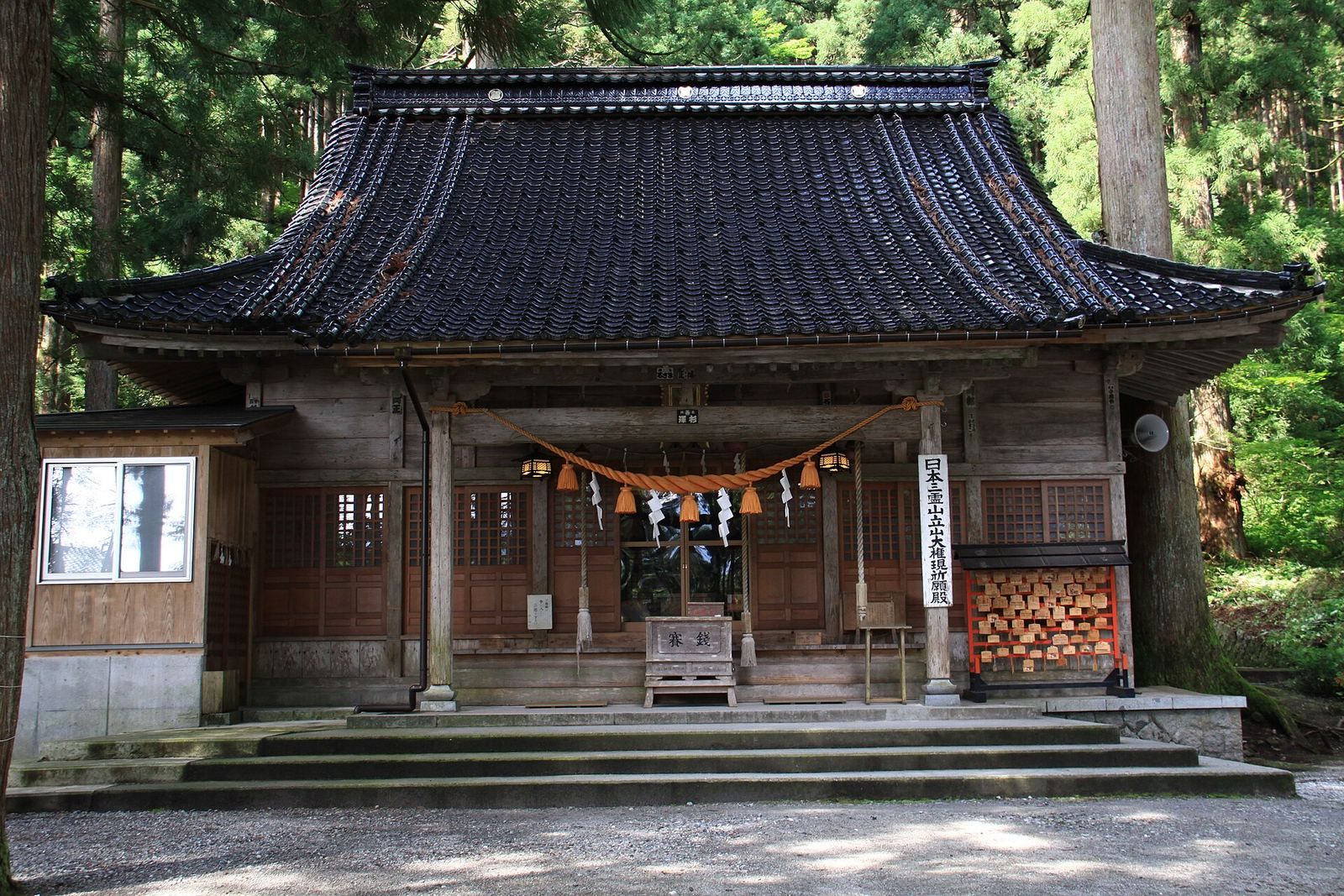
The Ashikuraji precinct covers about 26,446 square metres. At its rear, the wooden Great Shrine has a tiled roof and measures about 2.73 metres wide by 3.64 metres long. Nearby, the Young Shrine, also called the Rock Shrine, stands on rock. It is a wooden building roughly 3.64 metres square, with a copper-sheet roof that replaced an earlier wooden-shingle roof and four-sided lattice doors at the front. A ridge plaque bears the date 1588. Tradition attributes the building to Ouchi Koreyoshi and dates it to 1220, describing it as Ashikuraji’s oldest building.
Prayer Hall and central shrine
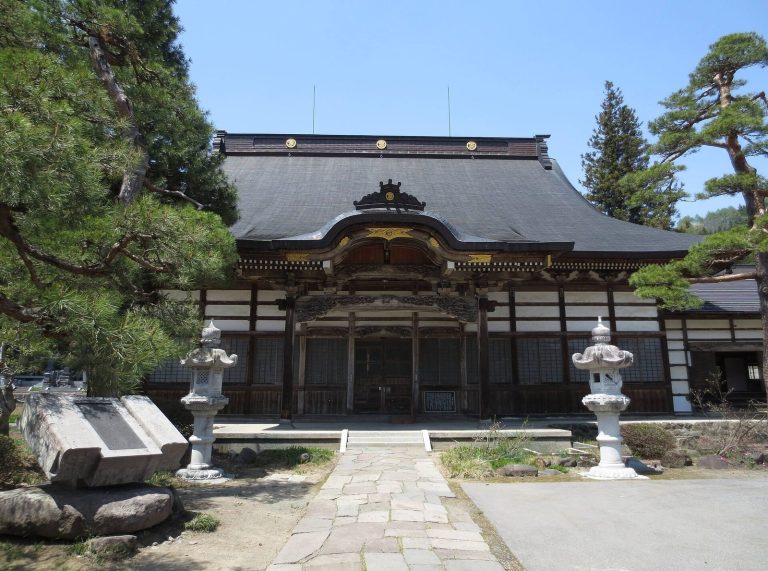
The Prayer Hall, once the complex’s lecture hall, is a wooden building with a tiled irimoya roof, in which hipped lower slopes meet gabled upper sections. It measures about 12.73 metres wide and 9.09 metres long and has a projecting entrance porch. On a low hill behind it stands a cypress-built shrine with a gabled roof and a plaque reading Original Central Shrine. A separate office building occupies the western part of the precinct.
Kaison-do and associated features
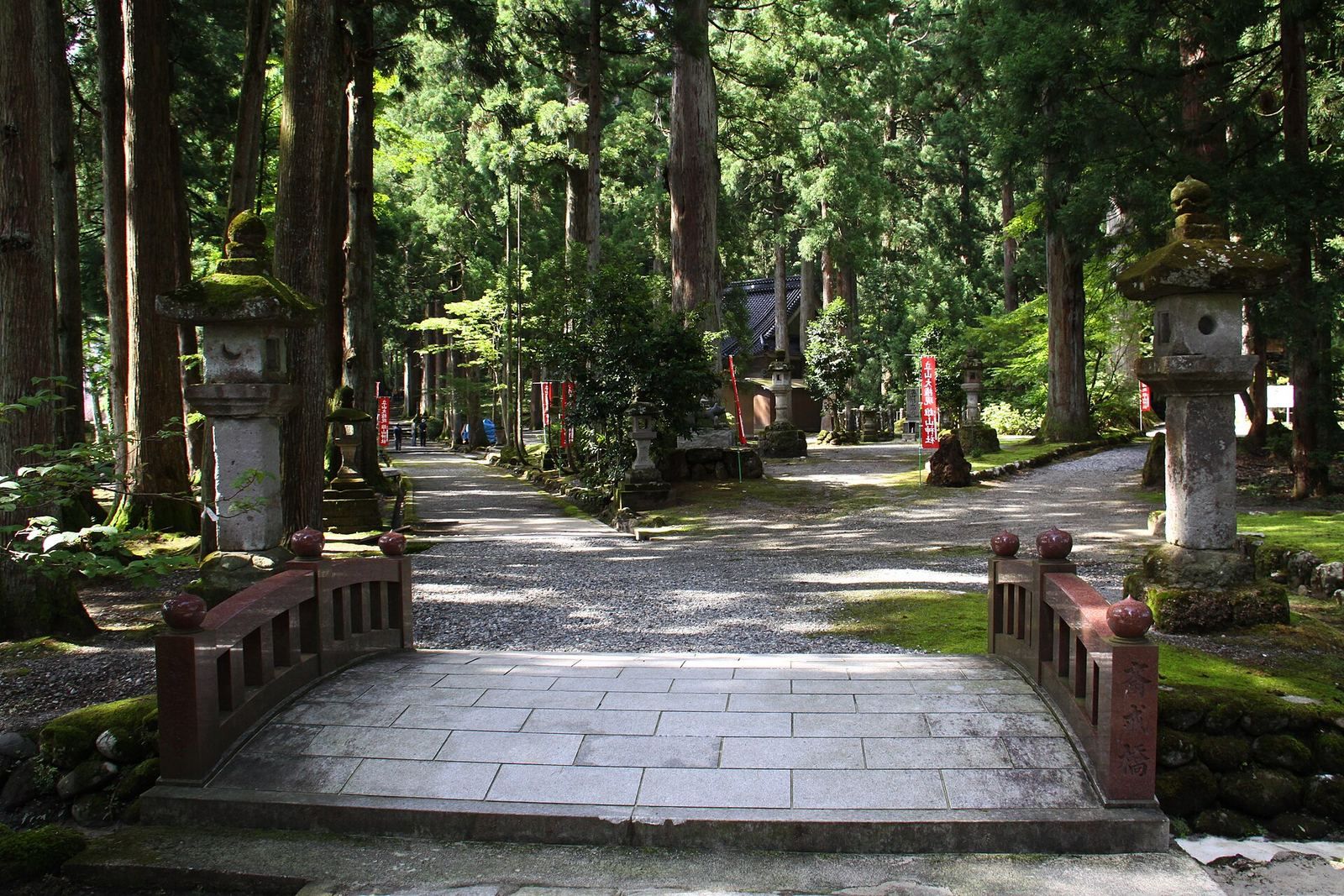
The Kaison-do stands high on the slope at the back of the precinct. The present building is vermilion-painted reinforced concrete. An earlier hall, near Jiko’s tomb, measured about 4.55 metres wide and 9.09 metres long. Other features across the grounds include stone towers dated 1771 and 1861, a hōkyōintō Buddhist stone pagoda, a stone monument, the founder’s tomb, subsidiary shrines, a 1927 stone torii, a 1940 stone shrine marker, a stone stage, and a hand-washing basin. A Koshin shrine stands outside the precinct.
Former monastery and Cloth Bridge
Before its dismantling, the Ashikuraji religious complex included the grandmother hall, Enma Hall, Taishakuten Hall, a large gate, a Nio guardian gate, Jizo Hall, Daikoku Hall, a Tachi-o Tenjin Young Shrine, and more than thirty lodging houses. The grandmother hall was a Chinese-style irimoya building with a curved karahafu gable over its porch, cypress-bark roofing, and a surrounding veranda. At its former site, cleared in 1972, an 1844 stone hand-washing basin survives. The Cloth Bridge crossed near the hall, with Enma Hall on the opposite side.
Cedar grove and religious objects
The Ashikuraji cedar grove contains 122 Tateyama cedars estimated to be 400 to 500 years old. Each has a circumference greater than two metres; the largest measures 6.6 metres around. The trees stand about 40 to 50 metres tall. Maedate Shadan also has a cedar grove within its precinct.
A seated wooden statue of Jiko, 87.9 centimetres high, is made from joined blocks of Tateyama cedar. It probably dates to the early Kamakura period and was originally painted, though much of the pigment has flaked away. Its pose depicts ascetic practice in rain and snow, at waterfalls, and in caves; the hands form a Buddhist ritual gesture. After a fallen tree damaged it, the statue was restored in Kyoto in 1966, when a repository was also built for it.
Three brass offering bowls at Ashikuraji each measure 19.4 centimetres in diameter and 10.3 centimetres high. Their lids are 18.3 centimetres across and 3.9 centimetres high, with paired circular bands of decoration. Inscriptions connect the bowls with the grandmother hall and its principal image. Terashima, a retainer of Jinbo Nagachika, donated them in 1547 for a memorial service. A bronze mirror found in a cave behind the Great Shrine in the early Meiji period measures 20 centimetres across and 1.2 centimetres thick. Its reverse shows peonies, two magpies, and butterflies in a naturalistic style. Although its style has been associated with the Fujiwara period, it is thought to date to the Kamakura period.
Records and maps associated with Iwakuraji include 481 documents dated from 1492 through the Showa period and 35 old maps, kept in a chest. Two andesite lanterns, each about 3.1 metres high, stand along the approaches to the Great Shrine and Young Shrine. Saeki Motoo donated them in 1689. The precinct also contains two portable shrines.
Maedate Shadan
Main hall
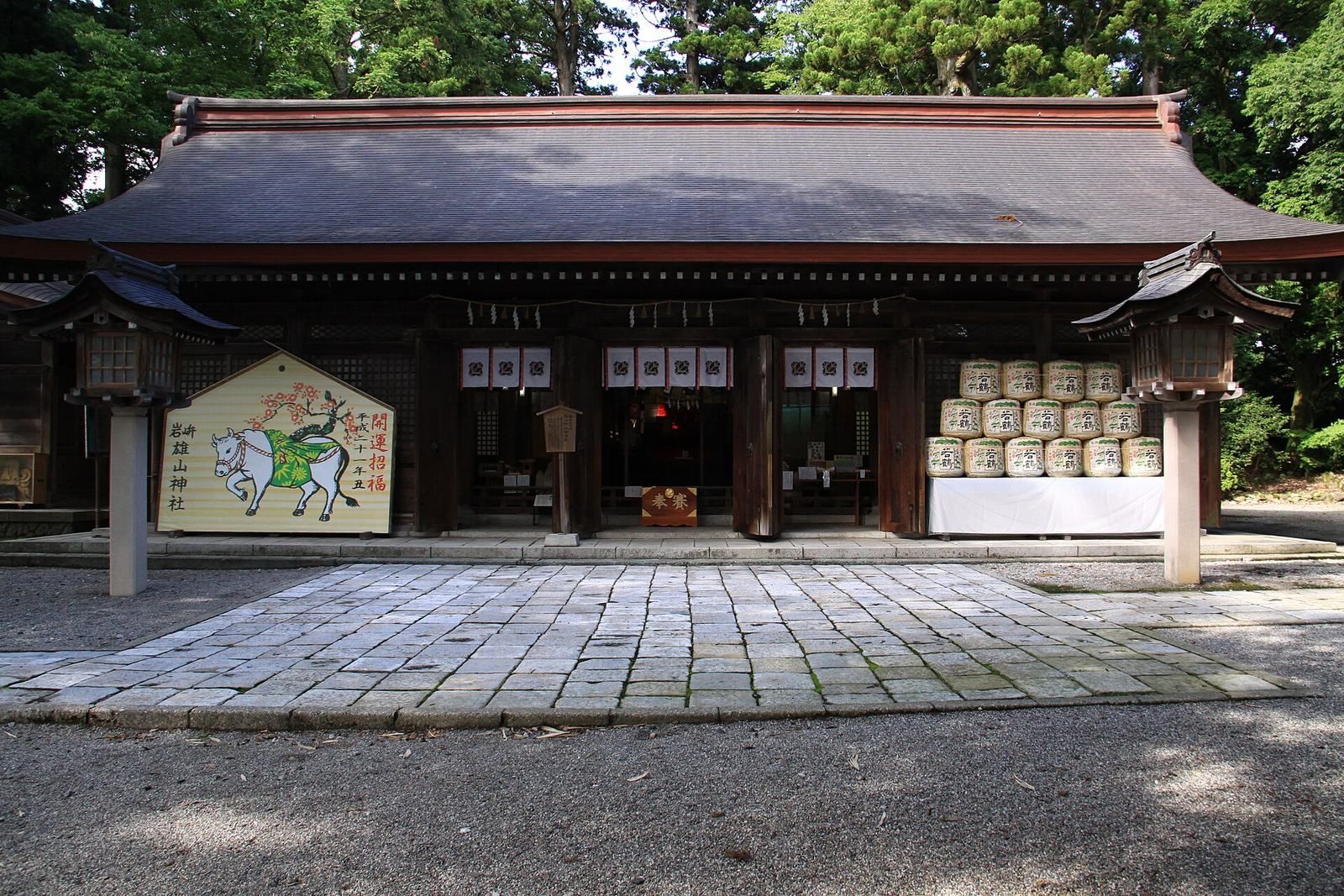
Maedate Shadan occupies about 17,521 square metres. Its wooden main hall has five structural bays and follows nagare-zukuri, with a single-bay entrance porch and a cypress-bark roof. It measures about 10.78 metres across, 9.9 metres long, and 6.45 metres high. It is the largest five-bay shrine hall of this architectural form in the Hokuriku region. The building underwent dismantling and repair with government support in 1923. Its roof covering changed from wooden shingles to cypress bark in 1945, and the hall was renewed in 2000.
Precinct buildings and subsidiary shrines
A building campaign from 1940 to 1942 added the worship hall, offering hall, food-offering facility, enclosure wall, former office, ritual lodging, front and east shrine gates, stone lanterns, and hand-washing facilities. An earlier worship hall from the Muromachi period was removed. A new office was completed in 1995, and part of the former office became ritual lodging. The layout includes front and east torii and their corresponding shrine gates, as well as subsidiary Tachi-o, Inari, and Hachiman shrines. In 1940, several damaged subsidiary shrines were combined with Hachiman Shrine. A stone stage was added in 2009.
Stone figures and ritual vessel
Stone komainu, guardian figures commonly placed at shrine entrances, stand beside the offering box at the worship hall. Made of green tuff, they measure 91.5 centimetres high, 48.5 centimetres wide, and 31.8 centimetres thick. Gyokusen-in, wife of Maeda Toshinaga, donated them. The shrine’s cast-iron yudate cauldron, used to heat water for a purification rite, measures about 1.33 metres across and 0.73 metres high. Kanamori Hikobei of Takaoka cast it, and Maeda Nariyasu donated it. Its companion cauldron was swept into the Joganji River in the 1858 flood. Worshippers traditionally sprinkled themselves with water heated in the surviving vessel as a pledge of purity.