Our Lady of Smolensk Church: An Orthodox Church in Borodino
Site at a Glance
- Popularity
- Medium
- Country
- Russia
- Primary era
- Early Modern
- Eras represented
- Early Modern, Modern
- Civilizations
- Russian
- Site type
- Religious
- Remains
- Church
On this page14 sections
History
Our Lady of Smolensk Church is a two-storey Orthodox church in Borodino, Russia, founded in 1697 and built between 1697 and 1701 in Moscow Baroque, a decorative Russian style that developed in the late seventeenth century, and traditional Old Russian forms.
Earlier churchyard and foundation
Before the Time of Troubles, Russia’s early seventeenth-century period of political crisis and contested succession, a churchyard here contained a Church of the Exaltation of the Holy Cross and a chapel to St. Nicholas. In 1626, the area’s fields were described as overgrown with forest.
The church’s foundation dates to 1697. The following year, village owner Timofey Savyolov petitioned for permission to build it. He and his brother Pavel, both high-ranking officials at the Russian court, are identified as its founders. Timofey was also the brother of Joachim, then Patriarch of Moscow, the head of the Russian Orthodox Church. The upper church was consecrated in 1701 for the Nativity of Christ, during the tenure of Timofey’s son Peter. The first priest was Semyon Yakovlev.
Battle damage and restoration, 1812–1839
On 25 August 1812, during the Battle of Borodino, the church’s bell tower was used to watch French troop movements. A cannonball struck the dome and badly damaged the tower. After French forces captured the village, they burned the church’s interior. In winter, the damaged building sheltered villagers returning from the forests to their burned homes.
The church remained closed from 1812 until 1839. In 1814, village owners Elizabeth Savyolova and Alexandra Davydova sought permission to have their peasants join another village’s parish. The Moscow Ecclesiastical Consistory, a church administrative body, allowed this only until the Borodino church was restored. Margarita Tuchkova, whose husband had been killed at Borodino, led restoration efforts. The lower chapel was restored and consecrated on 16 July 1816. Metropolitan Filaret of Moscow visited in 1824 and supported repairs to the upper church. State funds and donations paid for the work, completed by 1826, but the upper church was not then consecrated.
In 1837, heir to the throne Alexander Nikolayevich gave the church 500 rubles, his first donation to it. Emperor Nicholas I bought Borodino and its surroundings in 1839 and gave them to his son, the heir. The imperial family also had a palace built near the church. On 22 July that year, Filaret consecrated the upper church in honor of the Smolensk Icon of the Mother of God, replacing its original dedication to the Nativity of Christ.
Imperial-era visits and commemoration
Emperor Alexander II and Empress Maria Alexandrovna visited the church in 1861. In 1891, Grand Duke Sergei Alexandrovich and Grand Duchess Elizabeth Feodorovna also came to the village and church. The centenary of the Battle of Borodino brought further attention to the church: Emperor Nicholas II visited on 26 August 1912.
Closure, wartime damage, and restoration
The church closed in 1930 and was handed to a workers’ cooperative. In autumn 1941, a machine-gun position was installed in its bell tower. The church survived the war, but brick was removed from the upper walls until the early 1950s, and the bell tower was completely destroyed. Epifan Yakovin, the local collective-farm chairman and a war veteran, campaigned for the church’s demolition.
Restoration began in preparation for the 150th anniversary of the Battle of Borodino. Painters and scholars, including Pavel Korin, M. V. Alpatov, and Dmitry Likhachev, supported the work. Filmmaker and actor Sergei Bondarchuk made a decisive appeal, arguing that the building should be restored for the filming of War and Peace, the adaptation of Leo Tolstoy’s historical novel. On 16 March 1962, permission was granted to restore the church’s external silhouette. After reconstruction, the building housed a branch of the Borodino Military-Historical Museum-Reserve, a museum institution that preserves and interprets a historic area.
Return to worship
The first service after the closure took place in the lower church in 1989. At the museum-reserve’s initiative, the church was transferred to the Moscow Diocese, an ecclesiastical district overseen by a bishop. Igor Vostrikov became rector in 1990, and services in the upper church resumed in 1995. Archbishop Gregory of Mozhaisk consecrated the upper church on 16 July 2006, following extensive repairs. The church remains active in the Diocese of Odintsovo and is designated a cultural heritage site of federal significance in Russia.
Remains
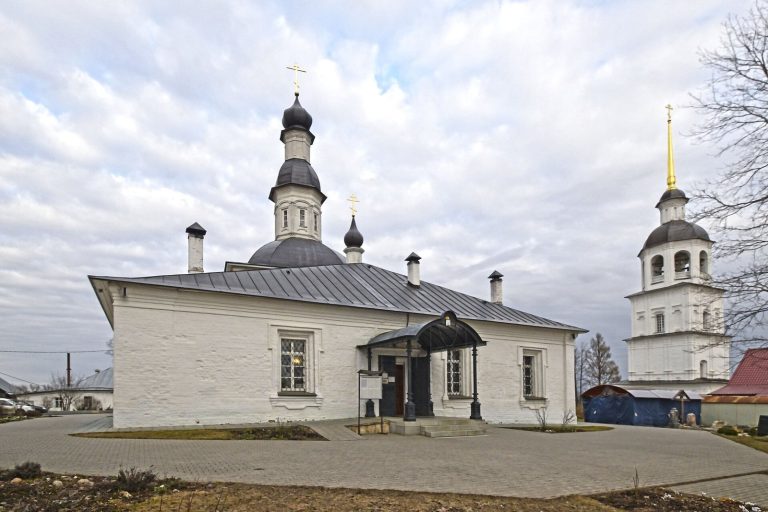
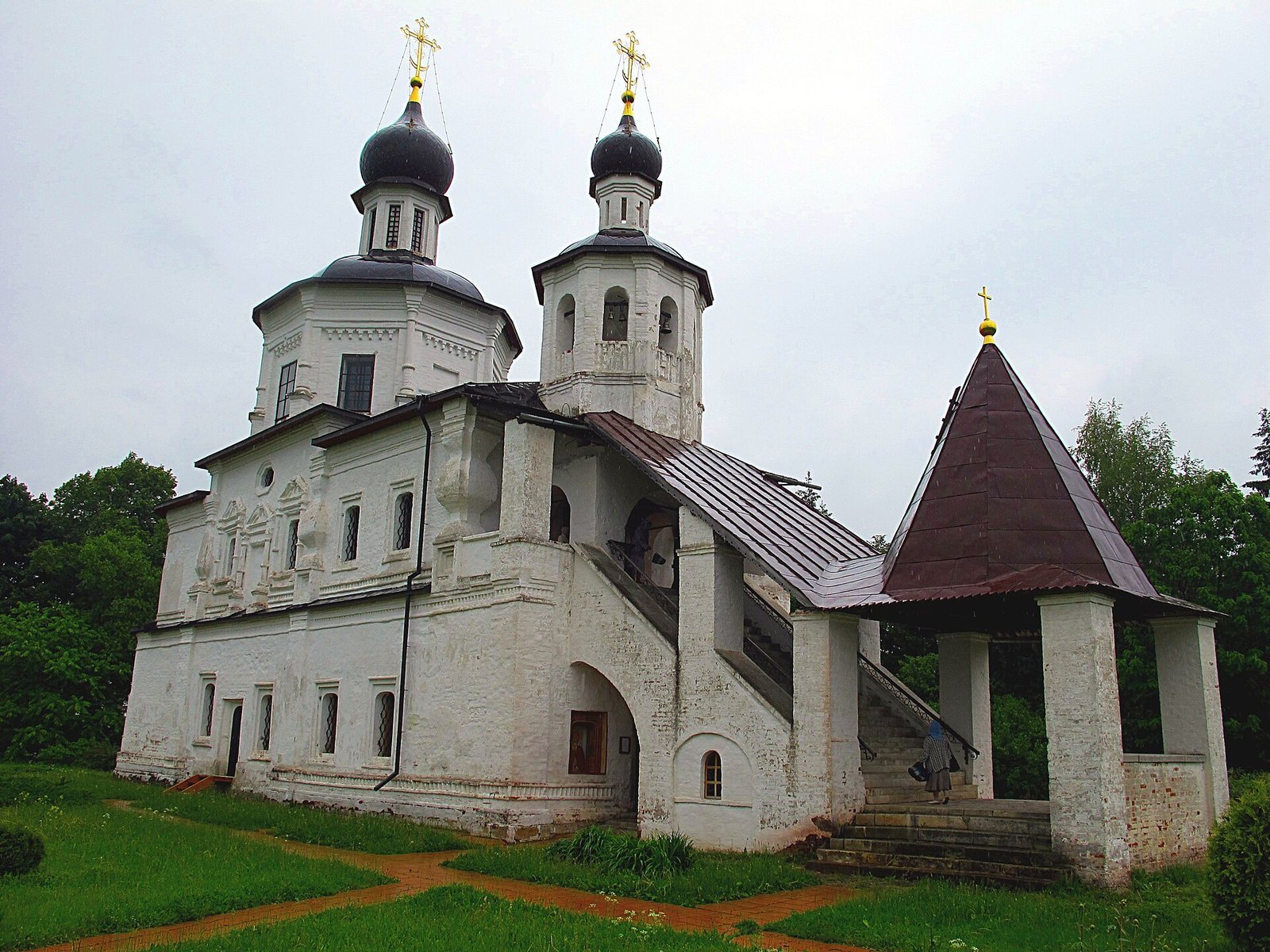
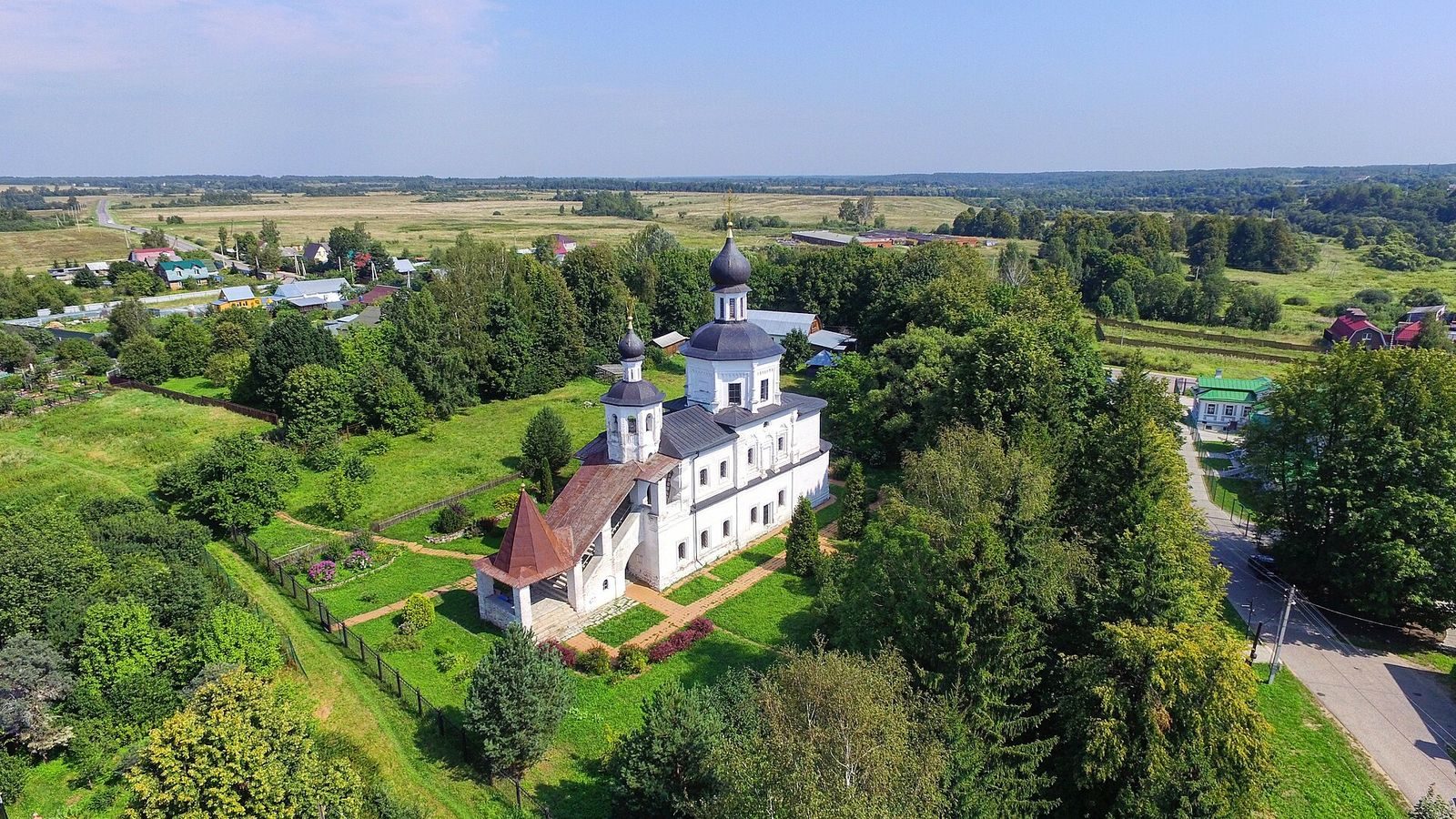
The small masonry church stands on a hill in central Borodino, slightly set back from the road. Its two-storey, ship-like composition combines a square main section with an upper level that rises toward an onion-shaped dome.
Form and exterior
Overall composition
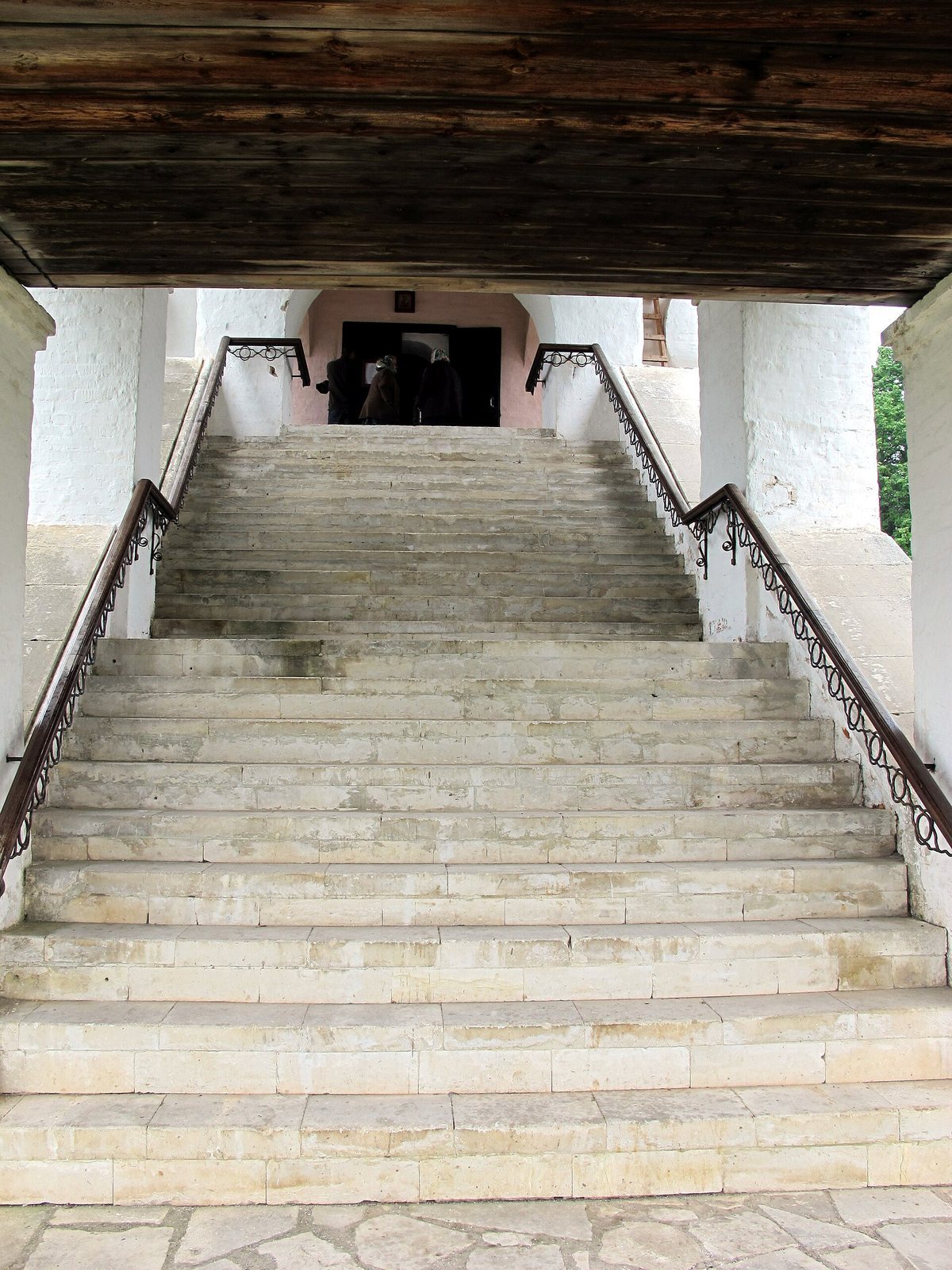
The lower storey is covered by cloister vaults, whose curved ceiling surfaces meet at a central point. Above it, the upper level rises from a square base into an octagon and ends in an open drum, the structure supporting the dome, with an octagonal interior. An adjoining hall extends from the main section and ends to the west in a stairway characteristic of seventeenth-century churches. A single-tier bell tower once stood above the upper stair landing, below the dome. Open wooden galleries originally ran along the north and south façades.
Exterior ornament
Both storeys have richly carved window surrounds. Patterned half-columns divide the faces of the upper octagon, which is capped by a decorative band. The narrow, vertically proportioned windowed drum strengthens the building’s upward outline. Small decorative posts divide the projecting sanctuary ends, in place of plain, shallow vertical bands on the walls.
Worship spaces and furnishings
Chapels and icon screens
The upper floor is the principal church, while the lower floor contains a heated winter chapel for worship in cold weather. Each level had an iconostasis, a screen of icons separating the sanctuary from the main worship area. The upper church’s iconostasis came from Alekseevsky Monastery during construction of the Cathedral of Christ the Savior on the monastery’s former site. Emperor Alexander II provided the lower church’s iconostasis.
Icons and painted decoration
An ancient Smolensk icon of the Mother of God that had accompanied Russian general Pyotr Bagration, a prominent commander in the Napoleonic Wars, was kept in the church. In 1861, the church received an image of Christ known as the Savior Not Made by Hands, a traditional Eastern Christian icon type understood as a miraculous image of Christ’s face. An icon of St. Sergius presented in 1891 had a precious-metal covering.
In 1912, A. P. Khatulev painted sacred images and ornament in a gilded, traditional style inside the church. During later restoration, Moscow artists led by P. A. Stepanov repainted the lower church’s walls.
Restored fabric
Work on the building’s masonry included replacing the floors, plastering the walls, and renewing the windows and roof. The crosses were repaired and gilded, and new window grilles and entrance doors were installed.