Monastery of Stavros: An Orthodox Monastery and Parish Church in Cyprus


Site at a Glance
- Rating
- 4.6
- Popularity
- Medium
- Country
- Cyprus
- Primary era
- Early Modern
- Eras represented
- Early Modern
- Civilizations
- Ottoman
- Site type
- Religious
- Remains
- Monastery
On this page12 sections
History
The Monastery of Stavros, also known as the Monastery of the Holy Cross, is a historic Orthodox monastery in Omodos, Cyprus, whose origins are traditionally linked to a chapel dated to AD 210 and a fourth-century foundation in the Byzantine tradition. It belongs to the Church of Cyprus and the Limassol Metropolis, an ecclesiastical jurisdiction headed by a metropolitan bishop. The monastery was later converted into a parish church, although its former monastic buildings remain associated with its religious history.
Origins and the True Cross tradition
Tradition attributes the monastery’s foundation, possibly around AD 301, to Saint Helena, the mother of Constantine the Great. Christian tradition particularly associates Helena with the discovery and distribution of relics of the True Cross. Historical research has not established a precise foundation date, but the monastery’s beginnings are linked with Helena’s visit to Cyprus in AD 327.
According to the foundation tradition, local people repeatedly saw a light or fire in a bush. When they excavated the place, they found a cave containing a relic of the True Cross. A chapel was built above it, and this chapel was later enlarged into a church and then into a monastery. A substantial settlement developed around the foundation. Saint Helena was also said to have arranged the transfer of relics connected with the Passion of Christ and other saints. Miracles attributed to the Cross helped establish the monastery as a Christian pilgrimage center.
Medieval and Ottoman periods
During the period of the Crusader states on Cyprus, Orthodox monks were expelled from the monastery. From 1471, the institution was held by Roman Catholic Benedictines, members of a monastic order following the Rule of Saint Benedict. Orthodox activity later resumed.
Muslim forces looted the monastery during the Egyptian invasion of 1426. After the Ottoman conquest of Cyprus in 1570, the complex was plundered again. Many monks and laypeople who had taken refuge there were killed or captured. The monastery nevertheless continued to operate under Ottoman rule. Around 1700, it received privileges from the Ottoman sultan, including protection granted through a firman, a formal sultanic decree or charter. Its immovable property extended to Istanbul and the Russian Empire.
Rebuilding and nineteenth-century history
Major rebuilding took place during the 1820s under the authority of Paphos Bishop Chrysanth. The work included the western wing and part of the northern wing, along with new Rococo furnishings and carved-wood decoration. The monastery also supported Filiki Eteria, a secret Greek organization founded in 1814 to promote independence from Ottoman rule and involved in preparing the Greek War of Independence of 1821. Its abbot Dositheus was arrested and executed in Nicosia on 10 July 1821 with the leading church hierarchs of Cyprus, including Paphos Metropolitan Chrysanth, Kition Metropolitan Meletius, Kyrenia Metropolitan Lawrence, and Archbishop Cyprian of New Justiniana and All Cyprus.
In 1850, the main church was repaired or enlarged and acquired its present appearance. Artists from the Russian Empire assisted with its painted decoration, while the final paintings of the church and monastery were produced by the Greek iconographer Othon Yavopoulos. A bell donated by Dositheus in 1812 also survives. It is described as the first bell to ring in Cyprus during the Ottoman occupation.
Parish church and museum
British colonial rule over Cyprus from 1878 to 1960 brought further difficulties for the monastery’s parishioners. In 1917, its property was divided among the inhabitants of Omodos. Several years later, after the last monks had departed, the monastery was dissolved as a monastic community and became a local parish church. The former monastic buildings were subsequently adapted as a museum. The principal feast remains the Exaltation of the True and Life-Giving Cross, and the monastery continues to draw pilgrims because of its Cross relics.
Remains
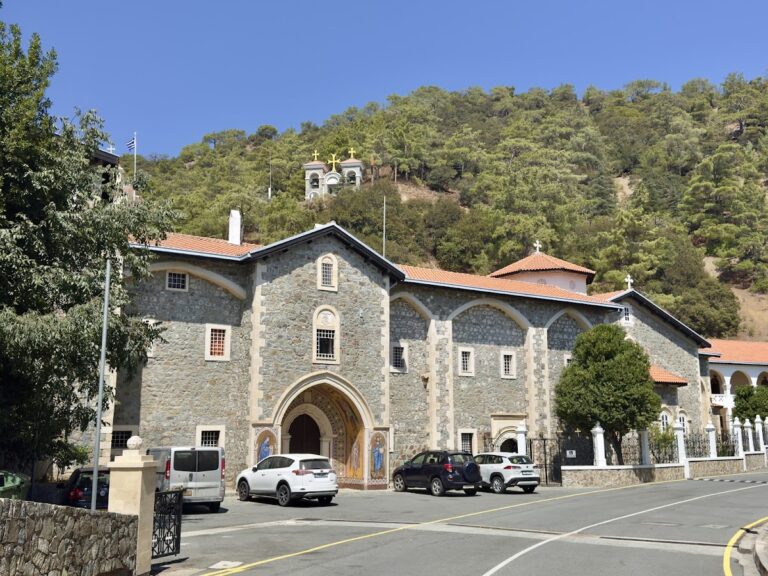
The Monastery of Stavros is a Byzantine-style stone complex organized around a central church and former monastic buildings. Its surviving fabric reflects the early religious foundation, the eighteenth-century waterworks, and the extensive rebuilding of the nineteenth century. The cave associated with the discovery of the Cross relic remains part of the monastery’s religious tradition, while the church and former monastic wings preserve furnishings, carved decoration, relics, and commemorative objects.
Church and sacred relics
Central church
The central church is the principal religious building and now functions as the parish church. Its interior contains a gilded iconostasis, an icon screen separating the sanctuary from the main body of an Eastern Orthodox church, dating from 1817. It was presented from the Russian Empire and carries Russian-style icons with a Slavonic inscription. A Cross incorporating relics associated with the Passion is set in or connected with the iconostasis. An icon of the Exaltation of the True and Life-Giving Cross stands to the right after entering the church, while a memorial plaque near the entrance gives AD 210 as the foundation date.
Cross and apostolic relics
The monastery preserves a relic of the True Cross in a precious liturgical cross, together with fragments of the so-called Holy Rope, traditionally identified as the rope used to bind Jesus to the Cross. The Holy Rope is described as the only surviving relic of its kind. The cave beneath the foundation tradition is associated with the discovery of the Cross, and a chapel was traditionally built above it before the church developed.
The relics of the apostle Philip include his skull. It was kept in Constantinople until 31 July 1204, transferred to Arsinoe near Paphos after the Fourth Crusade, and later moved to the Holy Cross church at Omodos for safekeeping after the theft of its valuable reliquary between 1735 and 1770. It was located at Omodos by 1788. The skull is displayed in a silver-gilt reliquary, a container made to preserve and present sacred relics, bearing Greek and English inscriptions and a list of relics. The reliquary is also described as carrying the personal seals of Emperor Theodosius the Great and Emperor Heraclius.
Other preserved relics include particles associated with Saint Nicholas, Saint Barbara, Saint Marina, Saint Charalambos, Saint Panteleimon, and Saint Tryphon. The collection also includes relics of 26 saints and a stone from Golgotha, the place traditionally associated with the crucifixion of Jesus.
Monastic wings and waterworks
Western and northern wings
The western wing and part of the northern wing were constructed during the major rebuilding of the 1820s. Their halls and corridors received elaborate carved-wood decoration in the Rococo style, an ornate artistic style known for intricate carving and decorative asymmetry. These woodcarvings are described as among the largest surviving examples in Cyprus. After the monastic community ended, the former monks’ buildings were converted into a museum.
Cistern and fountain
A water cistern and fountain were installed at the southwestern edge of the monastery in 1757 through the work of the monk Germanos. Later rainwater-collection cisterns supplied the complex with water. Until 1983, the monastery relied on cisterns and had no electricity, telephone, or piped water.
Nearby sites