Our Lady Church Belzig: A Romanesque Urban Church in Germany
Site at a Glance
- Rating
- 4.6
- Popularity
- Very Low
- Country
- Germany
- Primary era
- Medieval
- External website
- Open
- Eras represented
- Medieval, Early Modern, Modern
- Civilizations
- German, Holy Roman Empire, Margraviate of Brandenburg
- Site type
- Religious
- Remains
- Church
On this page12 sections
History
Our Lady Church Belzig, also known as St. Marien, is a Romanesque urban church in Bad Belzig, Germany, built during the second half of the thirteenth century. Romanesque architecture is a medieval style associated with heavy masonry, thick walls, and restrained rounded forms. The exact construction date is unknown, although an earlier plan from the first half of the thirteenth century appears to have envisaged a principal apse and apses projecting from both transept arms. That design was not completed.
Medieval Expansion
The nave was probably enlarged in the fifteenth century by the addition of a southern aisle. The tower was also likely raised with a two-tower upper design in mind, but only its northern side was finished. The church therefore acquired a form shaped by successive changes rather than by the execution of a single original plan.
Fire, Rebuilding, and Later Repairs
A fire in 1636 caused the tower to collapse. Between 1657 and 1665, masons repaired the damage and rebuilt large portions of the northern nave wall. The southern side of the tower was then covered by a lean-to roof, which slopes upward against a taller wall. The northern tower was reconstructed again in 1696 and 1697. Another fire, in 1850, damaged the tower and led to masonry repairs at its northeastern corner.
A keystone recalls a sermon preached by Martin Luther on 14 January 1530. Luther was the German theologian and reformer whose teachings initiated the Protestant Reformation. The church’s 1747 baroque organ and other historic small organs later became the basis for the Brandenburg Organ Museum.
Twentieth- and Twenty-First-Century Changes
Renovation work took place from 1974 to 1978 with financial support made available between 1973 and 1975 through a church-construction program of the Evangelical Church in Germany in the German Democratic Republic, the East German state that existed from 1949 to 1990. The two arched openings of the tower hall were sealed, a timber-beam ceiling was installed in the nave, and the nave was adapted as a community center.
From 2022 to 2024, a jury-selected art competition led to a redesign of the altar area. The sculptor Hans-Georg Wagner produced Connecting Trinity, an ensemble that joins the existing furnishings with newly made wooden elements.
Remains
Layout and Exterior
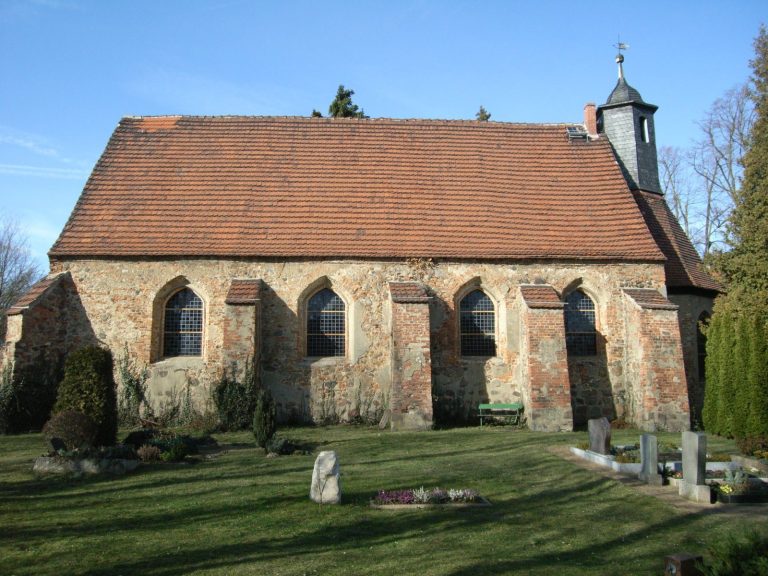
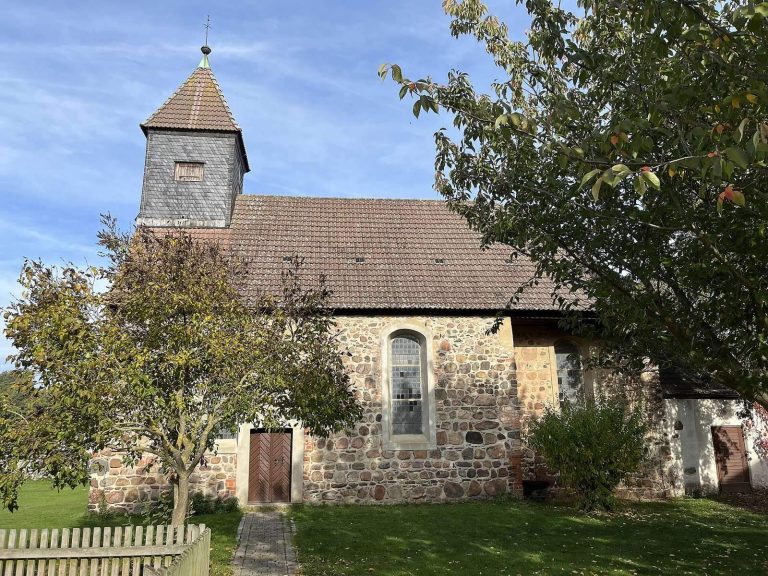
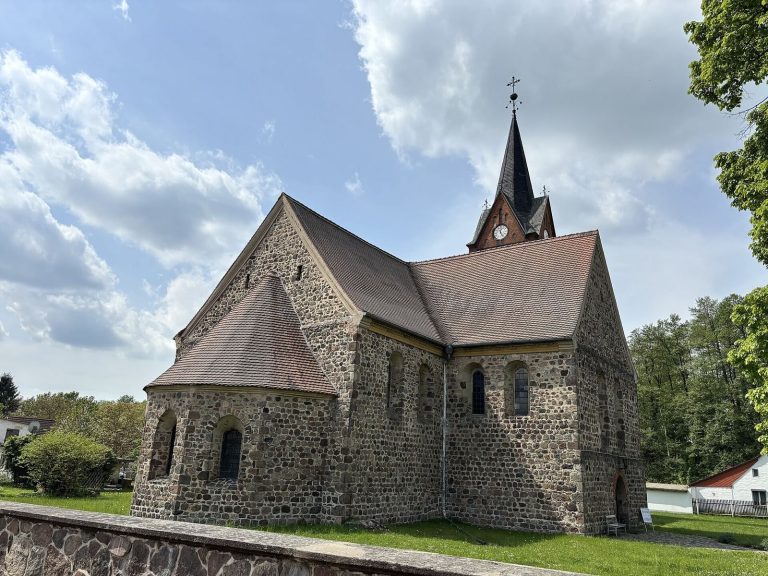
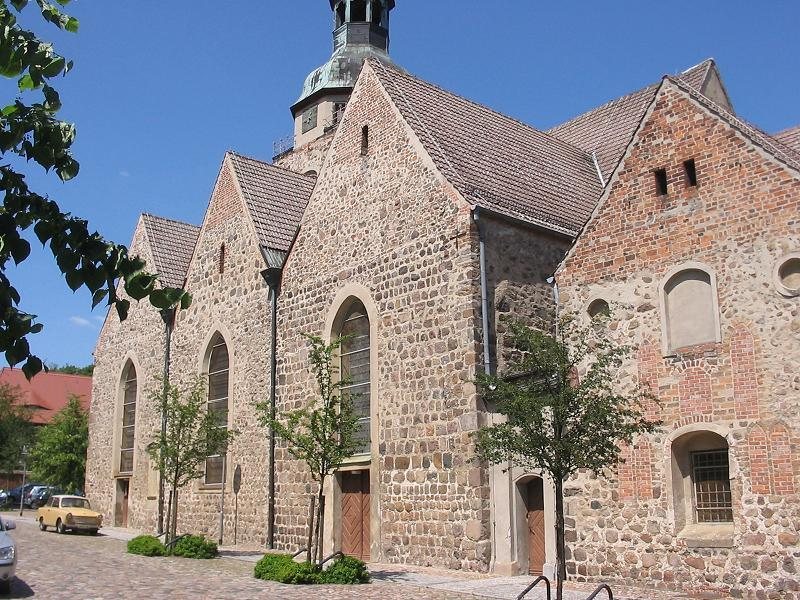
The church stands northeast of Bad Belzig’s market square in Brandenburg’s Potsdam-Mittelmark district. Its walls are built from regularly dressed fieldstone, laid in mostly even courses. The main body is a single-nave hall with a narrower rectangular choir at the east. Lower additions extend from the hall as transept arms, while a western extension containing the tower projects beyond the nave’s width.
A stepped entrance portal opens at the base of the tower. Its arch was faced again with masonry during the nineteenth century. Above, the northern tower ends in a baroque octagonal upper storey with a double lantern and curved hood. A lantern is a raised, often windowed structure crowning a tower or dome.
Choir and Attached Spaces
The nave is lit by pointed-arch windows. The southern windows of the choir are narrow lancets, while the northern openings are smaller and set higher. This uneven arrangement has led to the suggestion that a sacristy once stood beside the choir on the north. A sacristy is a room for storing liturgical objects and preparing for services.
Another sacristy probably stood against the southern choir wall from the beginning of the fourteenth century. It began as a one-storey fieldstone building and contains a barrel vault, a continuous semicircular or segmental ceiling. Blocked recesses in its southern gable, along with its windows, recesses, and brick gable, belong to the original building phase. The eastern gable of the church is marked by a large circular recess.
Furnishings and Artworks
Altarpiece
The wooden altarpiece was given by the Fugmann couple in 1660. Its central scene combines the Last Supper and the Crucifixion. Columns frame small doors carrying images of the donors. Beside the predella, the lower part of an altarpiece, stands a movable ornament in curling cartilage-work forms, a late Renaissance and Baroque style of carved decoration. The upper structure is crowned by a halo added in 1815.
Pulpit and Baptismal Font
Chr. Witt of Brandenburg an der Havel made the wooden pulpit in 1659 and 1660. Its many-sided basket rests on a turned support and carries representations of Jesus Christ and the four Evangelists, Matthew, Mark, Luke, and John, together with further cartilage-work decoration. A sandstone baptismal font from around 1600 came to the church from the Monks’ Church in Jüterbog.
Older Sculptures and Painted Panels
A wooden cross dates from around 1520, while a carved figure of a female saint dates from about 1430. The saint is lent by the municipality of Grabow in Mühlenfließ. Fifteen panels painted in 1616 portray episodes from the life of Christ. They were moved from the Gertrauden Chapel in 1959 and placed on the balustrade of the southern gallery in 1978.
Organ and Memorial Stones
The northern transept holds a baroque organ made in 1747 by Johann Adolarius Papenius. It was brought from Hordorf in Saxony-Anhalt to Bad Belzig in 1974, restored, and inaugurated in 1979. The instrument has 20 stops across two manuals and a pedal, as well as a manual coupler and a connection between the second manual and the pedal.
An epitaph, a memorial monument or inscription for a deceased person, in the southern transept commemorates Christian Ernst Müßigk, who died in 1724. A second, weathered stone beside the southern nave wall commemorates a woman who died in 1580.