Fortezza Vecchia: A Coastal Fortress in Sardinia


Site at a Glance
- Rating
- 4.5
- Popularity
- Low
- Country
- Italy
- Primary era
- Early Modern
- Eras represented
- Medieval, Early Modern
- Civilizations
- Crown of Aragon, Kingdom of Sardinia, Spanish
- Site type
- Military
- Remains
- Fort
On this page8 sections
History
Fortezza Vecchia is a small fourteenth-century fortress in Italy, located near Villasimius on the southern coast of Sardinia. Its early history belongs to the period when the Crown of Aragon, the dynastic monarchy that ruled or claimed territories across the western Mediterranean, brought Sardinia into its political sphere.
Aragonese Origins
The fortress’s predecessor belonged to the Carroz family, which received the stronghold as a fief after supporting the Crown of Aragon during the conquest of Sardinia in 1323–1324. Villasimius was then known as Carbonara, a name that survives in Capo Carbonara.
Sixteenth-Century Reconstruction
During the sixteenth century, repeated raids by pirates from the Barbary states, the North African states and political entities associated with maritime raiding in the western Mediterranean, prompted a wider effort to strengthen Sardinia’s coastal defenses. The island was administered by a viceroy, a governor acting on behalf of a monarch, for the Spanish Crown under Philip II.
The decision followed Charles I’s campaign against Tunis in 1535 and the failed naval expedition against Algiers in 1541. Charles I was also known as Emperor Charles V. Reconstruction of Fortezza Vecchia began in 1578, during the viceroyalty of Miguel de Moncada. A garrison occupied the fortress from 1590 to 1591, when it was called Fortalesa Biesa de Carbonayre. A document from 1599 placed it within the Fourth Division, which extended from Villanova, a district of Cagliari, to Sarrabus.
Savoyard Service and Later Defenses
Under the House of Savoy, the European dynasty that governed Sardinia before the island became part of the Kingdom of Italy, the garrison in 1767 comprised an Alcaide, the commander or governor of a fortified post, and three soldiers. They were equipped with two cannons.
Belgrano da Famolasco restored the fortress in 1769–1770. Further work followed in 1803. On 20 July 1812, the garrison repelled an attack by Barbary pirates after the attackers had captured the towers on the islands of Serpentara and Cavoli, respectively northeast and south of Capo Carbonara. In 1790, the engineer Quaglia had added several small bastions, projecting fortifications designed to allow defensive fire along the surrounding walls, to eliminate blind angles, or areas that could not be covered by rifle fire.
End of Military Use and Restoration
The fortress remained in operation until 1847, when its last Alcaide, Antonio Zara, was dismissed. It then fell into disrepair. The Cagliari superintendency responsible for protecting and restoring architectural, artistic, and historical heritage, the Soprintendenza ai BAAAS di Cagliari, restored the fortress between 1968 and 1973. Additional exterior work followed in 1987.
Remains
Setting and Plan
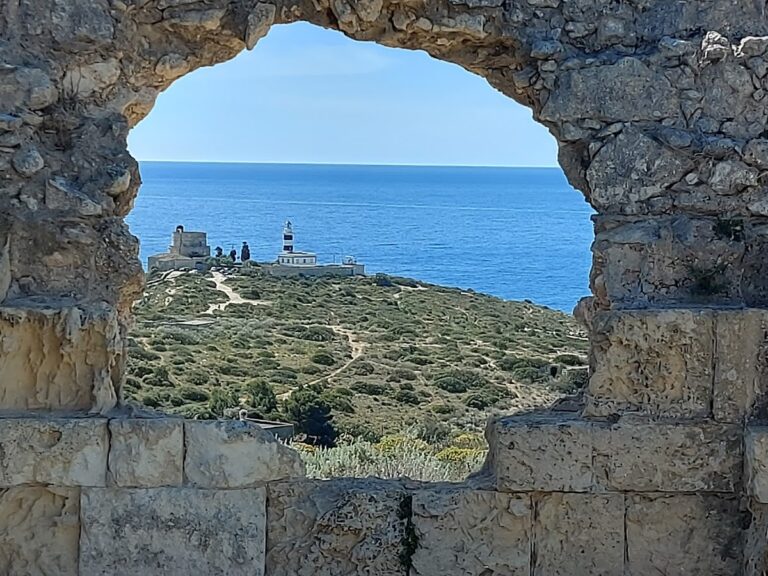
Fortezza Vecchia stands on a promontory above Spiaggia della Fortezza, the beach named after the fortress, on the western coast of the Capo Carbonara peninsula at the eastern end of the Gulf of Cagliari. It is approximately 700 metres from Stagno Notteri, a brackish-water lagoon on the peninsula’s eastern coast. Marina di Villasimius and the settlement of Notteri lie about 200 metres to the northeast, while Cala Caterina begins about 700 metres to the south. The centre of Villasimius is 3.2 kilometres to the northeast.
The fortress has an approximately equilateral-triangular plan, with sides measuring about 11 metres. Its walls rise approximately 10 metres and are about 1.20 metres thick. Natural stone and limestone masonry form the structure. Its present appearance reflects the sixteenth-century rebuilding and extensions, together with later defensive additions. Substantial parts of the fortress survive.
Bastions and Interior Collections
The small bastions added in 1790 remain part of the fortress’s later defensive arrangement. Their purpose was to remove areas that rifle fire could not directly cover from the existing positions.
The restored interior is used to display historical paintings, graphic works, maps, written documents, and decrees. These materials occupy the surviving structure and provide a historical collection within the restored fortress.
Nearby sites