Olavinlinna Castle: A Medieval Fortress in Savonlinna, Finland



Site at a Glance
- Rating
- 4.5
- Popularity
- Medium
- Country
- Finland
- Primary era
- Medieval
- External website
- Open
- Eras represented
- Medieval, Early Modern
- Civilizations
- Russian, Swedish
- Site type
- Military
- Remains
- Castle
On this page16 sections
History
Olavinlinna Castle is a medieval stone fortress in Savonlinna, Finland, founded by the Swedish nobleman and military leader Erik Axelsson Tott in 1475. Built on a rocky island in the Kyrönsalmi strait, it strengthened Sweden’s eastern frontier, protected Savonia, and controlled the waterways linking the surrounding lakes. Its foundation came during tensions involving the Kalmar Union, a late-medieval union of Denmark, Norway, and Sweden, as well as Novgorod and the expanding Grand Duchy of Moscow under Ivan III.
Foundation on the eastern frontier
The castle’s position was chosen with care. Strong currents in the strait prevented the water around the island from freezing, helping to preserve its defensive value during winter. The border established by the Treaty of Nöteborg followed waterways around Kyrönsalmi and Lake Haukivesi. At the time, Vyborg Castle was the only major Swedish defensive stronghold in eastern Finland, so the new fortress filled an important military need.
Construction depended heavily on the surrounding countryside. The parish of Juva, founded in 1442, supplied stone and other materials from its fields and lands. Local inhabitants paid taxes through labor and were required to transport building supplies. Tallinn master masons were brought to the site, while soldiers protected the work against Russian interference. Tott dedicated the fortress to Saint Olaf, the medieval Norwegian king Olaf II Haraldsson, who was later venerated as a Christian saint and regarded as the patron saint of knights.
The main castle was completed around 1485. Work then continued on the outer bailey, an enclosed defensive area outside the main castle, which was probably finished by about 1495. The construction and military activity surrounding the fortress encouraged the growth of Savonlinna, which received town rights in 1639.
Swedish military stronghold
Olavinlinna was repeatedly drawn into the Russo-Swedish conflicts. During the first war, Pietari Kylliäinen commanded the defense with approximately 150 soldiers and local peasants. Russian forces attacked three times but failed to take the castle. Disputes along the frontier continued until 1510, and further military operations affected the fortress during the sixteenth and seventeenth centuries.
After Gustav I Vasa became king of Sweden in 1523, he ordered repairs and additional strengthening. The towers of the main castle were raised, the walls were reinforced, and a large artillery tower was added to the outer bailey under the direction of Henrik von Cöllen. That tower was completed in 1565. Peter Hertig served as master builder in 1577.
The Treaty of Stolbovo later moved Sweden’s eastern frontier farther east, reducing Olavinlinna’s role as a border fortress. King Gustavus II Adolphus, a Swedish military ruler of the seventeenth century, visited the castle in 1622 after returning from campaigns in Poland. He remains the only Swedish king recorded as having visited it.
Fire, surrender, and Russian expansion
A major fire damaged Olavinlinna in 1654. During the Great Northern War, a conflict between Sweden, Russia, and their allies over control of northern and eastern Europe, the Swedish garrison surrendered to Russian forces on 28 July 1714. The Russians demolished Saint Erik’s Tower, named for the medieval Swedish king traditionally regarded as Sweden’s patron saint, leaving only its two lowest storeys. Sweden regained the Savonlinna region under the Treaty of Nystad in 1721.
Olavinlinna passed to Russia again in 1743 during the War of the Hats, a Russo-Swedish conflict that ended with the Treaty of Åbo. The treaty ceded Savonlinna and the surrounding region to Empress Elizabeth of Russia. Russian forces added bastions, projecting fortified platforms designed for artillery and firearms, together with other defensive works. The Russian field marshal Alexander Suvorov personally inspected the fortress’s rearmament.
In 1788, Finnish and Swedish marksmen besieging the castle could easily target people collecting water. A walled water channel was therefore built to protect access to the supply. The fortified area created around it became known as Suvorov’s outer bailey. In 1791, the Thick Tower was destroyed when a powder store exploded, and the Thick Bastion was constructed in its place.
End of military use and restoration
When Finland became the Russian Grand Duchy of Finland in 1809, Olavinlinna lost its military importance. It remained a garrison until 1847, stood vacant for several years, and then served as an investigative prison from 1855 to 1861. After the prison closed, the fortress was again unused. Fires in 1868 and 1869 destroyed or severely damaged much of its historic wooden fabric and interior decoration.
Restoration began in the 1870s, when Olavinlinna was treated as a historic monument. A major campaign carried out from 1961 to 1975 sought to return the fortress as closely as possible to its earlier appearance. Trees planted within the castle area were removed because they did not belong to the original setting and their roots were damaging the walls.
From fortress to cultural venue
The castle’s cultural history began with the first Savonlinna Opera Festival in 1912. The Finnish opera singer Aino Ackté had recognized the site’s suitability for performances during a visit in 1907. Festivals followed in 1913, 1914, 1916, and 1930, after which the event paused for 37 years. Annual festivals resumed in 1967, establishing a continuing cultural use within the historic fortress.
Olavinlinna now accommodates cultural activities that include the annual opera festival, which draws approximately 70,000 people, around 10 percent of them from outside Finland. Saint Olaf’s Day events take place on 29 July, and the castle also hosts an Easter Passion performance and professional boxing events. By August 2018, six televised Boxing Night events had been held there. Two small museums operate within the castle, one presenting objects found there or associated with its history and the other displaying Orthodox icons and religious artefacts from Finland and Russia.
Remains
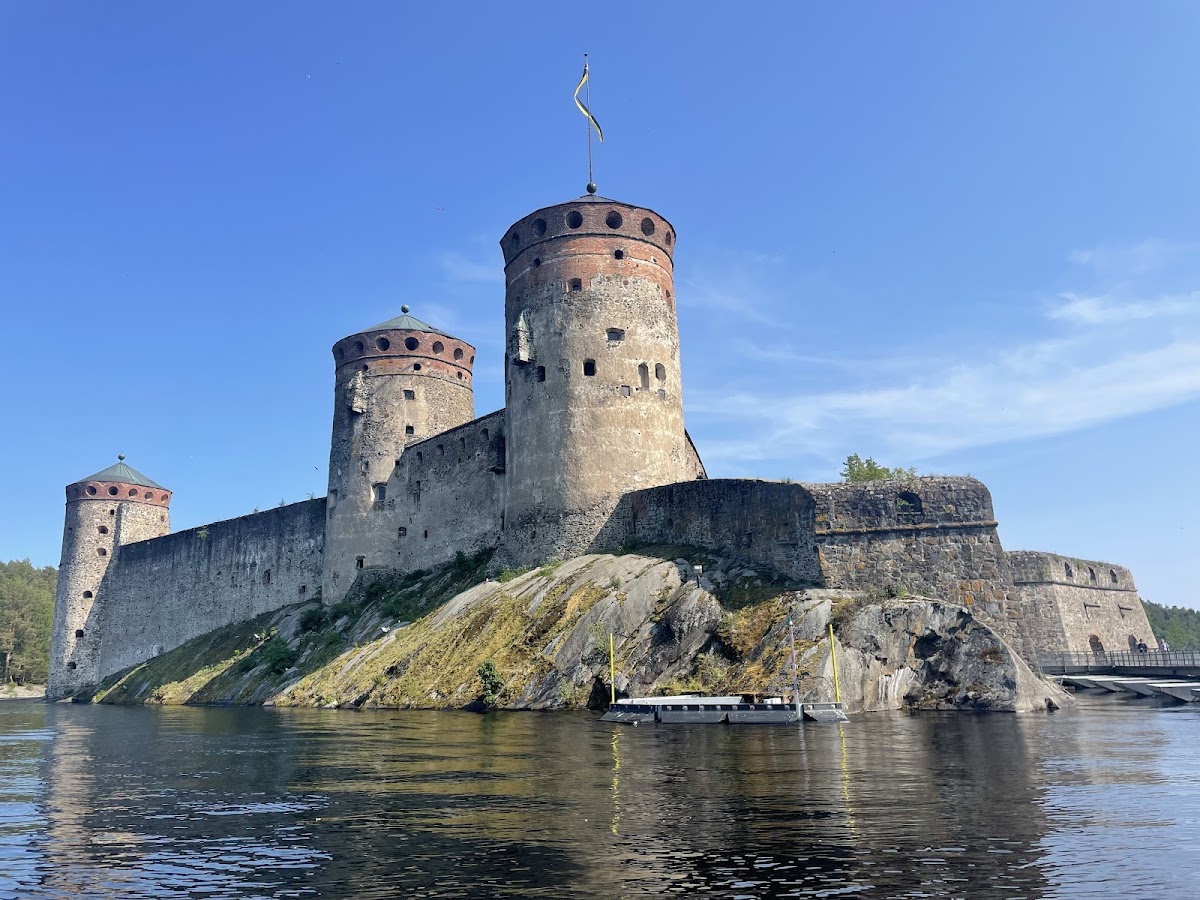
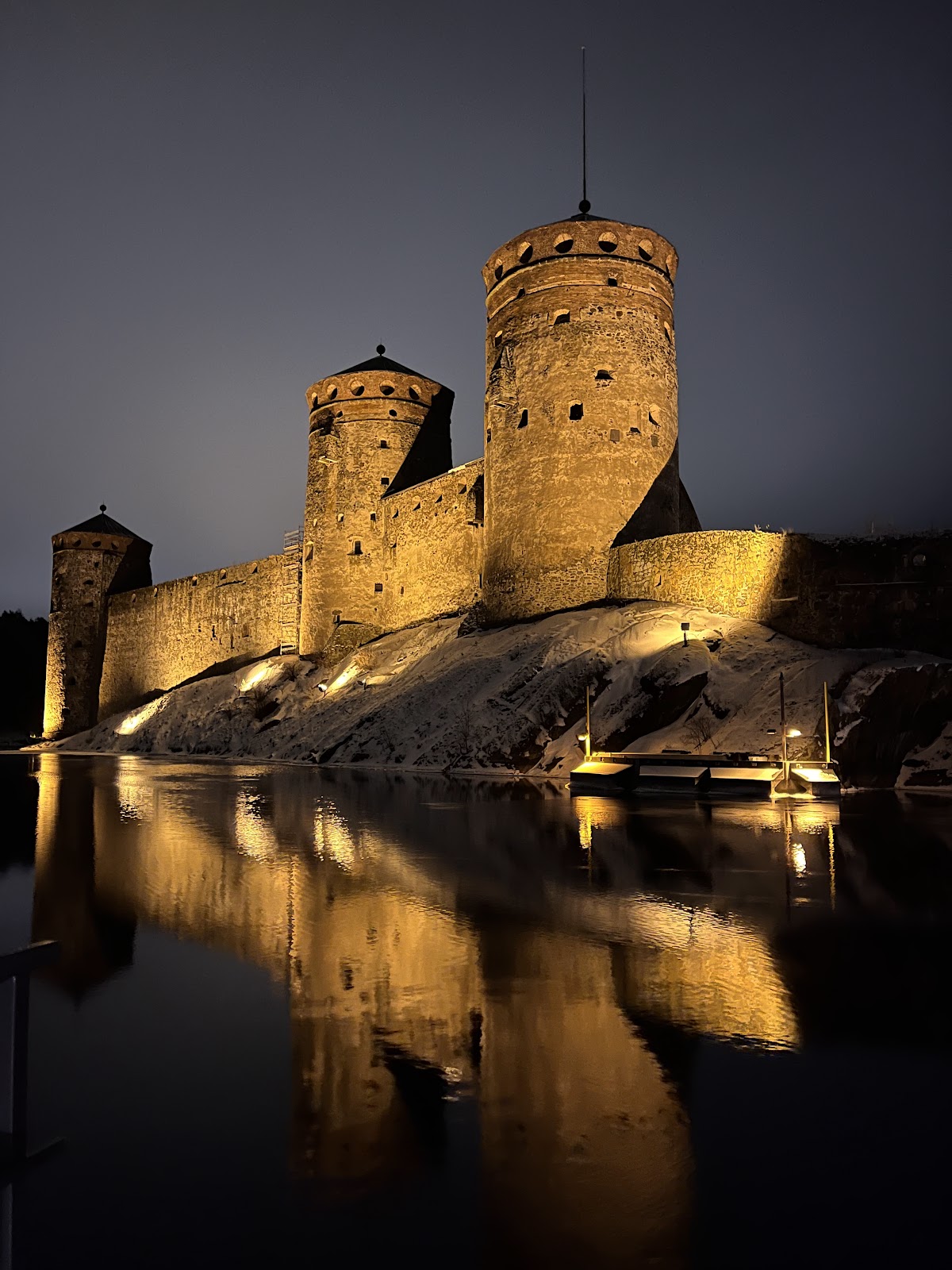
Olavinlinna occupies a rocky island in the Kyrönsalmi strait, where Lake Haukivesi and Lake Pihlajavesi meet. Its principal axis runs from east to west. The main castle stands at the western end, while the larger outer bailey extends to the east. The medieval fortress was later adapted into a Vauban-style defensive system, characterized by low, thick walls, projecting bastions, and overlapping fields of fire.
Main castle and medieval towers
Triangular main castle
The main castle has a roughly triangular plan and three towers. The wall between the northwestern and southern towers bends slightly at its midpoint, and its highest section contains a covered firing passage. Inside the walls is a three-storey palace. Storage spaces occupy the ground floor, the middle storey contains the castle hall, and the upper storey is now known as the King’s Hall.
Church Tower and chapel
The Church Tower, also called the Tower of the Holy Virgin and, during the medieval period, the Tower of Saint Olaf, contains a small chapel. The chapel was probably planned from the beginning because no other churches existed nearby at the time. It served as a church until the 1630s, when the King’s Hall was adapted for ecclesiastical use. The former chapel then became a storehouse, and its neglected ceiling paintings were destroyed.
During Russian rule from 1714 to 1721, the chapel was used for Orthodox worship and called the Chapel of the Prophet Elijah. It contains three altars, including a reconstructed high altar and two side altars. A small adjoining room has a hagioscope, an opening through which people could observe the altar during worship. Criminals and sick people could use it without entering the chapel, an arrangement described as rare in Finland. The chapel is now used by different Christian traditions for ceremonies including weddings and baptisms.
Bell Tower and Kijli’s Tower
The other surviving towers are the Bell Tower and Kijli’s Tower. The Bell Tower has also been called the Tower of Saint Olaf. Kijli’s Tower takes its name from the castle governor Nils Pederinpoika Kijli. Together with the Church Tower, these structures form the surviving three-tower group of the medieval stone fortress.
Saint Erik’s Tower
The remains of Saint Erik’s Tower stand within the castle area. Named for Saint Erik, the traditional patron saint of Sweden, the tower was demolished after the Russian capture of the fortress in 1714. Its two lowest storeys survived and remain part of the visible ruins.
Outer bailey and later defenses
Outer bailey structures
The outer bailey has a rectangular plan. Its surviving and identified components include the outer curtain walls, the Gate Curtain, the Water-Gate Curtain, the Bell Bastion or half-bastion, the Small-Gate Bastion, and Suvorov’s outer bailey. A curtain wall is the fortified wall that connects towers or bastions. These elements show how the original medieval enclosure was enlarged and reorganized for later artillery defense.
Thick Tower and Thick Bastion
The Thick Tower was formerly the fifth tower of the fortress. A powder explosion destroyed it in 1791, after which the Thick Bastion was built on its site. The replacement reflects the later conversion of Olavinlinna into a Vauban-style fortress, whose bastions allowed defenders to direct artillery and firearms along the walls and toward attackers.
Suvorov’s outer bailey
Suvorov’s outer bailey formed the fortified section built around the protected water channel in 1788. Its construction responded directly to the danger faced by people collecting water during a siege. The area became part of the fortress’s later bastion system, which also included the Thick Bastion, the Bell Bastion, and the Small-Gate Bastion.
Olavinlinna is a three-tower medieval stone fortress and is described as the northernmost medieval stone fortress still standing. It is also an early Swedish fortress designed with thick circular towers capable of resisting cannon fire. A pontoon bridge that can be swung aside was installed in 1974, providing the present bridge arrangement to the island fortress.