Nicastro Cathedral: The Episcopal Cathedral of Lamezia Terme, Italy


Site at a Glance
- Rating
- 4.7
- Popularity
- Low
- Country
- Italy
- Primary era
- Early Modern
- External website
- Open
- Eras represented
- Early Modern, Modern
- Civilizations
- Italian, Kingdom of Naples, Kingdom of the Two Sicilies, Spanish
- Site type
- Religious
- Remains
- Cathedral
On this page11 sections
History
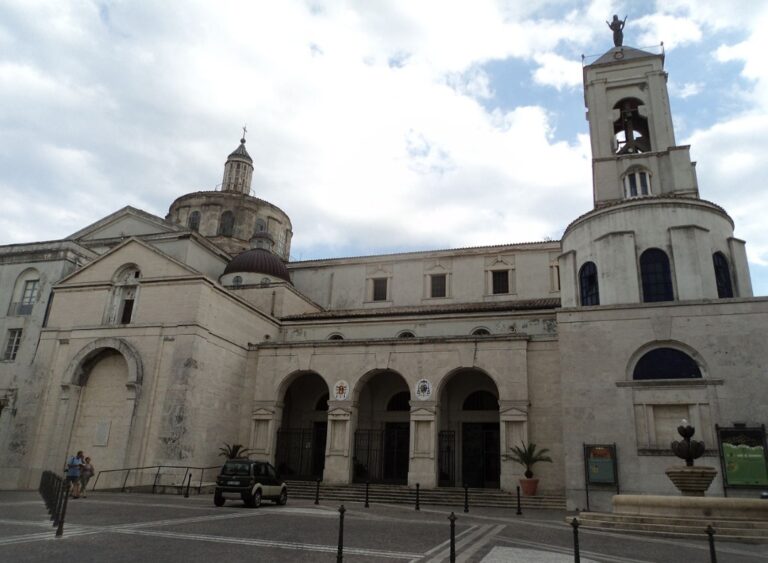
Nicastro Cathedral is a Roman Catholic cathedral in Italy, located in the historic center of Nicastro, now part of Lamezia Terme in Calabria. Dedicated to Saints Peter and Paul, it has served as an episcopal church since the Norman period and today serves the Diocese of Lamezia Terme.
Byzantine and Norman Foundations
Tradition holds that an earlier cathedral dedicated to the Assumption was built during the Byzantine period, when the Eastern Roman Empire exerted political and cultural influence in southern Italy. Its exact location is unknown, and Saracen raids destroyed it before the year 1000. Saracen was a medieval European term for Muslim raiders and forces active particularly in the Mediterranean.
In 1094, the Normans established a new cathedral dedicated to Saints Peter and Paul and following the Latin rite, the western liturgical tradition of the Roman Catholic Church. This Norman cathedral stood near the meeting point of the Piazza and Canne streams, in an area now situated between the Church of the Crucifix and a school building. Its site was therefore separate from that of the present cathedral.
Reconstruction and Later Changes
An earthquake destroyed the Norman cathedral in 1638. Construction of the present building began in 1640 at its current location under Monsignor Giovan Tommaso Perrone, although the date when the work was completed is uncertain. After a period of decline, Monsignor Carlo Pellegrini directed changes to the interior and renewed the liturgical furnishings.
Between 1825 and 1854, Monsignor Berlingeri reorganized and enlarged the interior. Later work altered the facade at the end of the nineteenth century, gave it its present configuration in 1925, and completed the cupola in 1935. The present staircase was built in the mid-twentieth century. In 1969, the presbytery, the area reserved for the principal altar and clergy, was transformed. The marble high altar from the first half of the nineteenth century, the wrought-iron screen, and the bishop’s chair were removed, while the wooden choir was reduced in size.
Nicastro Cathedral retained its cathedral status when the Diocese of Nicastro was renamed the Diocese of Lamezia Terme. It remains an active Roman Catholic church and serves as the cathedral of that diocese.
Remains
The present cathedral occupies its site in the historic center of Nicastro, while the earlier Norman building stood elsewhere near the confluence of the Piazza and Canne streams. The surviving building combines an interior enlarged and reconfigured in the nineteenth century with a Neoclassical facade, a twentieth-century cupola, and furnishings and equipment from different periods.
Exterior
Facade
The facade was extensively remodeled at the end of the nineteenth century and assumed its present Neoclassical form in 1925. Its sculptural decoration includes busts of Saints Peter and Paul, the cathedral’s patrons, together with busts of Popes Marcello II and Innocent IX. Both popes had previously been bishops of Nicastro. Marcello II, born Marcello Cervini, held the papacy in 1555, while Innocent IX, born Giovanni Maria Facchinetti, was pope in 1591.
Cupola
The cupola, or dome, was raised in 1935 and is covered with majolica, a form of glazed ceramic tilework. It forms part of the later exterior composition that followed the nineteenth-century remodeling and the facade’s 1925 configuration.
Interior
Plan and Presbytery
Between 1825 and 1854, the interior was reconfigured by raising the vaults to replace a deteriorated flat ceiling. The transept, the crosswise part of a church that intersects the nave, was extended and ended in two apses, which are curved or polygonal terminations. Two additional chapels were also built in the lateral aisles. The presbytery was later reshaped in 1969, when several earlier furnishings were removed and the wooden choir was reduced.
Wooden Choir
The wooden choir was made between 1693 and 1702. Monsignor Angeletti enlarged and completed it in 1731. Its size was reduced during the 1969 remodeling of the presbytery, leaving the choir as a surviving element that reflects the cathedral’s earlier furnishing scheme.
Pipe Organ
The cathedral contains a pipe organ built in 1960 by the Cremona firm Rotelli-Varesi. It has electric transmission, two keyboards of 61 notes each, and a pedalboard of 32 notes.
Nearby sites