Castello di Nicastro: Medieval Fortress of Lamezia Terme


Site at a Glance
- Rating
- 3.2
- Popularity
- Very Low
- Country
- Italy
- Primary era
- Medieval
- Eras represented
- Medieval
- Civilizations
- Byzantine, Kingdom of Sicily, Norman
- Site type
- Military
- Remains
- Castle
On this page8 sections
History
Castello di Nicastro is a medieval fortification in Italy, standing on San Teodoro hill in Nicastro, the oldest quarter of Lamezia Terme. Its origins are associated with Byzantine and Norman rule, but the date and builders of the first castle remain uncertain. It may have been established around the ninth century under the Byzantines, the rulers of the eastern Roman Empire, or in the eleventh century by the Normans, the northern European dynasty that conquered much of southern Italy.
Early fortress and Norman conquest
The first castle occupied the summit above the settlement and was built over an earlier fortress dating from the eighth or ninth century. The Normans restored and deliberately reused the elevated position during the second half of the eleventh century because it commanded the plain below and offered a strategically important view. Robert Guiscard’s Norman forces captured Nicastro in 1057. In the following year, possibly because of famine, the inhabitants rebelled and massacred the sixty soldiers of the Norman garrison.
Frederick II’s expansion
During a later phase, Frederick II, the thirteenth-century Hohenstaufen emperor and king of Sicily, enlarged the interior of the fortress. The works included barracks and prisons, together with a pentagonal keep, the principal fortified tower of a medieval castle, and an enclosing defensive wall.
Henry VII’s imprisonment and death
Castello di Nicastro is closely connected with the imprisonment of Frederick II’s rebellious son, Henry VII of Hohenstaufen, who was king of Sicily and Germany. Henry was confined at the castle for two years from 1240 under the custody of the castellan Martino d’Ippolito, a member of the Mantua-origin House of Ippolito.
The circumstances of Henry’s death in 1242 remain uncertain. One tradition places it on 12 April, when he was 31 and escaped while being transferred from Nicastro toward Martirano Castle. According to this account, he fell from his horse on a winding mountain road, struck a cliff, and died. Another claim attributes his death to an order from Frederick II, while a later interpretation holds that he died naturally from an illness contracted during his imprisonment. His body was later taken to Cosenza Cathedral by Leone Filippo De Matera, bishop of Martirano, who was also identified as a patrician of Cosenza and chancellor of the Kingdom of Sicily.
Earthquake damage and ruin
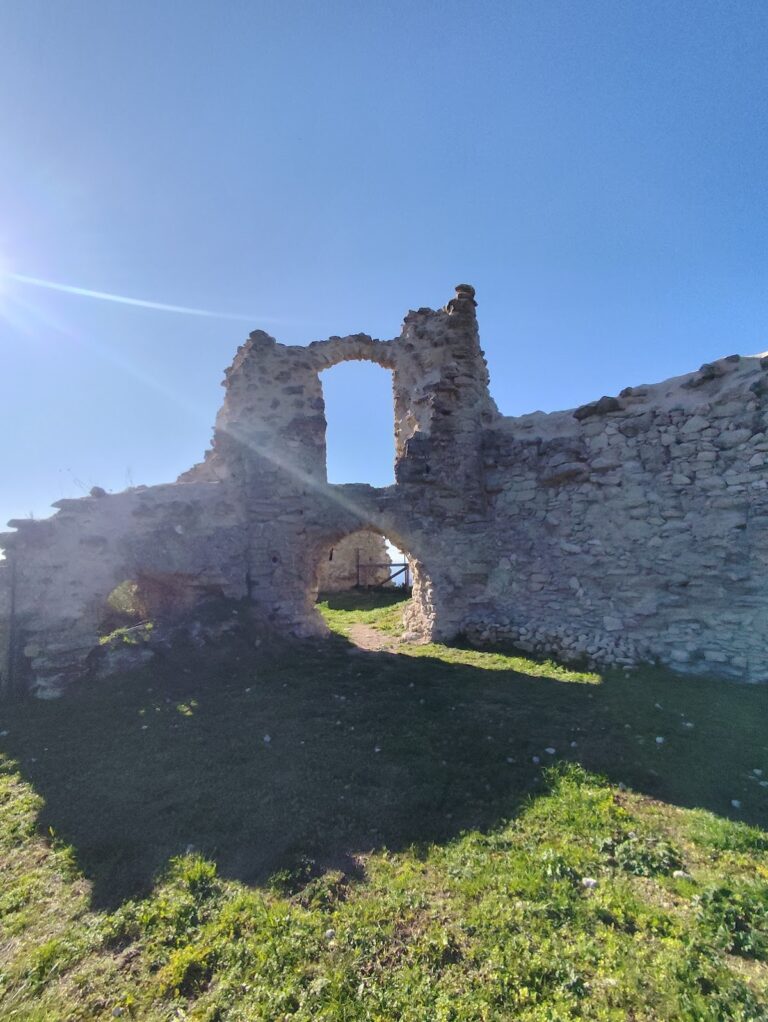
An earthquake on 27 March 1638 caused extensive damage to the castle. Castello di Nicastro is now a ruin owned by the Municipality of Lamezia Terme.
Remains
The fortress occupies the rocky summit of San Teodoro hill at approximately 299 metres above sea level. Its elevated position controlled the surrounding plain as far as the sea and served a defensive purpose. The original core stood at the centre of the settlement’s highest point, above the remains of the earlier eighth- or ninth-century fortress. The complex was built in rubble stone and developed as an enclosed hilltop stronghold.
Fortifications and surviving structures
The surviving ruin includes four cylindrical towers, bastions, sections of the enclosing defensive walls, and a buttress with a blind loggia, a recessed gallery-like feature with ornamental or closed openings. The former pentagonal keep, barracks, prisons, and defensive enceinte, meaning the circuit of walls enclosing a fortress, belonged to the complex expanded or developed during Frederick II’s intervention. The remains are now unstable and severely deteriorated.
Later descriptions
By 1778, the writer and traveller Henry Swinburne described Castello di Nicastro as a romantic ruin in a precarious position beside a roaring stream descending into a dark, wooded valley.
Nearby sites