Neresheim Abbey: A Benedictine Monastery and Baroque Church in Germany
Site at a Glance
- Rating
- 4.7
- Popularity
- Low
- Country
- Germany
- Primary era
- Early Modern
- External website
- Open
- Eras represented
- Early Modern
- Civilizations
- Holy Roman Empire
- Site type
- Religious
- Remains
- Monastery
On this page15 sections
History
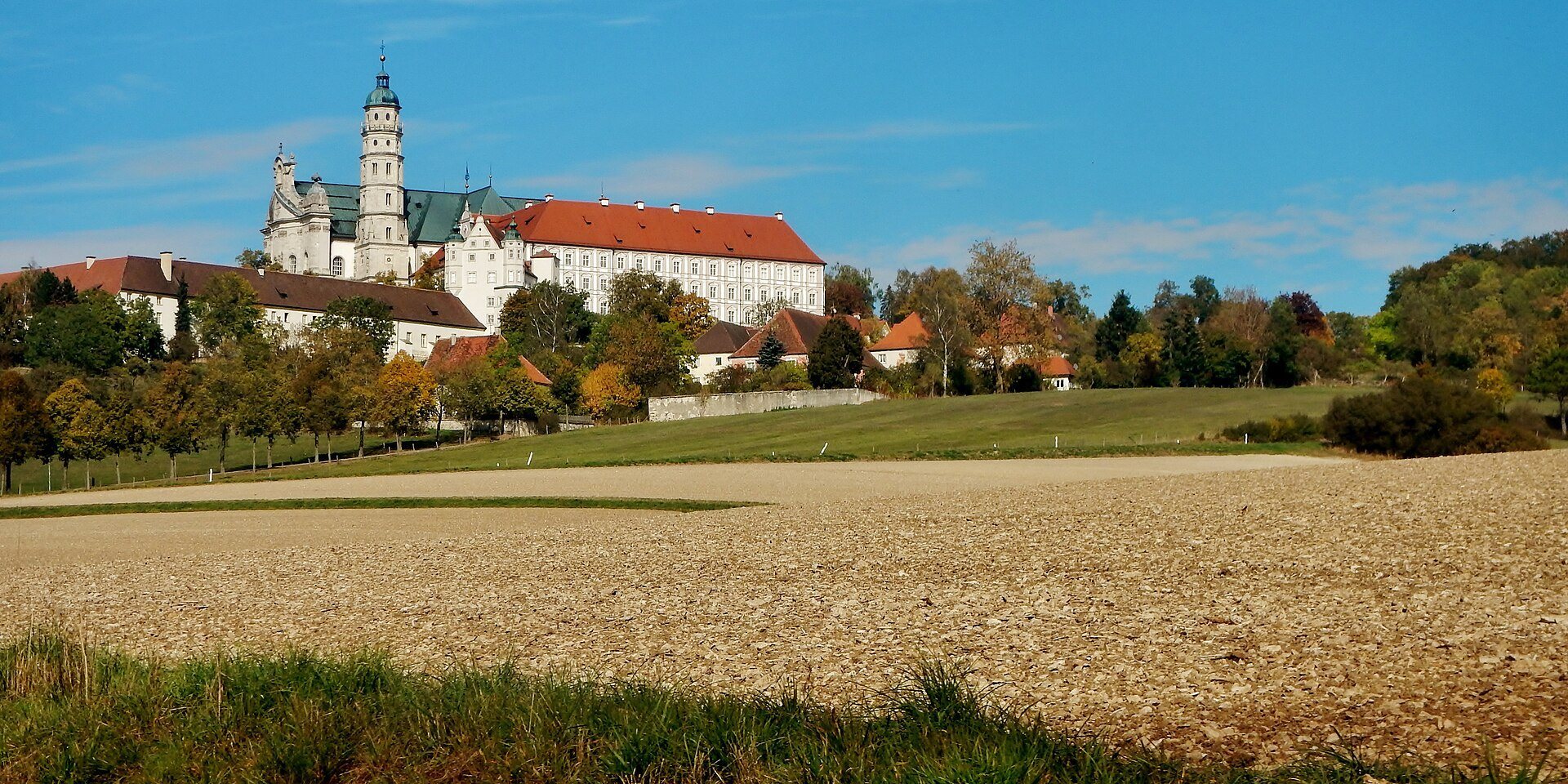
Neresheim Abbey is a Benedictine monastery in Germany, standing above the town of Neresheim on the Ulrichsberg overlooking the Härtsfeld. Founded in 1095, it developed from an Augustinian foundation into a Benedictine abbey and became known for its late Baroque church, built between 1750 and 1792. The community now belongs to the Beuronese Congregation, a federation of Benedictine monasteries associated with the Beuron reform.
Foundation and Benedictine beginnings
A former tradition attributed the monastery’s foundation to Duke Tassilo III of Bavaria in 777 and claimed that it was destroyed during the Hungarian invasions of 899 to 955 before being rebuilt by the Counts of Dillingen. This account is no longer compatible with current historical knowledge. The institution was founded in 1095 by Count Hartmann I of Dillingen and his wife, Adelheid of Winterthur-Kyburg, on the site of their castle at Neresheim. Adelheid was probably a daughter of the last Winterthur count, Adalbert II, and is described as an ancestress of the Counts of Kyburg.
The foundation initially housed Augustinian Canons. In 1106 it became a Benedictine abbey affiliated with the Hirsau Reform, a movement within Benedictine monasticism that sought stricter discipline and institutional renewal. The first Benedictine monks came from Petershausen in 1106, followed by a second group from Zwiefalten in 1119. Abbot Ortlieb, who had come from Zwiefalten, led the community from 1140 to 1163. A women’s community existed alongside the male community until the middle of the thirteenth century.
Another early abbot, Pilgrim of Berrieden, governed Neresheim from 1126 to 1138 and maintained an extensive correspondence with Hildegard of Bingen, a Benedictine abbess, theologian, writer, and composer. Around 1150, Abbot Ortlieb established the scriptorium, a workshop where manuscripts were copied and prepared. The monastery’s intellectual life later included educators such as Benedikt Holland, Karl Nack, and Beda Pracher, as well as Benedikt Maria Werkmeister, a reform-minded churchman.
Property, protection, and monastic reform
By the thirteenth century, Neresheim owned seven villages, received property and income from 71 other places, chiefly in the Härtsfeld, and incorporated ten parish churches. The abbey was repeatedly damaged by fire and warfare. Its difficulties included conflicts in the twelfth century, the Schmalkaldic War, the Thirty Years’ War, and the wars connected with the French Revolution.
After the Counts of Dillingen died out in 1258, a long dispute arose over the abbey’s legal status and the right to protect it. The Counts of Oettingen and the bishops of Augsburg both claimed authority. In 1263, Albertus Magnus, a Dominican theologian, philosopher, and bishop, issued a judgment that formally assigned the protection rights to the Augsburg bishopric. Oettingen nevertheless retained them in practice as a pledge.
From 1497 the abbey followed the Benedictine Melker Observance, another movement seeking religious discipline and institutional renewal. Abbot Johann Vinsternau promoted the observance particularly during his tenure from 1510 to 1529. Between the twelfth and eighteenth centuries, Neresheim formed 48 prayer confraternities with other monasteries.
A renewed dispute with Oettingen-Wallerstein over jurisdiction and the abbey’s imperial immediacy was mediated by an imperial commission in 1583. In 1685 Neresheim joined the Augsburg Congregation of the Holy Spirit, an organized federation of Benedictine monasteries. The convent maintained active relations with the University of Dillingen during the seventeenth and eighteenth centuries. It also operated a house of studies for philosophy and theology and a gymnasium until 1806.
Baroque renewal and imperial status
Abbot Simpert Nagel, also known as Niggl, led Neresheim from 1682 to 1706 during a period of Baroque renewal and served as president of the Augsburg Congregation. Abbot Aurelius Braisch, who governed from 1739 to 1755, initiated the present abbey church. His successor, Abbot Benedikt Maria Angehrn, pursued recognition of the abbey’s imperial immediacy and oversaw the substantial completion of the church.
A dispute that began in 1739 over the sale of timber led to more than two decades of litigation before the Imperial Chamber Court and the Imperial Aulic Council. A settlement approved in 1764 made Neresheim an imperial abbey. This status meant that the monastery held its territory directly from the emperor rather than through a territorial prince, and its abbot could represent it in the Imperial Diet. Neresheim received a seat and curiate vote on the Swabian bench of the Imperial Council of Princes.
Under the settlement, the abbey surrendered numerous possessions, including the town of Neresheim, to Oettingen-Wallerstein. Its remaining territory covered about 80 square kilometres and contained approximately 2,500 inhabitants. Michael Dobler, who died in 1815, was the last imperial abbot and served from 1787 until 1803.
Dissolution and refoundation
Neresheim was dissolved and secularized in 1803. Secularization involved the dissolution and confiscation of religious institutions and their property by secular authorities during the political reorganization of the German states. The former abbey passed first to the Princes of Thurn und Taxis, then to Bavaria in 1806 through the Confederation of the Rhine Act, and finally to Württemberg in 1810. The former monastery complex was officially called “Neresheim Castle,” while the associated municipality was incorporated into Neresheim in 1892.
Secularization dispersed many of the abbey’s possessions. The eighteenth-century silver table service of the Neresheim abbots went to the Thurn und Taxis family and is now associated with the Princely Treasury of Thurn und Taxis in Regensburg. In 1817, most of the manuscripts and incunabula, books printed before 1501, were transferred to the Thurn und Taxis court library. Sixty manuscripts and 25 incunabula remained at Neresheim. The 4,100-volume library of Obermarchtal also passed to the House of Thurn und Taxis, while most of the Neresheim monastic library remained there as a deposit.
The Princes of Thurn und Taxis enabled Benedictines from Beuron Archabbey and Emaus Abbey in Prague to reoccupy Neresheim in 1919. The abbey was canonically re-established on 14 June 1920. Bernhard Durst served as the first abbot after the refoundation, from 1921 to 1965, followed by Johannes Kraus from 1965 to 1977 and Norbert Stoffels from 1977 to 2012.
The community continues as a Benedictine house of the Beuronese Congregation. Pater Albert Knebel became prior-administrator in 2012 and was later elected conventual prior. In 2013 he discovered two accounts opened by the late Abbot Norbert Stoffels, containing approximately 4.3 million euros. In 2019, the Federal Court of Justice ruled that the money belonged to the monastery, allowing part of the continuing costs of repairing the monastery buildings to be covered.
Modern cultural life
A monastery museum opened in the convent building at the end of October 2009 and presents the history of the abbey. The former conference and guest house closed at the end of November 2021 and from April 2022 housed accommodation for refugees from Ukraine. A monastery café was established near the abbey church.
The Neresheim Abbey Boys’ Choir was founded by Albert Knebel on 13 February 2004. It sings at services in the abbey church and at performances elsewhere, with particular importance given to Gregorian chant. Since 1991, students and professors of London’s Royal Academy of Music have visited annually for a working week, taking part in services and concerts. The abbey church and the town of Neresheim became honorary members of the academy in 2016.
Remains
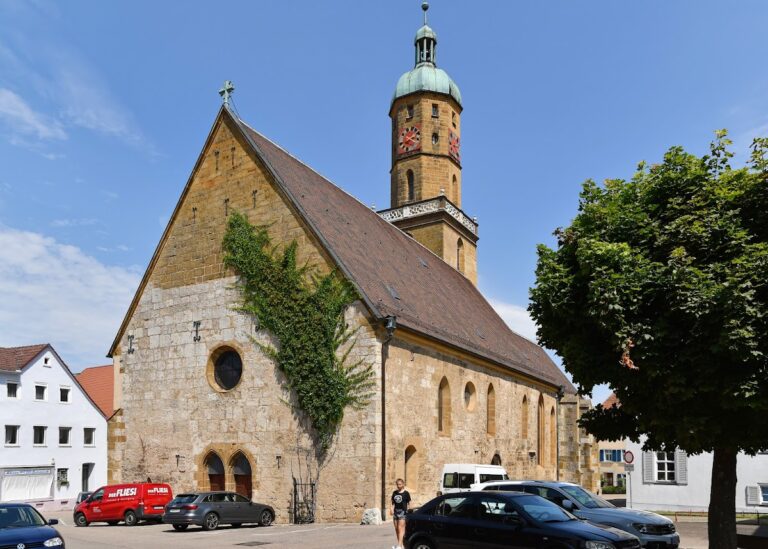
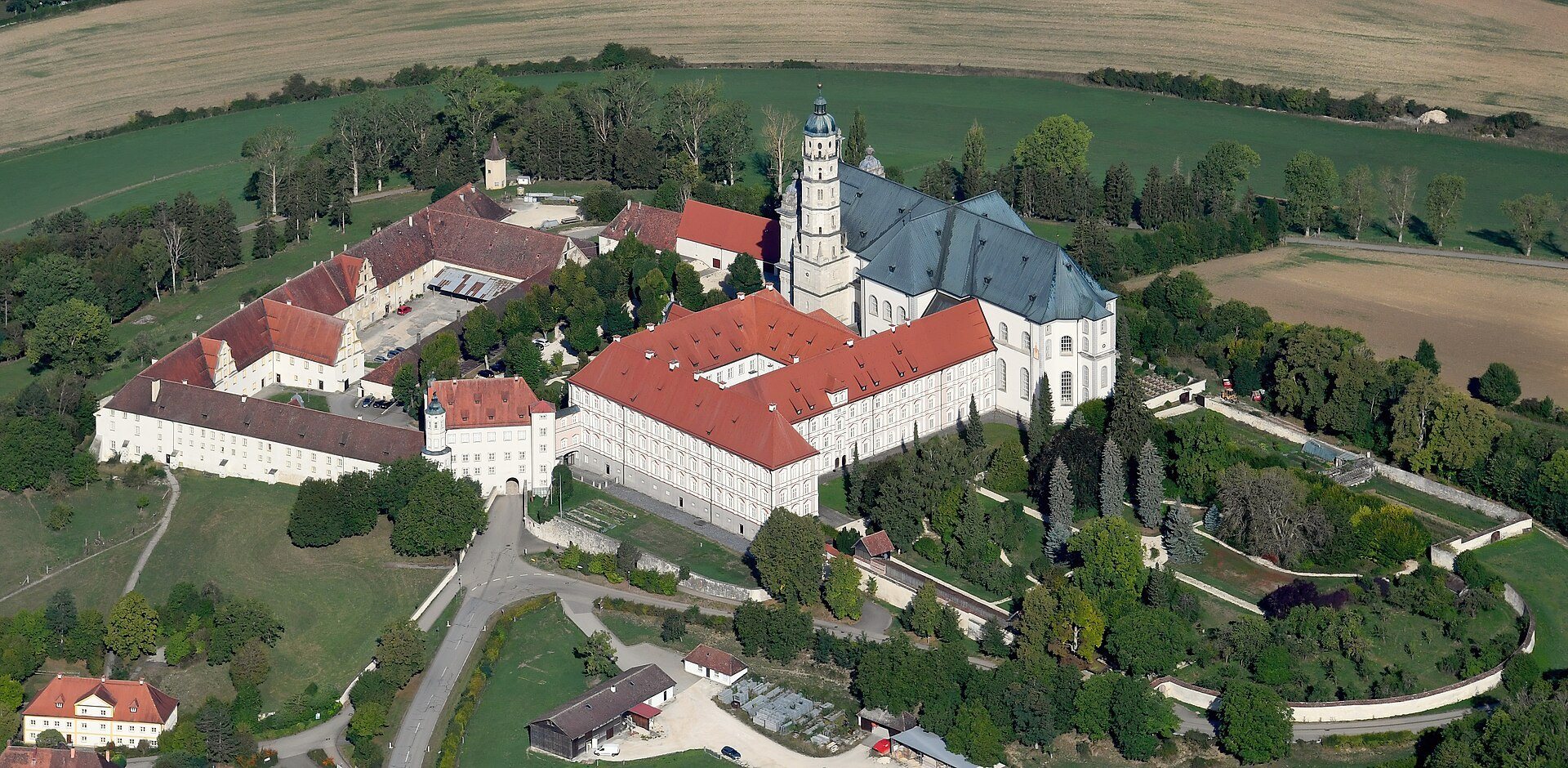
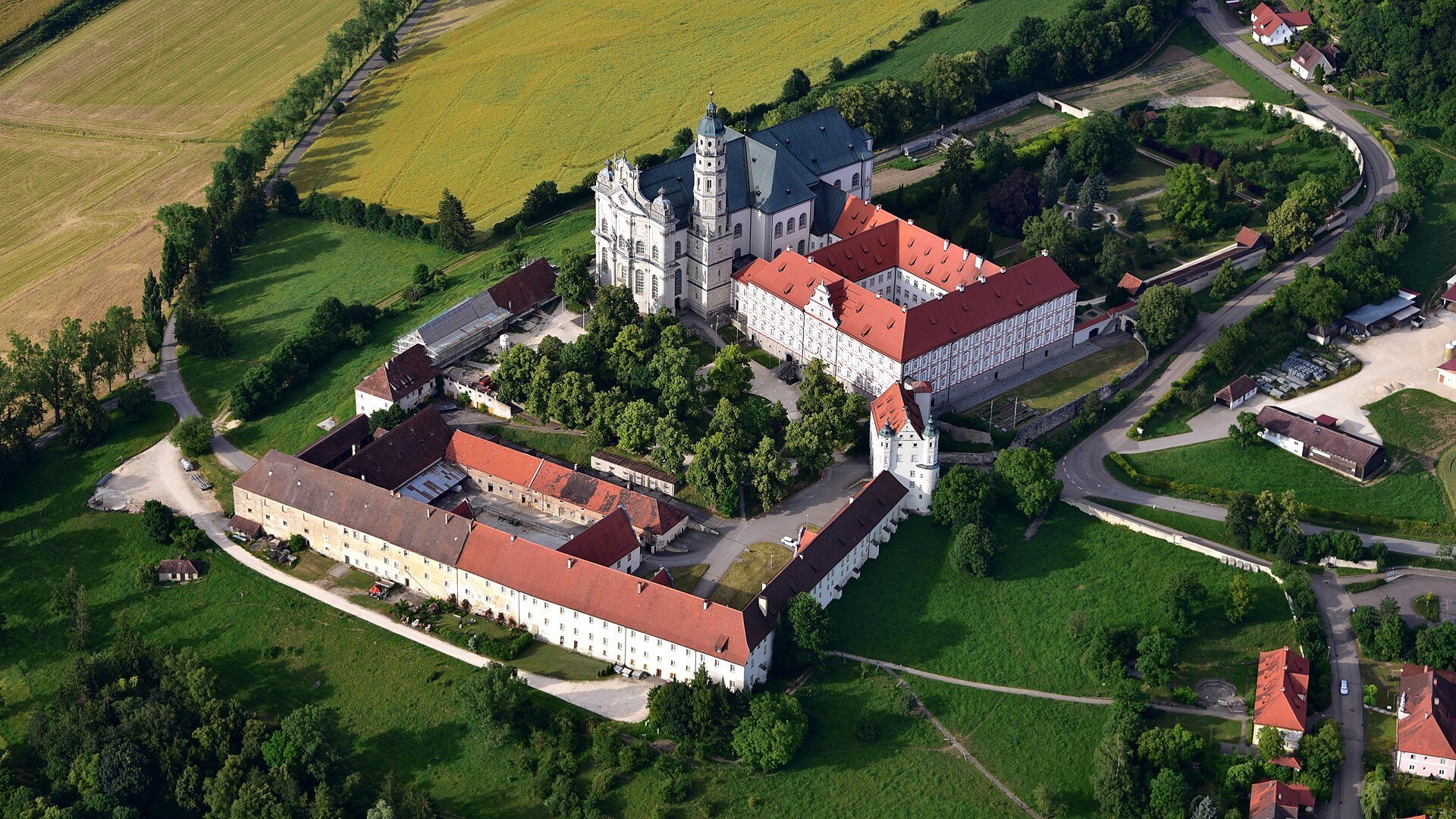
The surviving complex combines a late Baroque abbey church with the former convent building. The church follows a Latin-cross plan, in which a long nave intersects a shorter transept, and contains seven domed spaces. Its design combines a longitudinal arrangement with centralized spaces, while the convent building preserves Baroque interiors connected with the monastery’s religious, educational, and library functions.
The abbey church
Construction and spatial design
The medieval church stood south of the present building. It was a Romanesque basilica constructed between 1126 and 1190, enlarged with a larger choir in 1568 and 1569, and given a Baroque treatment in 1695. It remained in use while the present church was being built, until it was demolished in 1782 or 1783.
Balthasar Neumann received the commission for the present church in 1747 and submitted his first design that year. Work on the foundations began in 1748, although 1749 is also given as the beginning of construction. The official foundation stone was laid on 4 July 1750. Leonard Stahl, one of Neumann’s pupils, directed the work on site from 1748. After Neumann died on 19 August 1753, Johann Baptist Wiedemann of Donauwörth succeeded him.
The church was built from 1750 to 1792. Wiedemann intended to follow Neumann’s plans, but the convent ordered alterations in 1759 under Abbot Benedikt Maria Angehrn. The planned stone vaults were replaced by flat wooden vaults, and the lantern above the crossing dome was omitted. The vaulting was complete in the winter of 1770. The church was blessed in 1777, and construction was completed in 1792.
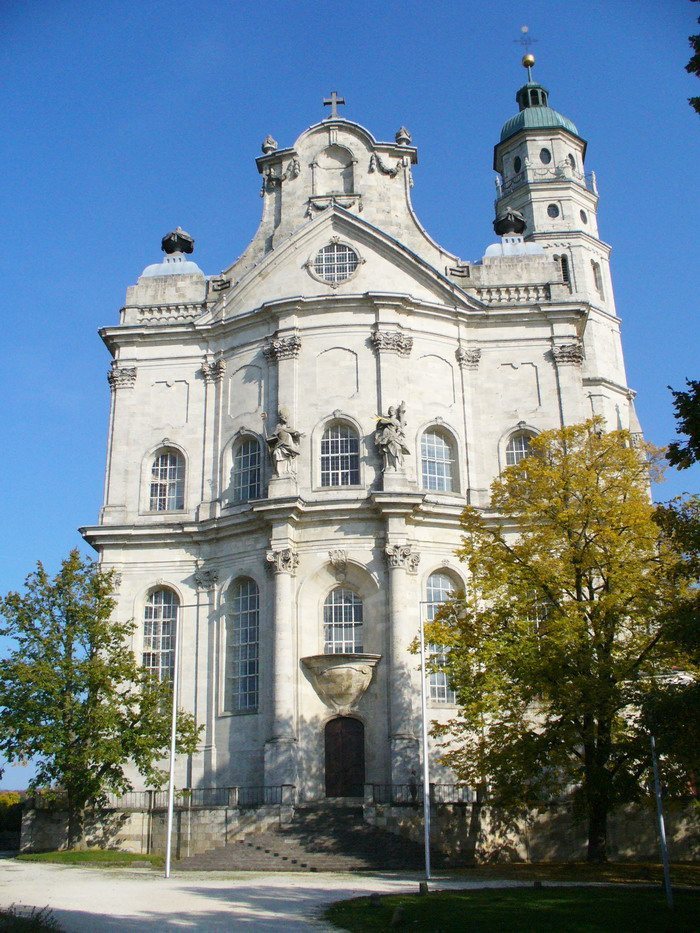
The building measures 83 metres in length and 35 metres in width. Its main dome rises 32 metres high, extends 24 metres in length, and is 20 metres wide. Four pairs of freestanding columns support it. Because Neumann died before the church was completed, and because later builders altered the design, especially in the dome construction and profiles, the finished building is attributed to him with reservations. An unexecuted variant of the design appeared on the reverse of the German 50-mark banknote issued from 1991 to 2002.
Frescoes and interior furnishings
Martin Knoller, court painter to the Austrian governor in Milan, was engaged by Leonard Stahl to decorate the church. From 1770 to 1775, Knoller painted seven dome frescoes, wall or vault paintings made on fresh plaster. They show scenes from the life of Christ, including Christ among the Doctors, the Last Supper, and the Ascension. The choir-wall crucifix is 6.6 metres high.
Between 1776 and 1792, the abbey’s master builder Thomas Schaidhauf furnished the interior with restrained blind arcades, architectural panels that resemble open arcades but do not provide passage through the wall. The arrangement has an early-classical regularity. The two side altars are dedicated to the Trinity and the Virgin Mary.
Organs and bells
Johann Nepomuk Holzhey of Ottobeuren built the main organ between 1794 and 1797. Schaidhauf designed its case, drawing on Josef Gabler’s organ case in Weingarten Basilica and on Holzhey’s earlier cases at Rot an der Rot and Weißenau. The Swiss firm Kuhn largely restored the instrument to its original condition in 1979. It has three manuals, or keyboards, with the couplings II/I, III/I, III/II, I/P, and II/P. Its tuning is Kirnberger III at A = 421 Hz, a historical keyboard temperament.
A Steinmeyer choir organ installed in 1949 has two manuals and 27 stops and can also be played from the main organ console. Its case derives from the choir organ built by Joseph Höß in 1781. The church’s peal consists of seven bells. Five were cast by Petit & Gebr. Edelbrock in 1961, one dates from 1571, and one dates from the fifteenth century.
Structural repair
The church was endangered in 1965 when settlement in the main dome caused cracks in the masonry. Comprehensive restoration took place from 1969 to 1975.
The convent building
Baroque structure and halls
Michael Wiedemann of Unterelchingen erected the convent building between 1699 and 1712. Its Baroque west-façade gable was probably removed in 1755, and no later than 1792, because of structural deterioration. The present gable was reconstructed in 2004 for fire-safety reasons. Since the original gable probably did not exist at the same time as the Baroque church, its reconstruction prompted discussion about the treatment of a protected cultural monument.
The former convent building contains the monastery museum, the Michael Hall, and a festival hall designed and richly decorated by Dominikus Zimmermann. The hall is described as the only festival hall designed by Zimmermann, who also worked on the Wieskirche.
Library and book collection
The monastic library began with the scriptorium established by Abbot Ortlieb around 1150. More than 200 incunabula were added at the end of the fifteenth century. Around 1600, Abbot Melchior Hänlin commissioned the rebinding of numerous books with costly cover tooling. Many more were rebound during the early eighteenth century, and books from the sixteenth century onward were largely bound in uniform white pigskin.
During the Baroque renewal, Abbot Simpert Niggl commissioned a library hall in the east wing of the convent building. Johann Schmuzer, a Wessobrunn master builder, created valuable stucco work there around 1700. Major library catalogues were compiled around 1550, in 1595, and during the second half of the eighteenth century. The last of these contained approximately 10,000 entries and is now in the Princely Court Library in Regensburg.
A further cataloguing campaign from 1935 to 1938 estimated the collection at 12,400 volumes. After the 1920 refoundation, the new working library grew to approximately 100,000 volumes by 1991.