Musée Ingres: A Former Episcopal Palace in Montauban


Site at a Glance
- Rating
- 4.7
- Popularity
- Medium
- Country
- France
- Primary era
- Early Modern
- External website
- Open
- Eras represented
- Medieval, Early Modern
- Civilizations
- County of Toulouse, English, French
- Site type
- Religious
- Remains
- Palace
On this page11 sections
History
Musée Ingres is a museum in Montauban, France, housed in a seventeenth-century episcopal palace beside the Pont Vieux and the Tarn. The building stands on the former site of the Château-Neuf, or Château Renaud, which itself occupied part of the comtal castle established after Alphonse Jourdain, Count of Toulouse, founded Montauban on 9 October 1144. The palace later became the town hall before being adapted for the museum that houses the city’s collections associated with Jean-Auguste-Dominique Ingres.
From Cantaloube to the comtal castle
The site originally formed part of an allodial estate called Cantaloube, meaning land held outright rather than as a feudal tenancy. Albert II, abbot of Saint-Théodard, purchased the estate from three knights of Montauriol on 14 May 1140. Alphonse Jourdain seized it in 1144, and the abbey later retained half of its rights over Montauban.
A comtal castle, the fortified residence or seat of a count, was under construction by 1145. In 1168 it was recorded as the Castellare, positioned on the right bank of the Pissotte and running parallel to the city walls. The Treaty of Paris of 1229 required Raymond VII, Count of Toulouse, to destroy the castle. Probable remains of its walls survive in the lower parts of the later palace.
The Château-Neuf under English rule
Montauban passed under English sovereignty after the Treaty of Brétigny in 1360. During the period of English rule from 1362 to 1372, Edward III’s son Edward, the Black Prince, ordered a new castle on the site of the earlier comtal fortress. The Black Prince, also known as Edward of Woodstock, was a major English commander during the Hundred Years’ War. The new complex included a wing along the river and a room later known as the hall of the Black Prince.
The inhabitants revolted against the English garrison in June 1369, leaving the castle unfinished. Despite its incomplete state, the manor was used for roughly a century and a half as a refuge by thieves and courtesans. The seneschal of Quercy expelled the courtesans from the Château-Neuf in 1520. In 1528, Francis I granted the castle to the consuls of Montauban, the city’s municipal governing officials. They hoped to finish it as a communal house, but limited municipal revenues prevented completion. Instead, they added a gate and rented out rooms within the complex.
Religious conflict and the destruction of the fortress
Religious conflict repeatedly changed the site. An annex to the Edict of Nantes in 1598 made Montauban a Protestant stronghold. During the fighting of 1562, the bridge tower beside the Château-Neuf was damaged in three assaults commanded by Blaise de Monluc. It was restored in 1569, demolished in 1574 because of poor workmanship, and rebuilt.
The city’s preparations to resist Louis XIII in 1621 brought further alterations to the medieval rooms and defenses. In January of that year, the consuls ordered the openings of all the medieval rooms to be closed. They also broke parts of their vaults to fill sections of the rooms and completed a raised platform in front of the fortifications. Montauban resisted Louis XIII’s siege from August to November 1621.
After the city capitulated in 1629, its fortifications were demolished through 1633. The work included the château’s crenellated walls and projecting watch structures. This ended the defensive phase of the site and prepared it for a new ecclesiastical use.
The episcopal palace
The bishop of Montauban and the cathedral chapter, the body of clergy assisting in the administration of a cathedral and diocese, had withdrawn to Beaumont-de-Lomagne. They returned after the Catholic repression led by the Marquis of Saint-Luc in 1661. Bishop Pierre de Bertier then decided to establish his residence on the Château-Neuf site.
In 1662, through the intervention of Claude Pellot, a royal intendant, and Colbert, Louis XIV granted Bertier the ruins of the old castle beside the bridge. Bertier had the houses within the Château-Neuf enclosure repurchased and retained the surviving lower rooms. The structures above them had already been demolished in December 1658. In 1663, he requested the adjacent bridge tower so that it could be removed because of its proximity to the planned palace, and the tower was subsequently demolished.
Bernard de Campmartin prepared the masonry and carpentry estimates and plans on 4 March 1664. Construction began with the main residential block, followed by the southern return wing and the southern part of the northern return wing, which contained the principal staircase. Acquiring the necessary properties slowed the work, but the palace was sufficiently advanced for Bertier to move in by 1671.
The residence remained unfinished when Bertier died after a carriage accident in 1674. His successor, Michel Colbert de Saint-Pouange, continued the project. In 1679 he commissioned the completion of the south wing and the construction of the northeastern pavilion containing the chapel. Building contracts were signed with Guillaume Coffinal and Géraud Calvet, carpentry was contracted on 27 or 28 December 1679, and the exterior wall finishes were subcontracted on 25 August 1680.
Campmartin, an architect for the king and master of royal repairs in Languedoc, designed the palace with a plan inspired by the Château de Laréole, built by Dominique Bachelier in 1579 for Pierre de Cheverry, Treasurer of France. The building’s initial purpose was to serve as the official residence and administrative seat of the Bishop of Montauban.
From town hall to Musée Ingres
During the French Revolution, the palace became national property in 1790. It was auctioned on 25 March 1791 and awarded to the municipality for 81,450 francs, for use as the town hall. Part of the town-hall rooms was later occupied by the district court.
The municipality installed 68 paintings donated by Baron Vialette de Mortarieu in 1843. In 1852, Jean-Auguste-Dominique Ingres, a leading French Neoclassical painter, gave Montauban 54 paintings and 24 Greek or Etruscan vases. A much larger bequest followed his death in 1867 and was developed by his friend Armand Cambon, a painter and museum curator associated with Ingres. Further donations eventually outgrew the space available for the municipal collections.
The former palace was classified as a historic monument on 11 March 1910, and its adaptation as Musée Ingres began in 1911. The building remains owned by the City of Montauban.
Remains
Palace layout and construction
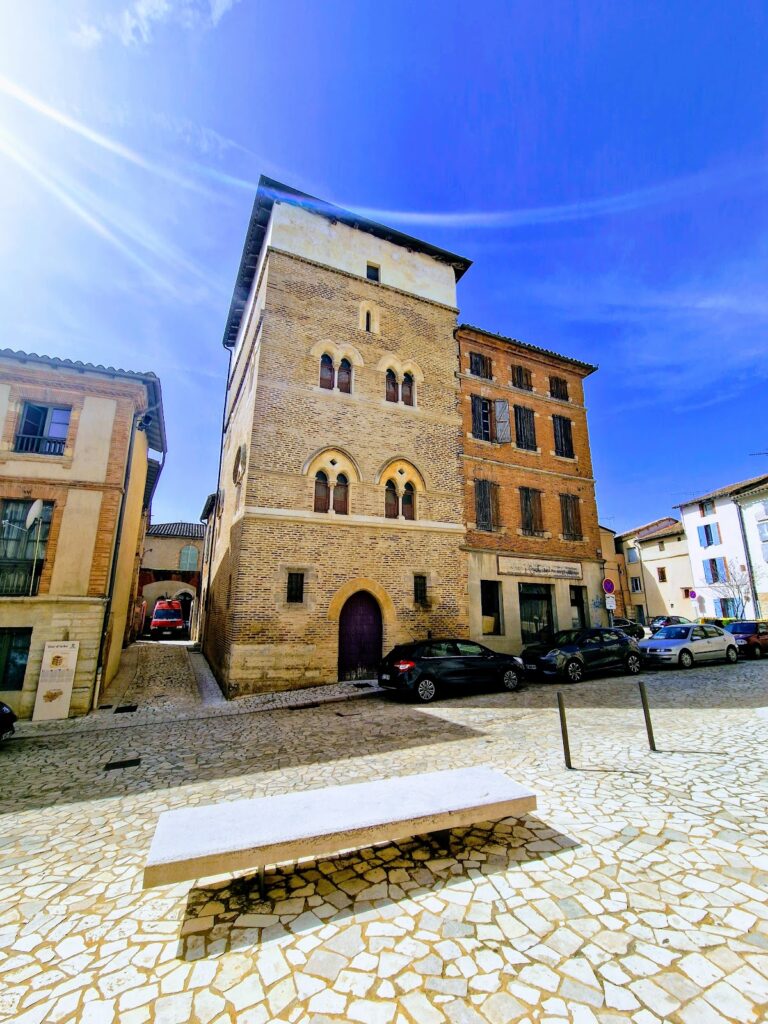
The former episcopal palace stands beside the Pont Vieux on the bank of the Tarn. Its principal body runs along the river, while a northwestern wing follows the bridge at a right angle to the main block. This bridge-side wing narrowed the road approaching the bridge; in the eighteenth century, the road was rectified to maintain a constant width parallel to the wing. The northeastern pavilion contains the chapel, and the southern part of the northern return wing contains the principal staircase. The bishop’s arms were carved on the frame above the staircase portal.
Medieval rooms and castle remains
Two medieval underground rooms survive beneath the palace’s right wing. They were built against the approach arches of the bridge, and the second room opens onto one of the arches. Rather than being entirely removed, the rooms were incorporated into the later palace.
Probable remains of the medieval comtal castle survive in the lower parts of the building. Among them is a Romanesque corbel, a projecting masonry element supporting or decorating a wall, carved with the head of a warrior. A legend identifies the head as Renaud, one of the Four Sons of Aymon, but that attribution is legendary.
Château-Neuf platform and defenses
The former Château-Neuf courtyard was filled from 1568 onward until it reached the present level. The resulting raised platform was known as Castel-Nyo, and the work continued until 1588. On the Tarn side, the platform was bordered by a crenellated parapet and protected by three small projecting guard turrets. These defenses were later removed after Montauban’s capitulation in 1629.
In 1574, one of the large windows in the hall associated with the Black Prince was walled up. Parts of the castle grounds were leased for houses, which appear in documents from 1581, 1585, and 1608. These alterations, together with the later palace construction, left the site as a layered complex in which medieval, early modern, and seventeenth-century elements remain connected.
Collections associated with Ingres
The museum’s collections include the paintings and Greek or Etruscan vases donated by Jean-Auguste-Dominique Ingres, as well as the 68 paintings given by Baron Vialette de Mortarieu. The collections reflect the building’s final transformation from episcopal residence and municipal building into a museum devoted to the artistic heritage associated with Ingres and Montauban.
Nearby sites