Monastery of Eisodia Theotokou, Myrtia: A Greek Orthodox Monastic Foundation
Site at a Glance
- Rating
- 4.9
- Popularity
- Low
- Country
- Greece
- Primary era
- Early Modern
- Eras represented
- Medieval, Early Modern
- Civilizations
- Byzantine, Ottoman
- Site type
- Religious
- Remains
- Monastery
On this page8 sections
History
The Monastery of Eisodia Theotokou, Myrtia, in Greece, is an active male Greek Orthodox monastery dedicated to the Presentation of the Theotokos, the Christian commemoration of Mary’s traditional presentation at the Temple. Also known as Panagia Phaneromeni Monastery, it was established around 1200, during the late twelfth or early thirteenth century, probably in the period of the Despotate of Epirus, a medieval Greek state that arose in western Greece and the Balkans after the Fourth Crusade.
Foundation and religious life
The monastery belongs to the Metropolis of Aetolia-Acarnania and is under the Ecumenical Patriarchate of Constantinople. Its principal annual celebration takes place on November 21, the feast of the Presentation of the Theotokos. A chapel dedicated to the Transfiguration has its own feast on August 6.
During the Ottoman occupation, the monastery served as a center of education. Saint Kosmas the Aetolian, an eighteenth-century Greek Orthodox monk and missionary known for preaching and founding schools in Ottoman-ruled Greece, lived there for a period.
Destruction during the Second World War
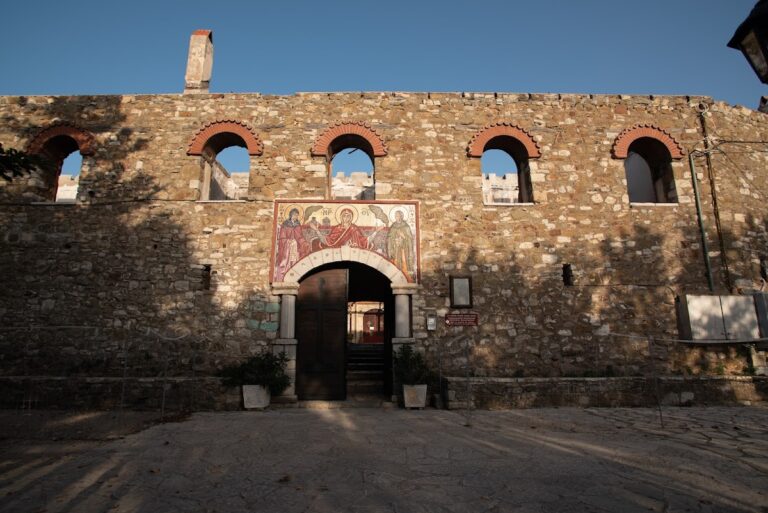
On July 10, 1943, the Battle of Myrtia was followed by a German occupation reprisal. German troops burned the monastery buildings, but the katholikon, the principal church of an Orthodox monastery, survived the fire. This survival preserved the central architectural and artistic record of the monastery through the destruction of much of its surrounding complex.
Remains
Church and setting
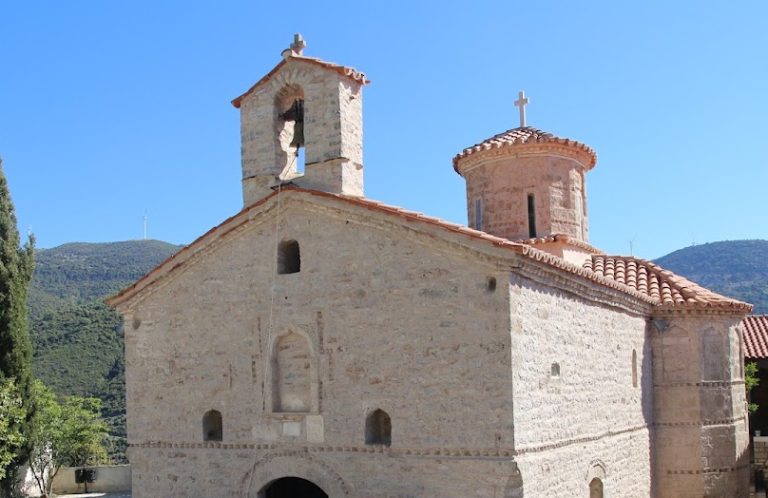
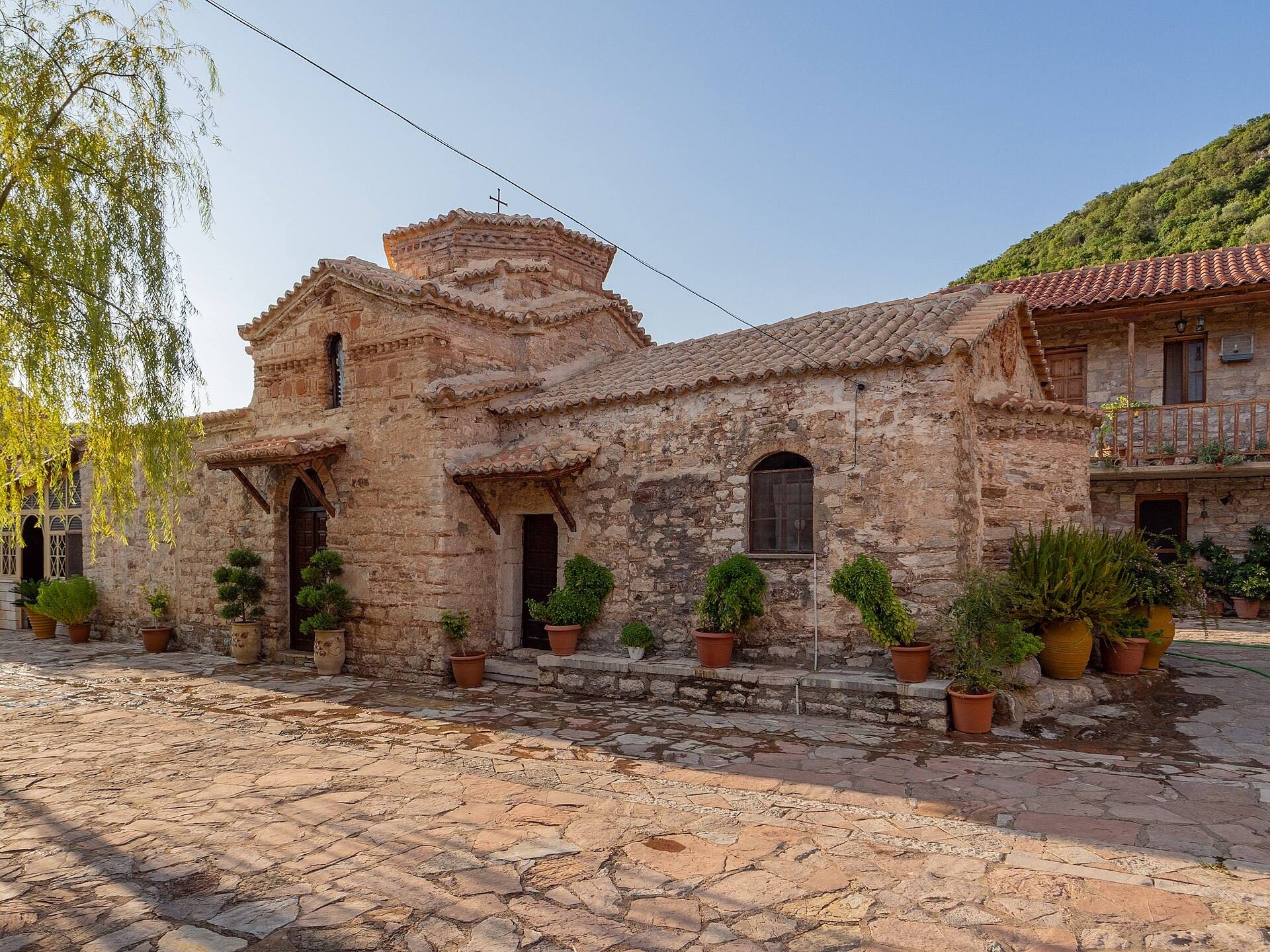
The monastery stands outside the village of Myrtia on the road between Agrinio and Thermo, in a wooded area northeast of Lake Trichonida. Its principal surviving building is the katholikon, a Byzantine cross-in-square church whose present form developed through the joining of an earlier sanctuary church and a later main church.
Sanctuary
The sanctuary began as a separate church built in the eleventh or twelfth century. It forms the eastern liturgical area of the complex and contains the altar. Approximately four centuries later, the present main church was attached to its west, creating the surviving arrangement.
Main church and narthex
The main church follows the Byzantine cross-in-square plan. A narthex, the entrance chamber adjoining the body of a church, was added in the seventeenth century. Together, these phases preserve the monastery’s architectural development from its early sanctuary through the later expansion of the church.
Frescoes and inscription
The church preserves wall paintings from the twelfth and thirteenth centuries, 1491, 1539, and 1712. The oldest is a depiction of the Dormition of the Theotokos, dated to the twelfth or thirteenth century. In 1491, Digenis Xenos painted the sanctuary’s arch and apse in the manner of the Cretan School, a regional tradition of Byzantine and post-Byzantine religious painting associated with a refined iconographic style developed in Crete. The main church was frescoed in 1539 by an unidentified painter connected with the Epirote School, the religious painting tradition associated with Epirus.
The oldest surviving inscription in the monastery dates to 1491. It is positioned west of the south door and is written in Middle Bulgarian.