Mnajdra: A Prehistoric Megalithic Temple Complex in Malta
Site at a Glance
- Country
- Malta
- Primary era
- Bronze Age
- Eras represented
- Stone Age, Bronze Age
- Civilizations
- Maltese Temple Culture
- Site type
- Religious
- Remains
- Temple
On this page13 sections
History
Prehistoric temple phases
Mnajdra is a prehistoric megalithic temple complex in Qrendi, Malta, built by prehistoric communities during the fourth millennium BCE. Its three temples belong to different periods of Malta’s prehistoric temple culture, known as the Ġgantija and Tarxien phases.
The upper temple belongs to the Ġgantija phase, dated to 3600–3200 BCE. The lower temple was built in the early Tarxien phase, while the middle temple was built or possibly rebuilt during the late Tarxien phase (3150–2500 BCE). Ceremonial finds have led archaeologists to interpret the complex as a place of religious activity, perhaps connected with healing or fertility.
Excavation and heritage recognition
J. G. Vance directed excavations in 1840, a year after the discovery of nearby Ħaġar Qim. James Fergusson drew the first plan in 1871, but it was inaccurate; Albert Mayr produced the first accurate plan in 1901. Thomas Ashby investigated Mnajdra in 1910 and collected important archaeological material. Excavations continued through 1954, including further work in December 1949.
Mnajdra was added to Malta’s Antiquities List in 1925. In 1992 it became part of the UNESCO World Heritage property for the Megalithic Temples of Malta, expanding a listing first established for Ġgantija in 1980. The property, which includes Mnajdra and four other temples, was extended again in 2015.
Damage and restoration
On 13 April 2001, at least three people used crowbars to topple or break about 60 megaliths and defaced stones with graffiti. The damage was initially considered irreparable, but restoration using new techniques was completed in 2002.
Remains
Layout and construction
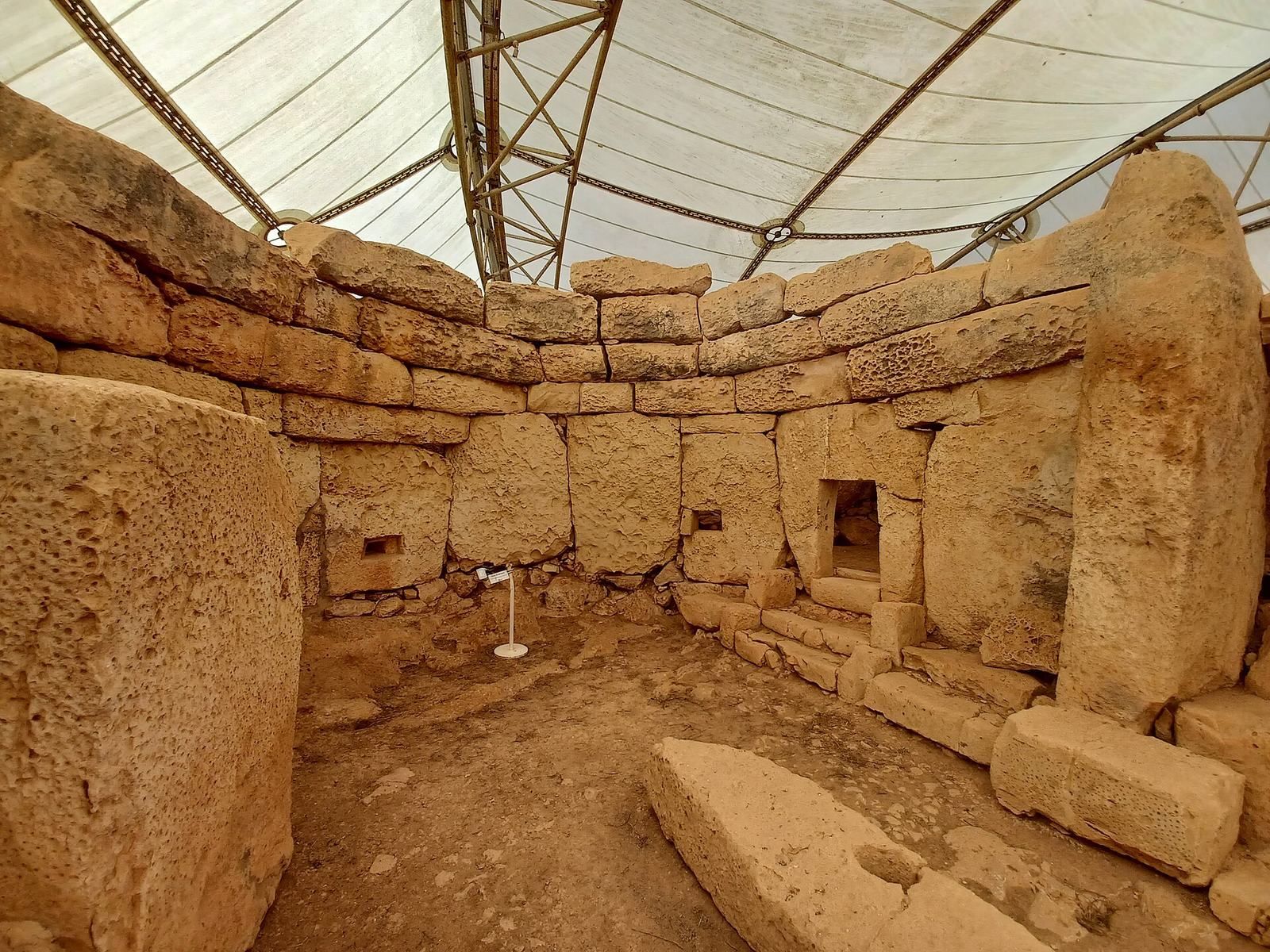
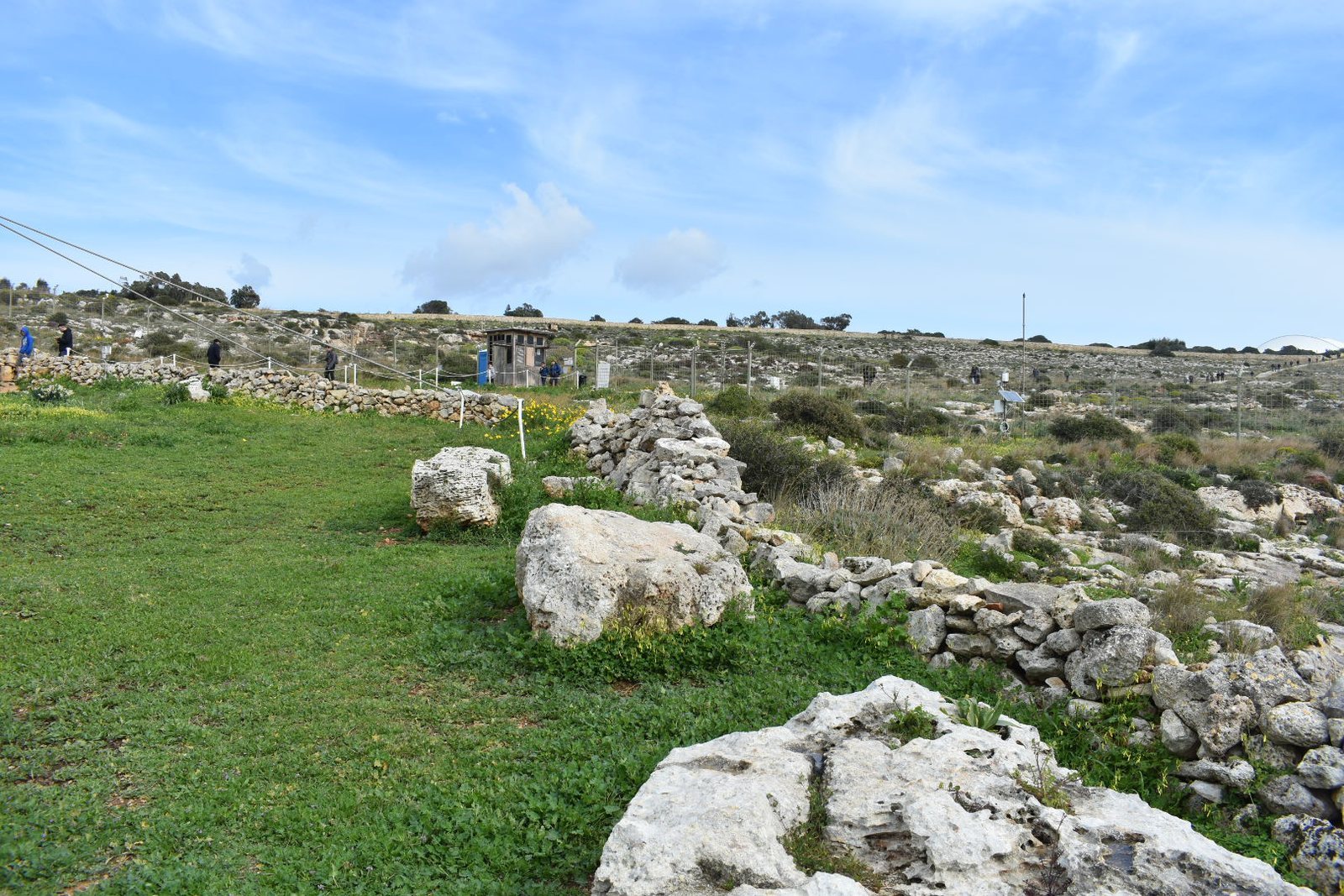
Mnajdra stands on Malta’s southern coast, about 497 metres from Ħaġar Qim. Its three adjoining temples are not connected. Their cloverleaf plan is more regular than Ħaġar Qim’s and has been compared with Ġgantija, the earlier temple complex on Gozo. The buildings use coralline limestone, harder than the globigerina limestone at Ħaġar Qim. Their construction combines small stones laid in successive inward-projecting courses with upright stones supporting large horizontal slabs.
The temples
Upper temple
The oldest temple has three curved chambers. A low screen wall blocks the opening into the central chamber, and rows of small drilled pits mark the inner faces of its pillar stones.
Middle temple
A hole cut through a large upright limestone slab forms the central doorway. The temple appears to have had a vaulted roof; its surviving base rests on the walls and consists of slabs topped by horizontal courses. This surviving element is considered the latest structure in the complex.
Lower temple
A large forecourt with stone benches leads to an entrance passage once covered by horizontal slabs, one of which remains. The temple also preserves the remains of a possibly domed roof. Spiral carvings and indentations decorate its surfaces. Windows open into smaller rooms, and one faces an arrangement of stones.
The lower temple’s main doorway and axis align with the sun. At the spring and autumn equinoxes, sunlight passes through the doorway and illuminates the main axis; at the summer and winter solstices, it lights the edges of the megaliths beside the entrance. These alignments have prompted suggestions that the temple served astronomical or calendrical purposes.
Carvings, furnishings, and finds
A niche in the lower temple bears small drilled holes, while another stone has many holes arranged in several right-aligned rows. These rows have tentatively been linked to periods measured by the moon. Stone benches and tables furnished the temples. Finds within them include flint knives interpreted as sacrificial, animal bones, and rope holes that may have been used to restrain animals for sacrifice.
Excavated objects
Excavations in December 1949 recovered two small statues, two large bowls, tools, and a large spherical stone that may have helped move the temples’ heavy stones. A graffito found at Mnajdra depicts a megalithic temple with a roof.
Present condition
The temples survive as well-preserved ruins, enclosed by a protective shelter completed in 2009.