Mezit Bey Mosque: An Ottoman Mosque in Edirne


Site at a Glance
- Rating
- 4.9
- Popularity
- Very Low
- Country
- Turkey
- Primary era
- Medieval
- Eras represented
- Medieval, Modern
- Civilizations
- Ottoman
- Site type
- Religious
- Remains
- Mosque
On this page6 sections
History
Mezit Bey Mosque is an Ottoman mosque in Edirne, Turkey, built in the mid-fifteenth century during the reign of Sultan Murad II. Mezit Bey, who served as sanjak-bey of Alacahisar, an Ottoman provincial governor and military-administrative official, is associated with its foundation. An entrance plaque gives 1442 as the construction date and attributes the building to the municipality, while the mosque’s historical attribution remains to Mezit Bey.
Foundation and early identity
Murad II ruled the Ottoman Empire from 1421 to 1444 and again from 1446 to 1451. During this period, the mosque was also known as Yeşilce Camii, meaning Green Mosque. The name referred to its interior tiles and to the glazed bricks that historically covered its minaret.
Damage and restoration
The 1752 earthquake and destruction during the Russian occupation caused the historic tiles to disappear. After the Balkan Wars, the mosque remained in ruins for many years among fields. An Arabic repair inscription at the entrance records a further repair dated 1307 in the Islamic calendar, corresponding to 1889–1890.
Turkey’s General Directorate of Foundations, the state institution responsible for administering and conserving many religious and charitable endowments, restored the mosque in 1990–1991. The ruined minaret was rebuilt during this work. The building was then reopened for worship and remains an active Sunni Muslim mosque, owned by the General Directorate of Foundations.
Remains
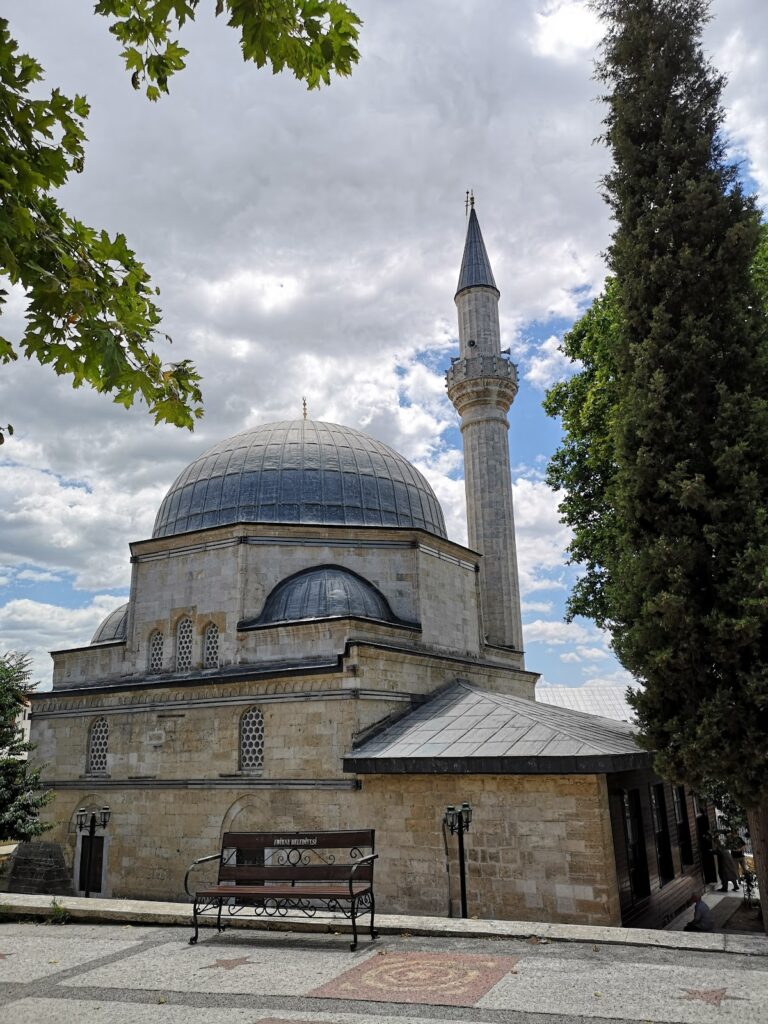
Mezit Bey Mosque occupies a large garden and follows an Ottoman architectural design based on an inverted T-shaped plan. In this layout, the principal prayer space is combined with side or rear rooms to form an inverted letter T. The building is covered by four domes and has a single minaret.
Building and interior
The mosque’s surviving architectural form reflects the Ottoman building tradition that developed under the empire, particularly in religious and civic structures. Its four domes cover the building, while the garden provides the setting for the mosque’s main structure. The interior tiles that gave rise to the name Yeşilce Camii were lost through the site’s later damage.
Entrance and minaret
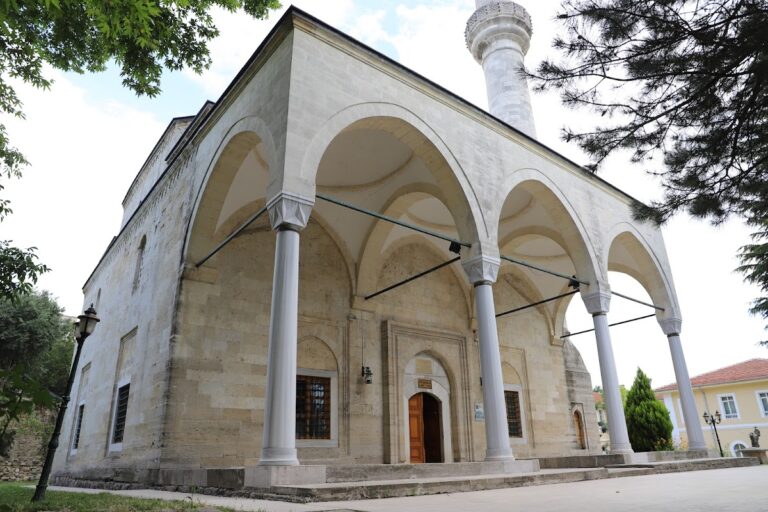
The entrance door carries an Arabic repair inscription dated 1889–1890. The minaret was historically faced with glazed brick, a feature associated with the mosque’s former name, and was rebuilt during the 1990–1991 restoration after its earlier ruin.