Mendut Temple: A Mahayana Buddhist Shrine in Central Java
Site at a Glance
- Rating
- 4.6
- Popularity
- Medium
- Country
- Indonesia
- Primary era
- Medieval
- Eras represented
- Medieval
- Civilizations
- Unclassified
- Site type
- Religious
- Remains
- Temple
On this page12 sections
History
Mendut Temple is a Mahayana Buddhist shrine in Mendut village, Central Java, Indonesia, built between approximately 780 and 830 during the rule of Indra of the Sailendra dynasty. The Sailendras were a ruling house associated with major Buddhist monuments in Central Java during the eighth and ninth centuries. Mendut lies about 3 kilometres east of Borobudur and, together with Pawon and Borobudur, forms a straight alignment traditionally understood as a religious sequence, although the exact ritual relationship among the three temples remains uncertain.
Sailendra foundations and later changes
Mendut is traditionally regarded as the oldest of the three aligned temples. Its construction took place during the late eighth or early ninth century, but the shrine was enlarged and altered after its initial building phase. Earlier structures were enclosed within the surviving main shrine, creating a layered architectural history.
The 824 Karangtengah inscription describes the construction of a sacred building called Venuvana, meaning “bamboo forest.” J. G. de Casparis identified Venuvana with Mendut, although this interpretation is disputed. Another reading associates the name with Ngawen Temple. A fragmentary inscription found in Mendut’s main shrine uses a script resembling the Kawi script employed at Borobudur.
Rediscovery and restoration
By the nineteenth century, Mendut had become a ruin concealed by bushes and mud, possibly deposited as ash from Mount Merapi. The site was discovered in 1836. Restoration under the Dutch East Indies colonial government began in 1897, followed by reconstruction of the base and walls from 1904.
The archaeologist Theodoor van Erp directed further work from 1908, although financial difficulties interrupted the project. Restoration resumed in 1925. Later archaeological research involved J. G. de Casparis, van Erp, and Arisatya Yogaswara. The government now administers and conserves the temple. Mendut forms part of the Borobudur Temple Compounds, which became a UNESCO World Heritage cultural property in 1991.
Continuing religious use
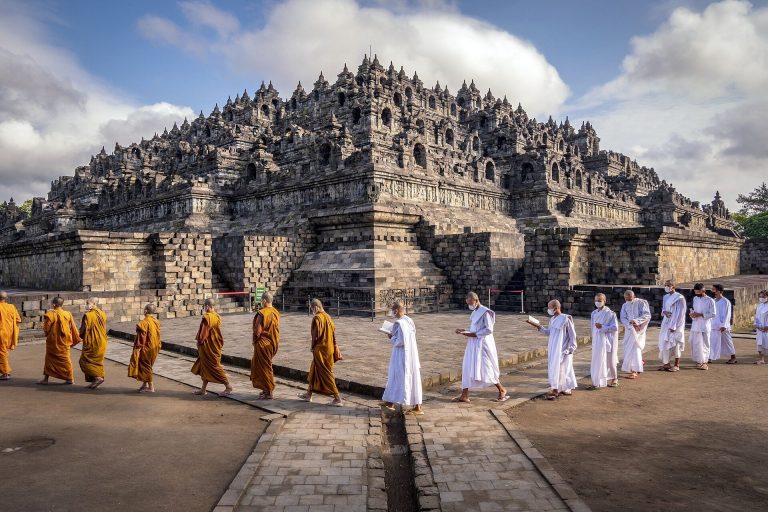
Mendut remains part of Buddhist religious practice in Java. During the full moon of May or June, Indonesian Buddhists traditionally make a Vesak pilgrimage from Mendut through Pawon to Borobudur, a route of about 4 kilometres. The observance includes collective prayer and clockwise circumambulation, known as pradakshina, in which worshippers keep the sacred building on their right.
Buddhists and followers of traditional Kejawen practice also worship at Mendut in the belief that prayer may fulfil wishes, including prayers for relief from illness. Childless couples pray before the image of Hariti, a Buddhist protective goddess associated with motherhood and children. In Javanese belief, Hariti is regarded as a figure of fertility, a protector of mothers, and a guardian of children.
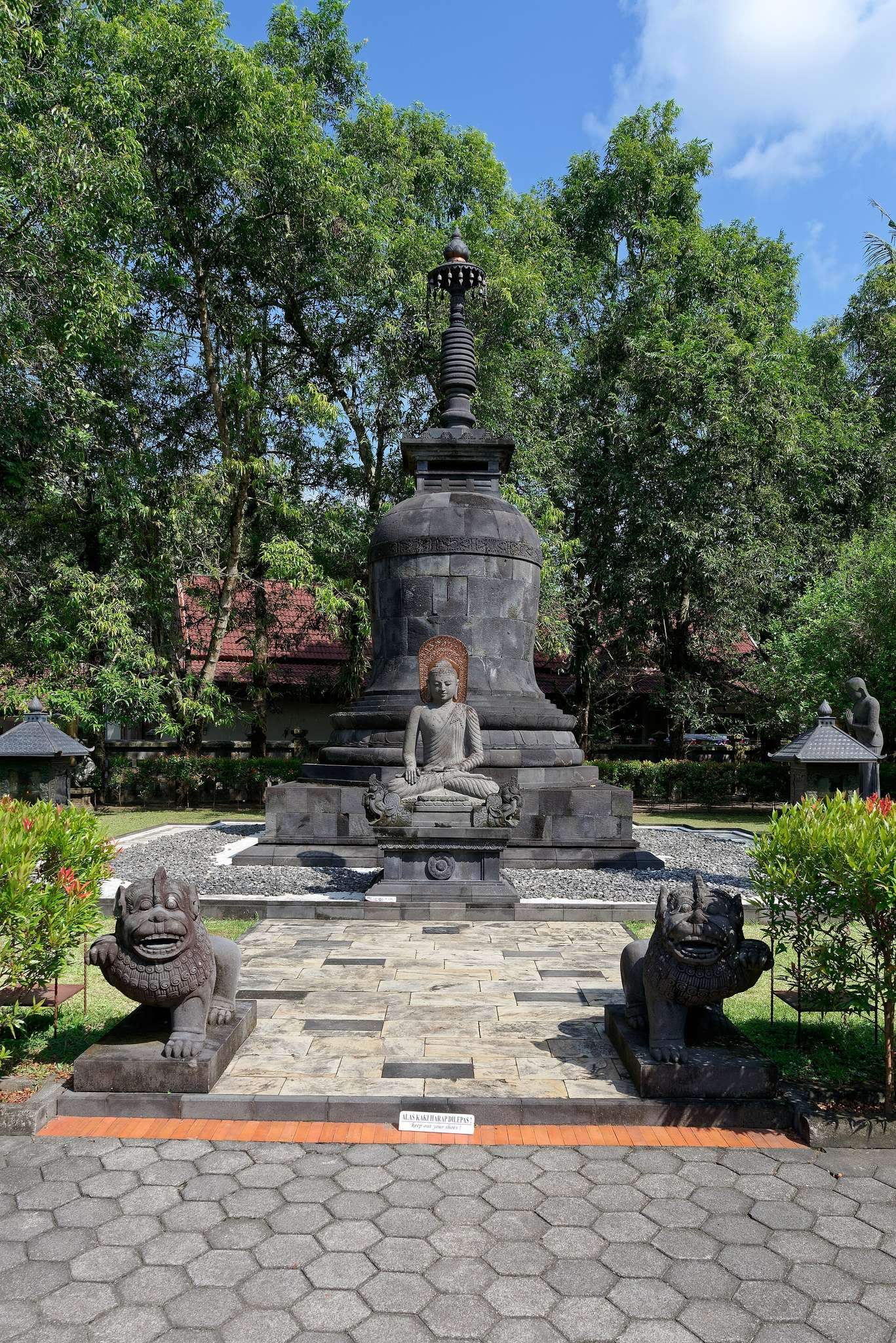
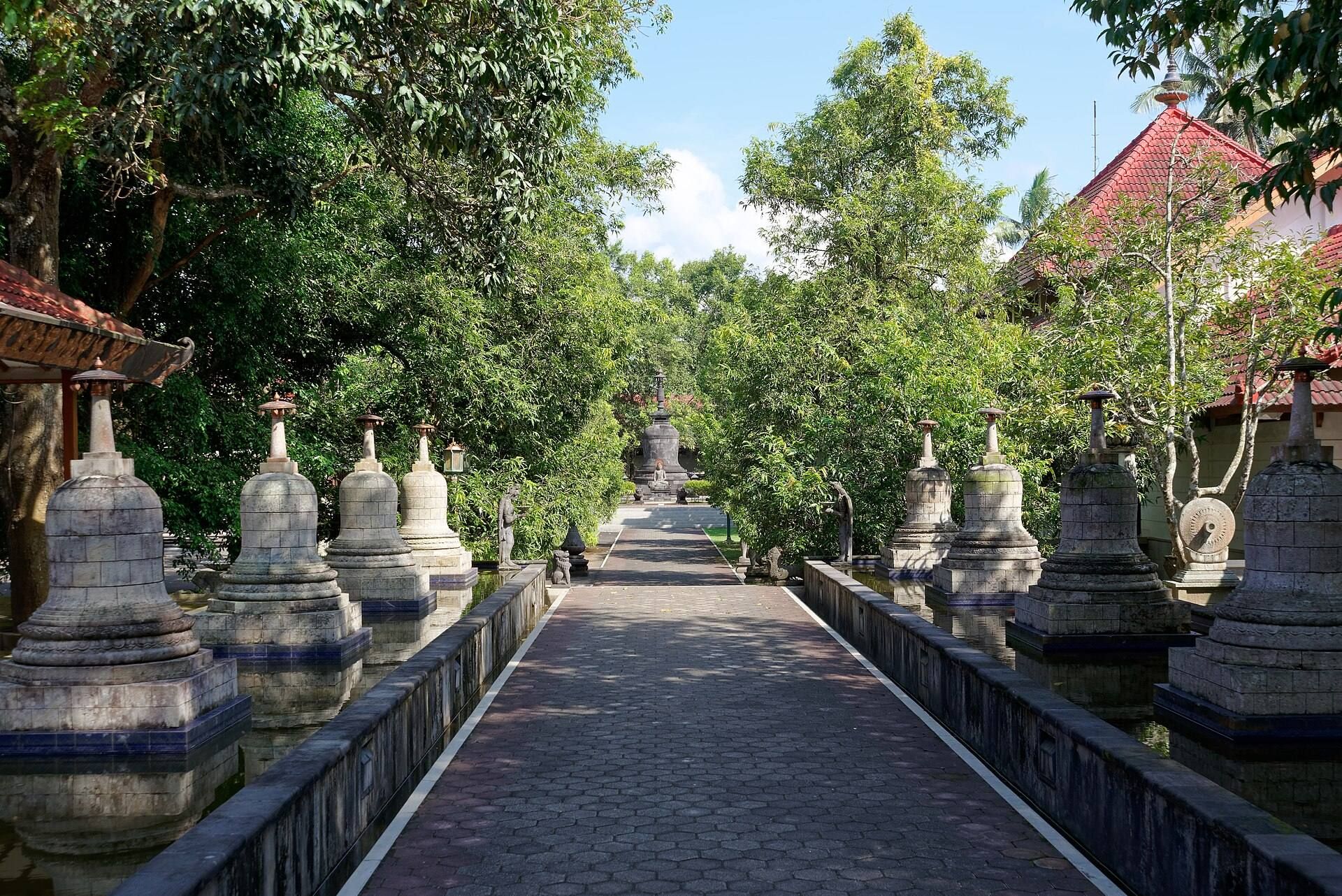
The Mendut Buddhist Monastery stands immediately outside the ancient temple compound. After a former Catholic monastery passed into private ownership in the 1950s, a Buddhist organization acquired the land. The monastery began with simple bamboo buildings and was gradually rebuilt from 1994. It conducts rituals at the ancient temple several times a year, while remaining a separate modern complex.
Remains
Compound and temple exterior
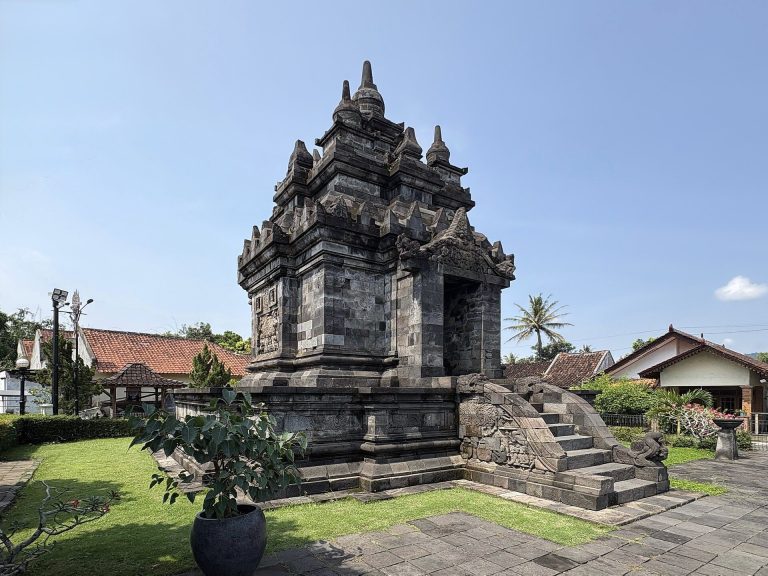
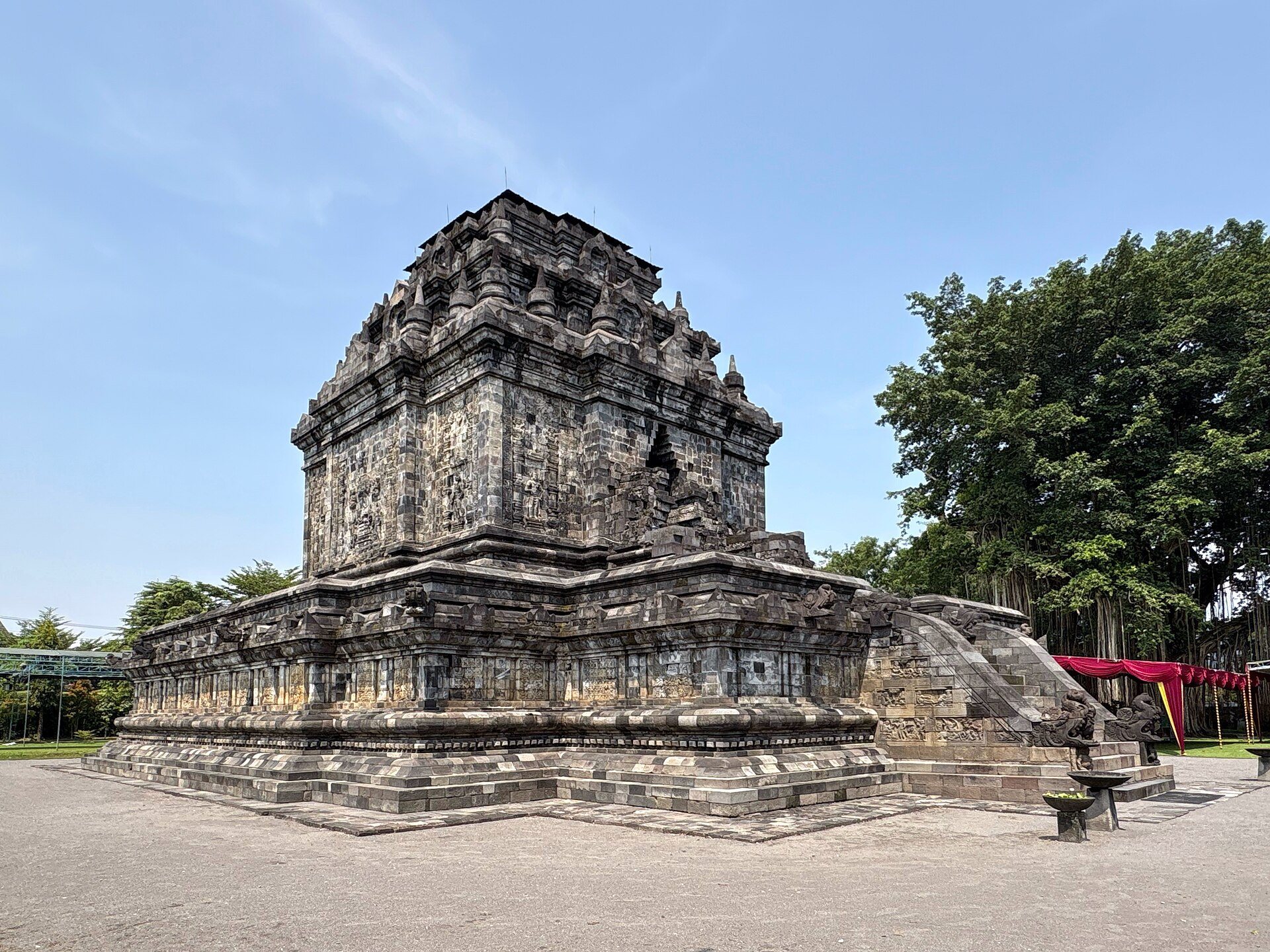
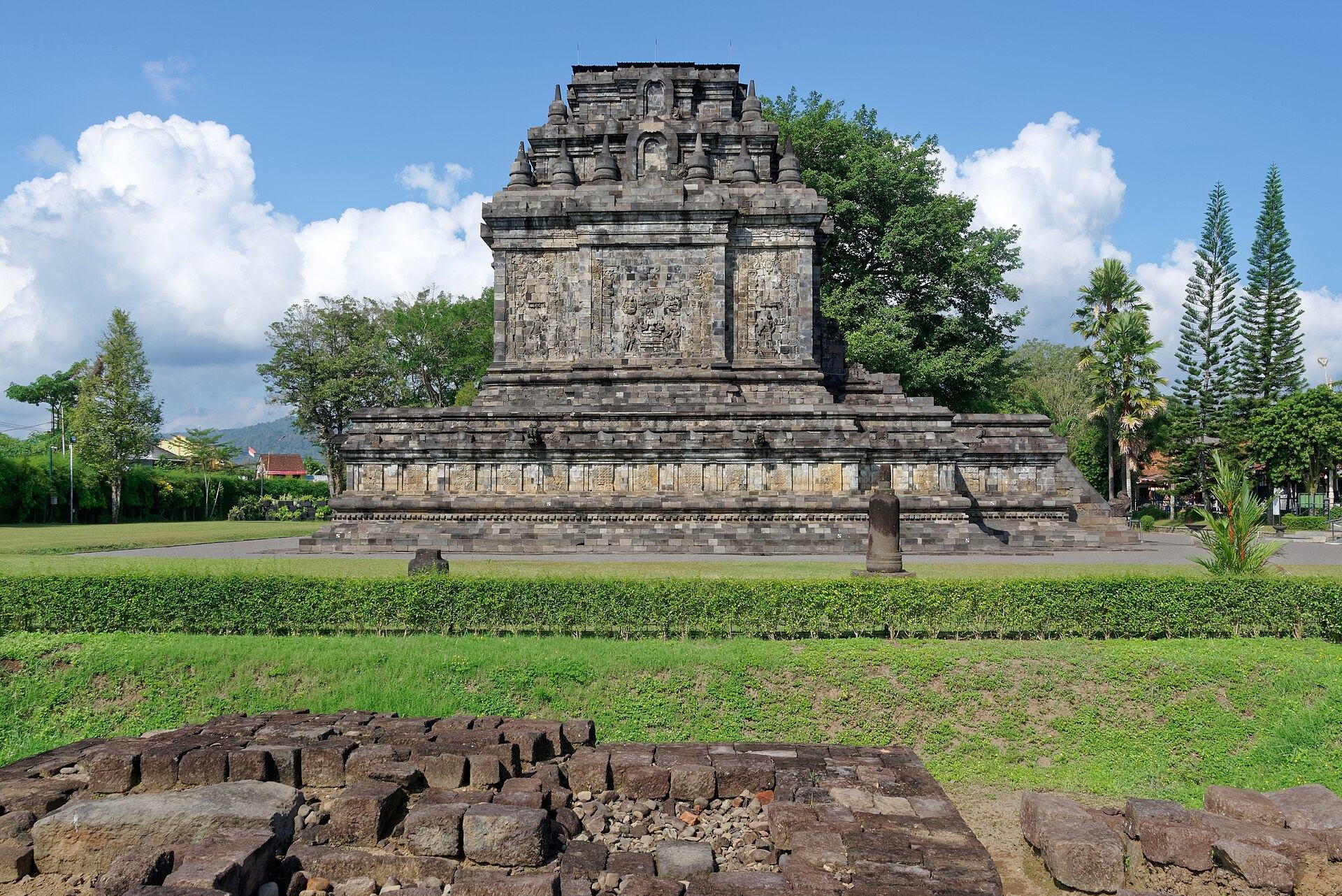
The temple compound covers approximately 50 by 110 metres, with the ancient shrine positioned in its southern part. A wooden vihara, or monastic building, is believed to have occupied the northern part. Mendut faces west or slightly northwest. Its main base is a stepped, irregularly articulated rectangle about 24 metres wide and 28 metres deep, rising approximately 3.5 to 3.7 metres above the ground. The restored structure reaches 26.4 metres in height.
A square balustraded terrace surrounds the temple body. Its arrangement provided space for pradakshina, the ritual of walking clockwise around a sacred structure. The upper portions carry 48 stupa ornaments. The original highest structure has been lost, and the front chamber also lacks its roof. Its roof is thought to have ended in a stupa finial comparable in size and style to the finial of Sojiwan Temple.
Entrance staircase and narrative reliefs
A projecting staircase on the western or northwestern side is flanked by makara sculptures. These mythological aquatic creatures commonly serve as protective motifs at entrances to South and Southeast Asian religious buildings. The staircase walls are covered with Buddhist narratives, including Jataka stories, which recount episodes from the Buddha’s previous lives and convey moral or religious teachings.
The southern or southwestern staircase wall has five rectangular and two triangular panels arranged in three registers. The northern or northeastern wall has six rectangular and three triangular panels arranged across four levels. Four panels on the southwestern wall and two on the northeastern wall have been identified as Jataka scenes, while others belong to different Buddhist narrative traditions.
The identified stories include the Abbhantara Jataka, in which a parrot reaches a golden cave to obtain mangoes for a queen, and the Dalhadhamma Jataka, where an old elephant regains its honour. The Kacchapa Jataka tells of a family escaping an epidemic and a tortoise attached to its home. The Manikanta Jataka concerns a serpent and a hermit, while the Suvannakakkata Jataka describes a crab protecting a Brahmin from a crow and a serpent. In the Kalayamutthi Jataka, a monkey loses all its beans while attempting to recover one that has fallen.
Other panels show a tortoise falling to its death after opening its mouth while being carried on a stick, and the god Agni protecting a child who reaches toward a fire. Together, the reliefs demonstrate that the staircase program included both Jataka material and other Buddhist moral narratives.
Exterior bodhisattva sculptures
The outer walls carry eight large bodhisattva reliefs. Bodhisattvas are Buddhist figures who seek enlightenment while assisting other beings. The group is generally interpreted through the imagery of a tantric Buddhist mandala, although the identification of individual figures remains debated.
The figures are associated with Akashagarbha, Maitreya, Sarvanivaranavishkambhin, Kshitigarbha, Vajrapani, Manjushri, Samantabhadra, and Padmapani or Avalokiteshvara. Their attributes include lotus flowers bearing jewels, a stupa in a crown, a naga or dragon tree, a vajra, a manuscript resting on a blue lotus, and swords or other objects held above lotuses. The figure at the right side of the northwest entrance is badly damaged, with only its lower portion surviving.
Three additional large reliefs, each approximately 2.7 metres high and 3.5 metres wide, appear on the northeast, southeast, and southwest exterior walls. They have been identified respectively with Cundi Avalokiteshvara, Avalokiteshvara, and Tara or Prajnaparamita. The reliefs form part of the temple’s wider program of Buddhist devotional imagery.
Interior chambers and sculptures
Mendut originally contained two chambers, a small front chamber and a larger central chamber. The front chamber has lost its roof and parts of its walls, while the principal sculptures survive in the main chamber. Their arrangement gives the shrine its central sculptural focus.
Front chamber reliefs
The inner walls of the front chamber show Hariti surrounded by children. On the opposite side is Kubera, a deity associated with wealth and treasures, linked here with Panchika and the yakshas, nature spirits or attendant figures in South Asian religious traditions. Flying devata figures and a kalpataru, or wish-fulfilling tree, complete the chamber’s imagery.
Main chamber sculptures
The main chamber contains three large stone sculptures. The central andesite image is about 3 metres high and is variously identified as Shakyamuni, Vairocana, or Amitabha. Andesite is a volcanic stone widely used for masonry and sculpture in Central Javanese monuments. The figure sits on a square seat with both feet lowered onto lotus flowers and makes the gesture of turning the wheel of the Dharma. This iconography represents the Buddha preaching at the Deer Park of Sarnath.
Two attendant bodhisattvas, each approximately 2.4 to 2.5 metres high, sit in relaxed poses with one leg lowered. The figure on the left is generally identified as Avalokiteshvara or Padmapani. It makes a gesture of granting wishes, reaches toward a lotus, and bears a small Buddha image on the front of its crown. The figure on the right is generally identified as Vajrapani. Its left hand extends toward the lotus pedestal in a gesture of touching the earth, while its raised right hand represents a vajra.
The identities of the three sculptures are not entirely certain. A 775 inscription from the Malay Peninsula describes a Sailendra temple dedicated to Shakyamuni, Padmapani, and Vajrapani, a correspondence that supports identifying the Mendut group in those terms. The arrangement has also been compared with the three sculptures formerly installed in the principal chamber of northern Plaosan.
The figures show affinities with Buddhist images from the Ajanta and especially Ellora caves in India, as well as with the later Gupta artistic tradition. One interpretation proposes that seven images once occupied the shrine as part of a Vajradhatu mandala, although only the central Buddha and two attendants survive. The sculptural program has also been associated with bodily, verbal, and mental liberation: the central Buddha with release from bodily action, Avalokiteshvara with release from speech, and Vajrapani with release from thought.
Modern monastery complex
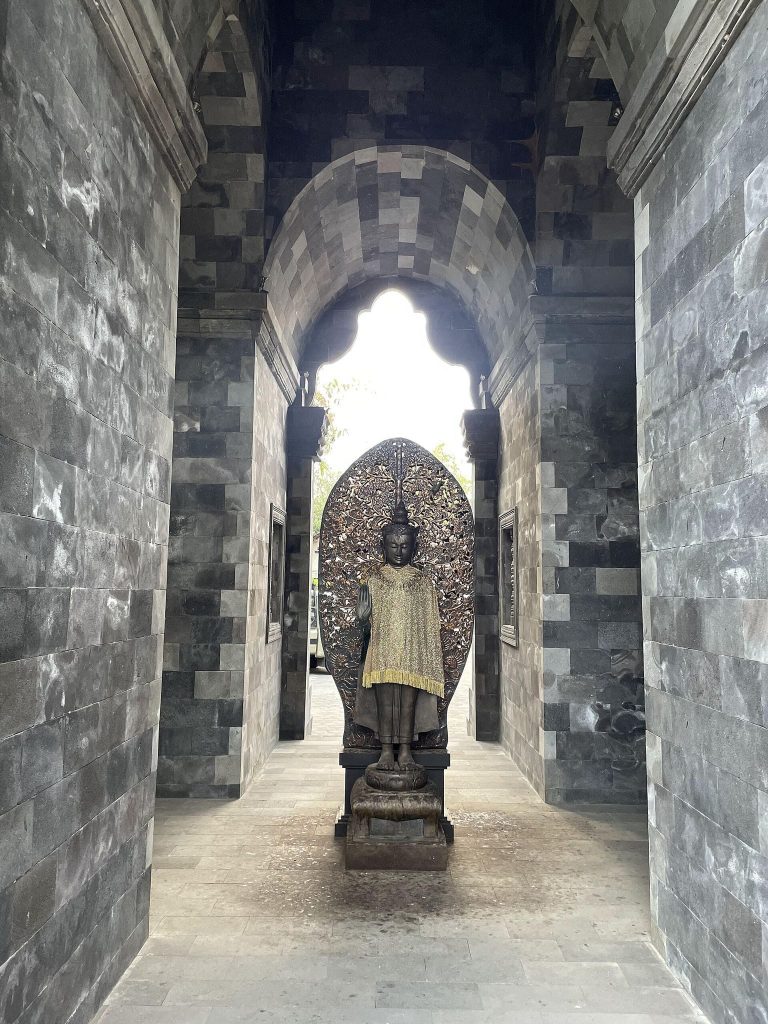
The adjacent Mendut Buddhist Monastery occupies a roughly one-hectare compound containing a lotus pond, a garden with bodhi trees, dormitories, stupas, and bodhisattva statues. A small pavilion with a pendopo-style roof houses a seated Shakyamuni image carved from granite and donated by a Japanese temple in 2002.
The monastery grounds also contain Candi Sangharaja, a later shrine built to commemorate the centenary of the birth of a Thai Supreme Patriarch. This structure belongs to the modern monastery complex rather than to the ancient Mendut temple ruin.