Megiddo Church: An Early Christian Prayer Hall in Israel
Site at a Glance
- Popularity
- Very High
- Country
- Israel
- Primary era
- Classical
- Eras represented
- Classical
- Civilizations
- Roman
- Site type
- Religious
- Remains
- Church
On this page7 sections
History
The Megiddo church is the remains of an early Christian house church, a domestic building adapted for worship and gatherings, in Israel. It lies within the area of the ancient Roman town of Legio, earlier known by the Hebrew name Kefar Otnay. The building is commonly dated to about 230 CE; if that date is correct, it may be the earliest excavated Christian prayer hall.
Dating and early Christian use
Coins, pottery, and the letter forms of the floor inscriptions support the commonly proposed date. Other chronologies place Christian use in the late third or early fourth century, while a still later date has also been suggested. The building itself may have been older than its use as a church, perhaps beginning as Roman premises in the early third century or before.
If the date of about 230 CE is accepted, Megiddo would rival the house church at Dura-Europos, in present-day Syria. That building is usually dated to about 233–235, though another proposal places it near 241. The Megiddo premises may have been adapted for worship, unlike the church at Aqaba in southern Jordan, identified as the earliest known Christian church built for that purpose from the outset. Aqaba’s first phase is dated to around 300, with proposed dates including 293 and 303.
The religious art has been interpreted as evidence that the congregation experienced relative calm before the upheavals of the later third century, though this reading is disputed alongside the later dating proposals. The finds have also been taken to suggest that Christians could live and worship alongside Jewish and Samaritan communities and Roman military personnel.
Abandonment and discovery
The building appears to have been abandoned hastily around 305 CE. This may have been connected to the persecution of Christians begun in 303 by the Roman emperor Diocletian, who ruled from 284 to 305.
Israeli archaeologist Yotam Tepper is credited with discovering the remains in 2005, and an inmate of the neighboring prison has also been credited with the discovery. Prisoners from the military prison took part in excavation and clearing work.
Remains
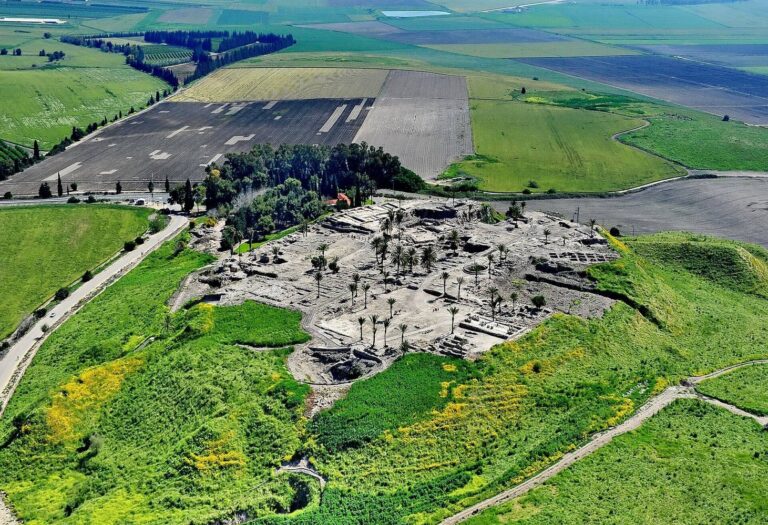
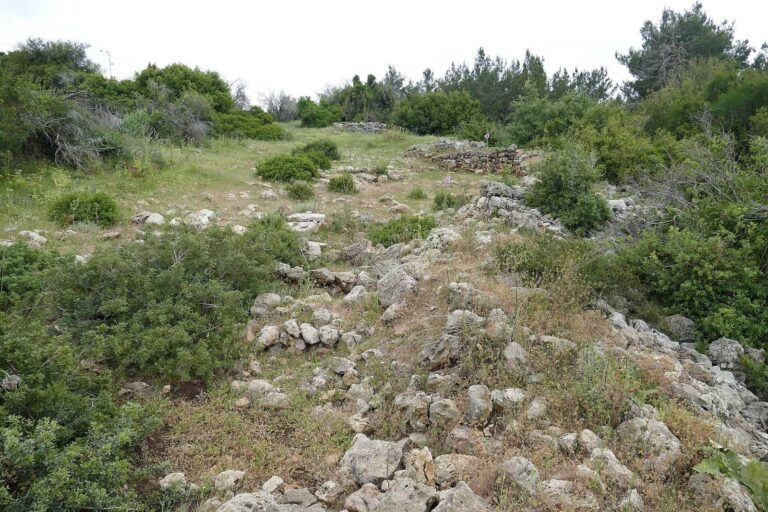
The remains lie a few hundred metres south of the tell, a mound formed by successive occupation and construction, near Megiddo Junction and Megiddo Prison. The foundations preserve the church’s footprint, including a well-preserved mosaic floor of about 54 square metres. Its four panels are arranged around a probable table, giving the floor a clear central focus.
Mosaic floor
Layout and decoration
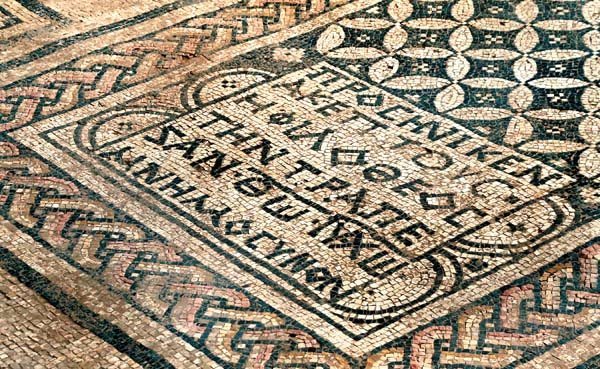
Small mosaic pieces, or tesserae, form monochrome rosettes and diamond shapes around the panels, with interlaced patterns along their borders. The southern panel has a carpet-like design of rosettes and two inscriptions. The northern panel combines an octagon with surrounding squares separated by diamonds and triangles, alongside a repeating angular-line pattern, a shield, two crescent shapes, a flower, and a checkerboard design. At its center, a prism-like form encloses a medallion bearing two fish, possibly a sea bass and a tuna. Fish were an early Christian symbol.
Two rectangular stones near the center of the floor, beside what appears to have been an arch, are thought to have served as legs for the table. The mosaic was deliberately covered when the church was abandoned.
Inscriptions and table
The northern panel’s inscription says that Gaianus, also called Porphyry, paid for the floor himself and credits its maker with completing the work. It describes Gaianus as a centurion, a Roman army officer who commanded a unit called a century, and as a “brother and dignitary” of the community.
One inscription on the western side of the southern panel describes Akeptous as God-loving and says she offered the table to God Jesus Christ as a memorial. The dedication has been interpreted as an early archaeological reference to the Eucharist, the Christian rite commemorating the Last Supper. The presumed central position of the table has been taken to suggest that communion was shared by the congregation rather than held in a clergy-only sanctuary. Akeptous’s name may derive from the Latin Acceptus; the suggestion that she had been enslaved remains uncertain.
The other inscription on the southern panel commemorates Primilla, Cyriaca, Dorothea, and Chreste, who may have been martyrs of the community. Their memorial appears opposite inscriptions associated with men, a placement that may indicate worshippers sat on different sides of the table.
The Greek inscriptions use mnemosynon, meaning “remembrance,” an uncommon word in its period but one found often in the New Testament, and prosferein, meaning “to offer,” a term frequent in the Gospels. One inscription abbreviates the name of Jesus Christ to its first and last letters and marks the form as sacred with a line above. The mosaic provides the earliest known evidence of this practice.