Esztergom Basilica: Hungary’s Primatial Cathedral
Site at a Glance
- Popularity
- Very High
- Country
- Hungary
- Primary era
- Modern
- Eras represented
- Early Modern, Modern
- Civilizations
- Austria-Hungary, Austrian Empire, Habsburg, Hungarian
- Site type
- Religious
- Remains
- Cathedral
On this page18 sections
History
Esztergom Basilica is the Roman Catholic cathedral in Hungary and the country’s primatial church. It is the cathedral of the Archdiocese of Esztergom-Budapest, a major diocese led by an archbishop, and the seat of Hungary’s primate, a senior church leader with national standing. The church is dedicated to the Assumption of the Virgin Mary, the Catholic belief that Mary was taken bodily into heaven, and to Saint Adalbert, a bishop and missionary who died in 997 while on a mission to Prussia. Its site first became a Christian religious center under Hungary’s first Christian king, Stephen I. The Classical building now standing was begun in 1822, and its final stone was set in 1869.
The first cathedral and its medieval successors
Stephen I built the first church here between 1001 and 1010. Dedicated to Saint Adalbert, it became Hungary’s first Christian church and cathedral. Fire almost completely destroyed the building during its early centuries, prompting its reconstruction. Damage during the Mongol invasion led to further rebuilding.
In 1304, Wenceslas III, king of Bohemia and a claimant to the Hungarian throne, sacked Esztergom and badly damaged the cathedral. A new cathedral followed in the fourteenth century. Its archbishops enlarged and embellished it during the fourteenth and fifteenth centuries, and its library was regarded as Hungary’s second most important.
Ottoman conquest and conflict on the hill
The Turkish-led Ottoman Empire, which ruled much of southeastern Europe as well as western Asia and North Africa, captured Esztergom in 1543 and almost destroyed the cathedral. Archbishop Pál Várdai and the cathedral chapter, a body of clergy involved in cathedral worship and administration, fled to Trnava with much of the church’s treasure. The archbishop’s residence moved there, and the chapter remained in exile until 1820.
During roughly 140 years of Ottoman occupation, repeated shelling devastated buildings on the castle hill. Austrian forces failed to take it in 1594, then recaptured it in 1595 and held it for ten years. The Habsburgs, a European ruling dynasty, took the hill again in 1686. In 1706, Hungarian insurgents who opposed Habsburg rule captured it under Francis II Rákóczi and caused further damage. Austrian troops remained in control of the strategically placed hill until 1771.
The nineteenth-century rebuilding
In 1820, Archbishop Sándor Rudnay returned the archbishopric’s seat and the cathedral chapter to Esztergom. He commissioned a grand new cathedral to restore the city’s place as Hungary’s religious center. A broader religious complex was first envisaged for the castle hill, but the plans that guided the cathedral’s foundations focused on the church. Its foundation stone was laid on 23 April 1822, Saint Adalbert’s feast day. After the architect died in 1824, his nephew, who had assisted him, took charge of construction.
Work stopped after Rudnay’s death in 1831. A simpler design was later proposed, but it met opposition. The project was reorganized under Archbishop József Kopácsy in 1838, the same year the builder in charge was murdered. A new architect substantially revised the design in the Classical style, removing plans for a primate’s palace and a large seminary. The Hungarian Revolution of 1848–49 interrupted construction again; work resumed under Cardinal-Primate János Scitovszky, a senior Roman Catholic cleric.
The cathedral was consecrated on 31 August 1856, before construction was complete. Franz Joseph I, Emperor of Austria and King of Hungary, attended, and Franz Liszt, a Hungarian composer and pianist, wrote a Mass for the ceremony. The final stone was set in 1869 under Cardinal-Primate János Simor.
Later use and modern changes
In 1991, the remains of Cardinal József Mindszenty, known for opposing communist rule, were transferred from Mariazell in Austria and reburied in the basilica’s crypt. The basilica continues to serve as a church and also houses a museum of religious treasures.
Remains
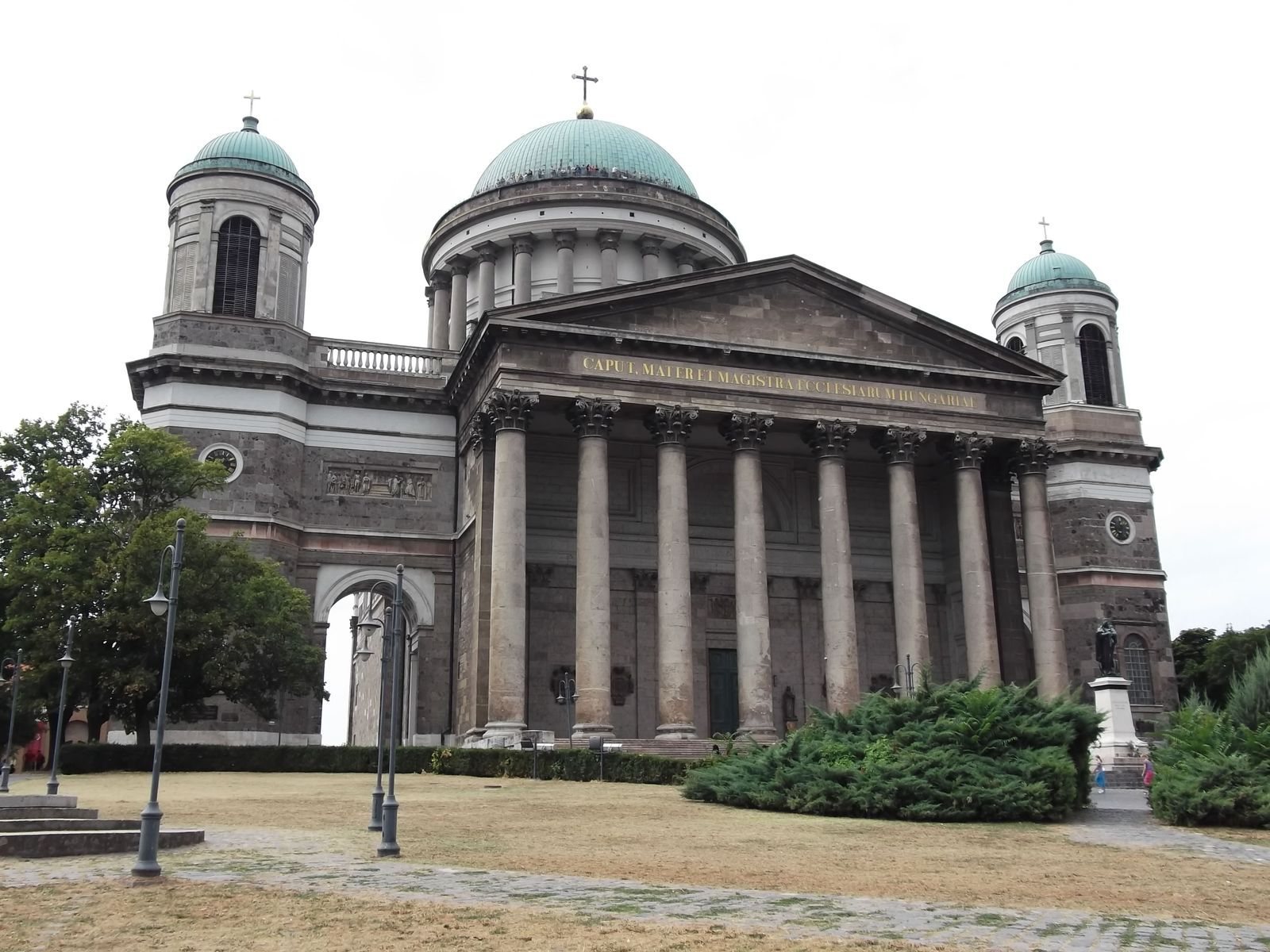
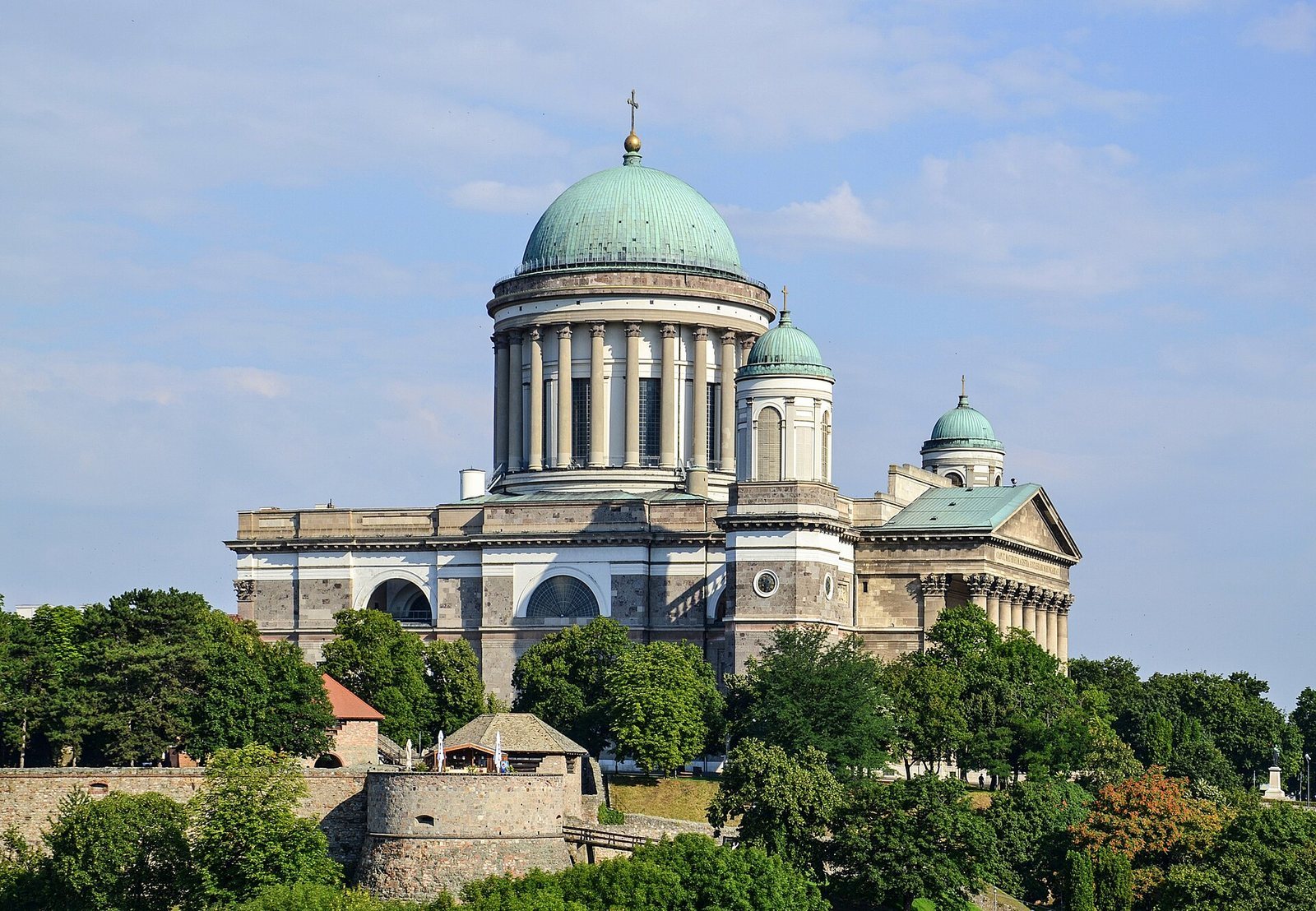
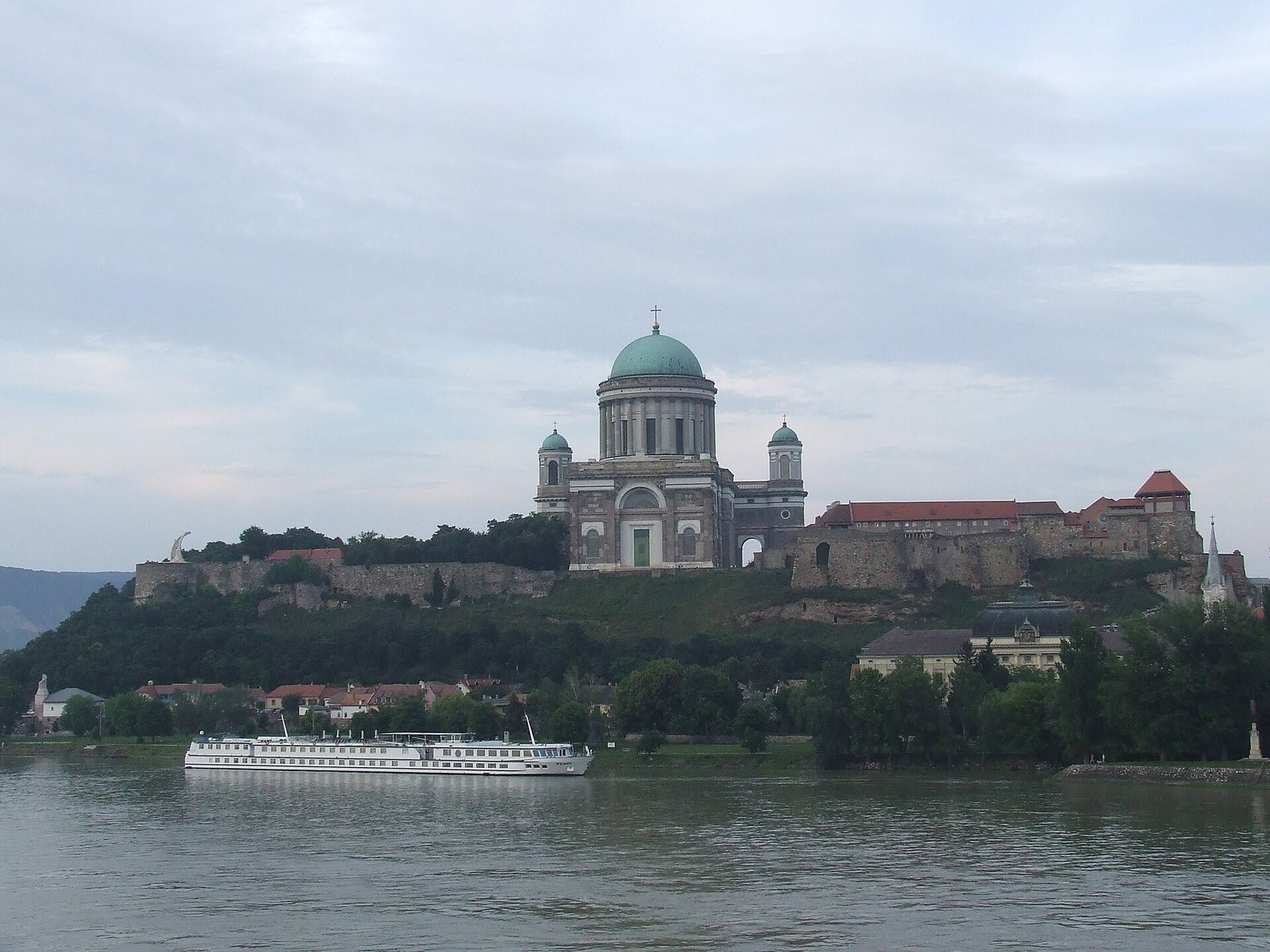
Set on castle hill beside the Danube, the basilica is a Classical building with a long main hall and a short crosswise transept, the part that crosses the church’s main body. Together they form a cross-shaped plan; two chapels, the treasury, and a reception hall extend it into a rectangle. The building is 118 metres long and 49 metres wide, with an interior area of about 5,600 square metres and a maximum height of 100 metres. It is Hungary’s largest and tallest church and is ranked among the world’s largest churches. Its east-northeast-facing front looks onto the broad Saint Stephen Esplanade. Two monuments stand to the building’s right, one to Saint Stephen and one commemorating Hungary’s Christianization. The basilica can be seen across Esztergom and from nearby Štúrovo in Slovakia.
Exterior and dome
Front and towers
The main entrance is a monumental columned porch with eight Corinthian columns, a classical type with ornate capitals. Each column is 22 metres high, and two towers flank the porch. Passage arches connect the towers with the central entrance. An inscription above it calls the basilica the “Head, Mother and Teacher of the Churches of Hungary.”
Domes
Three domes rise above the building. The central dome stands over the crossing, the area where the main hall and transept meet, and rests on a columned drum, the supporting structure beneath a dome. The drum has twelve windows. The dome measures 33.5 metres across and reaches an interior height of 71.5 metres.
Interior and sanctuary
Decoration and sculpture
The interior combines marble columns with walls faced in different kinds of marble, murals, mosaics, and statues. Ludwig von Moralt painted the murals. Sculptures by Italian artists Pietro Bonani and Pietro della Vedova, and Austrian sculptor Johann Meissner, accompany Hungarian works including István Ferenczy’s statue of Saint Stephen the First Martyr, Alajos Stróbl’s statue of Cardinal János Simor, and side-altar statues by György Kiss.
Dome mosaics
Four large hexagonal mosaics beneath the dome and its supporting structure depict Ambrose of Milan, Jerome of Stridon, Augustine of Hippo, and Gregory the Great, influential early Christian theologians.
Sanctuary
The sanctuary contains a carved white-stone altar beneath an Assumption painting by Michelangelo Grigoletti. The painting, on a single canvas about 13.5 by 6.6 metres, is the world’s largest painting on one canvas. An elaborately decorated bishop’s chair stands beside the sanctuary’s left wall.
Chapel, crypt, and treasury
Bakócz Chapel
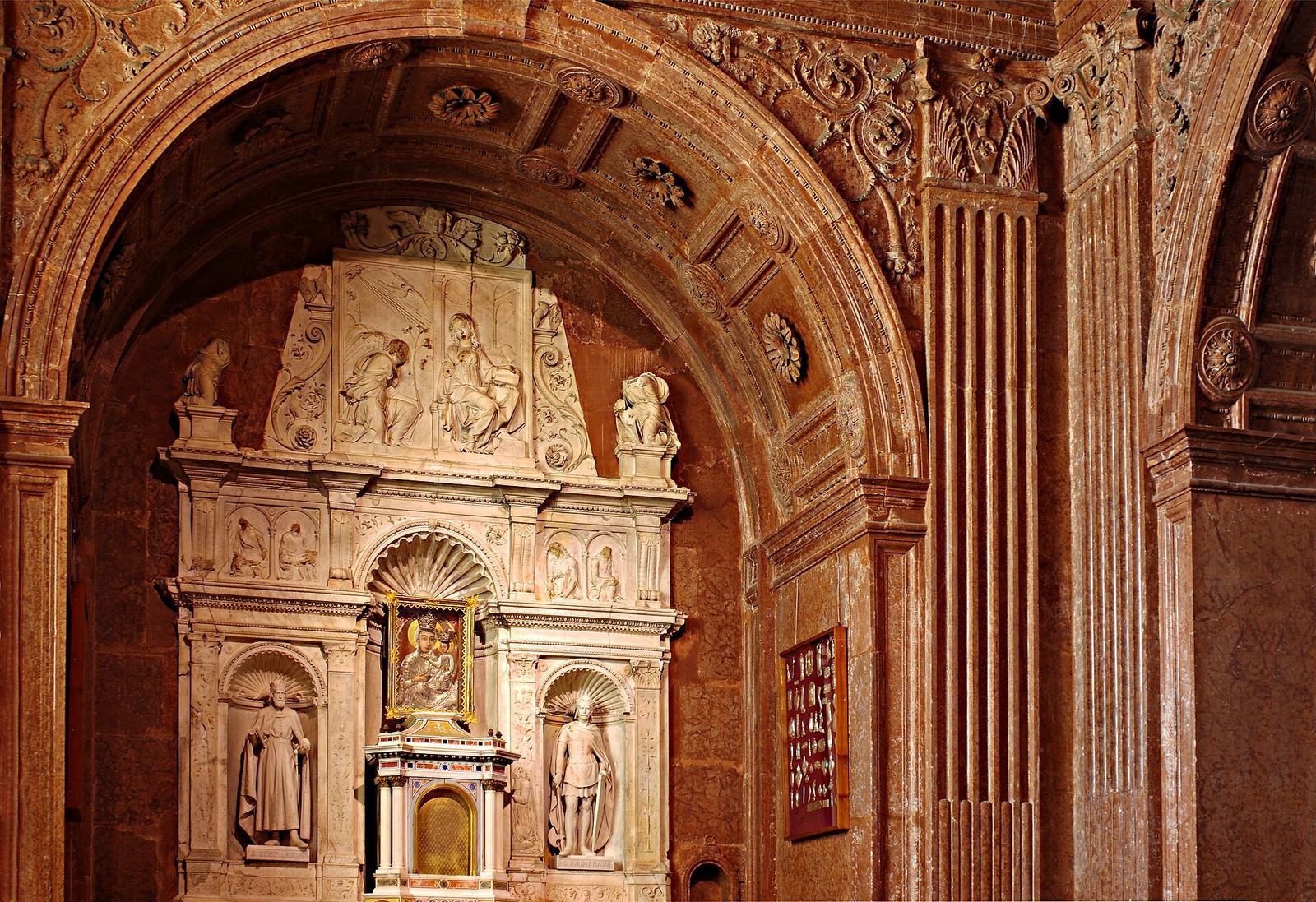
Italian craftsmen made the Bakócz Chapel in 1506–07 as a Renaissance structure decorated with red Süttő marble, a marble quarried near the Hungarian locality of Süttő. It stands to the left of the main hall and is among Hungary’s most valuable surviving Renaissance works of art. During construction of the present basilica in 1823, workers dismantled it into about 1,600 pieces and rebuilt it roughly 20 metres from its original position and about 8 metres higher. The chapel survived both the Ottoman destruction in 1543 and the damage inflicted on the hill in 1706.
Crypt
The large crypt beneath the cathedral was built in 1831 in an ancient Egyptian style. It serves as a burial place for Esztergom’s primate-archbishops, beginning with Károly Ambrus, who died in 1809, as well as other bishops and members of the cathedral chapter. Burials include Tamás Bakócz and his family, Jusztinián György Serédi, Sándor Rudnay, and Dénes Széchy.
Treasury
The treasury displays more than 400 pieces of jewellery and church art gathered by Esztergom’s bishops over several centuries. Its objects include a coronation cross of the Árpád kings, traditionally said to have been given to Stephen I by Pope Sylvester II; a gold crucifix decorated with pearls and gems and associated with King Matthias Corvinus; a worked piece of rock crystal from the Carolingian period, the era of Charlemagne and his successors in western Europe; and a communion chalice dated 1440.
Organ and bells
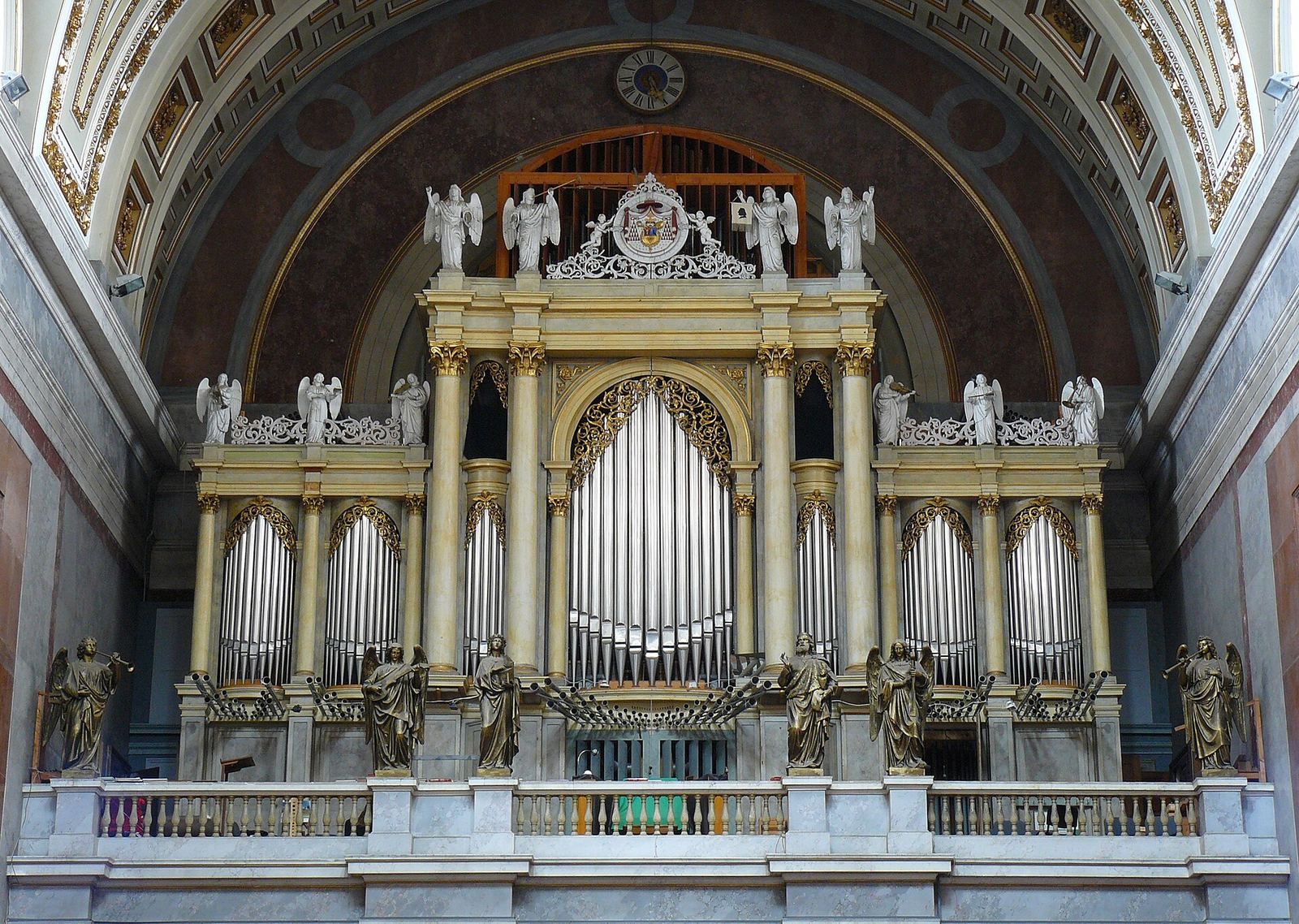
Ludwig Mooser completed the organ in 1856. It originally had 3,530 pipes, 49 stops controlling groups of pipes, and three hand-operated keyboards. It now has 89 stops, four keyboards, and a pedal; its pipes range from about 11 metres to 7 millimetres long. Rebuilding and expansion began in the late 1970s and remain unfinished. Bells hang in a wooden frame in the south tower. A bell dated 1751 was removed from the group and placed on display outside the church. In the 2020s, three bells cast in 1964 for the deconsecrated Holy Family Church, no longer a consecrated place of worship, in Gelsenkirchen-Bulmke were added to three existing bells. A new bell was cast in 2023. Cardinal Péter Erdő blessed the complete group on the First Sunday of Advent, and it first sounded in full at Easter 2024.