Matthias Church: A Gothic and Neo-Gothic Parish Church in Budapest, Hungary


Site at a Glance
- Rating
- 4.8
- Popularity
- Very High
- Country
- Hungary
- Primary era
- Medieval
- External website
- Open
- Eras represented
- Medieval, Early Modern, Modern
- Civilizations
- Habsburg, Hungarian
- Site type
- Religious
- Remains
- Church
On this page19 sections
History
Matthias Church, formally the Church of the Assumption of the Buda Castle, is an active Roman Catholic parish church in Budapest, Hungary, in the Buda Castle District. Built originally under King Béla IV in the thirteenth century, it combines medieval Gothic architecture with extensive nineteenth-century Neo-Gothic reconstruction. The church became a coronation venue, a principal mosque during Ottoman rule, and a major religious and political center of Buda.
Origins and Gothic Foundation
Tradition attributes the first church on this site to Saint Stephen I, the first king of Hungary, in 1015. That tradition was partly based on an inscription installed inside the church in 1690 and destroyed by fire in 1748, while clear surviving proof of Stephen’s foundation does not remain. The earlier church was destroyed during the Mongol invasion of 1241.
After the invasion, Béla IV sponsored a larger replacement built between 1255 and 1269. The first phase, from 1255 to 1260, comprised the main sanctuary and subsidiary sanctuaries under the direction of Villard de Honnecourt. Builders from the Cistercian monastery of Tišnov probably came to Hungary at the request of Agnes of Bohemia, a relative of Béla IV. Their dispersal around 1260 has no known explanation. A second group completed the church between 1260 and 1269, incorporating northern French Gothic influences transmitted through German master builders.
Béla IV temporarily granted the monastery on Margaret Island the jus patronatus, or patronal right to participate in a church institution’s protection or appointment, over the Buda church. Once complete, the Church of the Assumption became one of the earliest and most complete examples of classical Gothic church architecture in Hungary.
Medieval Expansion and Royal Patronage
During the second half of the fourteenth century, the church was transformed into a mature Gothic hall church. In this form, the nave and side aisles created a unified interior of approximately equal height. King Louis I began the southwest Maria Gate in 1370, and the side sanctuaries were enlarged under King Sigismund. The Prague Parler workshop took part in the final construction phase. Between 1412 and 1433, the Garai family commissioned a burial chapel beside the northern sanctuary through Nicholas II Garai.
The church reached a peak of medieval importance under Matthias Corvinus, the fifteenth-century king whose reign brought prosperity and major Gothic additions. After the southern tower collapsed in 1384, Matthias rebuilt it in 1470. He also erected a royal oratory beside the southern sanctuary. The church has been known as Matthias Church since the nineteenth century. Construction of the northwestern tower began late in the fifteenth century and was nearly complete, apart from its top, before the Ottoman conquest.
The building hosted events of national importance. A council met there in 1279 under Papal Lieutenant Fülöp Fermói and Lodomer, Archbishop of Esztergom, at the invitation of King Ladislaus IV. During the dynastic crisis that followed the extinction of the Árpád line in 1301, Wenceslaus III of Bohemia and Otto III of Bavaria were nominated there as kings of Hungary. In 1309, Charles I of Hungary was crowned in the church by Cardinal Gentile Portino da Montefiore and Tamás, Archbishop of Esztergom.
In January 1412, King Sigismund displayed captured Venetian banners in the church, an act later connected with the tradition of John Hunyadi. The church received King Albert II in 1438 and Władysław III of Poland in 1440 after their elections. Władysław later held a thanksgiving ceremony there with Hunyadi in 1444. John of Capistrano preached in the church while recruiting troops for a campaign against the Ottomans, and in 1455 Hunyadi received a cross from the papal legate Carvajal before leaving for Belgrade.
Pope Callixtus III founded a cathedral chapter near the church in 1456. The chapter was abolished during the Ottoman occupation. When Matthias Corvinus returned from captivity in Prague in 1458, he formally began his reign there without the Holy Crown of Hungary, the kingdom’s principal coronation regalia, promising before the altar to uphold the kingdom’s sacred rights. He celebrated both of his marriages in the church, to Catherine of Poděbrady in 1463 and Beatrice of Naples in 1476.
Ottoman Mosque and Catholic Restoration
In 1526, the church’s treasures were transferred to Bratislava. István Werbőczy, Palatine of Hungary, proclaimed there King John Zápolya’s alliance with France, the papacy, Venice, and Florence. Later that year, Ferdinand I of Habsburg attended Mass in the church.
The first Ottoman invasion in 1526 destroyed the medieval roof and most of the furnishings. Following the final Ottoman conquest of Buda in 1541, the building became the city’s principal mosque. Sultan Suleiman gave thanks for his victory there, while the altars and furnishings were discarded and the painted walls were covered with plaster. Known as Büyük, Eski, or Suleiman Han Cami, the mosque lost the royal oratory, northern tower, Garai chapel, and side chapels, whose stone was reused elsewhere.
The building remained Buda’s principal mosque from 1541 until the city was recaptured in 1686. A tradition called the Marian Miracle of Buda holds that cannon fire exposed an old votive statue of the Virgin Mary that had been concealed inside a wall. Its appearance before the praying Muslim garrison was associated by contemporaries with the collapse of the city’s defense on the same day. The statue was later carried through Buda in a thanksgiving procession, and the image remains an object of veneration.
After Buda’s recapture, the church first passed to the Franciscans and then to the Jesuits, a Catholic religious order. The Jesuits restored it in Baroque form and incorporated it into a larger complex. Their college supported the city’s post-Ottoman re-Catholicization and promoted devotion to Our Lady of the Hungarians, the idea of Regnum Marianum, or the Kingdom of Mary, and the veneration of Hungary’s sainted kings. After the Jesuit order was dissolved in 1773, ownership passed to the council of the city of Buda.
Neo-Gothic Reconstruction and Modern History
A major rebuilding directed by Frigyes Schulek took place from 1874 to 1896 under Franz Joseph I, Emperor of Austria and King of Hungary. The church was completed in 1893 before the Millenary celebrations. The work recovered an interpretation of the thirteenth-century plan, uncovered early Gothic elements, removed much of the Baroque fabric, and demolished adjacent former Jesuit buildings. It also introduced extensive Neo-Gothic designs, making the result both a restoration and, in places, a reconstruction.
Many historic stones were replaced with carefully made copies during the rebuilding. Although this reduced the amount of original material, Schulek’s precise reconstruction made the former appearance of the church legible and created an outstanding example of Hungarian Neo-Gothic architecture, with interior decoration associated with Eastern European Art Nouveau.
The church became a coronation venue for the Habsburg rulers of Hungary. In 1867, Cardinal János Simor, Archbishop of Esztergom, crowned Franz Joseph I and Elisabeth with the Holy Crown of Hungary. Franz Liszt’s Coronation Mass was performed there for the first time. On 30 December 1916, Cardinal János Csernoch crowned Charles IV and Queen Zita in the church.
In 1898, the remains of Béla III of Hungary and his first wife, Agnes of Antioch, were transferred to the northern chapel. The remains had been discovered during excavations in 1848 among the ruins of the royal basilica at Székesfehérvár, destroyed by the Turks.
An oratory in the northern gallery became the Chapel of the Knights of Malta in 1927. A 2005 restoration reinstated the coats of arms of deceased Hungarian members of the Order of Malta, a Catholic religious and chivalric order. The church suffered severe damage during the 1944-1945 siege of Budapest. German forces used the crypt as a camp kitchen, and Soviet forces later used the sanctuary as a stable. The Hungarian state repaired the war damage between 1950 and 1970, and the damaged organ was repaired and reconsecrated in 1984.
In 1936, a bilingual Hungarian and Italian inscription was installed on the right wall of the apse in memory of Lieutenant-Colonel Michele d’Aste, an Italian officer who was among the first to die in the liberation of Buda on 2 September 1686. An improvised explosive device detonated at the gate facing Fisherman’s Bastion in 1994, damaging sixteen windows. In 1999, the church became Catholic Church parish property for the first time in its history. State-financed restoration continued from 2005 to 2015. The church forms part of the UNESCO World Heritage property covering Budapest, the banks of the Danube, the Buda Castle Quarter, and Andrássy Avenue, inscribed in 1987 and extended in 2002.
Remains
Matthias Church is a Catholic building whose three-nave medieval basilican origin was reshaped into a Gothic hall church and then extensively reconstructed in the nineteenth century. The mature Gothic design raised the side-nave arches to the height of the main nave and introduced large windows with elaborate stone tracery, creating a bright, spacious interior. The building’s surviving form therefore combines medieval foundations and elements with Neo-Gothic fabric, reconstructed walls and vaults, and richly decorated interior spaces.
Portals and Towers
Maria Gate
The southwest Maria Gate was begun under Louis I in 1370. Its double-door portal has a tympanum, the decorated field above a doorway, showing the Virgin Mary asleep. The surviving gate dates from the beginning of the fifteenth century and is also described as a replica of the thirteenth-century main portal. Schulek reopened it during the nineteenth-century rebuilding and placed a foyer in front of it.
Southern Bell Tower
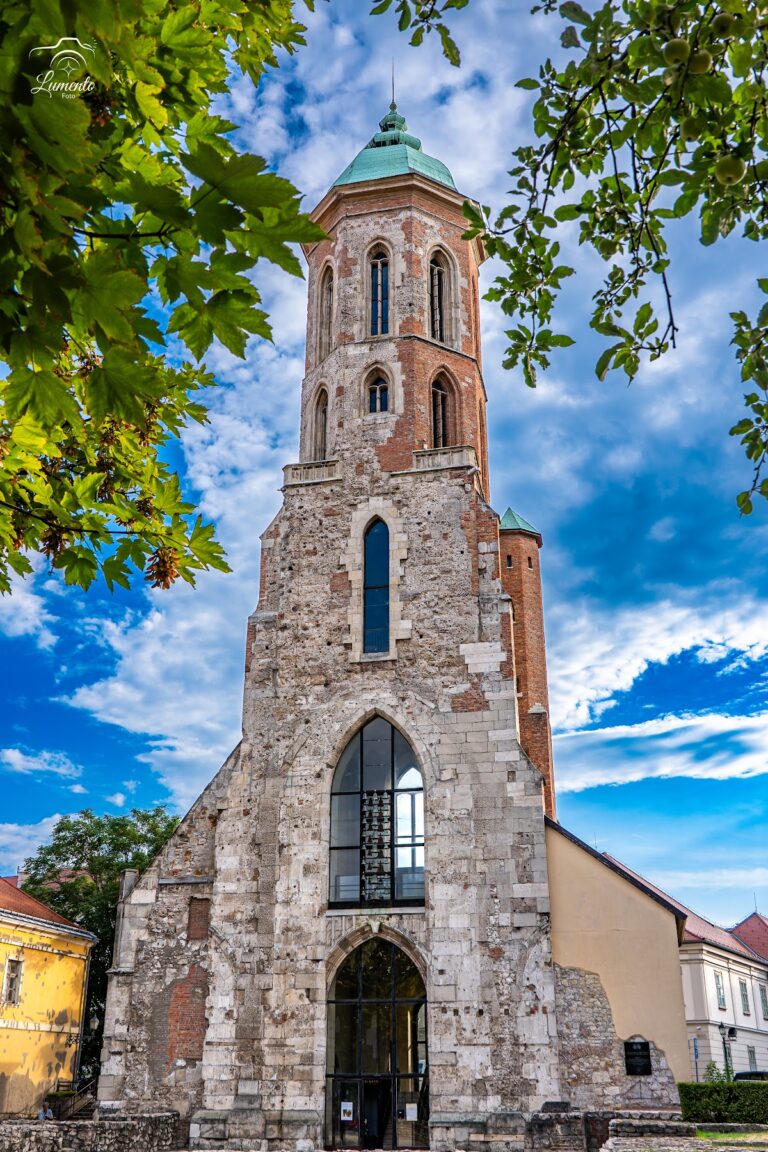
The southwest bell tower is associated with Matthias Corvinus and retains its original general form apart from its destroyed upper helmet. Nearly all of its stonework was replaced during the late nineteenth century, although original stone survives in the head of the great arch supporting the choir. Schulek added the elaborate Neo-Gothic upper decoration and the sequence of balconies, using older images as a guide.
Northwestern Tower
Construction of the northwestern tower began at the end of the fifteenth century. Schulek gave it a late Romanesque-style top and placed a gable between the two towers. The church now has seven bells. Six hang in the bell tower, while a damaged bell hangs in the cavalry tower. Three tower bells date from 1723, 1724, and 1891, and four new bells were installed in 2010, when the sound of the Saint Charles bell was also corrected.
Chapels and Royal Spaces
Royal Oratory and Saint Stephen’s Chapel
Matthias Corvinus’s royal oratory beside the southern sanctuary was destroyed during the Ottoman period. Schulek created a new royal oratory opening from the north into the main apse and added two sacristies. The medieval Garai chapel beside the northern sanctuary was replaced with a new Saint Stephen’s Chapel. Schulek also remodeled the Baroque side chapels along the northern nave in Neo-Gothic form.
Loreto Chapel
The medieval Loreto Chapel lies beneath the southern tower. It contains a Madonna statue from the late seventeenth century, made to replace the medieval statue that had been concealed within a wall during the Ottoman period. The chapel received a bell tower in 1719.
Chapel of the Knights of Malta
The Chapel of the Knights of Malta occupies an oratory in the northern gallery. Its commemorative shields represent notable chaplains and members who died before and after 1945. On All Souls’ Day, the knights add the arms of members who died during the preceding year.
Jesuit Complex and Interior Reconstruction
Baroque Complex
Between 1688 and 1702, the Jesuits added a large dormitory on the north side and a three-storey seminary on the south side. Between 1702 and 1714, the formerly free-standing church became part of this larger complex. A Baroque main altar was built in 1690, a lobby was added before the main entrance in 1696, and the Matthias bell tower received a Baroque onion dome in the same year. A new sacristy replaced the Bride’s Gate, and additional side chapels were added.
Neo-Gothic Interior
Schulek removed the Baroque connections and reconstructed damaged walls and vaults in an effort to recover earlier architectural forms. The crypt, originally built in 1780, was remodeled in a freely interpreted Neo-Gothic style. Bertalan Székely and Károly Lotz directed the nineteenth-century interior decoration, using surviving medieval wall-painting remains. They painted the figurative murals and prepared designs for stained glass executed by Ede Kratzmann and sculptural decoration executed by Ferenc Mikula. Mihály Zichy painted the altarpiece of Saint Imre’s Chapel, and Gyula Aggházy painted the altarpiece of the Loreto Chapel.
Pulpit
The pulpit was made between 1890 and 1893 during the rebuilding. Schulek designed it with the assistance of the art historian Béla Czobor, who helped prepare its iconographic scheme. Ferenc Mikula carved the statues, and Károly Ruprich made the Gothic Revival sounding board, the canopy above a pulpit that directs sound toward the congregation.
Made of sandstone, the pulpit has surfaces covered with Neo-Romanesque ornamental painting, including painted decoration on the statues. Its steps have a wrought-iron rail, while the platform rests on an outer ring of arches and a massive central pillar. The oak sounding board resembles a medieval tower and is topped by a Good Shepherd carved from linden wood. Beneath a blind arcade, the parapet contains the four Evangelists and the four Latin Doctors of the Church, authoritative Christian theologians recognized for major contributions to Western doctrine. The figures are John with an eagle, Augustine with a boy, Luke with an ox, Ambrose with a beehive, Mark with a lion, Gregory the Great with a dove, Matthew with an angel, and Jerome with a lion.
A pulpit installed in 1693 followed the church’s conversion from mosque to church, although its appearance is unknown. A Baroque pulpit installed in 1769, probably made by Károly Bebo for Countess Erzsébet Berényi, was demolished by Schulek in 1876. Its reliefs included figures possibly representing Moses and Aaron, angels, and a statue of the Risen Christ. Two flying cherubs from it survive separately, one in the Hungarian National Gallery and one in the parish church collection.
Museum and Associated Monument
The Ecclesiastical Art Museum extends from the medieval crypt to Saint Stephen’s Chapel. Its collection includes sacred relics, medieval stone carvings, and replicas of the Hungarian royal crown and coronation jewels. In front of the church, the Holy Trinity Column was erected in 1713 as a plague monument and later served as a model for many similar monuments in Hungary.
Nearby sites