Martinsburg: A Customs Castle on the Rhine


Site at a Glance
- Rating
- 4.5
- Popularity
- Low
- Country
- Germany
- Primary era
- Medieval
- External website
- Open
- Eras represented
- Medieval, Early Modern
- Civilizations
- Holy Roman Empire
- Site type
- Military
- Remains
- Castle
On this page8 sections
History
Martinsburg is a castle complex in Lahnstein, Germany, built in 1298 as a late medieval customs castle for the archbishops of Mainz. Originally called Lahnstein Castle, it protected the collection of Rhine tolls and later became part of Oberlahnstein’s town defenses and an occasional residence of the electors of Mainz.
Origins as a Mainz customs castle
The Archbishopric of Mainz was an important ecclesiastical principality of the Holy Roman Empire, and its archbishop also served as an elector, with a role in choosing the German king. Since 1292, Mainz had held shares in the imperial toll at Boppard with the permission of Adolf of Nassau, the German king who reigned from 1292 to 1298. A Rhine toll was a charge on goods or vessels using the river, so a customs castle protected both the officials and the facilities involved in collecting this revenue.
Lahneck Castle stood on a hill some distance from the Rhine. A fortified building was therefore established directly beside the river to safeguard Mainz’s toll-collection interests. A fortified structure probably occupied the site by the mid-thirteenth century. It appears in a document of 1244 and may have monitored traffic on the Rhine before the castle was built in its 1298 form.
Integration into Oberlahnstein’s defenses
Martinsburg was enlarged in connection with the construction of Oberlahnstein’s town wall after 1324. It became the southwestern corner of the town’s fortifications, while its own defenses could protect the castle if attackers captured the town. The complex also offered a final refuge for Mainz officials, since conflict between the townspeople and their ecclesiastical and electoral rulers was considered a possible danger.
During Oberlahnstein’s economic growth, Martinsburg served as the town’s castle. The customs clerk and other customs staff worked there alongside the gatekeeper, tower watchman, and supporting personnel. From the later Middle Ages, the complex also served occasionally as a secondary residence of the electors of Mainz and grew more important than Lahneck Castle.
Later alterations and protection
The water castle was repeatedly extended and altered, with work continuing until its association with the Electorate of Mainz ended in 1803. Martinsburg is privately owned and accommodates apartments, offices, a carnival museum, and a mint. It is protected as a cultural monument under the monument-protection law of Rhineland-Palatinate and is listed in the state monument register. Since 2002, it has formed part of the UNESCO World Heritage site Upper Middle Rhine Valley. It is also protected cultural property under the Hague Convention and carries that convention’s blue-and-white emblem for protected cultural property during armed conflict.
Remains
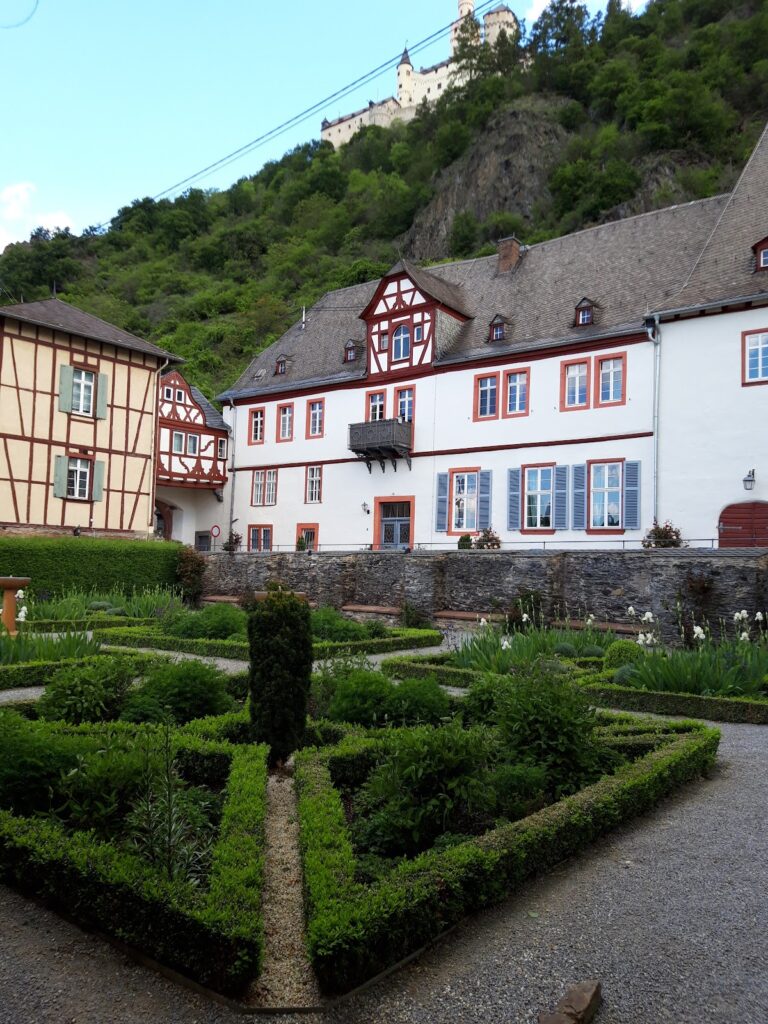
Martinsburg is a lowland water castle beside the Rhine and forms the southwestern corner of Oberlahnstein’s former town defenses. The surviving complex combines a medieval residential core and towers with later wings and a three-storey Baroque central building. Its enclosed arrangement reflects both its role in river customs administration and its incorporation into the town’s fortified perimeter.
Medieval towers and residential core
The oldest parts include a rectangular residential tower with two corner towers in the southern part of the complex. The foundations of a hexagonal main tower also survive there. The present keep, the castle’s principal fortified tower, occupies the position of those earlier foundations. Built around 1400, it rises 28 metres and has an adjoining stair tower and latrine tower, the latter containing toilets.
Town-facing defenses
On the side facing Oberlahnstein, a moat and fortified gate protected the castle. A projecting machicolation remains above the gate. This defensive structure had openings through which defenders could drop missiles or liquids onto attackers below. The arrangement allowed Martinsburg to function as part of the town’s defenses while retaining a protected position of its own.
Wings and Baroque central building
The northwest wing was added in the fourteenth century, followed by the present southeast wing in 1497. Between 1719 and 1721, a three-storey Baroque central building was constructed on the Rhine side between the medieval residential tower and the keep. These additions created the present combination of medieval and later architectural elements. Martinsburg is among the few castles on the Middle Rhine to have survived without destruction.