Manisa Relief: A Hittite Rock Monument in Türkiye
Site at a Glance
- Rating
- 4.4
- Popularity
- Very Low
- Country
- Turkey
- Primary era
- Bronze Age
- Eras represented
- Bronze Age
- Civilizations
- Hittite
- Site type
- Civic
- Remains
- Rock Art
On this page6 sections
History
The Manisa relief is a Hittite rock monument in Türkiye, near the city of Manisa, probably created during the Hittite Empire period in the 14th century BC. The Hittites were an Anatolian imperial civilization whose political center lay in central Anatolia during the second millennium BC. The monument is also known as the Akpınar relief, the Cybele relief, Taş Suret, and the Sipylos Monument.
Hittite origins and inscriptions
Cecil John Cadoux considered a date during the reign of the Hittite king Suppiluliuma I or his son Mursili II probable. Two Luwian hieroglyphic inscriptions are associated with the image. Luwian hieroglyphs were a writing system used for the Luwian language in several Hittite and post-Hittite regions.
Helmuth Theodor Bossert read the inscription on the left, known as Akpınar 1, as a reference to Prince Kuwalanamuwa. The same name appears on the Hanyeri and İmamkullu reliefs, although it is uncertain whether all three inscriptions concern the same person. If they do, Kuwalanamuwa would have been an unusually influential prince. Reliefs with hieroglyphic inscriptions at three different locations in Asia Minor are otherwise associated only with Hittite kings.
The inscription on the right, Akpınar 2, could not be read by Hans Gustav Güterbock, who examined the monument with R. A. Alexander in 1978. John David Hawkins later considered both inscriptions to be later graffiti and translated Akpınar 2, which he called Sipylos 2, approximately as “Zuwani, eunuch, river-lord(?) …”.
Changing interpretations
The identity of the carved figure has remained disputed. In the 2nd century AD, the Greek writer and travel author Pausanias identified it as the mother goddess Cybele and attributed it to Broteas, a son of the mythological king Tantalus. Cybele was an ancient Anatolian mother goddess whose worship later spread through the Greek and Roman worlds.
Bossert also identified the figure with Cybele, but Kurt Bittel rejected that interpretation. Bittel and Ekrem Akurgal nevertheless regarded the image as a female goddess. Peter Z. Spanos interpreted it as the Weather god, a major deity in ancient Anatolian religious traditions, while Horst Ehringhaus saw it as a mountain god. Current interpretation generally tends to treat the image as a male deity.
Several travellers described the relief during the 18th and 19th centuries, including Richard Chandler, Charles Texier, Gustav Hirschfeld, and Archibald Henry Sayce. The monument is sometimes incorrectly called the Niobe cliffs because it has been confused with another natural rock formation near Manisa, known as Weeping Niobe.
Remains
Cliff setting and carved figure
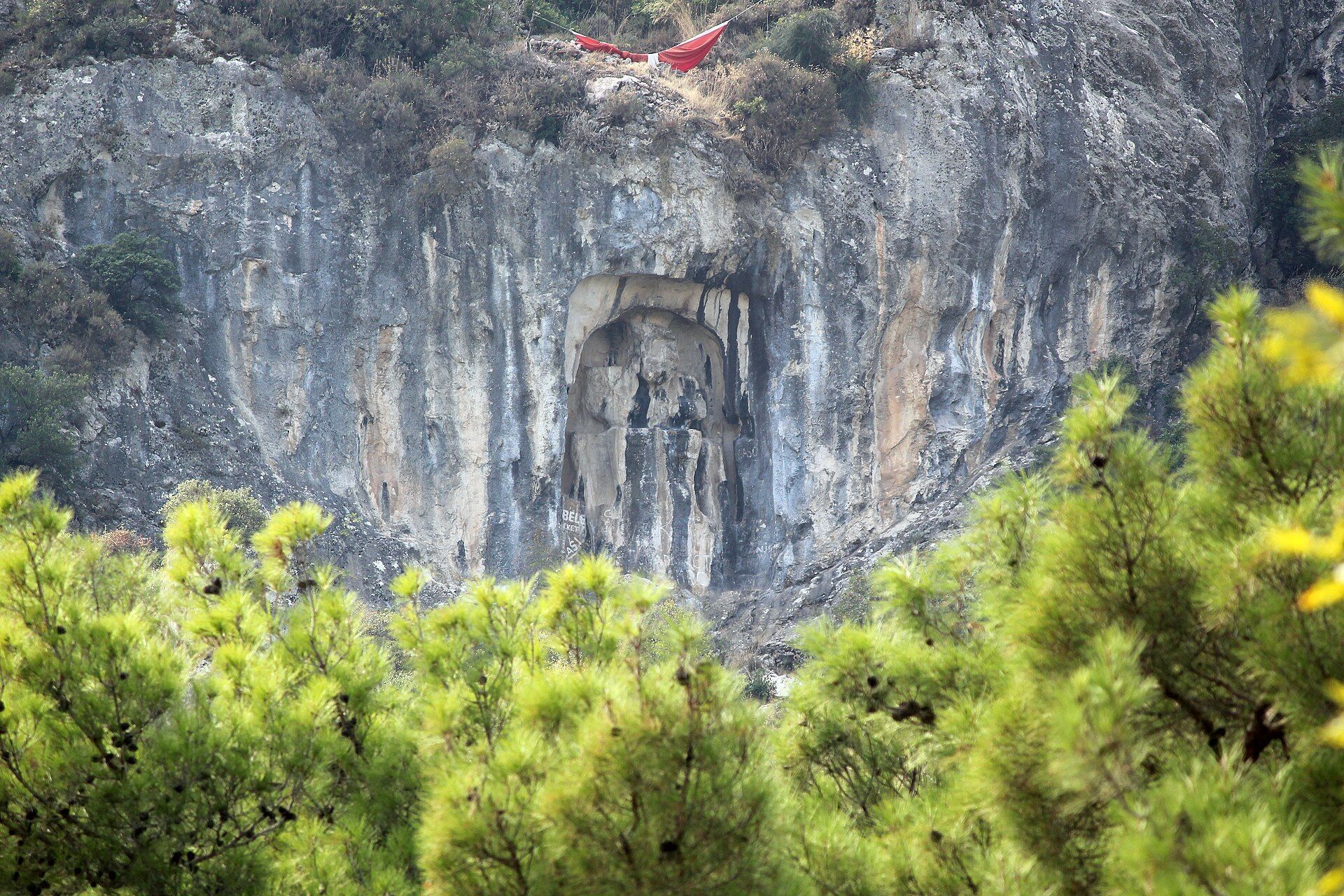
The relief occupies a niche about 100 to 120 metres up a granite cliff on Mount Sipylus. From this elevated position, it overlooks Manisa, the ancient Lydian city of Magnesia ad Sipylum, and the Gediz River valley, called the Hermos in antiquity. The carved figure is more than 6 metres high and survives in poor condition.
The seated image was made in high relief, a technique in which the figure projects strongly from the surface while remaining attached to the rock. It faces north and wears a tall, pointed headdress. Its hands appear to rest on its breasts, and its feet are placed on a footstool. The figure rises several metres, although its exact height is uncertain. Natural damage has partly broken away the head.
Luwian inscriptions
Two remnants of Luwian hieroglyphic inscriptions remain visible to the right of the figure’s head. One was carved as a raised relief inscription, while the other was cut into the rock as an incised inscription. Their position beside the image connects the writing directly with the monument’s carved surface, even though their date and meaning have been interpreted differently.