Madonnina dei Ronchi: A Catholic Church in Legnano
Site at a Glance
- Popularity
- Low
- Country
- Italy
- Primary era
- Early Modern
- Eras represented
- Early Modern
- Civilizations
- Duchy of Milan, Spanish
- Site type
- Religious
- Remains
- Church
On this page7 sections
History
Madonnina dei Ronchi is a Catholic church in Legnano, Italy, dedicated to the Virgin Mary and associated with the Archdiocese of Milan and the Ambrosian rite, a Milanese Catholic liturgical tradition distinct from the Roman rite. The church was established in 1641, during the Counter-Reformation, the Catholic reform movement and response to Protestantism.
The chapel and the 1641 church
A family chapel-oratory stood here before the sixteenth century, on the Strada Magna, now Corso Sempione, at the corner of present-day Via dei Ronchi. In 1641, Jossefo, a descendant of Oldrado II Lampugnani, authorized its conversion into a church. Provost Agostino Pozzo attributed the funds for the building to offerings made after healings that people regarded as miraculous and connected with the Virgin. Legnano’s nobles also gave generously to the Church and their community as they sought the favor of the Archbishop of Milan. Aristocratic support for religious institutions remained influential.
Later use and restoration
In the eighteenth century, the church was enlarged with a two-storey building for a canon. Mass in the ancient Ambrosian rite was celebrated at Madonnina dei Ronchi for a period; it is now held at the Church of Sant’Erasmo.
In 1984, the church’s three sundials were restored with the involvement of the Famiglia Legnanese, the Contrada Sant’Erasmo, and the Antares association. The work marked six hundred years since the death of Giovanni da Legnano, a fourteenth-century jurist and academic.
Remains
Setting, plan, and exterior
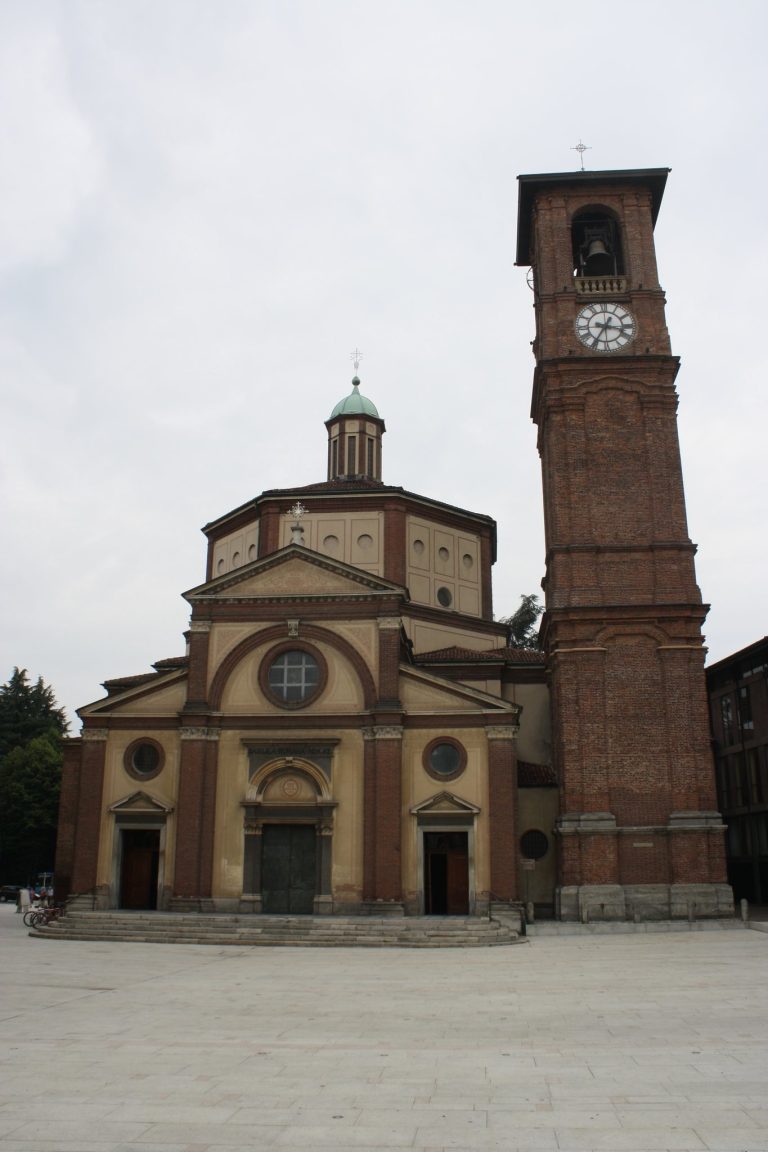
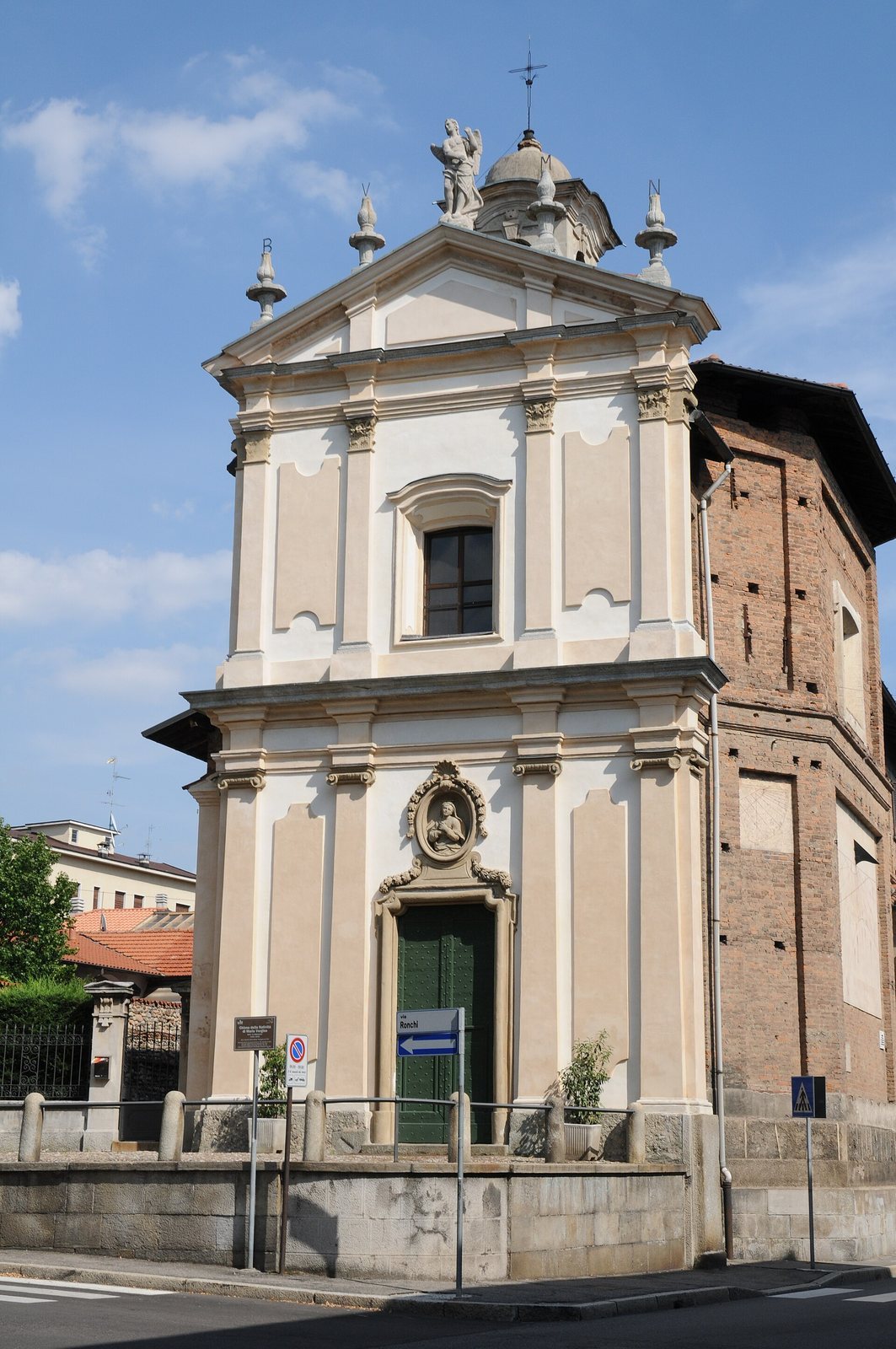
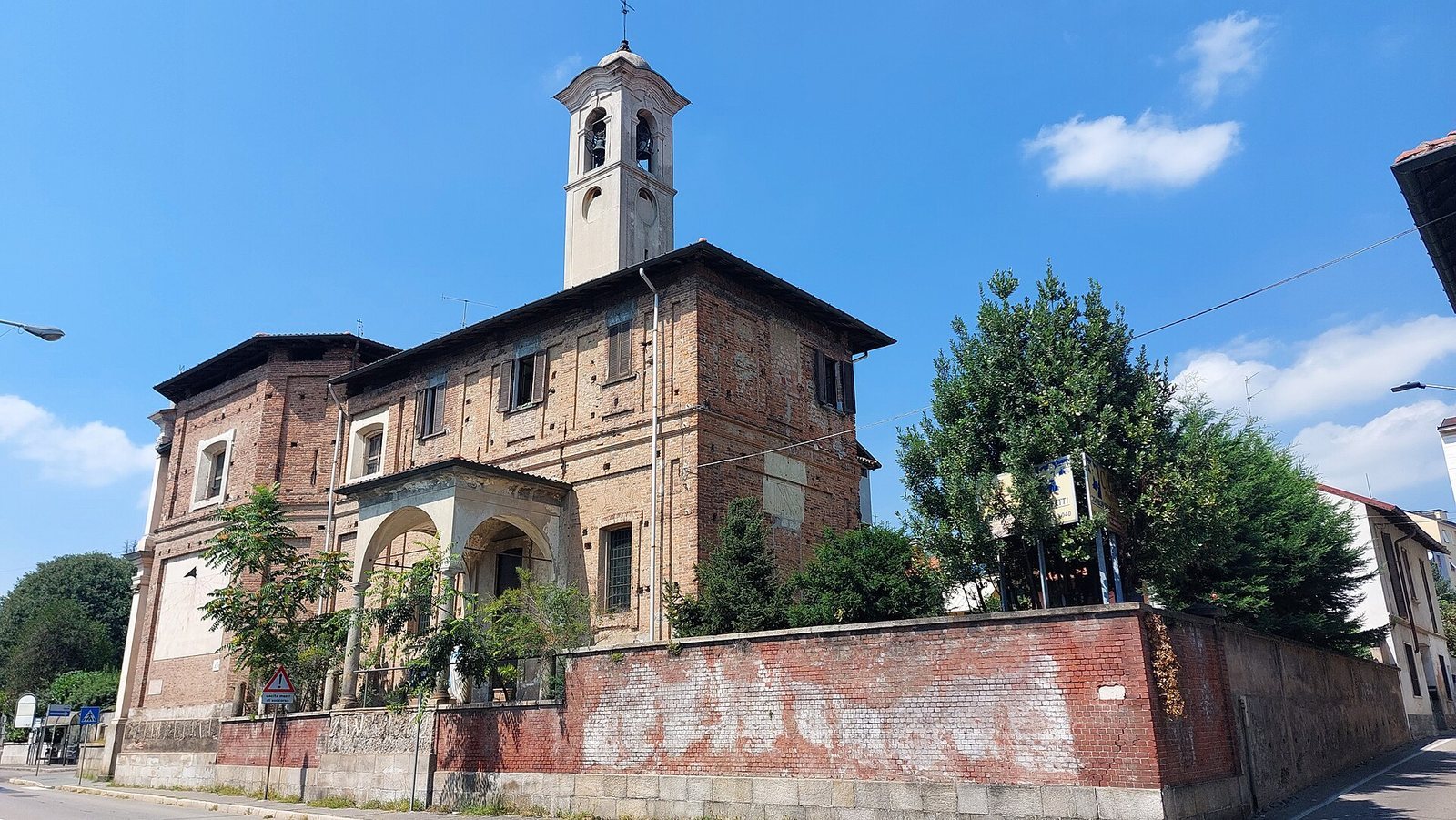
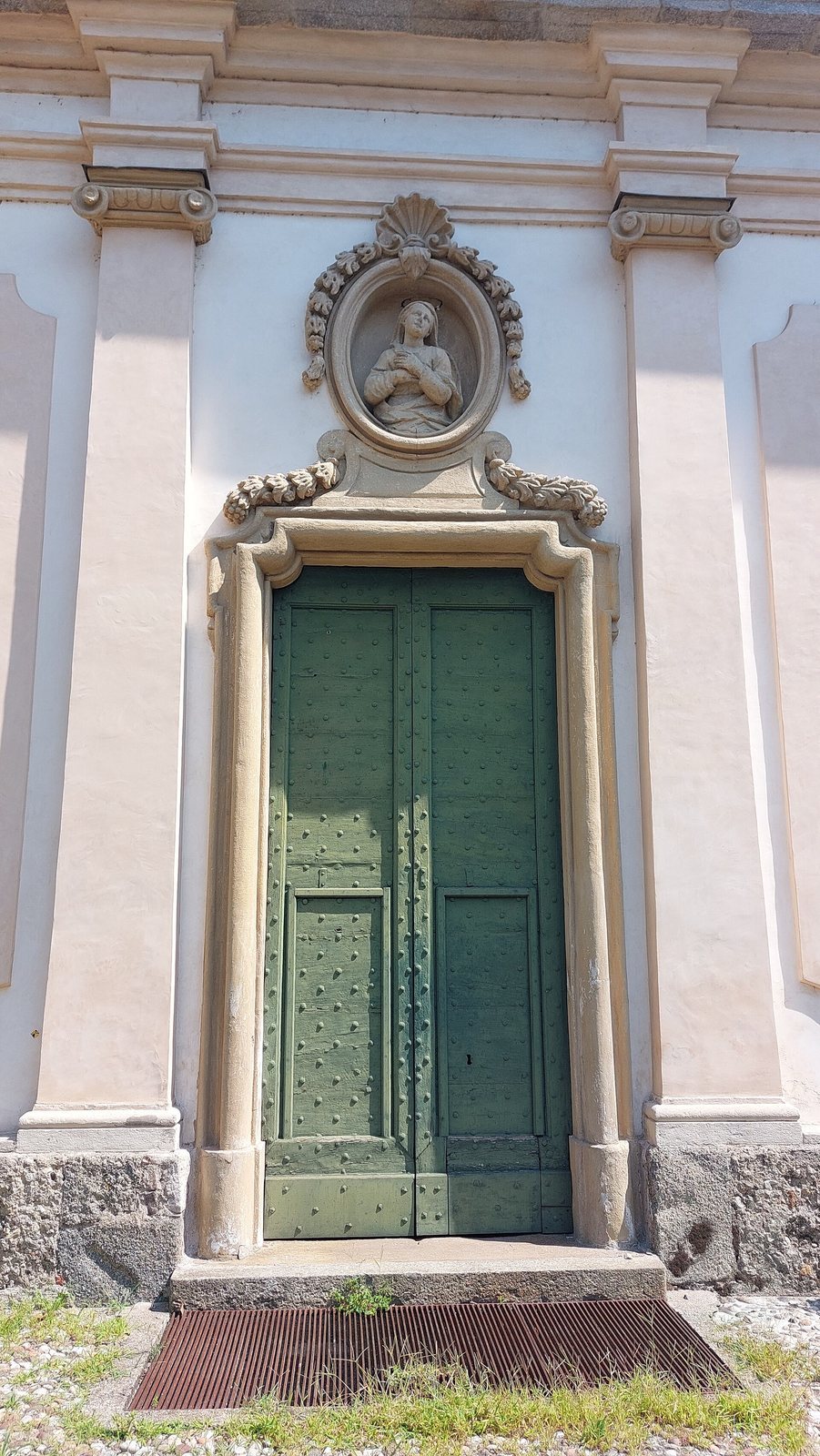
The church stands beside a broad raised plateau formed over centuries by deposits carried by the Olona River. At a bend known locally as the Ronco, the river accumulated material that helped form the plateau; the local name for this deposit gave the church its name. The church’s base is 1.8 metres above the road. Designed by Francesco Maria Richini, its form recalls his Church of San Giuseppe in Milan. The elongated octagonal plan comprises the main body, an apse (the projecting end of a church), and an entrance chapel containing the organ. The plastered façade is wider than the church body and has two tiers in Doric and Corinthian styles, two classical architectural orders. A central window lights the organ space, while the other exterior walls are brick. A bell tower stands on the left. Behind the apse is the two-storey building that served as the canon’s residence.
Interior and artworks
The apse and main ceiling have cross-vaults, ceilings formed by intersecting arches; the entrance chapel has a barrel vault, a curved ceiling shaped like a half-cylinder. The ceiling is embellished with pilasters, flat strips resembling columns, and stucco by Daniele Turri. Mosé Turri senior painted the vault frescoes. An altarpiece by Francesco Lampugnani depicts the Madonna with Saints Sebastian and Roch, while paintings of Saint Francis and Saint Joseph by the Lampugnani brothers adorn the altar chapel. Two paintings by Legnanino, the artist Stefano Maria Legnani, were transferred to the Sanctuary of Madonna delle Grazie in 1815. In 1828, Beniamino Turri was commissioned to make copies for the church.
Sundials
Three sundials installed during the church’s construction are set into its east, south, and southwest walls. They were intended to tell the time to travellers on the Strada Magna and remain the only functioning sundials in the area around Legnano.