Lucera Cathedral: An Angevin Gothic Cathedral in Italy


Site at a Glance
- Rating
- 4.8
- Popularity
- Low
- Country
- Italy
- Primary era
- Medieval
- Eras represented
- Medieval, Early Modern
- Civilizations
- Kingdom of Naples
- Site type
- Religious
- Remains
- Cathedral
On this page23 sections
History
Lucera Cathedral, formally the Basilica Cathedral of Santa Maria Assunta, is the principal church of Lucera, Italy, and the seat of the Diocese of Lucera-Troia. Built under Angevin rule between 1302 and 1317, it is an Angevin Gothic church, a style that combines French Gothic forms with local building traditions in southern Italy. The cathedral was dedicated to the Assumption of the Virgin Mary and remains an active Roman Catholic church.
Early Diocese and Medieval Predecessor
Tradition places the foundation of the Diocese of Lucera in the early Christian period, associating it with Bishop Basso and his successors Pardo, Giovanni, and Marco. An earlier cathedral was plundered in 663 by the Byzantine emperor Constans II. The church later disappeared from the historical record and probably fell into ruin during the thirteenth century, when Frederick II, the Hohenstaufen Holy Roman Emperor and ruler of southern Italy, relocated Sicilian Saracens to Lucera.
Frederick II’s testament stipulated that the ruined church should be repaired. That plan did not produce the present building. After Charles II of Anjou’s campaign against the Saracens of Lucera in 1300, the Angevin king ordered a new cathedral. It may have occupied the site of the demolished Saracen mosque. Construction continued from 1302 to 1317, although the church was consecrated on 14 October 1302.
Angevin Construction
The cathedral’s design is traditionally attributed on stylistic grounds to Pierre d’Angicourt, a French architect and builder active in Angevin southern Italy. His precise role remains uncertain. The securely documented commission connecting him with the site dates from 1304 and concerned the demolition of houses that stood where the cathedral was being built.
The present form of the church dates predominantly from the fourteenth century. Its position in the history of southern Italian architecture is defined by its Angevin Gothic character. It is one of the southernmost brick Gothic churches in mainland Italy and one of the few examples of Angevin Gothic outside Naples.
Baroque Alterations and Nineteenth-Century Restoration
During the sixteenth and seventeenth centuries, the cathedral was renovated in the Baroque manner and received four lateral chapels. Nineteenth-century restoration sought to recover a Romanesque or Gothic appearance, but in doing so removed much of the building’s Renaissance and Baroque historical fabric.
After the church became an Italian national monument in 1874, restorations carried out with the approval of Ruggiero Bonghi dismantled and sold the interior marble decoration. Several chapels and the side porticoes were demolished, while old wrought-iron gates were removed or melted down. The surviving elements included the transept side altars, the small altars at the rear of the church, and the Rococo holy-water stoups. Pope Gregory XVI had declared the church a minor basilica in 1834.
Marian Devotion and Later Memory
On 25 March 1955, Bishop Domenico Vendola declared the cathedral the diocesan Marian sanctuary of Santa Maria Patrona. The church has also been popularly associated with Santa Maria della Vittoria because it preserves a small gilded wooden statue of the Virgin from the late fourteenth century. Tradition connects the statue with the Angevin victory over the Hohenstaufen in southern Italy.
The cathedral also preserves a Renaissance marble gisant, a sculpted reclining funerary figure, whose identity is unknown. Until the 1930s, when the sculpture was raised from the floor, entering worshippers kicked and spat on it. The custom was directed at the figure and was later recounted by Giuseppe Ungaretti during the period when the sculpture had been raised.
Remains
Facade and Main Structure
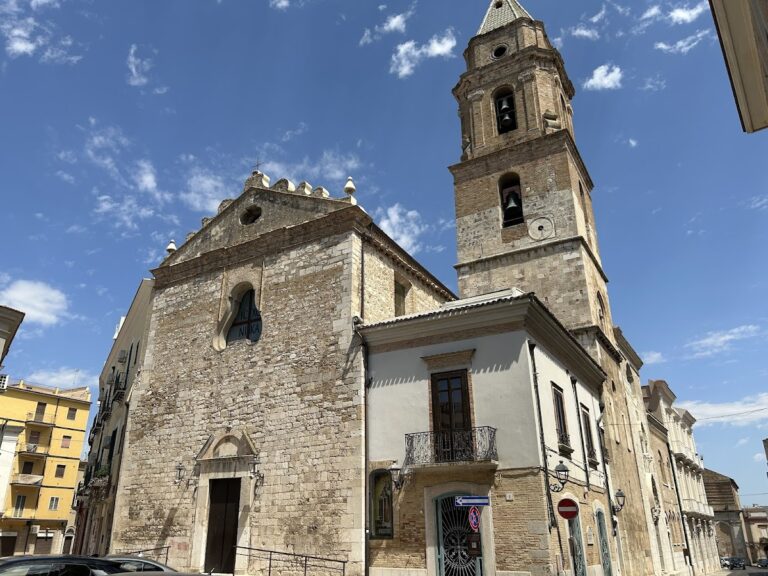
The cathedral stands in Piazza del Duomo in Lucera’s historic center. Its facade is asymmetrical. A square bell tower occupies the right side and is crowned by a sixteenth-century octagonal lantern, while an octagonal tower rises on the left. One of the three entrance portals opens within the bell tower.
Central Portal
The central portal is framed by a column-supported aedicule, a small architectural shrine or frame, above which appears the Angevin coat of arms. Its lunette contains a fourteenth-century sculpted Madonna and Child. A rose window is set above the entrance, while a tall single-light window rises over the left portal.
Interior Arrangement
Inside, pillars divide the church into three aisles. A transept crosses the main body, and three Gothic apses, one for each aisle, terminate the eastern end. The ceiling retains exposed timber trusses, giving the interior a clearly legible medieval structural character.
Entrance Area and Nave Art
Baptistery and Sacred-Oil Repository
Near the entrance to the left aisle, the baptistery stands within a Renaissance ciborium, a canopy or architectural enclosure over an important liturgical installation. Nearby is a fifteenth-century tabernacle attributed to Pietro di Martino of Milan. It served as a repository for sacred oils.
Paintings and Rear Altars
The side aisles contain paintings attributed to or associated with several artists. Girolamo da Santa Croce is linked with Madonna della Seggiola, Ippolito Borghese with Crucifixion, Felice Brusasorzi with The Last Supper, and Francesco Solimena with Saint Francis of Assisi. The attribution of the last work is uncertain.
Two small seventeenth-century altars stand against the rear wall. One is surmounted by Fabrizio Santafede’s The Assumption of the Virgin with Saints John the Evangelist and Nicholas. The other carries an anonymous artist’s Holy Family.
Pulpit and Recumbent Sculpture
In the final bay of the right aisle is a pulpit dated 1560 and supported by four columns. An inscription beneath its cornice mentions the family name Allegranzio Scassa. Beneath the bell tower stands a Renaissance marble gisant showing a reclining, curly-bearded man at rest. It probably belonged to a funerary monument that was later dismantled and moved a short distance from the basilica’s side entrance. Its identification with Pier della Vigna, the thirteenth-century official and adviser of Frederick II, is erroneous.
Transept and Patronal Altar
Side Altars
The transept contains two side altars. Giovanni Raguzzino made the right-hand altar in 1690 for Saint Roch. The left-hand altar, dated 1790, is dedicated to Santa Maria Patrona of Lucera. Its upper niche holds the venerated fourteenth-century wooden statue of the Virgin associated with Santa Maria della Vittoria.
Mozzagrugno Tomb
Beside the patronal altar is the monumental tomb of Giulio and Ascanio Mozzagrugno. It includes a marble high-relief of the Madonna of Graces with souls in purgatory and two funerary genii attributed to Pietro Bernini. The portrait busts of the two brothers are attributed to Michelangelo Naccherino.
Chapels and Apses
Gagliardi Chapel
The left lateral apse became the Gagliardi Chapel during the sixteenth century. The chapel was restored at the end of the nineteenth century after its marble furnishings had been stripped. It contains the remains of Blessed Agostino Casotti, who was bishop of Lucera in 1323.
Gallucci Chapel
The right lateral apse was converted into the Gallucci Chapel in the sixteenth century and also restored at the end of the nineteenth century. Its furnishings include a fifteenth-century wooden crucifix, a mid-fourteenth-century gisant from the Neapolitan school depicting an unidentified knight, and a fourteenth-century fresco of the Imago pietatis, the Man of Sorrows, showing Christ after the Crucifixion. A modern inscription incorrectly identifies the knight as Charles II of Anjou.
Fresco Cycles
The chapels retain seventeenth-century painted cycles attributed to Belisario Corenzio, a painter active particularly in Naples and southern Italy. Their subjects include the life of Mary and Jesus, together with the martyrdom of the apostles and protomartyrs, the earliest or pioneering martyrs associated with a Christian community or tradition. The cycle devoted to the latter subject has also been attributed more recently to Avanzino Nucci.
Presbytery and Apse
Altar from Castel Fiorentino
At the center of the presbytery is an altar made from a stone slab recovered from the ruins of the domus at Castel Fiorentino, where Frederick II died. Blessed Giovanni Vici of Stroncone brought the slab to Lucera at the beginning of the fifteenth century. A smaller slab brought at the same time later became the altar of the church of Santissimo Salvatore. The principal slab is supported by six small columns.
Choir and Frescoes
The lower part of the apse contains an eighteenth-century wooden choir. Above it is a series of frescoes attributed to Belisario Corenzio depicting the Dormition and Assumption of the Virgin. Four medallions in the presbytery vault portray Bishops Basso, Pardo, Marco d’Eca, and Agostino Casotti, linking the medieval and early Christian history of the diocese with the cathedral’s later interior.
Nearby sites