Lubshanskaya Fortress: An Early Medieval Fortified Settlement in Russia
Site at a Glance
- Popularity
- High
- Country
- Russia
- Primary era
- Medieval
- Eras represented
- Medieval
- Civilizations
- Unclassified
- Site type
- Military
- Remains
- Fort
On this page15 sections
History
Lubshanskaya Fortress is an early medieval fortified settlement on the Volkhov River in Leningrad Oblast, Russia. Its stone-and-earth stronghold took shape in the late seventh or early eighth century, in a period associated with the arrival of Slavic populations in the Ladoga region.
Early settlement and regional contacts
An unfortified fishing station may have occupied the site from the third century. A fortified settlement associated with Finno-Ugric peoples, who speak languages in a branch of the Uralic family, developed around the turn of the sixth and seventh centuries. Its timber-and-earth defenses probably fell out of use in the early eighth century. The settlement appears to have suffered a fire during that century, possibly amid conflict with incoming Ilmen Slovenes, an early Slavic population.
The settlement has been interpreted as part of contact networks linking the Kama region, around the Kama River in western Russia, with southern Ladoga, Finland, and central Sweden. One reconstruction proposes that Finno-Ugric communities, including groups historically called the Perm, Ves, Chud, and Sum, first came into contact with Scandinavians, with Slavic groups joining later. A separate regional model, proposed before the fortress was discovered, describes movement from the Åland Islands, an archipelago between Sweden and Finland, toward Ladoga during the Vendel period, an early medieval Scandinavian period before the Viking Age. In that model, Ilmen Slovenes from the Volkhov and Lake Ilmen regions joined interactions with Finno-Ugric communities during the seventh century.
The fortress and the growth of Ladoga
A stone-and-earth fortress was built at Lubshanskaya in the late seventh or early eighth century. Archaeologist E. A. Ryabinin dated a rebuilding on a stone foundation to around 700. The fortress predates the built-up area at Staraya Ladoga’s earthen hillfort, which began developing in the mid-eighth century. Finds from Lubshanskaya have been interpreted as evidence of a population of central European Slavic origin, with connections to West Slavs on the Baltic coast, Slavic groups including the Krivichs of the Upper Dnieper, and communities of the Danube region.
A Scandinavian settlement, possibly established by people from Gotland, arose around 753 on the opposite bank of the Volkhov, about two kilometres upstream. It later became Staraya Ladoga, where glass bead production began in the 780s. Lubshanskaya probably served as a watchpost and helped exercise military and administrative control over the river’s mouth. Within about a decade of Ladoga’s founding, Scandinavian-style buildings and objects there had given way to material associated with early Slavic culture.
Ninth-century upheavals and abandonment
A major fire struck Ladoga around 840. Finds appearing there afterward have been interpreted as evidence of a Scandinavian male subculture. Another catastrophe around 865 has been linked to the Primary Chronicle, a medieval East Slavic chronicle, and its account of the expulsion of the Varangians, Scandinavian groups active in eastern Europe.
Lubshanskaya ceased functioning in the second half of the ninth century, as the early Rus polity, the medieval lands and political community of eastern Europe, was taking shape. Its abandonment has been connected with changes at Ladoga described in the chronicle, including its account of Rurik, a Varangian ruler invited to rule in Rus. One proposed explanation is that falling water levels in Lake Ladoga, the lake’s retreat northward, and the shallowing of the small river at the fortress reduced its value as a watchpost. Ladoga may then have taken over that role.
Archaeology and later recognition
Survey excavations around the turn of the 1960s and 1970s were followed by E. A. Ryabinin’s archaeological expedition, which began work in 1997 and continued intermittently for about five years. That work brought wider attention to the site. Nicholas Roerich, a Russian painter and writer, had depicted the fortress in the upper-right corner of Guests from Overseas, a painting made in several versions between 1901 and 1910, before archaeologists knew of the site.
The fortress has federal cultural-heritage status, with its protection linked to a resolution of the Leningrad regional executive committee dated 10 July 1978.
Remains
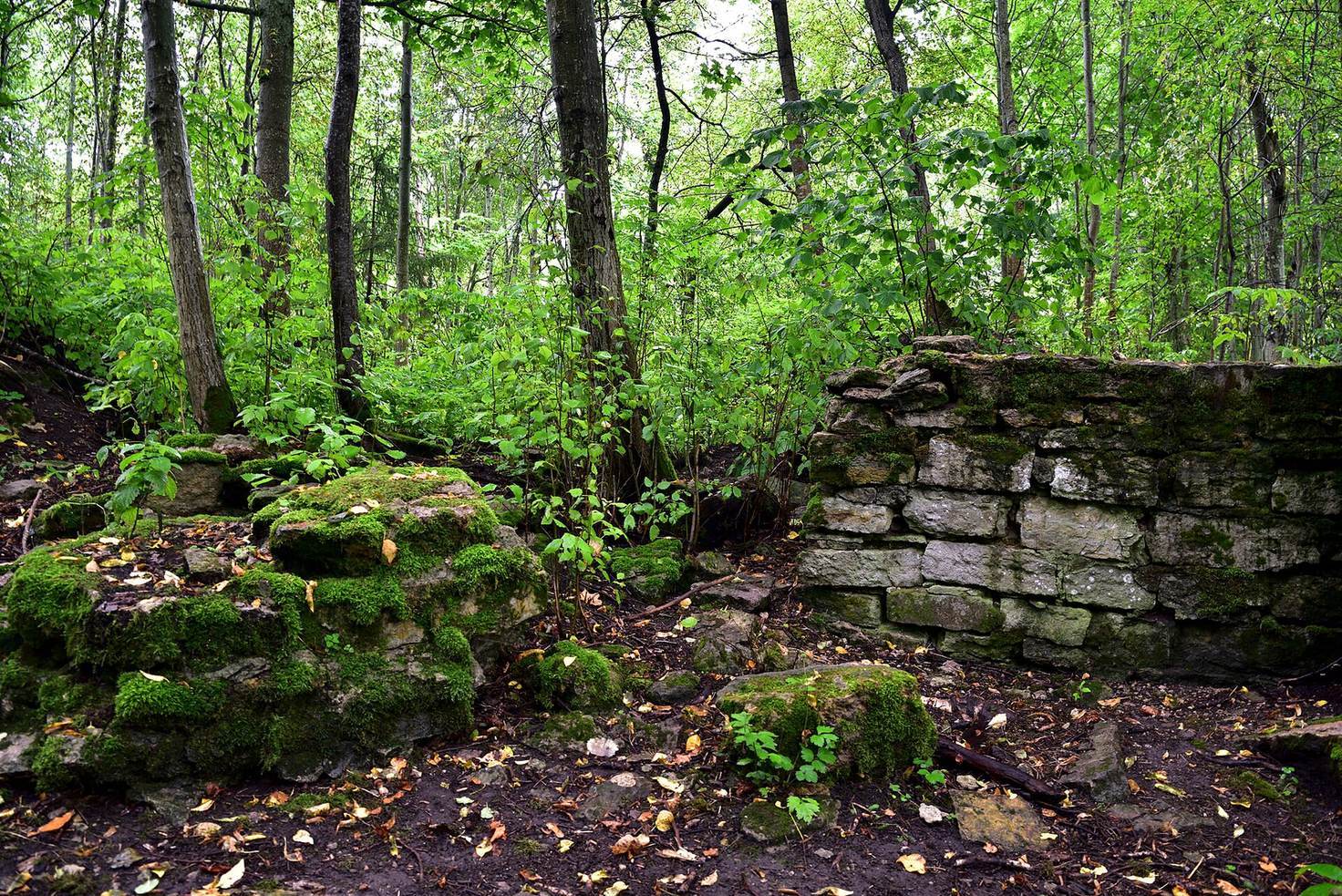
The fortified promontory occupies the right bank of the Volkhov at its meeting with a small tributary, about two kilometres north of Staraya Ladoga, at the river’s former mouth. The enclosed area measures approximately 45 by 45 metres. A curved rampart, or defensive bank, about 70 metres long and up to 18 metres wide at its base, defines the enclosure. Its surviving fabric reflects successive timber-and-earth and stone-clad defenses.
Defensive works
Stone-and-earth fortress
Flagstone-clad fortifications survive to a height of up to 2.2 metres. They are among the earliest defenses of this kind in northwestern Rus. Remains of further retaining walls and timber defenses along the rampart’s crest also survive. A reconstruction proposes a clay bank about three metres high, reinforced by two loosely piled stone supports and topped by a defensive wall made from timber cells, log frameworks packed with earth. The whole defensive structure is reconstructed as reaching up to seven metres. Its building traditions have been linked to Slavic communities in Central Europe, with proposed parallels in the region between the Danube and the Baltic coast.
Earlier timber-and-earth defense
Below the stone fortress are traces of an earlier earthen bank topped by a wooden palisade, a barrier of upright stakes. Radiocarbon dating places this defense between the seventh century and the first half of the eighth. Its associated deposits contain abundant fish bones, handmade pottery, bone tools, and hearths, a combination described as typical of early Iron Age settlements studied around Ladoga.
Settlement layers and finds
Stoves and pottery
The occupation layer associated with the stone-and-earth fortress contains flagstone stove structures and handmade pottery. The pottery resembles material from the lower layers of Staraya Ladoga’s earthen hillfort.
Metalworking and seafaring
More than a thousand objects have been recovered, including casting molds, ornaments and ingots made from metals other than iron, unfinished pieces, and manufacturing waste. Ornament forms resemble those found across the northern Slavic cultural zone, while other objects have parallels among Slavic communities of the Danube region and the Upper Dnieper. Dozens of iron objects point to developed blacksmithing; their working techniques have been compared with those of Ladoga’s earliest archaeological layer. Boat rivets and other fittings indicate contact with Scandinavian seafarers.
Glass beads
More than twenty blue, cube-shaped glass beads have been found at Lubshanskaya. Their type differs from beads at Staraya Ladoga, where four comparable examples were known and dated to 810–840. The Lubshanskaya beads were not made at Ladoga and have been interpreted as evidence of connections along the Silk Road.
Belt fitting
A belt fitting from the site belongs to a type widespread in the Kama region during the sixth and seventh centuries. A comparable fitting came from Ladoga burial mound 140 at Pobedishche. In the Nevolino culture, an archaeological culture of the Kama region, such belts formed part of women’s ceremonial dress. They also marked high status and were worn by elite men in Estonia, Finland, and central Sweden. Comparable Finnish fittings date to 650–700, Kama examples to 650–730, and related Asian objects to 680–740. The Asian distribution has been tentatively connected with itinerant merchants from eastern Finno-Ugric communities.
Arrows
Arrows found in and near the outer side of the fortress walls have been interpreted in relation to the ninth-century upheavals around Ladoga. A Scandinavian-type arrow has been associated with the fire around 840, while locally classified arrows have been linked to the catastrophe around 865.