Lordscairnie Castle: A Ruined Tower House in Fife


Site at a Glance
- Rating
- 3.6
- Popularity
- Very Low
- Country
- United Kingdom
- Primary era
- Early Modern
- Eras represented
- Early Modern
- Civilizations
- Kingdom of Scotland
- Site type
- Military
- Remains
- Castle
On this page7 sections
History
Lordscairnie Castle is a ruined tower house in the United Kingdom, near Cupar in Fife. The Lindsay family, a Scottish noble dynasty whose members later held the earldom of Crawford, commissioned the five-storey residence around 1500. Its history includes royal visits, religious use, and later adaptation for agriculture.
The Lindsay family and construction
Cairnie belonged to the Lindsay family from 1355. Around 1500, Alexander Lindsay of Auchtermoonzie commissioned the tower. He was the second son of the 4th Earl of Crawford and later became the 7th Earl of Crawford, inheriting the earldom after his nephew was killed at the Battle of Flodden in 1513. Lindsay died in 1517.
Royal visits and sixteenth-century politics
John Knox, a Scottish Protestant reformer and historian, recorded that James V visited Lordscairnie shortly before the king’s death in 1542. Knox said that James came to see the Earl’s daughter and included a sexually derogatory description of her in his account.
James VI visited Lordscairnie after travelling to Ballinbreich Castle in June 1583. In July, James Stewart, Earl of Arran, stayed at what was described as “Carnye, the house of Crawford.” In September, after the collapse of the Gowrie regime, the political administration associated with William Ruthven, 1st Earl of Gowrie, Robert Pitcairn negotiated his release from Lochleven Castle. Pitcairn was then to be held under bond at Lordscairnie.
Later use and conservation history
The castle was unoccupied during the seventeenth century. An outlawed Episcopal congregation, a Christian group governed through bishops, used it for religious meetings. The building was later adapted for agricultural purposes.
In the late 1990s, the American entrepreneur Robert Bourne bought the ruin intending to restore it as a second home and a retreat for software developers. By 2003, he had completed historical research, geophysical and archaeological investigations, engineering studies, and design surveys under the guidance of Historic Scotland, the Scottish government heritage agency that preceded Historic Environment Scotland. Restoration work had not begun when the property was sold to a local hotelier.
The property returned to the market in 2012 with an asking price of approximately £220,000, while restoration was estimated to require at least £1 million. Lordscairnie Castle has been a scheduled monument, designated as SM859, since 1935.
Remains
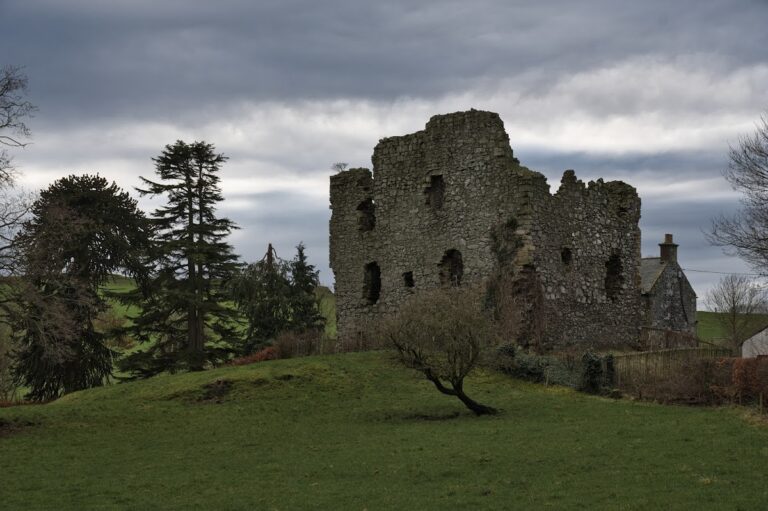
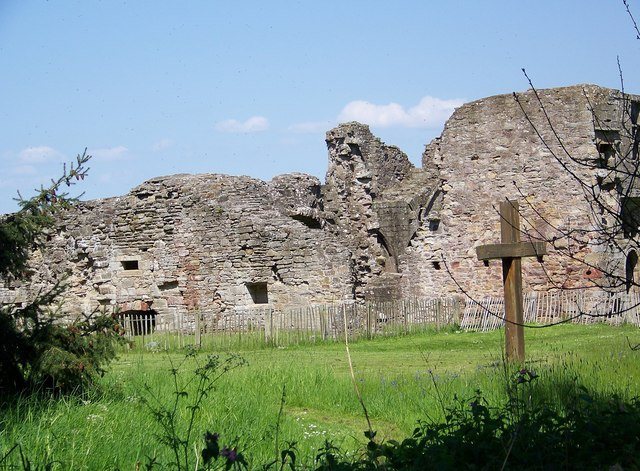
Lordscairnie Castle stands near Moonzie, approximately 4 kilometres northeast of Cupar. The surviving complex is organized around a ruined L-plan tower house built from rubble stone, with a separate round tower to the northeast that once formed part of an outer enclosure.
The tower house
The original building rose through five storeys, including a basement covered by a barrel vault and a garret at the top. A stair tower on the northwest side connected the floors and led to an entrance at ground-floor level. The parapet has been lost, and many dressed stones from the window surrounds have also disappeared. The main structure survives in ruinous condition.
The outer enclosure
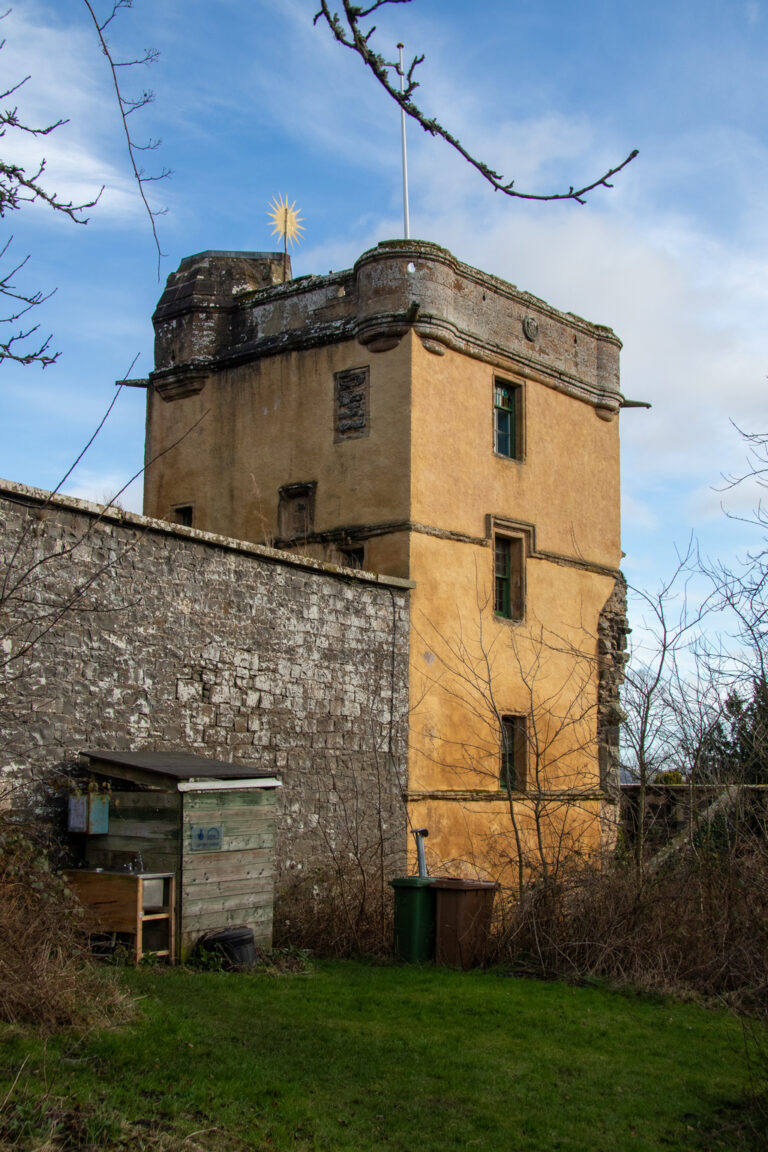
A single round tower stands northeast of the main tower. It formerly flanked a gate in the wall surrounding the outer enclosure, linking the separate defensive feature to the approach and boundary of the castle. The round tower remains as part of the ruinous site.