Locronan Parish Close: A Breton Church and Pilgrimage Precinct
Site at a Glance
- Popularity
- High
- Country
- France
- Primary era
- Medieval
- Eras represented
- Medieval, Early Modern, Modern
- Civilizations
- Duchy of Brittany, French
- Site type
- Religious
- Remains
- Church
On this page19 sections
History
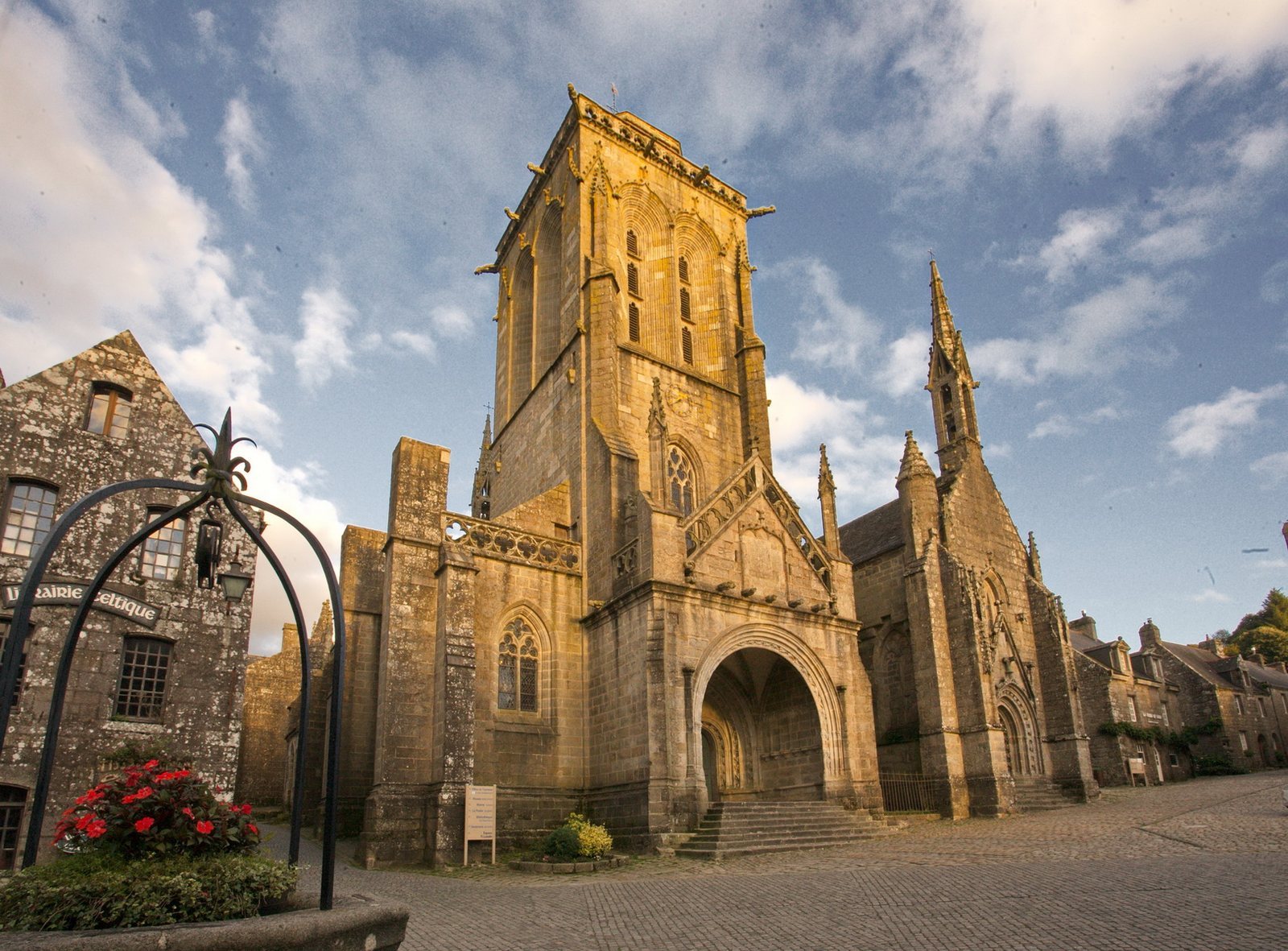
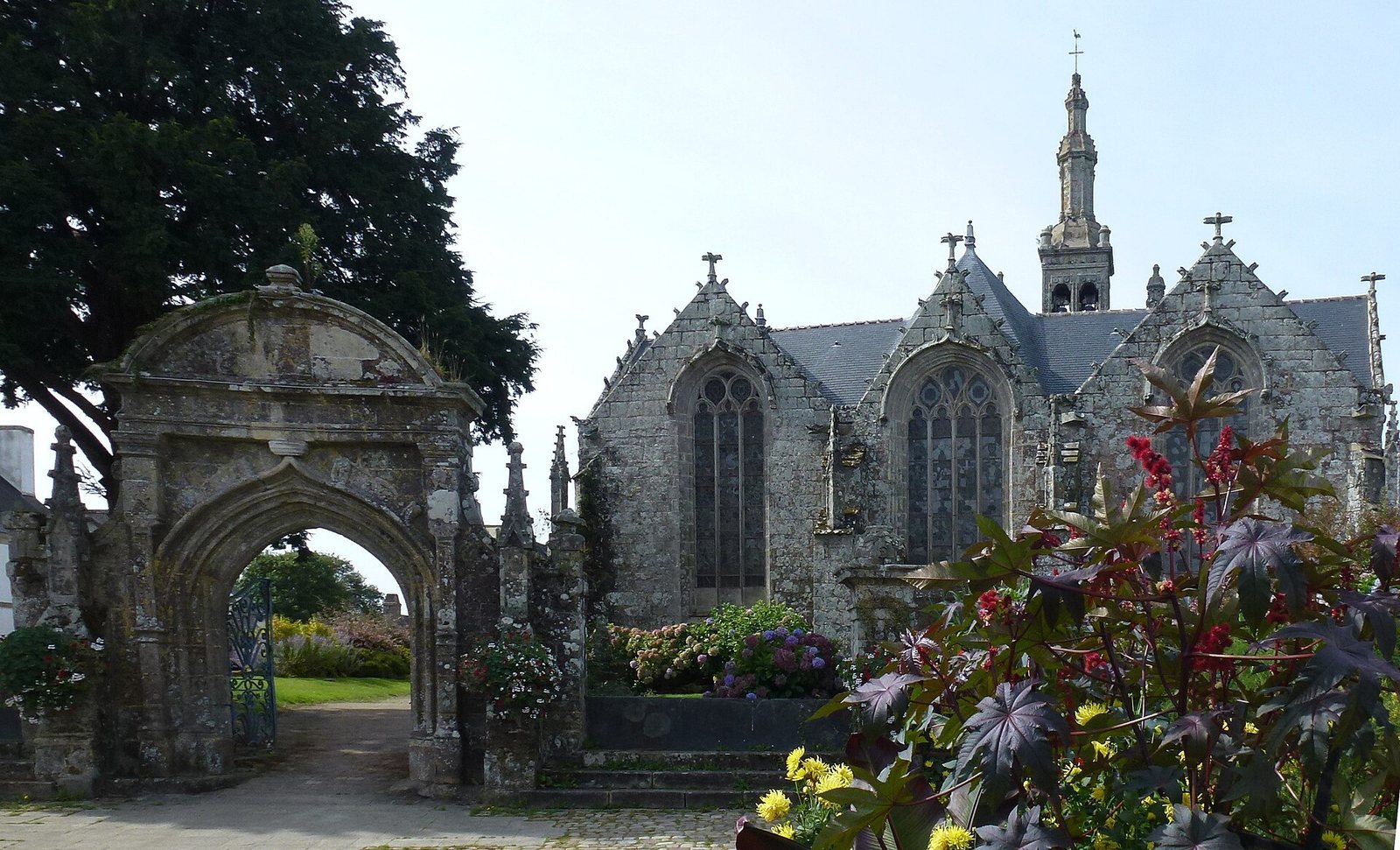
The Locronan Parish Close is a parish precinct in Locronan, France, grouping a Catholic church with its cemetery, chapel, and calvary, a sculpted outdoor cross. Its present church was built between 1430 and 1480, and Locronan became a pilgrimage destination through devotion to Saint Ronan.
The priory and pilgrimage
In 1031, Alain Canhiart, Count of Cornouaille, founded a priory at the place associated with Saint Ronan’s hermitage. Cornouaille was a historic territory in Brittany. Canhiart placed the priory under Sainte-Croix Abbey at Quimperlé, a monastery of the Benedictine order. Its Romanesque church, built in an earlier medieval style marked by rounded arches and heavy masonry, drew pilgrims seeking Saint Ronan’s help for children and the continuation of their families. Ronan was revered as a Breton hermit and Christian saint; tradition identifies him as an Irish missionary active in the sixth century.
The fifteenth-century church and Pénity chapel
The lords of Névet undertook the construction of the present church between 1430 and 1480. Donations, privileges, and financial support from the dukes of Brittany helped the work, and the dukes also visited Locronan. The church was dedicated to Saint Ronan. Francis II, Duke of Brittany, is identified as a donor of its window depicting the Passion of Christ.
Work on the Chapelle du Pénity, added on the church’s south side, began in 1485 and was completed around 1515. Its builder was Pierre Le Goaraguer. The chapel’s location is traditionally linked to Ronan’s former hermitage, and its name means “hermitage” in Breton. Anne of Brittany commissioned it in gratitude for the birth of her daughter Renée in 1510.
Saint Ronan’s tomb first stood in the church’s monks’ choir and was later transferred to the Pénity chapel. His bodily remains are kept at Quimper Cathedral; some relics, meaning remains or objects revered for their religious association, are kept at Locronan near the tomb.
Continuing devotion and later changes
The church serves as the starting and ending point of the Troménie, a traditional Breton religious procession following a pilgrimage route. The local observance has a major and a lesser form.
Lightning struck the church tower’s spire repeatedly. After three strikes, it was demolished in 1808. The church has been listed as a French historic monument since 1846. The Rosary altarpiece was restored in 2015.
Remains
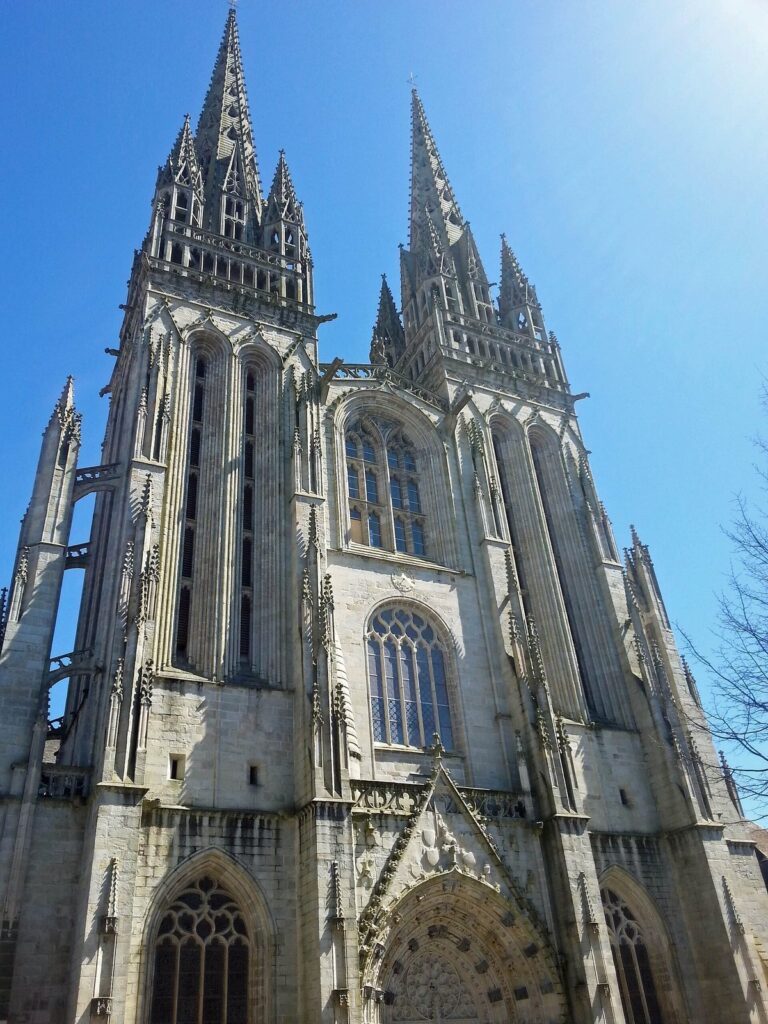
The precinct is centered on a rectangular church 43 metres long, with a cemetery and calvary among its religious features. The church’s three aisles, western tower, porches, choir, and attached south chapel shape its plan. The floor rises slightly toward the choir, a gradient retained because of geological constraints.
Church and chapel architecture
The main church
The church is divided into successive sections, or bays. Its width increases at the final sections of the south aisle, while the north aisle is wider than the south. The central nave, or main aisle, has no windows and receives light through openings in the side aisles. At the eastern end, the choir, the area around the altar, has a flat end and a window divided by stone tracery into six lights.
A massive tower more than 30 metres high adjoins the west end of the nave. Its upper level has two tall, round-headed openings on each of its four sides. The tower once carried a 68-metre spire. The steeply rising nave roof is interrupted at its center by a gable topped with a small roof turret.
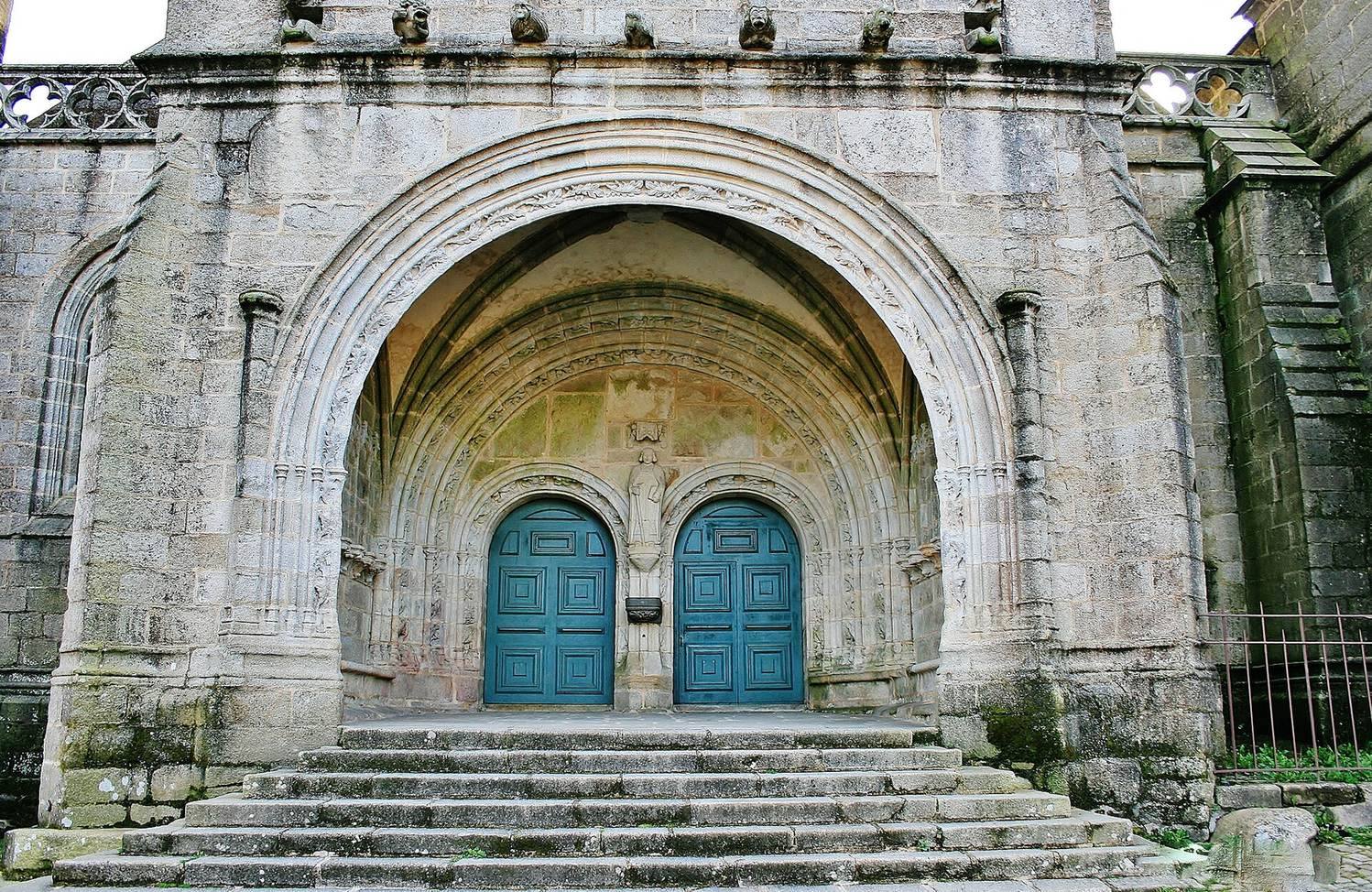
Steps lead to the west porch and its large round-arched entrance, framed by carved bands. Inside, a vaulted ceiling has crossing ribs; projecting supports line the side walls, and slender columns carry three-lobed arches. A granite statue of Saint Ronan stands on a plinth between the two inner doorways. A smaller porch opens on the north side. The sacristy is attached there, and its dormer window has Flamboyant tracery, a late-Gothic pattern of elaborate, flame-like forms.
The Pénity chapel
The Pénity chapel has one nave and three structural sections. Two large arches connect it to the south end of the church’s nave; its western section does not open into the church.
Stained glass
The choir window
The six-light window at the choir end dates to 1476–1479 and contains 17 scenes of Christ’s Passion and Resurrection. One panel depicts a member of the Névet family, whose contribution helped fund the church. The family’s heraldic arms appear in the window’s final panel.
Other windows
A two-light window preserves sixteenth-century fragments, including a Mercy Seat image, showing God the Father presenting or supporting Christ, dated to around 1500, and a depiction of the Apostle Peter. Other panels may come from a Jesse Tree, which traces Christ’s genealogy through Jesse, father of King David, or from an Adoration of the Magi. The four-light window in the Pénity chapel retains early-sixteenth-century glass. Its two central, tall and narrow openings show Saint Catherine with her sword and the Apostle Paul; the upper tracery contains a Crucifixion group.
Altars, furnishings, and statues
The Rosary altarpiece and pulpit
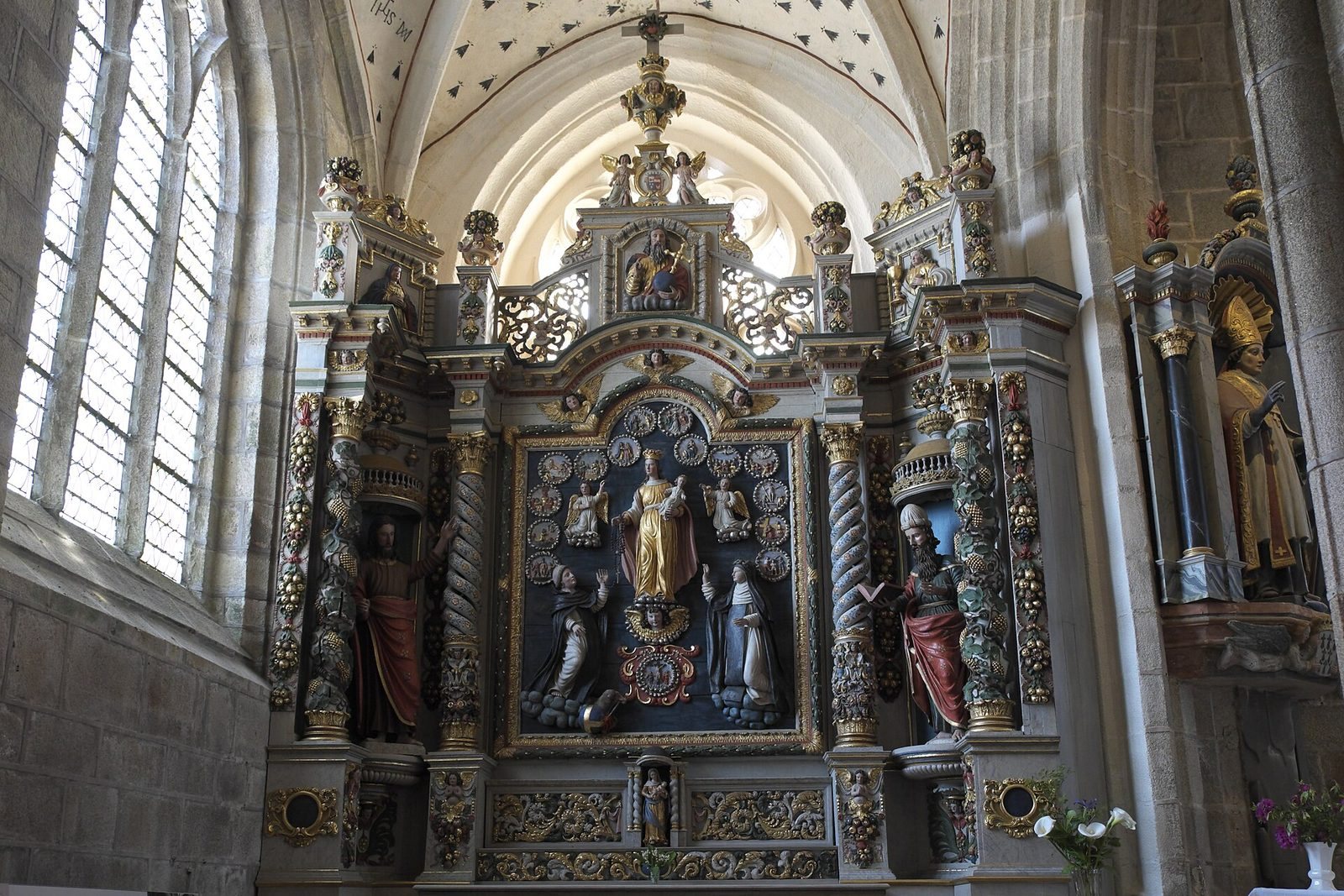
Made in 1668 by Maurice Le Roux’s workshop, the Rosary altarpiece has twisted columns and 15 small reliefs, sculpted images projecting from a background, depicting the mysteries of the Rosary. This Catholic prayer centers on meditations about events in the lives of Christ and Mary. At the center, the crowned Virgin Mary gives a rosary to Saints Dominic and Catherine of Siena; God the Father holds a globe above them. Carved figures of Saint Joseph and Saint Joachim occupy side niches, with a small statue of the Virgin Mary in a niche at the base.
The pulpit, made in 1707 by Louis Bariou and Guillaume Le Poupon, has nine colored, gilded-framed reliefs on its stairs and bowl. They depict episodes from Saint Ronan’s life and legend. A gilded angel holding a trumpet stands above the pulpit beneath its canopy. The design was modeled on a pulpit at Crozon.
Font, altar, and organs
A fifteenth-century granite baptismal font with two bowls, one smaller than the other, stands in the north aisle’s baptismal chapel. The high altar dates to the early eighteenth century and has a carved, gilded container for the consecrated Eucharist, topped by angels carrying a cross. Thomas Dallam installed an organ in 1672; a second organ, in a classical style, dates to 1983 and was made by Benoist and Sarélot.
Statues
Seventeenth-century painted wooden statues of the Virgin Mary and John the Evangelist flank the choir window. Nearby are a painted granite Saint Ronan dressed as a bishop and a painted wooden Saint Corentin, the first bishop of Quimper and patron saint of its diocese. Other statues represent Saint Ronan, Saint Yves of Kermartin, Saint Alar, Saints Apollonia, Margaret, Maurice the Abbot, Anthony, Christopher, Eutrope, Fiacre, Roch, and Michael, as well as Mary Magdalene, Saint Barbara, Saint Anne, Saint Louis, the Virgin Mary, and John the Evangelist. Images of local saints are made in stone, painted wood, and plaster.
The statue of Saint Christopher dates to the sixteenth century. A painted granite statue of Saint Roch, dated 1509, is signed “Guillimin” on its supporting base. Roch holds a scraper and a loaf of bread; an angel touches the scraper, while a dog brings the bread. A fifteenth-century granite Saint Michael is shown weighing souls.
Sculpture and tomb in the Pénity chapel
The Entombment and related scenes
The chapel’s painted kersantite Entombment group, made around 1500, is carved from a dark igneous rock quarried in Brittany. Mary bends over Christ with clasped hands as John supports his head. Joseph of Arimathea holds a shroud on one side, while Nicodemus holds the crown of thorns on the other. Mary Magdalene, carrying her ointment jar, stands behind Mary; she and the two men wear richly ornamented clothing. Two fifteenth- or sixteenth-century reliefs set into the wall below depict Noli me tangere, when the risen Christ appears to Mary Magdalene, and the meeting at Emmaus, when he appears to two disciples. A carved, painted wooden Pietà dates to the sixteenth century.
The tomb monument
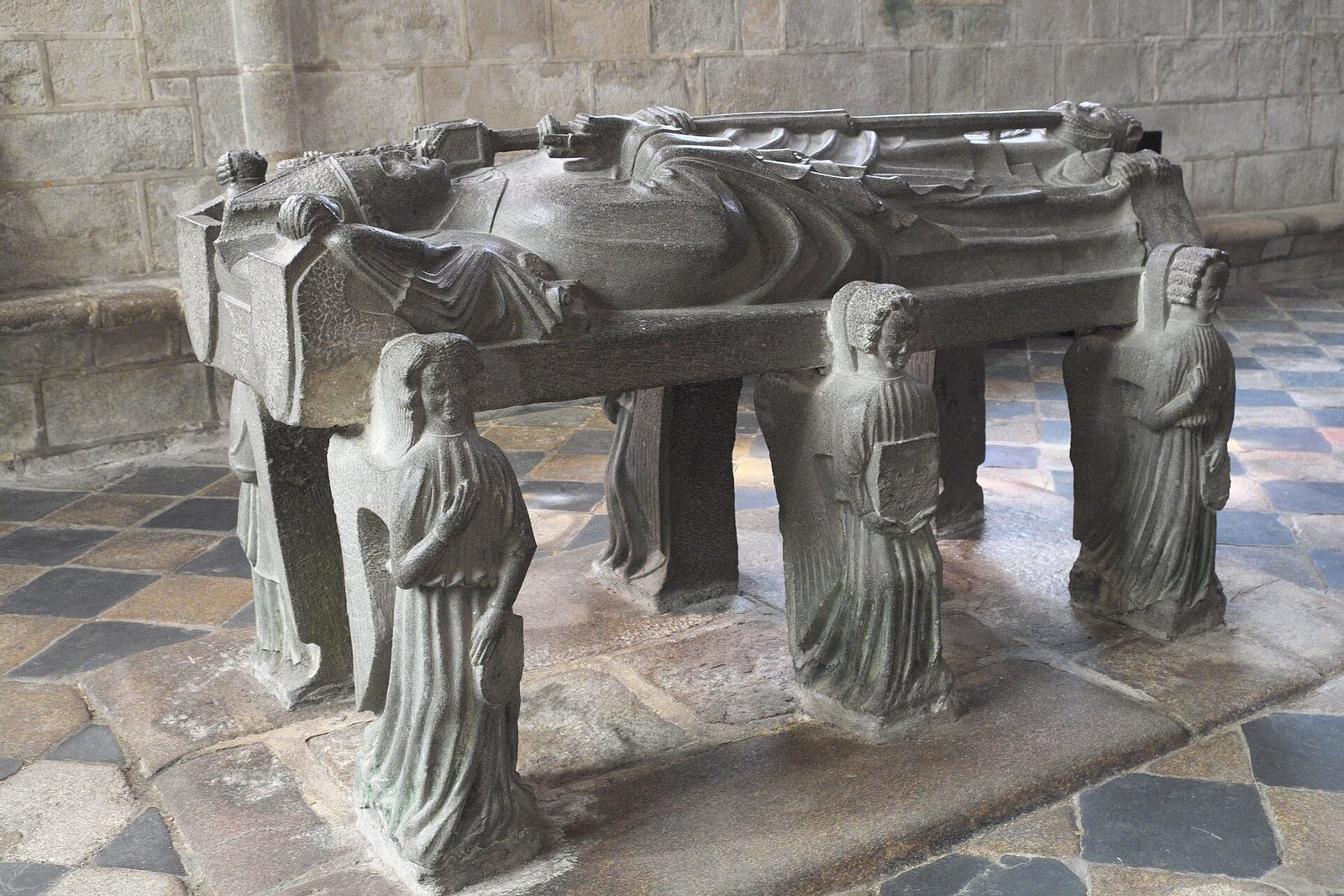
The memorial tomb is a kersantite cenotaph, a tomb monument that does not contain the person’s remains. Attributed to a Breton workshop, it dates to the first half of the fifteenth century, around 1423–1433, and its style suggests it predates the chapel by about half a century. The reclining figure of Saint Ronan wears a bishop’s robes, raises his right hand in blessing, and holds a crozier, a bishop’s hooked staff, in his left.
Six angelic caryatids, sculpted figures serving as supports, carry the tomb slab on their wings. Shown as women in long, deeply folded robes, they hold heraldic shields. Two more angels flank the cushion beneath Ronan’s head. At his feet, a lion bears five coats of arms, and the end of the bishop’s staff enters its mouth. The monument also displays the arms of John V, Duke of Brittany, and his wife Jeanne of France.
The cemetery calvary
The six-metre calvary in the church cemetery dates to the sixteenth century. Small carved figures stand partway up its cross-shaft, and a reverse-facing image of the resurrected Christ appears at the top. The sculptural group around the central crucifix includes the Virgin Mary with Saint Peter on one side, and John the Evangelist with a bishop on the other.