Kunitzburg: A Medieval Hilltop Castle Ruin near Jena


Site at a Glance
- Rating
- 4.6
- Popularity
- Low
- Country
- Germany
- Primary era
- Medieval
- External website
- Open
- Eras represented
- Medieval
- Civilizations
- Holy Roman Empire
- Site type
- Military
- Remains
- Castle
On this page12 sections
History
Kunitzburg, also called Burg Gleißberg, is a medieval hilltop castle ruin in Germany, in the Kunitz district of Jena. Established around 1100, it occupied the northern end of the Hufeisen landform and became the seat of the Lords and Vogts of Glisberg, later known as the Gleißberg family. Its history reflects the changing control of imperial possessions, noble lordships, and administrative territories in Thuringia.
Early Lords and Imperial Possession
The castle’s earliest holders were probably the Lords and Vogts of Glisberg. Later traditions connect the family with a castle on Veitsberg in 974, Walther von Glisberg’s foundation of the Scots Monastery in Erfurt in 1036, and Herman von Glizberg’s participation in the Battle near Homburg Monastery in 1075. The identities of these early figures and their connection with Kunitzburg remain uncertain.
Bertha von Glizberg, the wife of Heinrich von Groitzsch, founded the monastery at Thalbürgel in 1132 and later established a foundation there for seven religious women. Her hereditary estate included Bürgel, which was first mentioned in 1133 in the monastery’s foundation charter. The charter traditionally associated with Bertha and her relatives is now regarded as a forgery produced in 1729, and the proposed connection between the Gleißberg family and the counts of Glizburg mentioned by Arnold of Quedlinburg is considered unlikely.
Liutoldus de Glizberg was named in 1133 in connection with the foundation of the Benedictine monastery at Bürgel. Wolfgang Hartmann has proposed that an Ekbert von Gleißberg was Liutold’s father and Bertha’s brother, and that this branch belonged to the Reginbodonen family. This reconstruction remains an interpretation rather than an established genealogy.
In 1158, Frederick I, known as Barbarossa, made the Gleißberg mountains, the castle, and the Jenzig imperial possessions. Imperial ministerials, legally dependent service nobles who performed administrative, military, and judicial duties for a ruler, subsequently occupied the castle and took their name from Gleißberg. They apparently came originally from the Pappenheim and Kalden family in the Palatinate and belonged to the family of the lords of Weimar. The castle itself appears in written evidence in 1261 as castrum Glizberg.
Transfer to the Reuss and Wettin Dynasties
Rudolf of Habsburg, king of the Romans from 1273 to 1291, allegedly destroyed Gleißberg in 1289 or 1290 during a campaign to recover imperial territory in Thuringia. Numerous castles were demolished during that campaign. A document issued by Walter IV of Gleißberg at the castle on 17 December 1293, however, makes destruction at that earlier date unlikely.
The Gleißberg family’s economic position weakened during the thirteenth and fourteenth centuries. Castle estates were sold, land was given to the Church, and property was lost through legal disputes. The family is said to have become extinct with Walther von Glisberg in 1317. Around 1320, probably because of financial difficulties, its members accepted the feudal overlordship of the Lords Schenk of Dornburg, who had previously been their equals.
The family remained at the castle as vassals until selling it in 1327 to Heinrich II Reuss of Plauen for 150 marks. This ended Gleißberg family rule. Heinrich V probably moved to Weimar, while his brother Johannes entered the clergy. In the same year, the future Emperor Ludwig the Bavarian granted Heinrich II the castle as an imperial fief, meaning property held formally from the Holy Roman Emperor rather than from a territorial prince. Heinrich had bought the lordship while serving as guardian of the underage Margrave Frederick II of Meissen, using the margrave’s money for the purchase. This led to claims by the Wettins, a powerful dynasty whose territories included much of central Germany.
Gleißberg continued to be treated as an imperial fief until at least 1350, and the fief was confirmed for the younger line of Reuss of Plauen in 1359. Rival claims by the Wettins and the kings of Bohemia, including Charles IV, who was also Holy Roman Emperor, eventually ended with a Wettin victory. After Heinrich Reuss IV died in 1398, Margrave Wilhelm took the lordship back as a reverted fief. Before that change, the Reuss family had expanded the estate through effective administration and further acquisitions.
Decline and Destruction
From the end of the fourteenth century, Gleißberg was repeatedly pledged to different rulers in Thuringia and was eventually incorporated into the Wettin administrative system. In 1429, the lordship was valued at 4,000 Rhenish gulden, the same valuation assigned to Hildburghausen and Heldburg. After the death of Landgrave Frederick the Peaceful in 1440, Gleißberg was probably incorporated into the Dornburg district.
As the castle’s use declined, it fell into decay. Mass was celebrated in the castle chapel twice each week by the pastor of Kunitz until the services were transferred to Kunitz on 28 April 1450. On 8 March 1450, Duke Wilhelm of Saxony enfeoffed his councillor Apel Vitzthum of Roßla, Apel’s brothers Busso and Burkhard, and Friedrich von Witzleben with Gleißberg. They were required to repair the completely ruined and decayed castle.
The Vitzthums were expelled from Thuringia after Wilhelm recognized that they had accumulated wealth and property at his expense. Wilhelm then allied with the cities of Erfurt, Nordhausen, and Mühlhausen and stormed Gleißberg in 1451. Although the Vitzthums had repaired the castle as far as possible in the short time available, the keep was demolished in 1453. An official remained there briefly, but the castle was never rebuilt and continued as a ruin.
Later Associations and Preservation
One later tradition identifies Hedwig Carolina E(c)kmann, a woman from Malmö popularly called the “Swedish Countess,” as the castle’s last resident. After arriving in Jena in 1809, she lived with her son, daughter, and maid in a log house erected at the ruin until 1815. She supported herself through handicrafts and farming. The claim that she was related to the Swedish king Gustav IV Adolf is unverified, and she was not a countess despite the older description. She may have been involved in the Swedish coup of March 1809 and died in Stuttgart in 1839 at the age of 70.
The ruin attracted hikers and local-history enthusiasts for many decades. In 1922, the Kunitzburg community was founded and built the nearby Burgklause about 100 metres southeast of the ruin between 1925 and 1931. Arson destroyed the building down to its cellar in 1963. It was rebuilt as a youth club for the municipality of Kunitz and is now used for rented events rather than regular public operation.
Remains
Hilltop Setting and Defenses
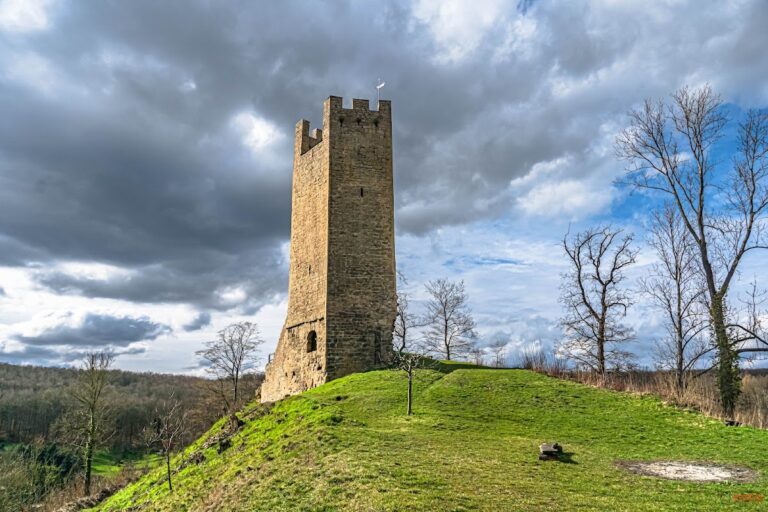
Kunitzburg stands at approximately 325 metres above sea level, about five kilometres northeast of Jena. Its foundations occupy the northern end of the Hufeisen, formed by the Jenzig and the steep Großer Gleisberg mountain, which projects westward into the Saale valley. The ruin lies within the Kunitz area, while the boundary with Golmsdorf runs only a few metres downslope.
The site’s position provided strong natural protection on the north and west, where the ground falls away in an extremely steep slope. Deep ditches on the south and east separated the outer bailey, the part of a castle complex outside the main fortified enclosure, from the main castle. Surface finds, especially pottery, belong broadly to the twelfth through fifteenth centuries, while archaeological and building investigations have not established precise construction dates for the complex.
Surviving Castle Structures
Residential Building
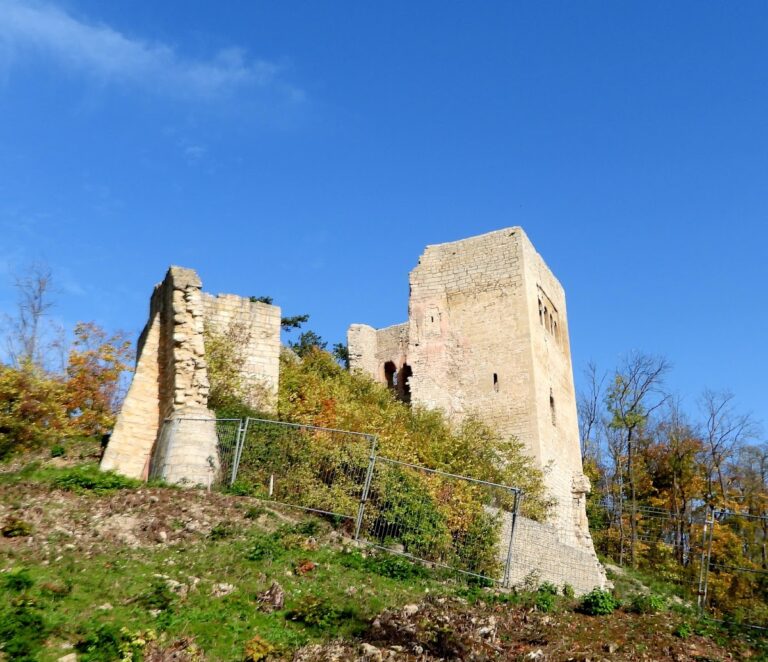
A substantial residential building stands directly above the steep rock slope. It probably dates from after 1300 or was remodelled after that date. Two seat-niche windows, each with a recessed seat beside a two-light opening divided into two vertical sections, provide the basis for this dating. The building survives as a wall.
Keep and Curtain Wall
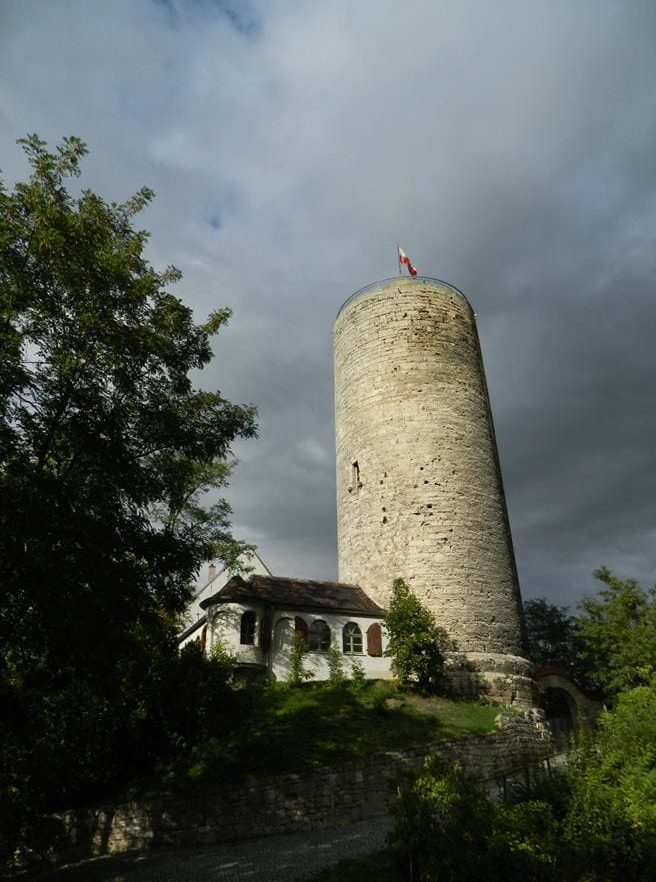
The round keep, the principal fortified tower of a medieval castle, dates approximately to 1200–1250. It was demolished in 1453 and now survives as a stump. Small sections of the curtain wall, the defensive wall enclosing the castle, remain with buttresses attached. Together with the keep fragment, these wall remnants mark the fortified core of the site.
Castle Well
A castle well has been partly excavated and remains among the surviving features. Its position within the ruin belongs to the physical organization of the fortified settlement, alongside the residential wall, tower remains, and fragments of the enclosing defenses.
Burgklause
The Burgklause was built approximately 100 metres southeast of the castle ruin between 1925 and 1931. Its cellar belongs to the pre-1963 building, while the superstructure dates from the reconstruction after the arson fire. The building received an electrical connection in 1955 and later served as a youth club before becoming a venue for rented events.